What Is Lead Generation? A Complete Beginner’s Guide

Introduction
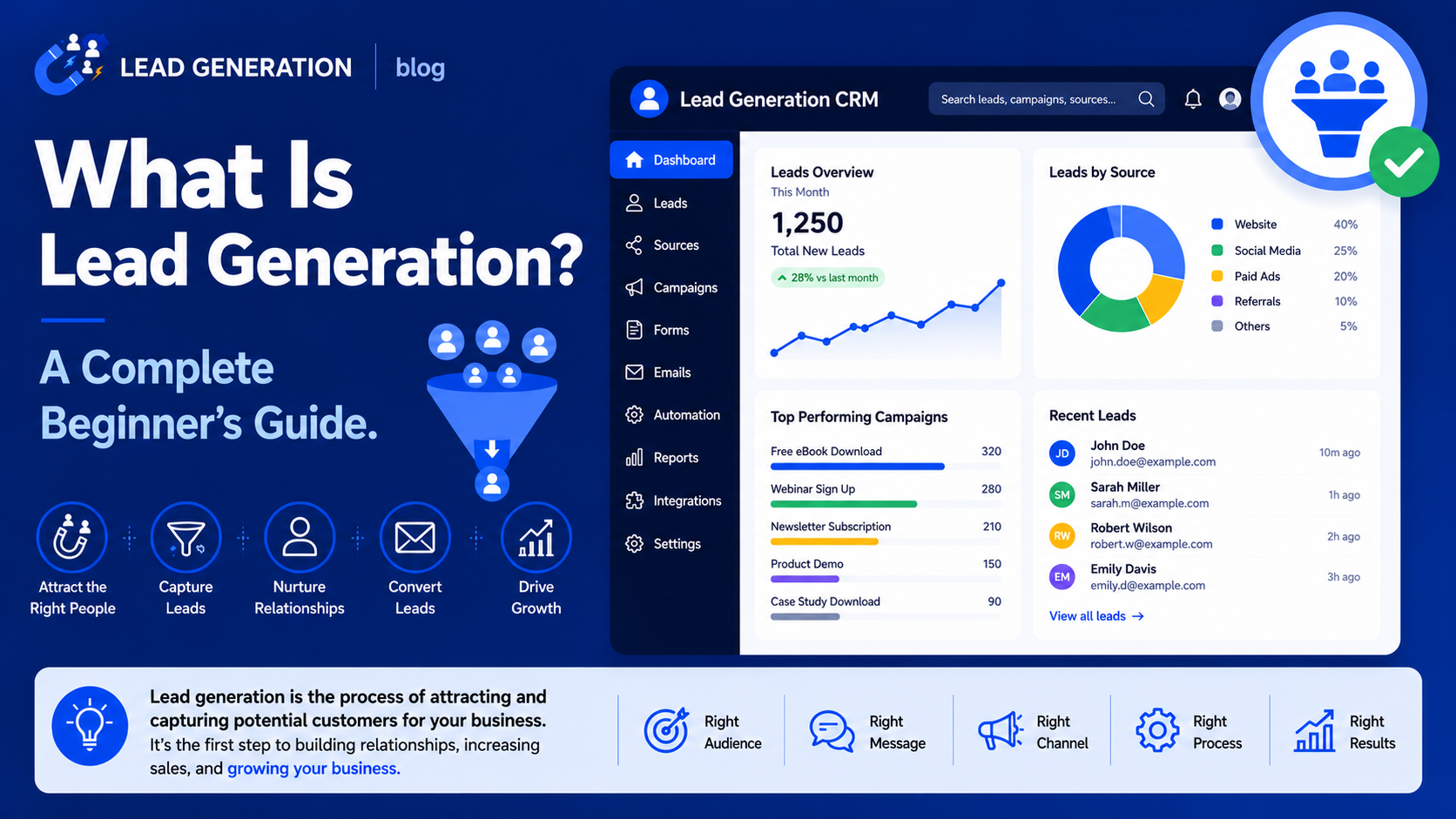
There is a similarity among all successful businesses that cannot be overlooked, and it is that of having a continuous supply of customers to transact business with. In other words, no business can succeed without customers who would show some level of interest in the products or services provided.
Lead generation is one of the key processes involved in digital marketing since it allows businesses to target the right people who are already interested in their products or services. This way, instead of spending money on advertising to everybody, businesses will use their resources for building stronger relationships.
This article aims to provide information about the definition of lead generation, its process, importance, and best practices.
What Is Lead Generation?
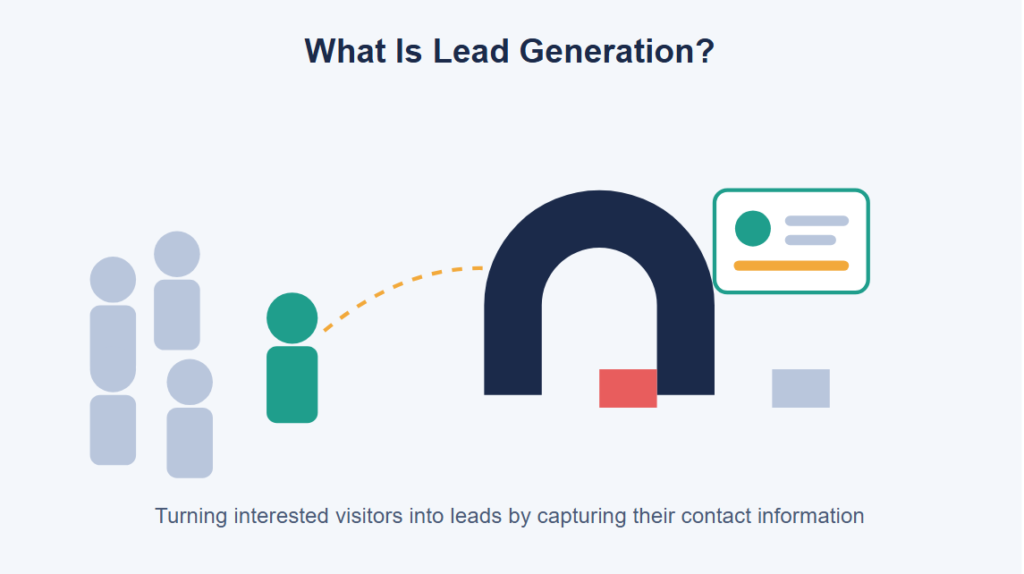
Lead generation refers to a practice where individuals who could be interested in your products or services are attracted and encouraged to provide you with contact information such as an email address or a telephone number.
A lead can be defined as an individual who shows interest in what you have to offer but does not become a client yet. This person can either download a free guide, sign up for your newsletter or ask for a demo of the product.
Lead generation connects marketing and sales processes. If there were no lead generation process, companies would have to depend on attracting visitors and hope for sales.
Why Lead Generation Matters
Lead generation is vital since each business requires a continuous stream of potential customers. If a business depends on just referrals or repeat customers, there will be no growth in the long run. The right lead generation approach will ensure future chances to do more business.
Some of the greatest advantages are:
- Ensuring a constant stream of potential customers
- Growing the visibility of a brand
- Sales efficiency improvements
- Reducing the cost of acquiring each customer
- Developing long-term relationships with prospects
- Sustainable business growth
Firms generating qualified leads focus more on closing a sale rather than pursuing uninterested prospects.
How Lead Generation Works
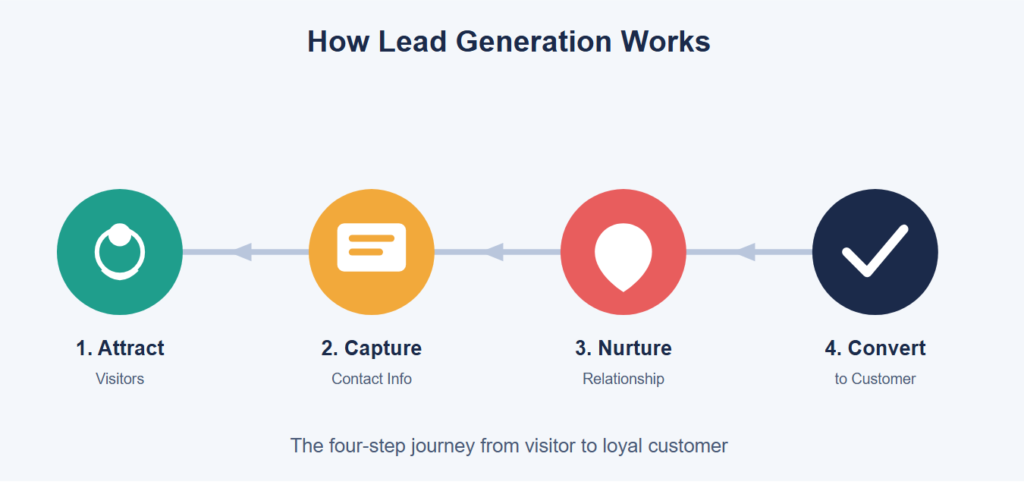
While each company has its unique process for lead generation, the process can always be broken down into four basic steps.
1. Attract Visitors
The first of these steps involves attracting people to your company. Different marketing channels such as search engines, social media, email marketing, online advertising, and referral marketing are used by companies to reach out to prospective customers.
2. Capture Contact Information
But once the visitors land on your site, you have to give them some reason to give out their information.
Lead magnets include:
- Free E-books
- Reports of the industry
- Checklists
- Templates
- Free trials
- Product demonstrations
- Webinars
- Discounts
The visitors will trade their contact information for something in return and become your leads.
3. Nurture the Relationship
Not everyone will purchase immediately.
Marketing strategies such as email marketing, education, product updates, and case studies are used by companies to create trust in the long run. This strategy of building trust is called lead nurturing.
In this way, the customers gain knowledge about the product while their queries and objections are resolved.
4. Convert Leads into Customers
Finally, the right prospects will make their purchases.
A great website design, good product copy, customer testimonials, and excellent sales support all help with conversions.
The key is not just getting more leads, but getting the right leads that turn into customers.
Types of Lead Generation
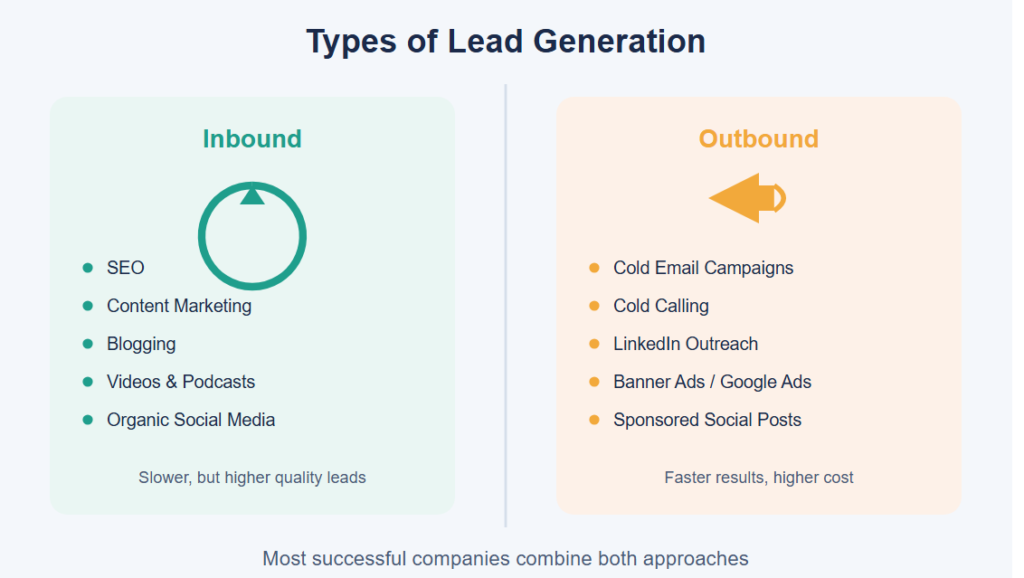
Lead generation can be achieved using two major methods.
Inbound Lead Generation
The inbound method involves attracting clients by offering them useful information that would solve their problems.
These methods include:
- Search engine optimization (SEO)
- Content marketing
- Blogging
- YouTube videos
- Podcasts
- Organic social media
While this method may take more time to yield results, it will give quality leads in the long run.
Outbound Lead Generation
Outbound marketing refers to actively engaging with prospective customers.
Some common approaches include:
- Cold email campaigns
- Cold calling
- Outbound LinkedIn activities
- Banner advertisements
- Google Ads
- Social media sponsored posts
Outbound marketing may generate quick responses, although they may need more financial resources than inbound marketing.
Most effective companies use both inbound and outbound approaches to generate maximum leads.
Popular Lead Generation Channels
There are plenty of ways to attract leads.
Search Engine Optimization
SEO allows you to rank in search engines for queries made by people seeking solutions to their problems or products.
Content Marketing
Creating informative and valuable content positions your company as an expert and attracts interested customers.
The most common forms of content are:
- Blog articles
- Case studies
- Videos
- Whitepapers
- Industry reports
- Tutorials
Useful content not only helps in answering questions but also helps the reader to know more about your business.
Email Marketing
Email is still one of the highest ROI marketing methods. Once people subscribe, you can offer them educational content and promotional material for conversion.
Social Media
Social media sites such as LinkedIn, Facebook, Instagram, and X allow companies to reach out to their prospects directly. Through informative posts, case studies, and industry information, you earn credibility while gathering leads.
Paid Advertising
Through pay-per-click advertising, your brand gains instant exposure. You can target particular audiences depending on their demographics, interest, searches, and geographical locations.
What Makes a Good Lead?
Not all leads have the same worth.
Good leads usually have these characteristics:
- Meet your ideal customer criteria
- Have a real requirement for your products/services
- Have the power to decide on purchases
- Fall within your desired budget
- Indicate intention to buy
Quality beats quantity most times when it comes to business.
Best Practices for Successful Lead Generation
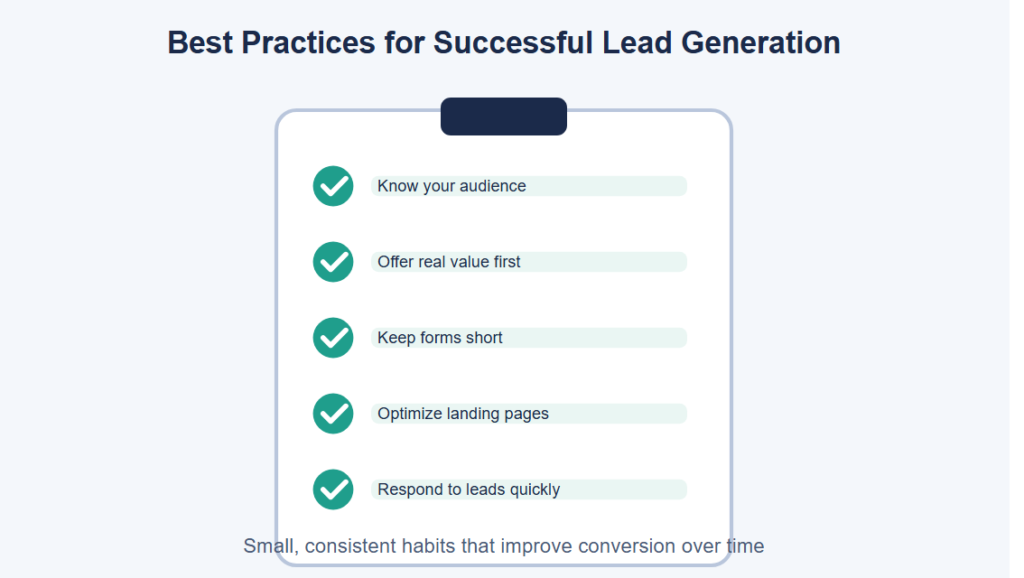
Companies that consistently acquire leads generally adhere to some well-tested rules.
Learn about your audience before launching your marketing campaigns. The more you understand about their problems and goals and obstacles, the easier it will be for you to create content appealing to them.
Offer something valuable before demanding their contact information. Offer your free stuff in order to solve their problems, not to advertise your products.
Make your forms short. The more information you ask them to enter, the lower the probability of a conversion.
Optimize your landing pages with a good headline, powerful copy and call to action. Your page should be focused on one particular task.
React to leads fast. Studies prove that companies which react quickly to the new leads are much more likely to convert them into customers.
Track performance on a regular basis. Analyze your conversion rate, cost per lead, cost of acquiring new customers.
Common Lead Generation Mistakes
Despite the experience marketers have gained throughout years, they still commit many mistakes that lower lead quality.
The most typical mistake is trying to please all people, rather than addressing certain audiences. Widespread marketing messages will be hard to resonate with anyone.
Also, publishing articles for search engines instead of users is quite a common mistake. Quality articles work better since they earn trust and engagement.
Not optimizing the website for mobiles is another expensive mistake, as there are many users who browse the Internet on smartphones. As a result, websites load slower and bring less conversion.
Besides, many companies ignore lead nurturing after gathering contact details. Getting an email address is not the final step; further communication is necessary.
The Future of Lead Generation
Lead generation keeps changing with the shift in technological advances that alter consumer behavior.
With the advent of artificial intelligence, businesses can now customize their marketing efforts, qualify leads, and streamline tedious processes. Simultaneously, consumers are demanding more personalized, meaningful, and credible interactions.
The future of lead generation will continue to favor those companies that invest in providing value, developing genuine connections, and respecting user privacy.
Conclusion
Lead generation is not just about obtaining email addresses. It is an organized process through which firms attract the proper audience, build relationships, and convert prospective clients into loyal customers.
Whether you’re a startup, local firm, or a large company, lead generation investment will result in future growth opportunities. Through audience research, content creation, website optimization, and nurturing of leads, you can create an effective lead generation system.
It is not always the companies with the largest budget that succeed; it is those who deliver the most value to their customers.