What Is a Content Audit? (And How to Do One)

The content audit involves an assessment of all the pieces of content found on your website in order to determine their effectiveness, areas for improvement, and those which need updating, merging, deletion, or retention.
It is safe to assume that your website will have pieces of content that are negatively impacting your site’s overall SEO. The content audit will help you find them and address them.
This article explains what a content audit is, why it is important for SEO, and how to conduct one effectively.
What Is a Content Audit?
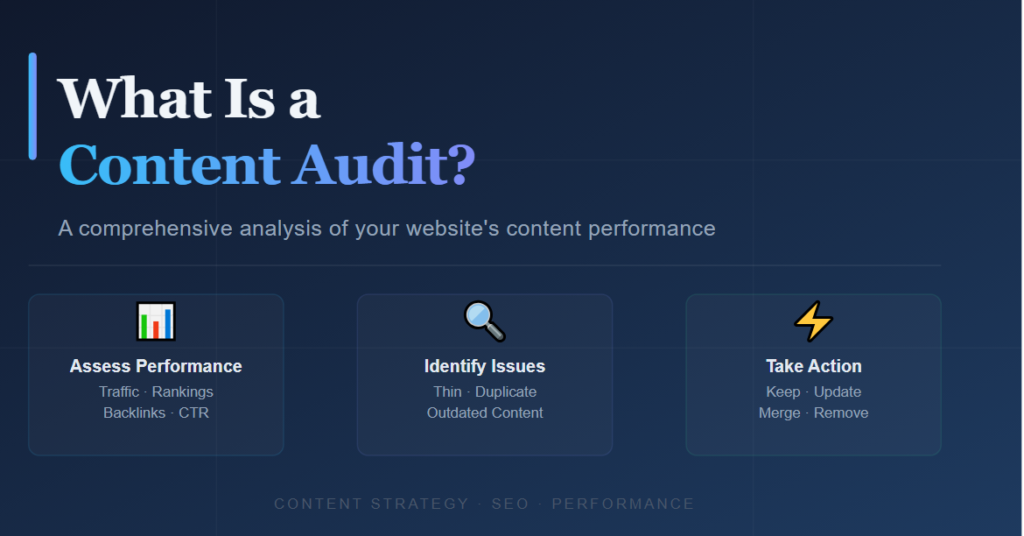
The purpose of content auditing is to conduct a comprehensive analysis of the website’s content.
While content gap analysis involves evaluating the shortcomings in the existing website content, content auditing focuses on evaluating content you currently possess, and asking yourself questions like:
Is This Content Doing Its Job?
This content may be required for:
- Driving organic traffic through searches
- Conversion from visitor to prospect/customer
- Achieving authority in your domain/industry
- Backlink generation from other websites
If your website content is not meeting any of these objectives, then it is a good opportunity for improvement/removal.
Why Content Audits Matter for SEO
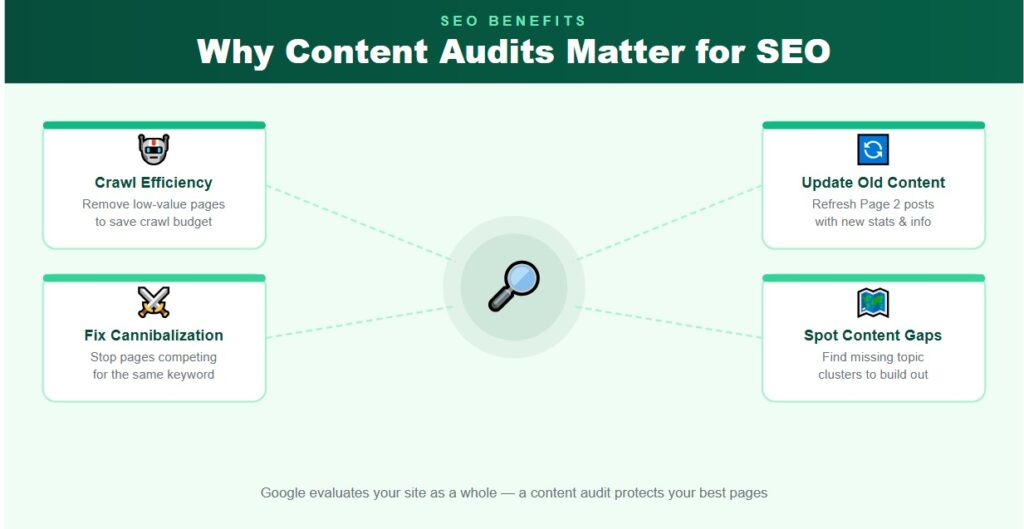
Google considers the site as a whole rather than just individual pages. A high amount of thin, outdated, or duplicate content can actually affect the ranking of your good pages negatively.
A content audit will assist you to:
Improve Crawl Efficiency
A search engine’s crawling is limited by crawl budget. Pages of low value can be taken down, allowing Googlebot to focus on more important content.
Consolidate Keyword Cannibalization
When two pages on your website are targeting the same keyword, they will compete against each other in the SERP. Content audit will help you discover this.
Update Outdated Content
Pages ranked on Page 2 of the SERP using valuable keywords may only require updating statistics or adding information. These possibilities may emerge during a content audit.
Identify Content Gaps
Reviewing your current content will help identify topic clusters that are not complete.
Types of Content to Audit
Content audit normally entails:
- BBlog posts & articles
- Landing pages
- Product/Service pages
- Resource pages (guides, case studies, white papers)
- Video/multimedia pages
It is not always necessary to audit all your content at once.
Where Most Teams Start
Often the place to start will be with the blog since it is usually the biggest and often the messiest in terms of quality.
How to Do a Content Audit (Step by Step)
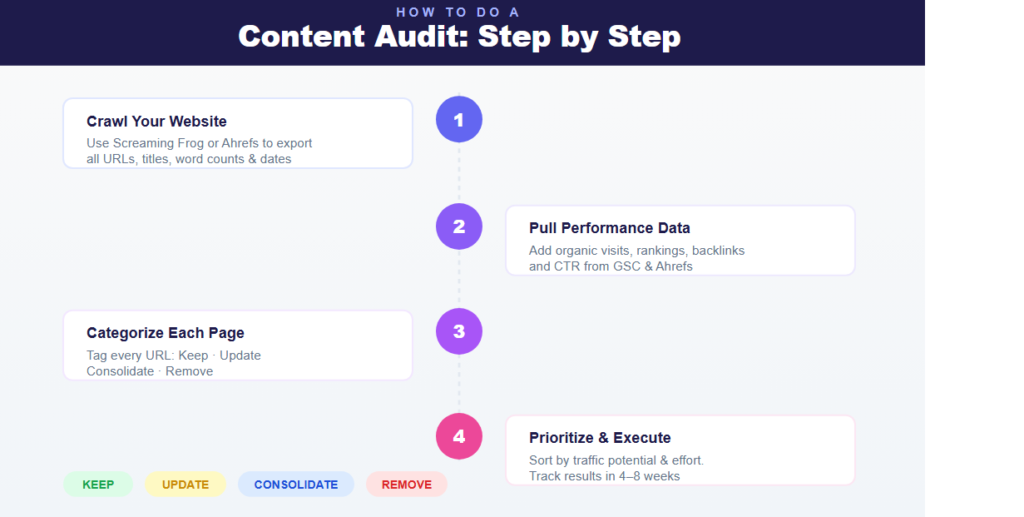
Step 1: Crawl Your Website and Create an Inventory
Use any tool such as Screaming Frog or Ahrefs Site Audit to perform crawling on the site and get a list of all URLs:
Your Spreadsheet Should Include:
- URL
- Page title
- Words count
- Publication date
- Last update date
Step 2: Pull Performance Data
Also include information for each URL from Google Search Console and Ahrefs or other SEO tools:
- Organic visits (past 3–12 months)
- Ranking keywords
- Backlinks count
- Click-through Rate
Step 3: Categorize Each Page
Based on the available data, categorize each page into one of four actions:
Keep
Highly-trafficked and highly-ranked pages that are currently doing well. Do nothing or improve.
Update
Pages that used to perform well but have since declined in popularity, are out of date, or lack important information being covered by a competitor. Update.
Consolidate
Two or more pages discussing the same topic. Combine them to create one single page and then redirect the less performing URLs.
Remove
Zero traffic, zero backlinks, zero keyword ranking, zero strategy value. 301 redirect or delete.
Step 4: Prioritize Your Action List
You can’t edit 50 pieces of content at once.
Prioritize By:
- Traffic Potential (How much traffic could this page drive if optimized?)
- Strategic Importance (Is this page crucial to a product/service offered?)
- Level of Effort (A quick change versus a total overhaul?)
Step 5: Execute and Track
Prioritize the higher-priority changes first.
Measure the Results
Once updates are implemented, observe how they affect rankings/traffic within 4 to 8 weeks.
Content Audit Tools
They make the process quicker and more efficient:
Ahrefs Site Audit
Crawls your website to check for any technical problems, and gets organic performance metrics for each page.
Google Search Console
Free impressions, clicks, CTR and rank information for every page indexed by Google.
Screaming Frog
An effective website crawler which can export all page level information such as title, meta descriptions, word count, and status codes.
Google Analytics
Engagement metrics such as time on page, bounce rates, and conversion rates will give insight into content effectiveness besides SEO related performance measures.
How Often Should You Do a Content Audit?
For most sites, an annual content audit is ideal.
For High-Publishing Websites
Sites that publish frequently (weekly or more) may benefit from a rolling audit, reviewing older content on a quarterly schedule rather than doing everything at once.
Content Audit vs. Content Gap Analysis
They are sometimes seen as the same thing but aren’t really.
Content Audit
A content audit reviews what you have and evaluates its performance.
Content Gap Analysis
Content gap analysis checks if there are topics you should write about that you’re not currently covering.
Why You Need Both
Both are vital components of good content strategy.
Ideally, one does a content audit prior to adding new content, because how can you know what is missing without knowing the condition of what you have?
Final Thoughts
While not particularly glamorous, a content audit is a high ROI activity in content marketing.
Every website has a lot of traffic stuck on underperforming pages, which require only a bit of help to rank once again.
Take time out to do your first content audit for this quarter. A partial audit of your top 50 pages will yield great results.