What Are SEO Keywords? A Beginner’s Complete Guide

All content created by you for organic search has its starting point in the form of keywords. However, keywords are not only words but also windows that give you insight into what your target audience is searching for. It is crucial to understand how to discover, analyze, and implement keywords in SEO.
What Are SEO Keywords?
SEO keywords are the terms entered by users when they are trying to search for information, products, or services via search engines. These terms are a link between the needs of the audience and the content you create.
Using certain keywords for an optimized page indicates that this particular page is the best answer to the search query among all other possible results offered. Doing it correctly means earning traffic organically; however, choosing irrelevant or unsearched keywords would mean failure.
Types of SEO Keywords
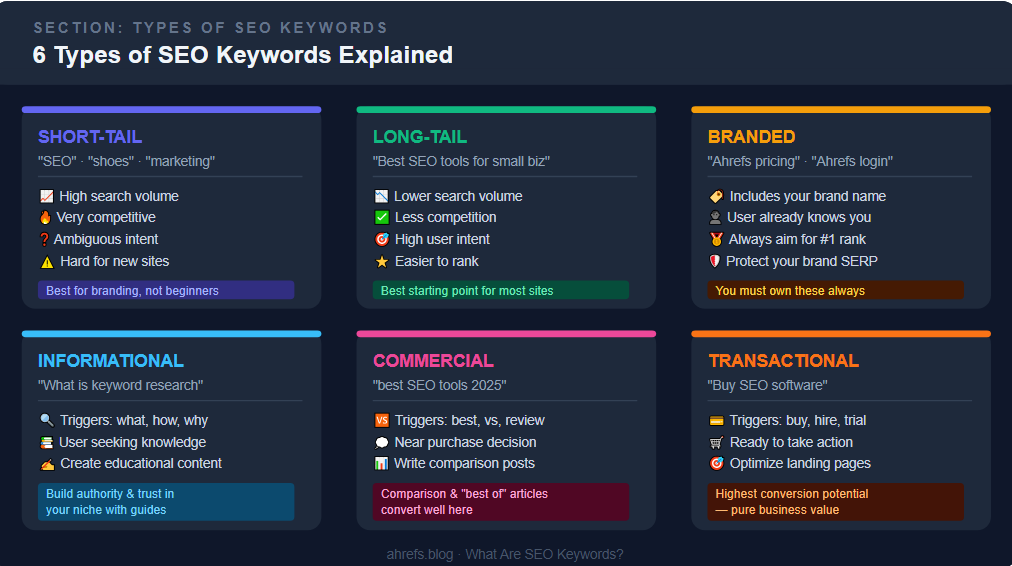
Short-Tail Keywords
Short-tail keywords are very generalized terms that usually contain only one or two words.
Examples include “SEO,” “shoes,” and “marketing.”
Characteristics:
- High search volume (thousands to millions of searches per month)
- Very competitive, mostly occupied by authority websites
- Highly ambiguous intent, difficult to determine what the user is looking for
- Very challenging for novice or small websites to rank for
Strategy note:Short tail keywords are important for branding purposes, but not always a good choice as a starting point for the majority of websites. There is too much competition and the purpose is vague.
Long-Tail Keywords
Long tail keywords are more defined keywords with at least three words.
Examples: “Best SEO tools for small business,” “How to conduct a technical SEO audit,” “SEO keyword research for beginners.”
Characteristics:
- Low search volume for each keyword but high overall search volume for all long-tail keywords
- Less competition as compared to short-tail keywords
- High intent by the user since the person searching knows exactly what he wants
- Easier to rank in searches
Strategy note:Most websites should focus on long-tail keywords because these are easy to rank in, have good conversion rates due to high intent, and create overall more traffic than short-tail keywords.
Branded Keywords
The branded keywords contain the name of the organization and the products.
The examples of branded keywords include “Ahrefs pricing,” “Ahrefs vs Semrush,” and “Ahrefs login.”
This type of keyword comes from someone who knows about your existence. You must always be the #1 on all your branded keywords.
Non-Branded Keywords
The non-brand keywords have no brand name included within them. Such keywords are used when one uses open search and is competing for them.
Informational Keywords
Informative Keywords are keywords that are used by individuals seeking information. Such keywords usually include words such as: What, how, why, when, guide, tutorials, tips.
Examples include “What is Keyword Research”, “How to improve Domain Authority” & “Why is my Website not Ranking”.
Create information content around educational keywords. Informational keywords refer to the type of searchers who look for information. Your aim should be to establish yourself as an expert in your niche.
Commercial Keywords
Commercial keywords are keywords that are used when a user is trying to make a choice. They may include keywords like “best,” “vs,” “review,” “alternative,” “top.”
Example: “best SEO tools 2025,” “Ahrefs vs Semrush,” “Moz alternatives.”
Create comparison articles and “best of” articles around commercial keywords. This type of searcher is close to making a purchase decision.
Transactional Keywords
Transaction-related keywords are those that people who want to act, make purchases, download, subscribe, and contact will use to search.
Examples: “Buy SEO software,” “Ahrefs free trial,” “SEO consultant hire.”
Such keywords are all business-related. Design optimized landing pages and product pages for transactional keywords.
Local Keywords
These are keywords that either have some form of geographical modifier or indicate that the search was made locally.
Some examples of local keywords are: “SEO agency London,” “dentist near me,” “Chicago digital marketing.”
If you are running a business that is localized in nature, then local keywords are one of your most important priorities.
How to Find SEO Keywords
Keyword research is an essential part of understanding what your target audience is searching for. Here are some proven techniques:
Use a Keyword Research Tool
Keywords Explorer by Ahrefs is a keyword research tool designed specifically for this purpose. Type in a seed keyword (keyword that broadly relates to your business) and find:
- Hundreds of keyword ideas
- Monthly search volumes for each
- Keyword Difficulty Score (from 0-100)
- Click through rate data
- Traffic potential (what traffic you will get if you ranked #1)
Start with 3–5 seed terms related to your business and let the tool expand your list.
Analyze Competitor Keywords
In Ahrefs’ Site Explorer, input the domain name of the competitor and head to Organic Keywords to see all keywords ranked by the competitor and their ranks.
These include:
- Keywords on which they rank from 1st-3rd but are not present on your end.
- Keywords on which you rank from 10th-20th but they rank from 1st-5th.
Use Google’s Own Tools
Google Search Console gives you an insight into the exact keywords bringing visitors to your website, even those you had no idea you were ranked for.
Google autocomplete (suggestions) give related keywords.
Also people also ask the section that gives follow-up questions.
Mine Your Existing Content
Start by reviewing your top-performing pages. What are the keywords you are currently ranking for? Is there any room for new content that focuses on similar keywords?
How to Evaluate Keywords
You will need to rank which keywords should be targeted based on their value.
Search Volume
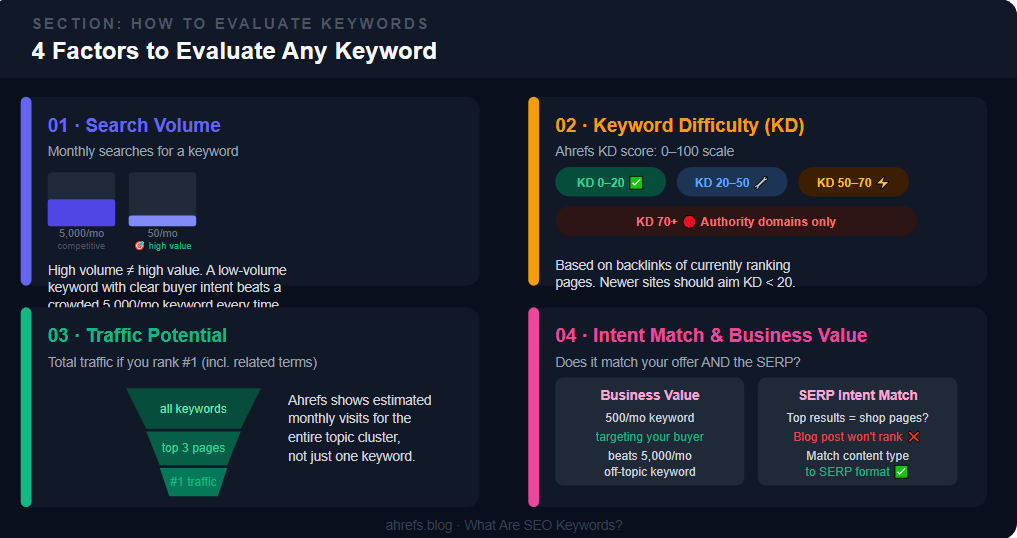
Traffic is important, but high traffic does not necessarily mean a keyword is valuable. For example, a keyword with a volume of 50 and no competition with evident intent to buy may be more valuable than a keyword with a volume of 5,000 and intense competition.
Keyword Difficulty (KD)
Ahrefs KD shows how difficult it would be to rank within the first ten positions on the basis of the backlinks that the currently ranking top-ranking pages have.
General Tips:
- KD between 0 and 20: Feasible for newer or smaller websites
- KD between 20 and 50: Can be obtained through decent content and some link building
- KD between 50 and 70: Needs considerable efforts from an already authoritative website.
- KD above 70: Ideal for authoritative domains with enough resources.
Traffic Potential
Traffic Potential by Ahrefs indicates the potential monthly traffic a top-ranking page can generate by ranking number one for a particular keyword, considering the various other keywords as well.
Business Value
How pertinent will the particular keyword be to your business? You may need to prioritize a keyword that has 500 searches per month pertaining to your offer over one that boasts 5,000 searches but just 5% of them represent your target market.
Search Intent Match
Are you able to develop something relevant that will fully meet the purpose of this keyword? If other top results in the SERPs all feature ecommerce pages while yours is strictly a blog post, then no matter how good it is, there’s little chance for success here.
How to Use Keywords in Your Content
Identifying keywords is not enough; using them effectively is what gets you higher rankings.
Keyword Mapping
Give your website page its own primary keyword to avoid keyword cannibalization. The other keywords, called supporting or semantically related ones, can be used in your content naturally.
Natural Placement
Use the main keyword in:
- Title tag (most important location)
- Heading level one
- Opening paragraph
- 2–3 heading levels two (where appropriate)
- URL slug
- Meta description
- Alt tags for featured images
Avoid stuffing: Keyword repetition is not necessary anymore. Write for real people, not for search engines.
Topic Coverage
Ranking in today’s world for a particular keyword is no longer just about repeating that keyword throughout your website; it is now more about covering the entire subject matter. Look at the top five ranking websites for your particular keyword. Which subtopics do all these sites discuss?
Common Keyword Mistakes
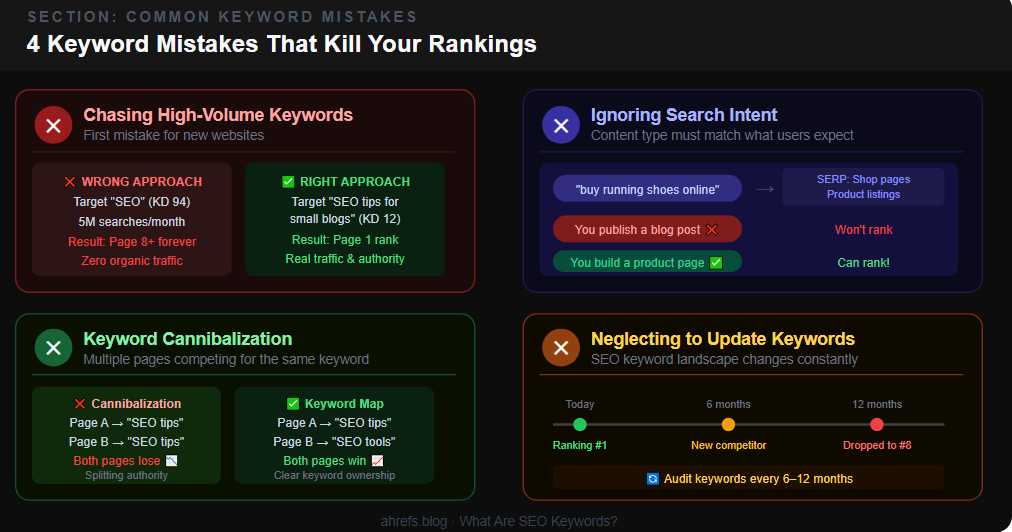
Going After the Highest-Volume Keywords First
High volume keywords are always very competitive. When you are starting off as a new website, you should be looking at long tail and low difficulty keywords where you can actually achieve rankings and establish your authority.
Ignoring Search Intent
Producing an informational guide if your keyword requires product pages will not work. The type of content needs to match the keyword purpose.
Keyword Cannibalization
More than one page with the same keyword battles each other. Make sure to maintain a keyword map and have only one page for each keyword.
Neglecting to Update
Keyword searches change. New competitors come up. The topics change as well. Review your keywords every 6–12 months.
Conclusion
Your SEO keywords are the cornerstone of all the content that you produce for the purpose of organic ranking. Knowing what kind of keywords exist, being able to discover and analyze them properly, and incorporating them into your content is the main difference between the websites that attract organic visits and websites publishing their content in vain.
Begin by researching intent-driven long-tail keywords that your website can rank for. Establish authority and gradually move on to more challenging keywords as your website develops.