Translation Project Management: How to Run Multilingual Projects Without Chaos

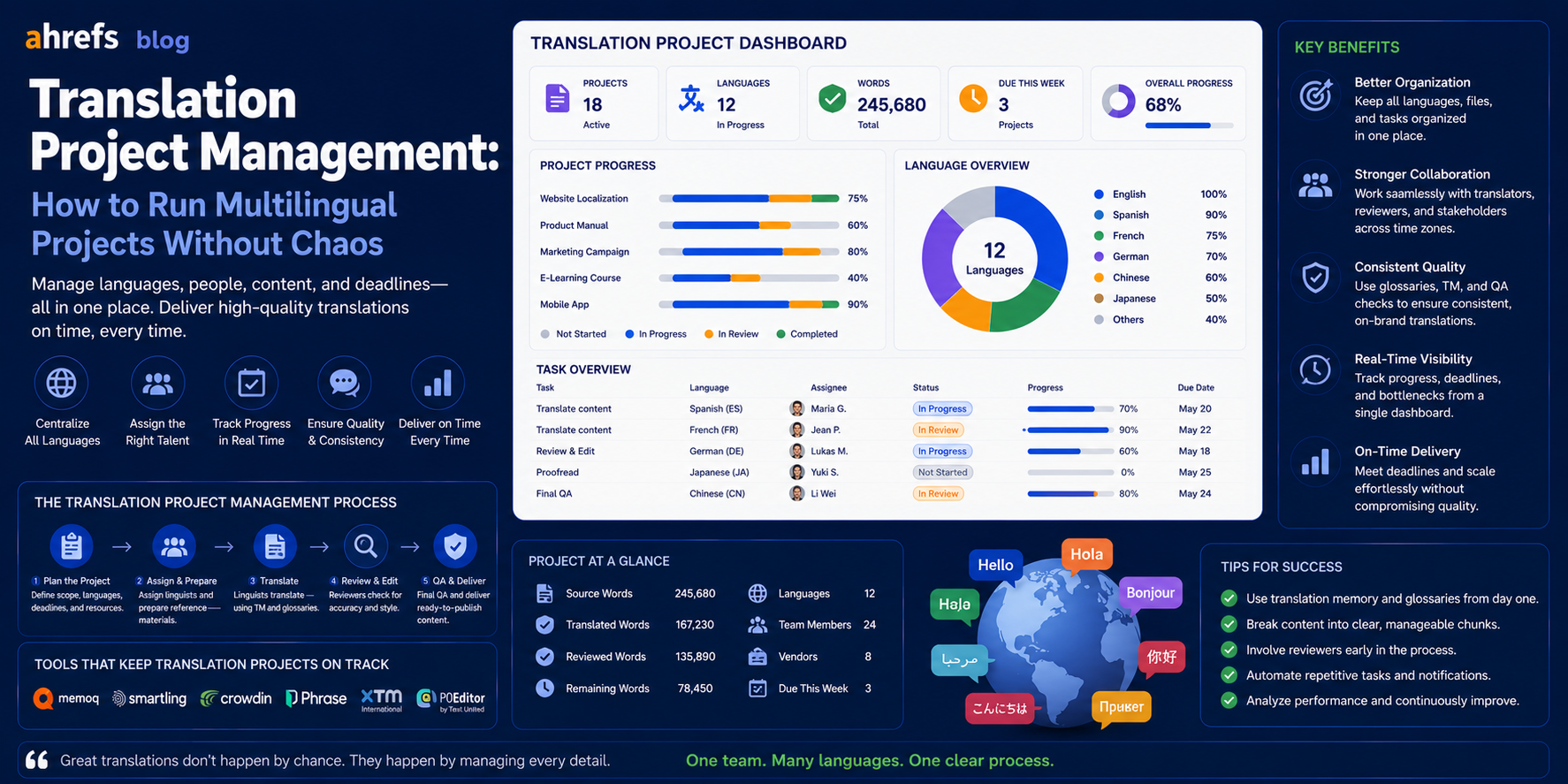
Translating fails predictably: terminological disparities among languages, versioning confusion due to changes in source documents in the middle of the translation process, missing deadlines because of the lack of monitoring of vendors’ work, and quality problems that emerge only after the delivery. This is what is called translation project management, a way of managing a multilingual content delivery process. How does it work?
Table of Contents
- What Is Translation Project Management?
- The Key Participants in a Translation Project
- The Workflow of a Translation Project
- Translation Memory and Terminology Management
- Tools Used in Translation Project Management
- The Most Common Challenges in Translation PM and How to Fix Them
- Conclusion
What Is Translation Project Management?
Translation project management (or sometimes referred to as localization project management if the range of activities includes culturalization, formatting, and adaptation to regional markets) involves planning, coordination, and quality assurance of projects requiring content to be translated from a source language into one or more target languages.
The process is far more complicated than simply sending a document to a translator because:
- Large-scale projects involve multiple language pairs simultaneously.
- Source texts undergo changes during the translation process (for example, live product documentation, changing marketing materials).
- Various specialists are involved (translators, revisers/editors, proofreaders, DTP professionals, QA managers).
- Management of terminology consistency across the large amount of text is needed.
- Files are in specific formats (XML, XLIFF, InDesign, HTML).
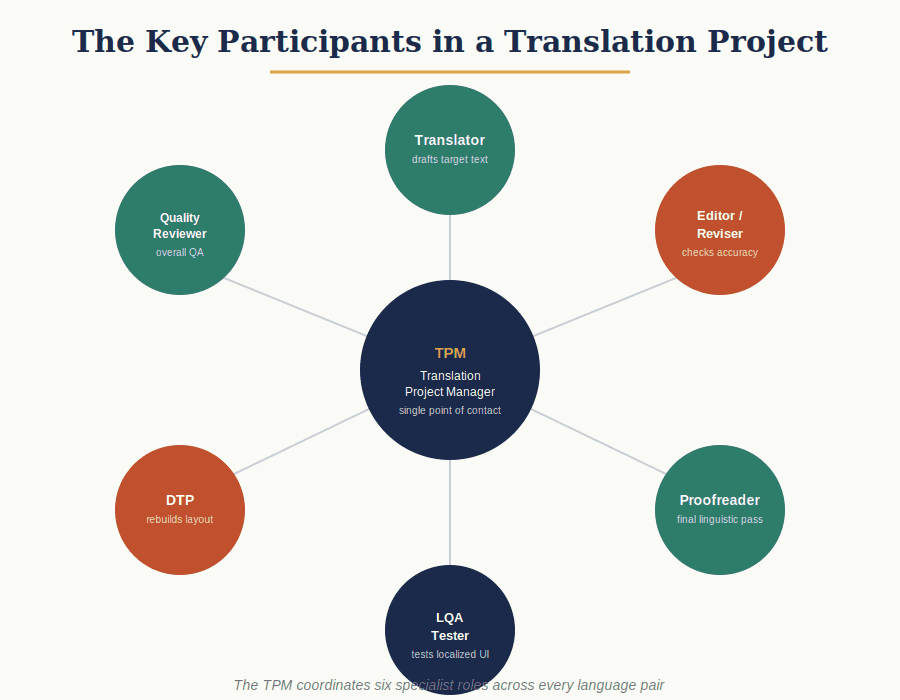
Key Roles in a Translation Project
Translation Project Manager (TPM)
Is responsible for everything involved in the project: scoping, scheduling, allocation of vendors, quality control, client interaction, and delivery. The TPM is the focal point of contact for all languages and all vendors.
Translator
Is responsible for generating the first draft in the target language starting from the source language. Works exclusively with a specific language combination and subject matter.
Editor / Reviser
The second linguist checks the translation work for accuracy and consistency with the client’s style guide.
Proofreader
This is the last linguistic check that usually comes after desktop publishing in order to identify formatting related problems with the text (broken lines that alter the meaning, incomplete user interface strings, etc.).
Desktop Publisher (DTP)
Where the project involves designing the documents (such as PDFs, InDesign files, brochures), the DTP experts will reformat the translation in such a way that it resembles the original format by considering text expansion (as German text is 30% more extended compared to English) and right-to-left languages (such as Arabic or Hebrew).
Quality Reviewer / LQA Tester
In case of localizing software and digital products, the Linguistic Quality Assurance tester will check if everything is translated correctly and adapted culturally, with no mistakes in displaying the user interface strings, etc.
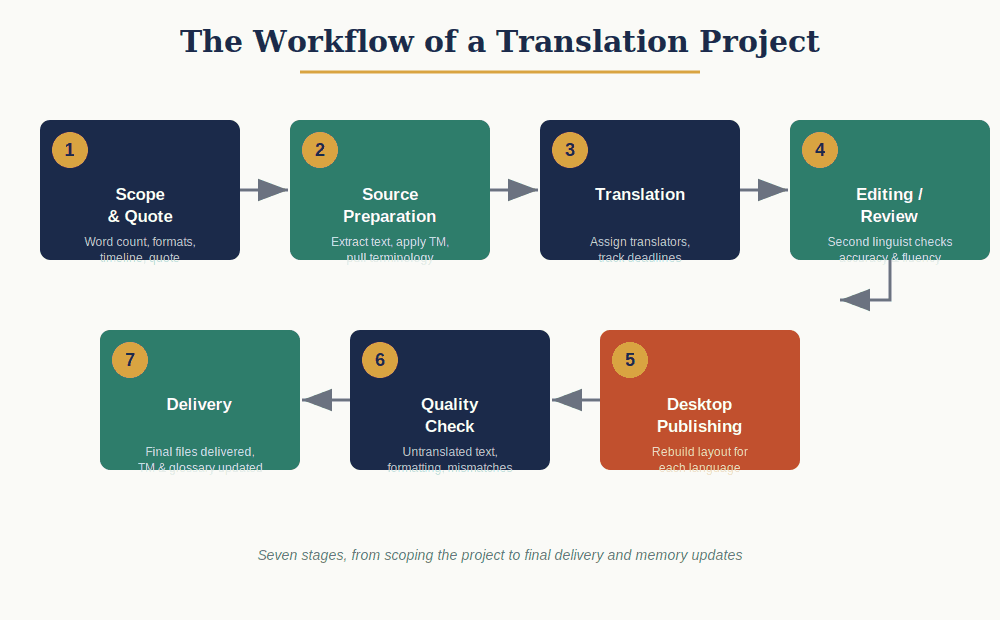
The Translation Project Workflow
Translation management of a good translation project involves the following steps:
1. Scope and Quote
Analyzing the source files (word count, source file format, language combinations, subject difficulty, desired turn-around time). Creation of a quote and time line.
2. Source Preparation
Preparation of files for translation: extraction of translatable text from the source formats (usually to XLIFF or other translation formats), application of Translation Memory to fill-in already translated segments, terminology extraction.
3. Translation
Assignment to translators of the appropriate language combinations. Monitoring the project against the deadline. Reporting any source questions (terminology issues, unclear source text) to the client.
4. Editing / Review
The second linguist examines the translated text with regards to accuracy, consistency, and fluency. Change tracking is performed and compared with the source document.
5. Desktop Publishing (if applicable)
The translation file is then put back into the design. DTP ensures there is no text overflow, compatibility of fonts, and proper layout for each language.
6. Quality Check
QA tools will check for:
- Untranslated fragments
- Incorrect formatting
- Mismatched terminology
- Differences in numbering and dating
- Missing/extra text
7. Delivery
Delivered final files in the requested format by the client. Updated project memory and glossary for future projects.
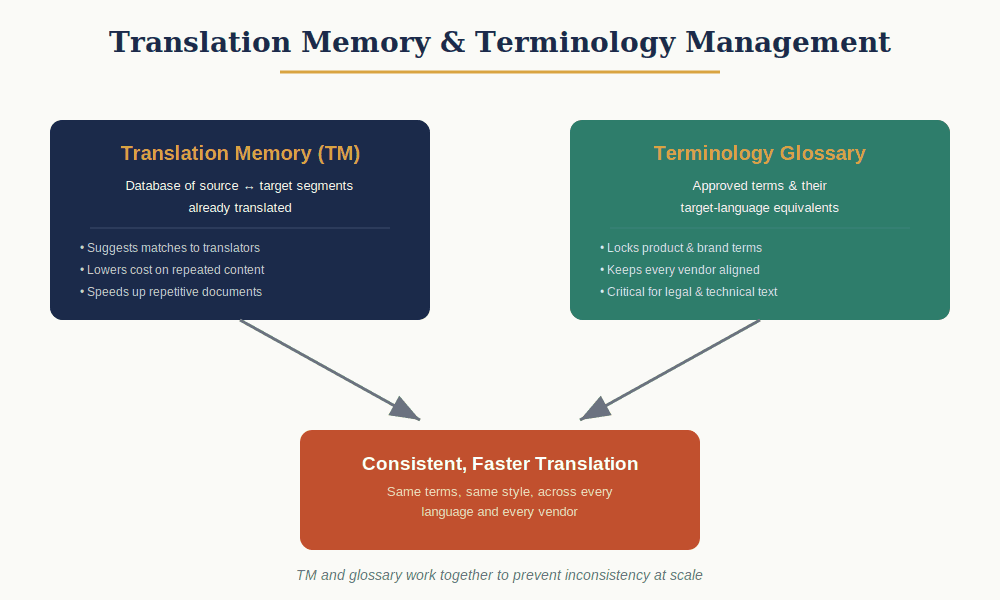
Translation Memory and Terminology Management
Translation Memory (TM)
Database of source/target segments that have already been translated. Whenever new content is entered which has been previously translated, the TM suggests the earlier translation for the translator to accept, edit, or reject.
Benefits:
- Cost reduction (translation charges less or nothing for matches)
- Consistency in translation of large volumes of content
- Faster turn-around time for documents containing repetitive content (technical manuals, legal documents)
Terminology Glossary
List of agreed upon terminology and its agreed upon translations into the target languages. This will ensure consistency in translation of product names, technical terms, and brand-related vocabulary regardless of who is translating any particular batch. Crucial in technical, legal, and product-related translation where inconsistent terminologies cause a lot of problems.
Tools for Translation Project Management
Translation Management Systems (TMS)
Specialized platforms designed to support the entire translation process:
- XTM Cloud: Excellent TM & terminology management capabilities and workflow automation, popular among LSPs and in-house teams
- Phrase (previously known as Memsource): Frequently employed for software localization; excellent API capabilities for continuous localization
- SDL Trados Business Manager / WorldServer: High-end; typically employed by big multilingual enterprises
- memoQ: Often utilized in European translation markets; document-based translation processes
CAT Tools (Computer-Assisted Translation)
Utilized by translators (not by the PM level) to take advantage of TM, control terminology, and work effectively in translation-friendly environments:
- SDL Trados Studio
- memoQ
- Wordfast
- OmegaT (free)
Localization Platforms for Software/Digital
For groups developing multilingual software or websites:
- Lokalise: Good at software user interface strings, continuous localization, and API-driven processes
- Crowdin: Widely used for open source projects and game localization
- Transifex: Localization of web and mobile applications via an API
Common Translation PM Challenges and How to Solve Them
Source content changes during translation
Establish a content freeze date prior to commencing translations. Should there be any need for changes, budget and charge for the re-translation of the changed segments using XLIFF-based workflows.
Inconsistent terminology across languages or vendors
Maintain a glossary by necessity and perform TM-based consistency checks prior to delivery. Brief the translators on the terminology needs prior to translation and not after having reviewed the initial draft.
File format complexity causing delays
Process files in a proper TMS, which deals with the format conversion; do not give InDesign/HTML files directly to translators to handle the technical aspect.
Missed deadlines in multi-vendor projects
Insert buffers at all transition points (translation to editing, editing to DTP, DTP to quality assurance). These transition points are the points where delays build up because everyone is waiting for full information from the previous process.
Final Thoughts
Translation project management may be less exciting than translation work, but it is what decides whether your multilingual project will ship on schedule and in the manner you need it to. Properly set up TMS, updated translation memories, approved client terminology glossaries, and established workflows for each language pair will save you from most of the problems that cause headaches in translation projects. Build the structure once, and future projects will go smoother and quicker.