Software Development Best Practices, What High-Performing Teams Actually Do

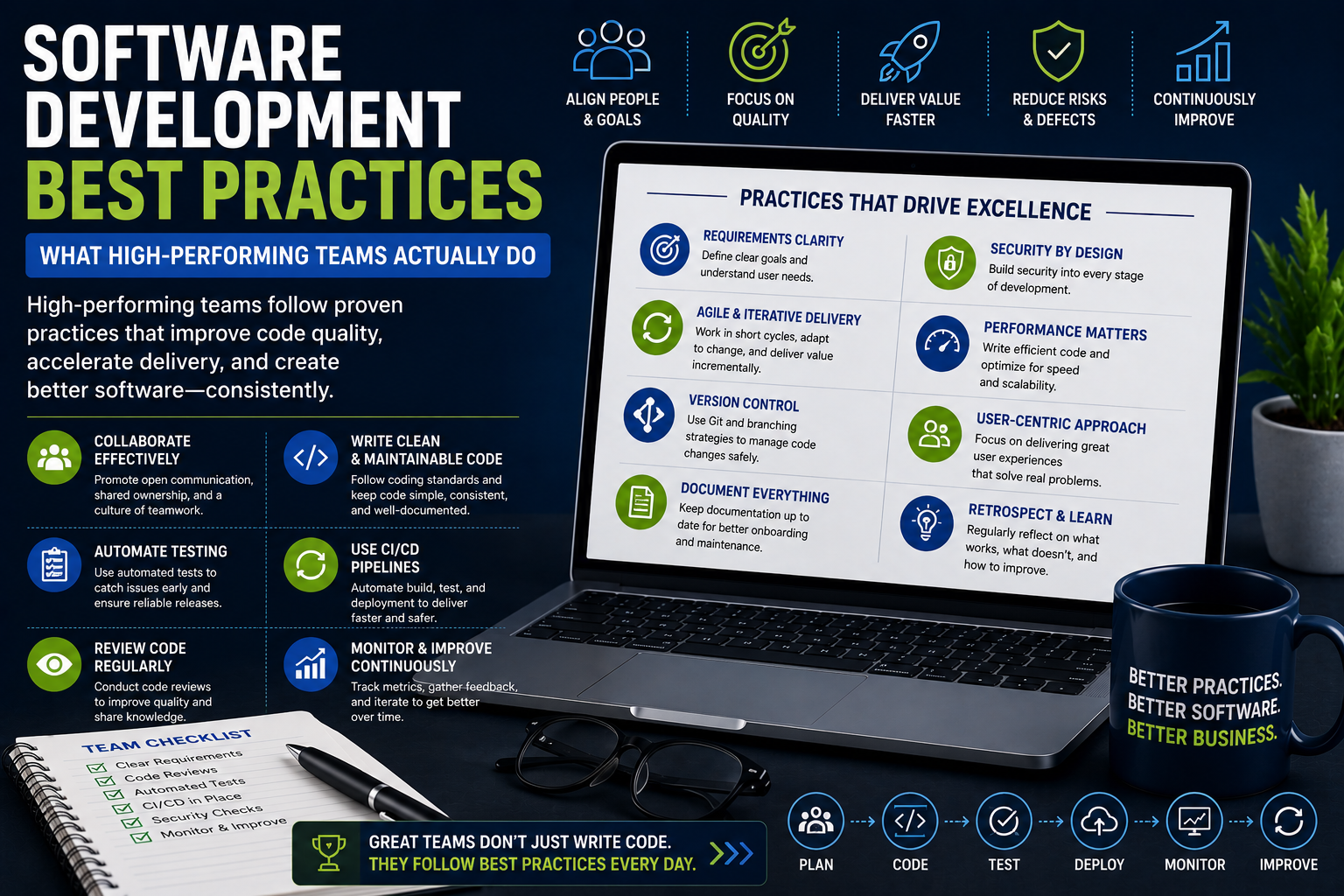
Everyone has an opinion about how to write software. However, when one analyzes those teams that always deliver high-quality software on time, certain practices always appear.
This is not an attempt to create a utopian ideal list. These are those practices that definitely improve the quality of the code, increase the velocity of the team and make products more reliable.
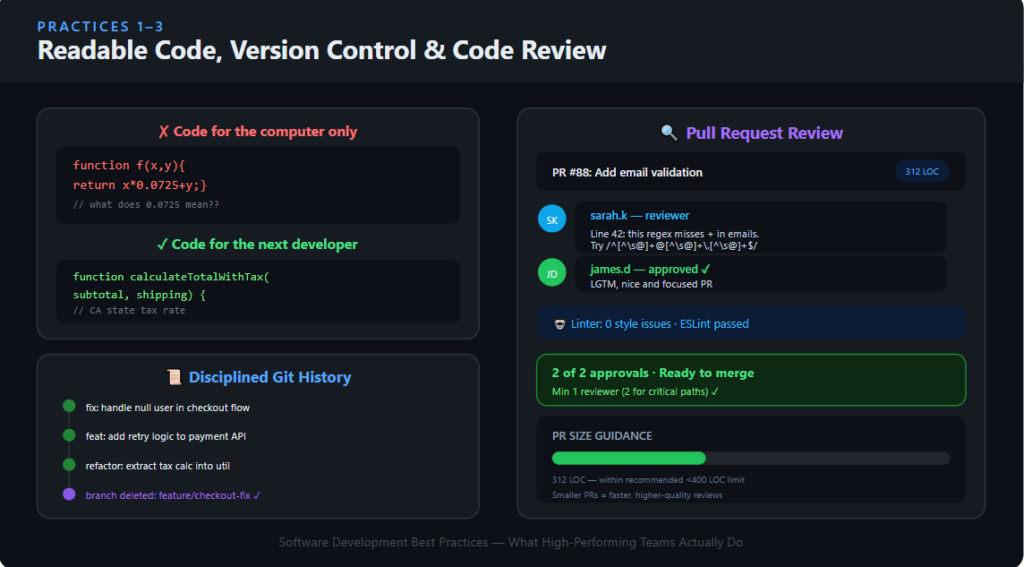
1. Write Code for the Next Developer, Not Just the Computer
Functional code is a given. Code that the next person (or even next year’s you) understands, adapts, and enhances is the benchmark.
What This Means in Practice
- Give meaningful names to variables and functions
- Comment on why, not what (code shows the what; comments give the reason)
- Make sure functions have one job
- Choose clarity over cleverness
The most costly code to maintain is code no one understands.
2. Use Version Control, and Use It Well
Git is table stakes. However, in addition to using Git, high-performing teams have version control discipline which entails the following:
- Commit early and often:Small and focused commits are easier to review and easier to roll back
- Write meaningful commit messages:Future colleagues (as well as you) will be grateful
- Use feature branches:Never commit directly to master/main
- Delete branches after merging: Keep the repo clean
Good Git history is among the most underrated forms of documentation.
3. Review Every Piece of Code Before It Ships
Code review is one of the most productive processes in software engineering.
It finds bugs, shares knowledge, maintains coding standards, and gradually improves code quality.
Best Practices for Code Review
- A minimum of one reviewer per pull request (two for critical paths)
- Review for logic and correctness, not only style
- Try to keep PRs small – less than 400 LOC
- Provide specific actionable feedback (“this is bad” is not it)
- Use linters to automate style checking to leave logic review for humans
Teams that bypass code reviews tend to introduce more bugs and build up more technical debt.
4. Write Tests, Especially for Critical Paths
Code without tests is an expense. Tests aren’t what slow you down; they’re what enable you to be fast without breaking anything.
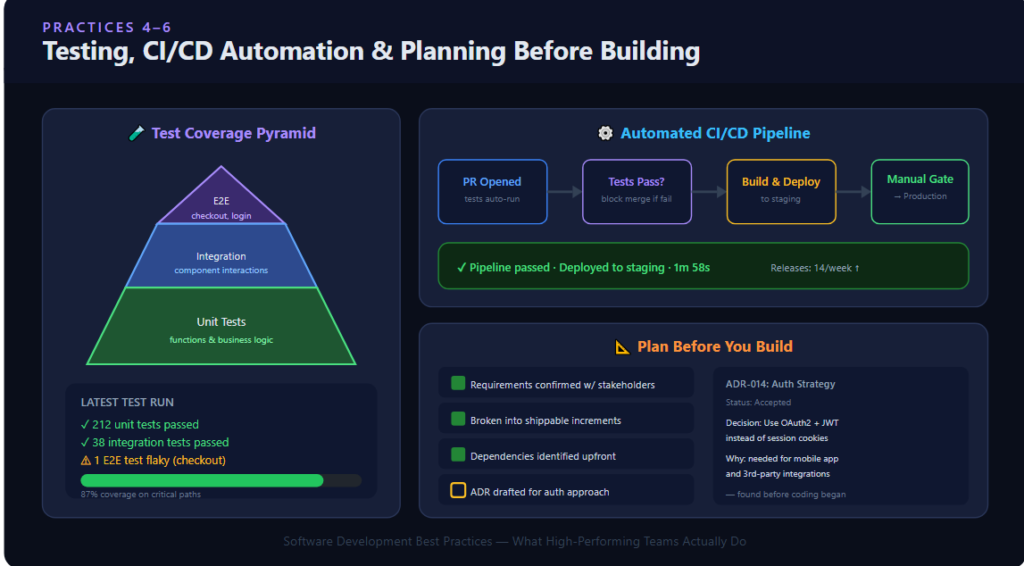
Minimum Viable Testing Coverage
- Unit tests:Functions / Business logic
- Integration tests:Component interactions
- End-to-end tests: Important user flows (e.g., checkout, login, submission of data)
Shoot for relevant coverage of the important code, rather than trying to get 100% coverage of irrelevant code. A well-written test suite that you update is far more valuable than an enormous but unmaintained test suite.
5. Automate the Build, Test, and Deployment Pipeline
The process is lengthy, non-repetitive, and prone to mistakes. The CI/CD pipeline ensures that the development process becomes efficient with automation of the steps from code writing to deployment.
A Basic CI/CD Pipeline Should
- Automate testing on each pull request
- Do not allow merge if testing fails
- Automate build and deployment to staging upon successful merge
- Manual gate needed before deploying to production
Teams with an established CI/CD pipeline release more often and experience less downtime in production.
6. Plan Before You Build
It is natural to feel the pressure of beginning work right away, but teams that do not plan will face the consequences down the road.
Before Writing Code
- Define the requirements clearly with stakeholders until there is no ambiguity left.
- Divide the features into small, shippable increments.
- Recognize all dependencies and points of integration at the outset.
- Document critical architectural decisions (even briefly).
The most ideal point to detect a design problem is prior to writing the code. The least desirable point is post-release.
7. Handle Errors and Edge Cases Explicitly
Almost all software behaves itself in the normal case but falls apart when something unforeseen occurs.
Good Error Handling Means
- Anticipating possible failure modes and reacting to them
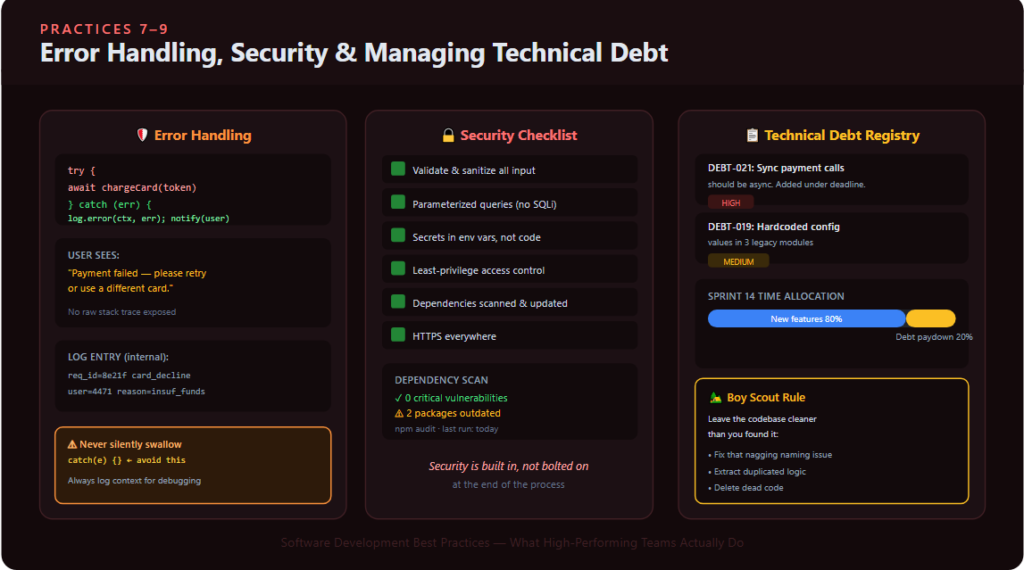
- Generating useful error messages for the user and caller
- Logging those errors in sufficient context for debugging later on
- Never suppressing exceptions without reason
The difference between a nuisance and a disaster can often come down to error handling.
8. Keep Security in Mind Throughout Development
Security does not come at the end of the process; rather, it is an integral part of the whole development process.
Key Security Best Practices
- Always validate and sanitize the user input
- Use parameterized queries to avoid SQL Injection
- Do not store any secret inside your code; rather use environment variables
- Use the principle of least privilege for access control
- Keep your dependencies up to date and do vulnerability scanning
- HTTPS Everywhere
The most effective way to secure an application is while writing the code. The least effective way to secure it is when you have already had a breach.
9. Manage Technical Debt Deliberately
Technical debt is a certainty. Cutting corners for the sake of time, architectural choices that made sense at the time but not anymore, code that “works, but we would never write it this way again”.
The issue isn’t the existence of technical debt. It’s failing to manage it.
Best Practices
- Keep track of technical debt (backlog or separate registry)
- Spend some fraction of each sprint paying off technical debt
- Do refactoring gradually, never have an opportunity for big bang refactoring
- Talk about technical debt during architectural reviews to avoid adding more debt
Technical debt uncontrolled is the primary reason why software development teams get slower.
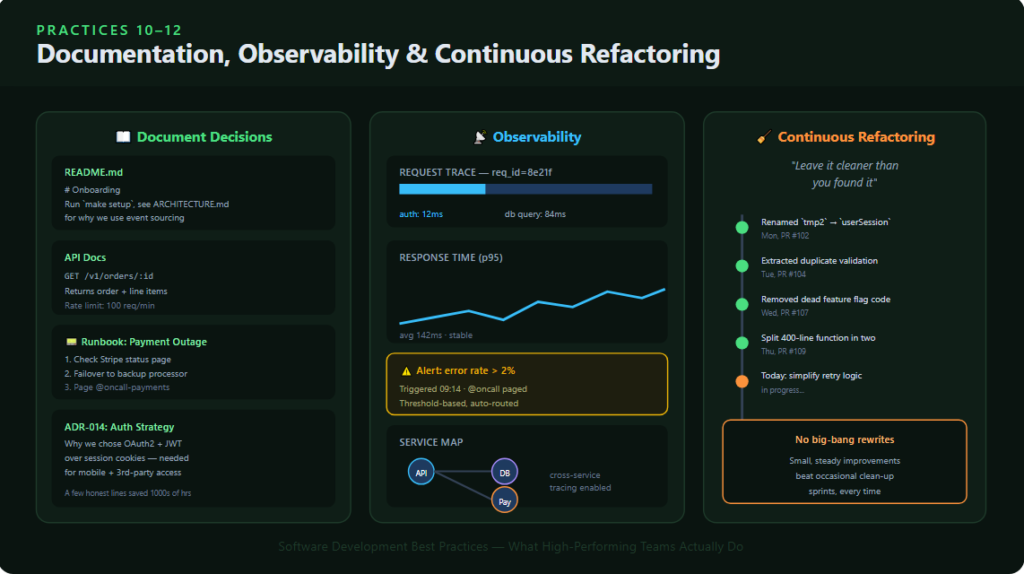
10. Document Decisions, Not Just Code
Great teams capture the “why” behind big decisions, not just the “what” and the “how.”
Useful Things to Document
- Architecture decision records (ADRs): Why you selected this methodology rather than others
- API documentation: What is revealed by the system and how to leverage it
- Onboarding guides:How to make sure a new developer is productive fast
- Runbooks: What to do when specific things fail
It does not have to be fancy. Sometimes just a couple of lines on a Confluence page or a GitHub README explaining an important decision saved thousands of hours.
11. Build Observability In From the Start
What cannot be seen cannot be fixed. It is essential to set up logging, monitoring, and alerts prior to production deployment.
At Minimum
- Traceable logs that use request ID
- Monitoring of application performance (reaction time, failure rates)
- Alerts if threshold limits are reached for key metrics
- Tracing in distributed environment
Good instrumentation helps teams solve problems quicker.
12. Refactor Continuously, Not Periodically
Good code bases do not come from sporadic “clean-up sprints.”
The “Boy Scout Rule” in programming: leave the codebase cleaner than when you arrived. Correct that naming issue that has been bothering you. Refactor that duplicated code into a function. Delete that useless code that has been blocking your path.
A sustainable pace of development is achieved through continual improvement, not through the occasional rewrite.
Bottom Line
Good development practices are not complex. Most engineers have learned them already.
Where it gets difficult is doing these consistently in deadline situations, legacy codebases, and with teams who have ingrained habits.
It’s the teams that do this consistently who build durable software. Who release faster than before and spend much less time firefighting in production.
That’s the payback.