SEO Quiz: Test Your Knowledge with 20 Essential Questions

This SEO quiz tests your knowledge on the basics of SEO whether you’re getting ready for an interview, analyzing your team’s skills, or simply refreshing yourself on the subject.
The right answer and some explanations will follow each question.
How to Use This Quiz
Go through it cold first and answer each question before reading the explanation. Then go back and look at how you did on each one.
Consider using your weaknesses as a way to begin learning more.
Score Guide
- 18–20 correct: Good foundation for further specialization.
- 14–17 correct: Good foundation but with some missing pieces.
- 10–13 correct: Good foundation but with many missing pieces.
- Under 10: Good foundation for future study.
The Quiz
Question 1
What does “search intent” mean in SEO?
A) The keyword used by the user when searching on Google
B) The hidden objective of the user’s search C) How often the keyword is searched each month
D) The Google algorithm to understand content
Answer
B)The underlying goal or motivation behind a search query.
The concept of search intent can be called the key concept of SEO in the current conditions. It does not matter whether the user is looking for information to learn something, compare something, buy something, or just find directions – the search intent defines your content strategy.
An incorrectly matched intent will never make your page rank well.
The Four Main Intent Types
- Informational (wants to know)
- Navigational (wants to go somewhere)
- Commercial (wants to comparison shop)
- Transactional (wants to do something)
Question 2
What is a canonical tag and what problem does it solve?
A) Tag for fast loading pages B)Tag for optimizing pages for mobiles
C) HTML tag used by search engines to choose between duplicate pages D) Tag for adding schema markup
Answer
C)An HTML element that tells search engines which version of a duplicate page is preferred.
Where there are copies or duplicates of the same (or near duplicate) content on different URLs, the search engines will be forced to make a choice regarding which URL to consider authoritative.
The rel=canonical meta element points towards the canonical URL that should receive the SEO benefits.
Common Canonical Tag Use Cases
- HTTP Version VS. HTTPS Version
- WWW Version VS. Non-WWW Version
- Trailing Slash Problem
- Filter/Tracker URLs
- URL Parameters From Filters Or Tracking
Question 3
What is the difference between Domain Rating (DR) and Keyword Difficulty (KD)?
A)DR assesses content quality; KD assesses technical quality. B) DR assesses a website’s backlinks; KD assesses difficulty of ranking for keywords. C)DR is a metric devised by Google; KD is a metric devised by Ahrefs. D)They measure the same thing from a different point of view.
Answer
B) DR measures a site’s backlink authority; KD measures keyword competitiveness.
Domain Rating (DR)
An estimate at the site level of its backlink authority.
Keyword Difficulty (KD)
An estimate at the keyword level of ranking difficulty.
Both are not Google metrics but proprietary metrics from Ahrefs.
Question 4
What are Core Web Vitals, and are they ranking factors?
A)Content quality metrics; yes, they are ranking factors B) Google’s user experience metrics; yes, they are proven ranking factors C) Page Speed Metrics; no, they are not ranking factors D) Mobile-friendly metrics; they have an indirect effect on ranking
Answer
B) Google’s user experience metrics; yes, they’re confirmed ranking factors.
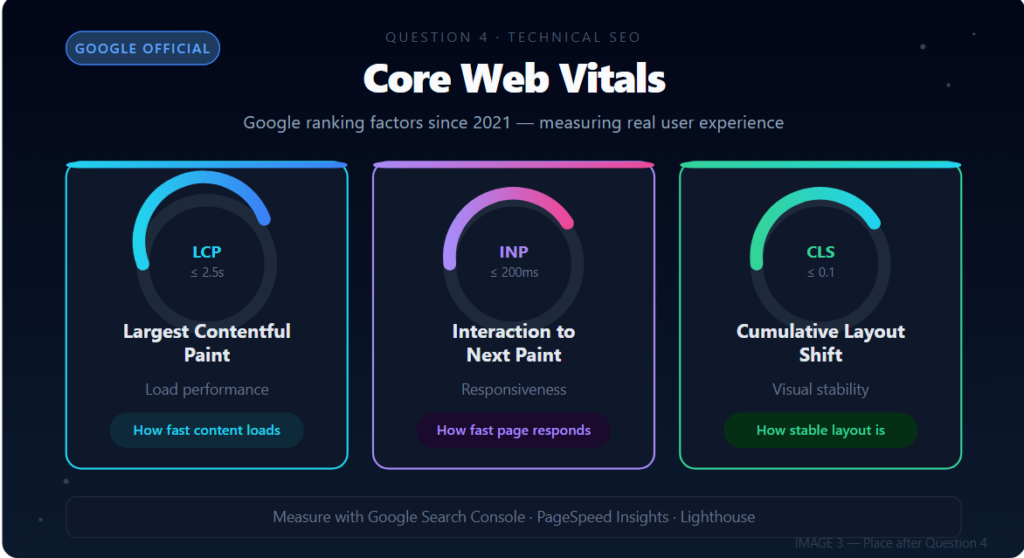
Core Web Vitals Include:
Largest Contentful Paint (LCP)
Evaluates load performance
Interaction to Next Paint (INP)
Evaluates responsiveness
Cumulative Layout Shift (CLS)
Evaluates visual stability
Google announced Core Web Vitals as ranking factors in 2021.
Question 5
What is keyword cannibalization?
A) If competitors are trying to rank for your branded keywords B) If more than one page on your website ranks for the same keyword C) As keywords become less used over time D) If Google no longer includes a keyword in their search engine
Answer
B) When multiple pages on your own site target the same keyword.
These factors result in keyword cannibalization, where pages are competing against one another.
Common Fixes
- Combine duplicate pages
- Redirect duplicate pages
- Content differentiation
Question 6
Which HTTP redirect type is correct to use for a permanent URL change?
A) 302 redirect
B) 301 redirect
C) 307 redirect
D) 410 redirect
Answer
B 301 redirect.
The usage of a 301 indicates that the move is permanent and that most of the ranking signals will be transferred to the new URL.
Redirect Overview
- 301: Permanent Move
- 302: Temporary Move
- 307: Temporary Redirect Alternative
- 410: Gone Content
Question 7
What does “crawl budget” mean and why does it matter?
A) The budget allocated to SEO tools that crawl your website. B) The number of pages Google crawls from your website in a certain amount of time. C) How much money is charged for Google indexing the pages of your website. D) Maximum internal linking in your website.
Answer
B) The number of pages Google will crawl within a given timeframe.
Crawl budget matters for websites that have many pages.
Crawl Budget Optimization
- Low value pages removal
- Fix crawl issues
- Break redirect chains
- Parameter URL avoidance
Question 8
What is the rel=nofollow attribute and what does it do?
A) It makes the loading of the link faster. B) It blocks search engines from crawling the webpage that is being linked. C) It tells Google that it shouldn’t pass any PageRank through the link. D) It eliminates the link from Google’s index.
Answer
C) It signals to Google not to pass PageRank through a link.
Google considers nofollow as a hint now instead of considering it as a command.
Related Attributes
- rel=”sponsored”
- rel=”ugc”
Question 9
What is the purpose of XML sitemaps?
AA) To enhance page loading speed B) To enable search engines to find your site pages C) To avoid indexing pages D) To view a map of your website
Answer
B) To help search engines discover and crawl important pages.
XML Sitemap Best Practices
- Index only indexable webpages
- Do not index redirected pages
- Avoid indexing noindex pages
- Submit using Google Search Console
Question 10
What does E-E-A-T stand for, and why does it matter?
A) Engagement, Effort, Authority, Traffic B) Experience, Expertise, Authoritativeness, Trustworthiness C) Efficiency, Engagement, Accuracy, Traffic D) Experience, Education, Analysis
Answer
B) Experience, Expertise, Authoritativeness, Trustworthiness.
E-E-A-T allows Google to determine content quality and credibility.
Especially Important For
- Health content
- Financial content
- Safety-related topics
- Other YMYL content
Question 11
What is a Featured Snippet and how can you optimize for it?
Answer
A Featured Snippet is a highlighted answer box that appears above organic results.
Optimization Tips
- Target question-based keywords
- Answer questions in 40-60 words
- Create lists, tables, and paragraphs
- Structure content for easy extraction
Question 12
What is the difference between a 404 and a soft 404?
Answer
404
Provides an honest HTTP “not found” status.
Soft 404
Returns success (200) code but shows a not-found message. Soft 404s are wasteful for crawl budgets and mislead search engines.
Question 13
What is the correct way to use H1 tags for SEO?
Answer
Use exactly one H1 per page containing the primary keyword.
H1 Best Practices
- One major H1 element is:
- Page Topic Description
- Matches Search Intent
- Consistent with Title Tag
Question 14
What does “link equity” mean?
Answer
Link equity is the ranking power passed from one page to another through hyperlinks.
Key Principles
- Higher-authority pages pass more value
- Internal links distribute authority
- More outgoing links dilute available equity
Question 15
What is the purpose of hreflang tags?
Answer
Hreflang tags help search engines serve the correct language or regional version of content.
Common Examples
- English (US)
- English (UK)
- French (Canada)
- Spanish (Mexico)
Question 16
What is Google Search Console primarily used for?
Answer
Monitoring organic search performance, indexation, and technical SEO issues.
Key Reports
- Performance
- Index Coverage
- Core Web Vitals
- Mobile Usability
- URL Inspection
- Manual Actions
Question 17
What is schema markup and what benefit does it provide?
Answer
Schema markup is structured data that helps search engines better understand content.
Benefits
- Rich results eligibility
- Higher click-through rates
- Improved search appearance
Common Schema Types
- Article
- Product
- FAQ
- LocalBusiness
- Event
- Review
Question 18
What is the best way to handle thin content pages?
Answer
Evaluate each page individually.
Possible Actions
Update
Improve content quality and depth.
Consolidate
Merge overlapping pages.
Remove
Delete low-value pages and redirect appropriately.
Question 19
What is the difference between organic traffic and paid traffic?
Answer
Organic Traffic
Traffic from unpaid search results.
Paid Traffic
Traffic generated through advertisements.
Key Difference
Organic traffic compounds over time, while paid traffic stops when advertising spend stops.
Question 20
What is “search engine positioning” and how is it different from general SEO?
Answer
Search engine positioning focuses on ranking positions for specific keywords, while SEO is the broader discipline.
SEO includes:
- Technical SEO
- Content marketing
- Link building
- User experience optimization
Positioning measures the ranking outcomes of those efforts.
Score Summary
Count your correct answers:
- 20/20: Exceptional. You’re operating at a professional level.
- 17–19: Strong. A few areas to revisit, but solid foundation.
- 14–16: Good working knowledge. Worth reviewing missed areas.
- 11–13: Developing foundation. Prioritize fundamentals.
- Under 11: Great starting point. Focus on foundational SEO concepts first.
What to Study Next
If You Missed Technical SEO Questions
Study:
- Redirects
- Canonical tags
- Core Web Vitals
- XML sitemaps
Run a technical SEO audit on a real website.
If You Missed Content and Keyword Questions
Focus on:
- Search intent
- Keyword research
- Content optimization
If You Missed Backlink Questions
Study:
- Link building
- PageRank
- Link equity
- Authority metrics
Practice backlink analysis in SEO tools.
If You Missed Questions About Google’s Tools
Set up and explore:
- Google Search Console
- Google Analytics
Direct experience is the fastest way to learn.