SEO for Restaurants: How to Get Found When People Search for Places to Eat

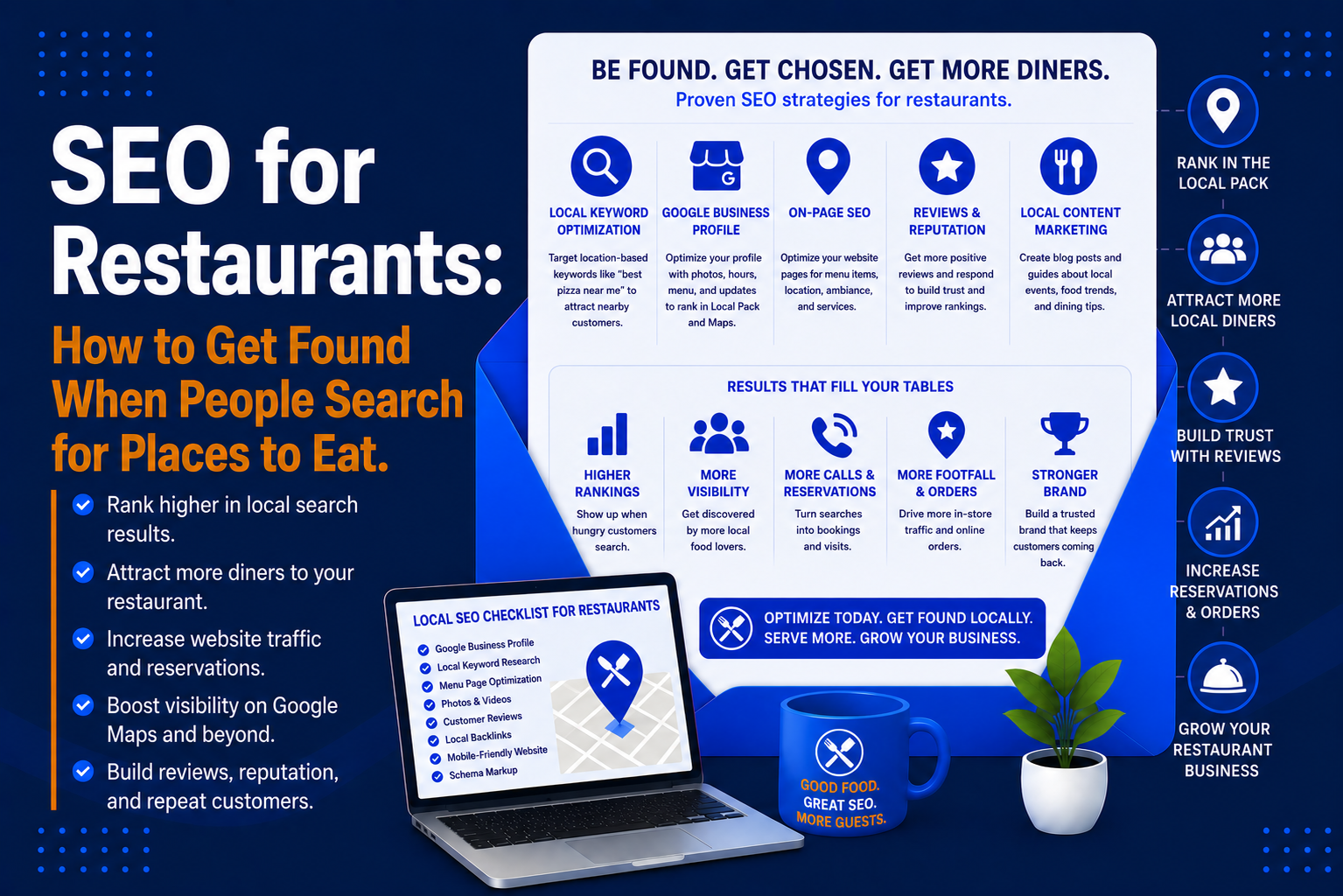
Restaurant discovery happens completely online. When people want to figure out where to go to eat or “where to have the best [food] in [city],” they head to Google. These restaurants are going to get traffic because they’re showing up in the results. Those that aren’t aren’t.
SEO for restaurants is mostly a local SEO game, but with some hospitality-specific components.
Why Restaurants Need Local SEO
Restaurants succeed or fail by the flow of foot traffic and table bookings. In contrast to service industries, where customers can plan for days or weeks ahead of time, restaurant choices are made just 30 to 60 minutes prior to consumption. This is why localized searches become vital when looking to reach customers at their peak intent stage.
“Pizza near me”, “restaurant near me” and “Italian food in [City]”, are all searches from hungry individuals who will make a choice right away.
Google Business Profile: The Restaurant’s Most Important SEO Asset
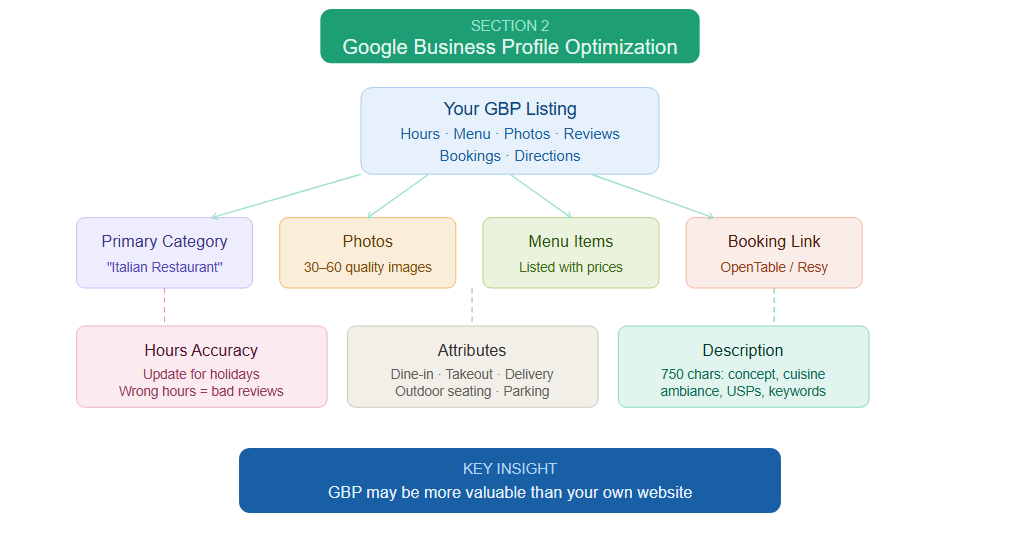
For Restaurants, your GBP may be more valuable to you than your own website because this is where Google will deliver your hours of operation, menu items, pictures, reviews, bookings, and directions. People use the information in your GBP to make decisions without ever visiting your website.
Restaurant GBP Optimization
Primary Category
The category that is most relevant would be “Italian Restaurant,” “Sushi Restaurant,” “Pizza Restaurant,” “Steakhouse,” etc.
Secondary Categories
Include other categories where relevant. A pizza joint which additionally serves pasta and calzones can include:
- Pizza Takeout
- Italian Restaurant
- Pizza Restaurant
Business Name
Exact name only without any keywords in it.
Description
750 characters to describe your concept, cuisine, ambiance, neighborhood, price range, and unique selling propositions. Include relevant keywords in it.
Menu
List your menu items right into GBP. Google can feature menu items in search results. Price listings would be ideal since this helps target the appropriate customers.
Attributes
Complete every applicable attribute:
- Dine-in
- Takeout
- Delivery
- Outdoor seating
- Parking
- Reservations
- Alcohol service
- Vegetarian options
- Vegan options
- Wi-Fi
- Reservations required
Hours
Correct hours are important. Mispublished hours on your GBP listing leads to bad reviews and customers not coming back. Update immediately during holidays.
Booking Link
Link your table reservation system (OpenTable, Resy, Yelp Reservations, or direct booking). “Reserve a Table” button greatly boosts conversion from your GBP.
Photos
This is where restaurants succeed or fail on local search. Include 30-60 high-quality images featuring:
Food
Hero shots of your top dishes, well-lit and styled.
Ambiance
Interior pictures that give the feeling (lunch, dinner, weekend if different).
Exterior
So that the customers know the building.
Bar (if applicable)
The cocktail and wine list and bar ambience.
Team
Chef and front-of-house staff (personalizes the experience).
Pictures should be updated frequently, as out-of-date photos with menu items cause conflict.
Restaurant Keyword Strategy
Cuisine Keywords
- [Cuisine] Restaurant [City]
- Best [cuisine] Restaurants [City]
- [Specific dish] Restaurant [City] (e.g., best sushi rolls [City], wood-fired pizza [City])
Occasion Keywords
- Date Night Restaurant [City]
- Family Restaurant [City]
- Private Dining Restaurant [City]
- Large Groups Restaurant [City]
- Happy Hour Restaurant [City]
- Brunch Restaurant [City]
Proximity Keywords
- “nearby restaurant”
- “nearby restaurants near [landmark]”
- “nearby [type of cuisine] restaurants in [neighborhood]”
Feature Keywords
- “restaurants with outdoor seating in [city]”
- “dog-friendly restaurants in [city]”
- “24-hour restaurant in [city]”
- “restaurants open
Restaurant Website SEO
Restaurant web site SEO may suffer due to the dominance of GBP for local searches. A well-optimized web site will attract further keyword-based visitors who are searching for more information.
Menu Page
The menu page is the most valuable page on your restaurant website.
Ensure:
- Menu is HTML text, not a PDF or image (PDF menus can’t be crawled effectively)
- Menu items include descriptive language with relevant keywords (“wood-fired Neapolitan margherita pizza” not just “margherita pizza”)
- Prices are accurate and updated
Location Page
If you only have one location, this may be the page on your website’s homepage. However, if you have multiple locations, make a separate page for each:
- Name, address, phone number (NAP)
- Hours
- Parking and transit information
- Directions
- Google Map embed
Schema Markup
Schema for restaurants can create rich results in Google searches (star ratings, price range, type of food, hours).
Implement:
- Schema for restaurant on homepage/location page
- Schema for menu linking to sections of your menu
- Schema for reviews/aggregaterating
Review Management for Restaurants
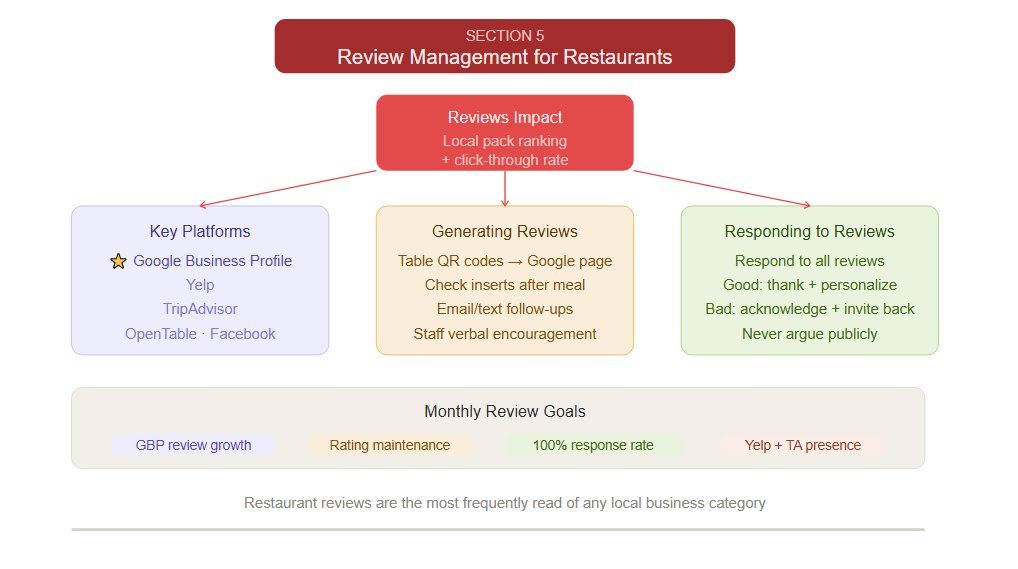
Reviews for restaurants are arguably some of the most frequently read and powerful reviews of any kind of local business. Reviews impact a restaurant’s local pack ranking and even click-through rate.
Key Review Platforms for Restaurants
- Google Business Profile (highest priority)
- Yelp
- TripAdvisor
- OpenTable
- Yelp (critical in many markets)
Generating Reviews
- Table tents with QR codes taking them to the Google review page
- Presenter inserts after the receipt/check encouraging reviews
- Email follow-ups to those who made an online order
- Training your front-of-the-house staff to encourage reviews verbally to happy clients
- Text messages post meal for those making a reservation if you have their contact information
Responding to Reviews
Address all reviews, good or bad.
For the good: Thank you for your kind words. I appreciate what you said about [something particular from their experience]. For the bad: Thank you for contacting me. I will look into the matter and get back to you. Please return. Don’t argue publicly.
Content for Restaurant SEO
Restaurants come with built-in content strengths: seasonality, culinary expertise, community engagement, and local pride are all content opportunities.
Blog/Content Ideas for Restaurants
Menu Announcements
“Introducing Our New Fall Menu: The Work Our Chef Has Done”
Keywords like new menu items and freshness are captured.
Chef Spotlights
“Meet Our Executive Chef: What Inspires Him and His Culinary Philosophy”
Content marketing for E-E-A-T to separate you from the corporate competitors.
Seasonal Specials
“Mother’s Day Brunch Menu 2025: Book Your Table Today”
Keywords associated with specific seasons.
Neighborhood and Community Content
“The Best Parts of [Neighborhood]”
Local identity content that creates community backlinks and fosters brand loyalty.
Local Ingredient Sourcing
“Our Produce Sourcing Story: [Local Farm Collaboration]”
Content that helps to differentiate farm-to-table concepts. Secures backlinks from local food publications.
Cocktail and Wine Guides
“What Is Natural Wine? The Basics for Beginners” Educational content related to your beverage program that drives organic traffic.
Food Delivery and Takeout SEO
These have emerged as an important source of income.
Optimize For
Online Ordering Page
Make sure that your own direct ordering site, if you have one, is optimized and indexed under “[restaurant name] online ordering” and “[cuisine] delivery [city].”
Delivery Platform Presence
Doordash, Uber Eats, and Grubhub listings will be found when searching Google for delivery information.
You can optimize your profiles here by doing:
- Full descriptions
- Good pictures
- Menus
Google Maps Optimization
The visibility on Google Maps is particularly beneficial for restaurants since Maps is integrated into Google’s search engine results and a lot of searches occur through the Google Maps application.
Maps Ranking Factors
- GBP completion and accuracy
- Review number and rating
- Image quality and quantity (the number of interactions with images is used as an engagement factor)
- Frequency of posts (restaurants posting frequently seem active)
- Proximity (algorithms, but verification of address is important)
Measuring Restaurant SEO
Monthly Metrics
- GBP calls
- Direction request clicks
- Website clicks
- Reservation clicks
- “Restaurant near me” local pack ranking
- “[Cuisine] restaurant in [City]” local pack ranking
- Online reservations attributed to organic/GBP
- Review number growth and rating
- Organic traffic to menu and location pages
Conclusion
Restaurant SEO is largely about playing the Google Business Profile game with a good website and steady creation of reviews. Those who have the most comprehensive Google Business Profile pages, the best photos, the most legitimate reviews, and appropriate categories emerge victorious in restaurant SEO.
Allocate 2-3 hours each month for the maintenance of your Google Business Profile by updating your photos, replying to your reviews, and creating seasonal content. Over time, this will accumulate into dominating local search results.