SEO for Hotels: How to Get More Direct Bookings Through Google

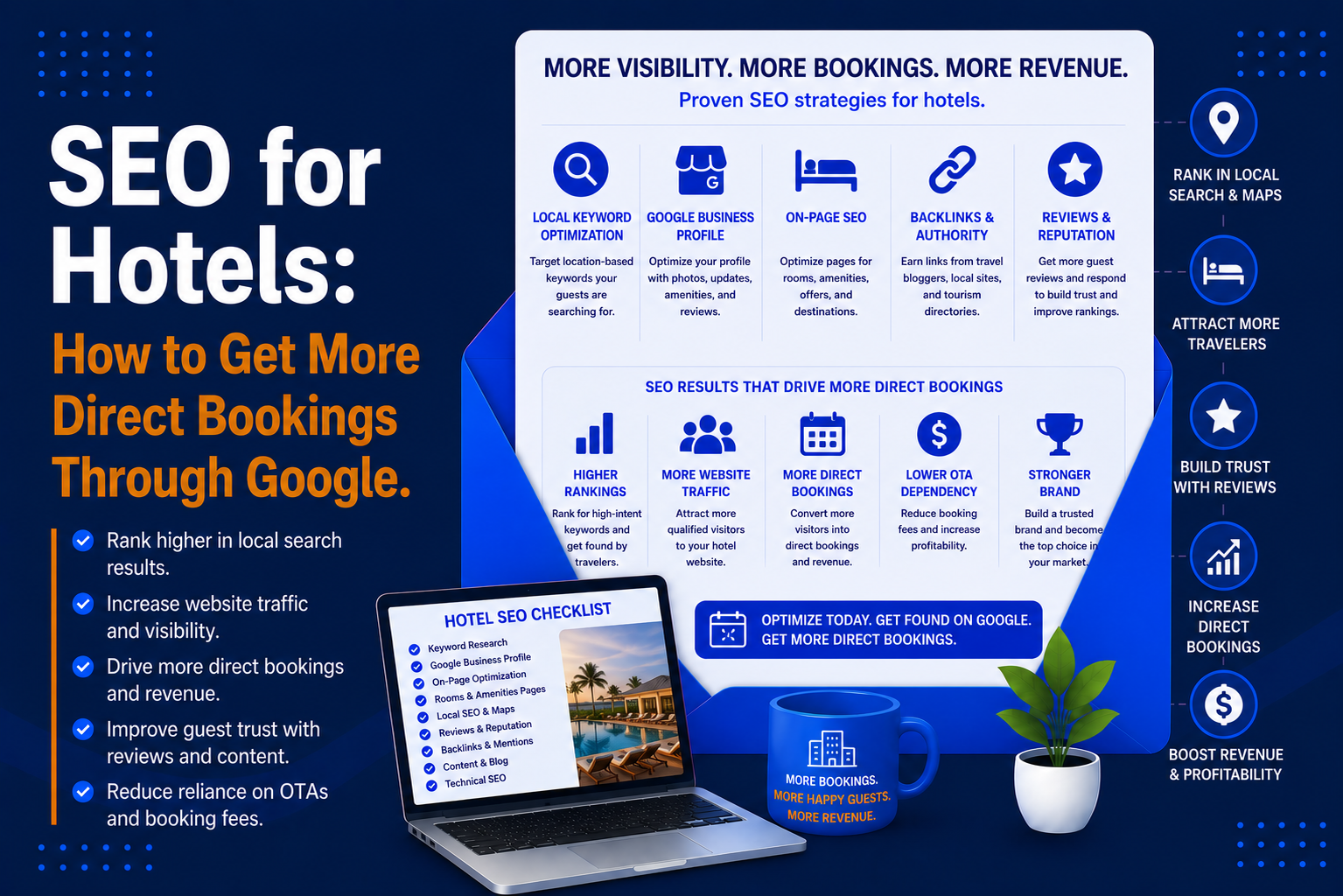
The particular SEO problem faced by hotels is unique to very few industries out there; namely the OTAs (Online Travel Agencies), including Booking.com, Expedia, Hotels.com, and Airbnb. These giants control all search engine results related to hotels with huge ad spending and domain authorities that can never be rivaled.
However, hotel SEO is not about trying to outdo the OTAs in their own game but about owning the search engines in which hotels hold the edge in order to generate their own bookings without the 15%-30% commissions the OTAs charge and build relationships with customers.
Hotel SEO Strategy: Where You Can Win
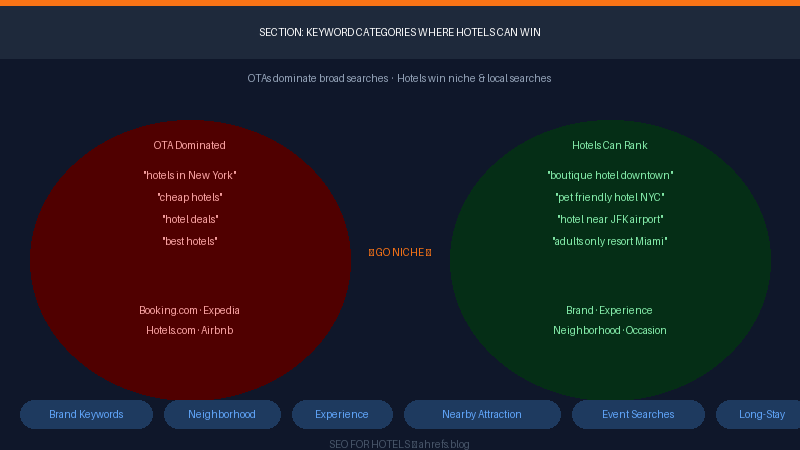
Strategic perspective on successful hotel SEO: OTAs prevail in comparative searches; hotels triumph in niche searches.
Keyword Categories Where Hotels Can Rank
Brand Keywords
“Your Hotel Name”: The #1 position is yours for your brand. If not, something’s wrong. Make sure your site and your GBP work to capture your brand searchers before your competition does.
Experience-Specific Searches
“Boutique hotel [city]”; “Luxury spa resort [city]”; “Adults only hotel [city]”; “Pet friendly hotel [city]”; “Historic hotel [city].”
These searchers are after an experience, your experience, not just a room.
Neighborhood and Event Searches
“hotels near [location],” “hotels near [airport],” “hotels in [district].”
Location-based keyword searches may not face too much competition from “hotels in [city].”
Long-Stay and Purpose Searches
“extended stay hotel [city],” “hotels with kitchenettes [city],” “business
Nearby Attraction Searches
Hotels near “museum”; hotels close to “convention center”; hotels near “university”.
Most travelers conduct searches based on their proximity to the destination.
Google Business Profile for Hotels
Your GBP is vital in searching for hotels locally and using the Google Hotel Search.
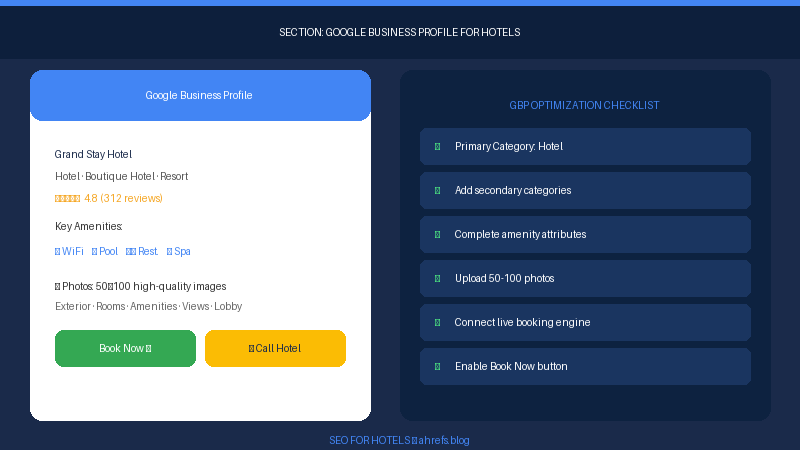
GBP Optimization for Hotels
Primary Category
“Hotel.”
Secondary categories: “Bed and Breakfast,” “Resort,” “Boutique Hotel,” “Extended Stay Hotel,” “Motel”, all applicable ones only.
Description
Explain your hotel concept, including unique aspects of your hotel’s location and the facilities available at the hotel such as a pool, free breakfast, free parking, spa, and a restaurant.
Amenities
Check each amenity attribute that is relevant to your listing. They are clearly visible on hotel search results pages:
- WiFi
- Pool
- Restaurant
- Bar
- Spa
- Fitness center
- Parking
- Pet policy
- Airport shuttle
Photos
The photo quality of a hotel is directly correlated to its conversion rate.
Include at least 50-100 good quality images which include:
- External: Building, entrance, parking
- Rooms: Each type of room (standard, deluxe, suite) from different angles
- Amenities: Pool, spa, gym, restaurant, bar
- View: Your hotel may have unique views; showcase them
- Common: Lobby, meeting places, outside areas
- Local area: Nearby places of interest
Google Hotel Search Integration
List your property on Google Hotel Search so that you will show up on the price comparison tool of Google. List your booking engine so that you get live rate and availability information shown in your listing.
Booking Button
List your direct booking engine so that you get the “Book Now” button leading to your site and avoiding intermediaries such as OTAs.
Hotel Website SEO
Homepage
Your homepage must speak volumes about:
- Name of the property along with its location
- What makes your property unique (positioning)
- Amenities offered at your property
- Photography
- Booking or availability search widget
Room Type Pages
Each room type will require a unique page:
- Standard/Classic Rooms
- Deluxe Rooms
- Junior Suites
- Suites
- Family Rooms
- Accessible Rooms
Room pages include: room descriptions, measurements, beds, occupancy rates, available views, amenities, and booking CTAs.
Apply schema markup (Hotel Room and Accommodation schema).
Amenity Pages
Create specific pages for important amenities:
- Restaurant and Bar (with menu link)
- Spa
- Pool and Fitness Center
- Event Space
- Business Center
These pages are designed to get results for “hotels with spa [city]” and “hotels with rooftop bar [city].”
Location Pages
A “Location” or “Our Neighborhood” page will get results for proximity searches:
- Your address with Google map
- Distances by foot to main attractions
- Transport options (airport, public transportation)
- Description of neighborhood
Nearby Attractions
“Things to Do near [Hotel Name]”
Optimized for travelers who will book a stay with you. Will rank for queries like “[attraction] near hotel”. In addition, will improve guest experience (an advantage only available with direct bookings that OTAs cannot provide).
Direct Booking Incentives and SEO
You should have a strong value proposition that differentiates you from the OTAs.
Direct Booking Benefits to Prominently Feature
- “Best Rate Guarantee”. You can legally demand that OTAs honor the same rate as on your website.
- “Free Cancellation when Booking Direct”. Different from cancellations at OTAs.
- “Free Complimentary Amenity” (free breakfast, free parking, room upgrade, spa credit, etc.)
- “Earn Loyalty Points”. If you have a loyalty program.
- “Speak Directly with Hotel Representatives”
These are reasons for people who discover you via OTAs to become direct customers on your website.
Local Citation and Travel Directory Presence
Apart from GBP, there is a need for an accurate and complete presence in the online travel space.
Travel Directories
- TripAdvisor
- Expedia
- Booking.com (despite OTA sites, your listing should be accurate and complete.)
- Hotels.com
- Kayak
- Trivago
Review Platforms
- TripAdvisor (critical)
- Yelp
Travel Media
The local tourism organization’s directories, city visitor guides, travel blogs about your destination.
Hospitality Associations
Hotel/lodging association in your area directory, CVB listing of your area
Content Marketing for Hotels
Hotels have natural content marketing advantages as you already work in the travel industry which is exciting by nature.
High-Value Hotel Content
Destination Guides
“[City] Travel Guide: The Ultimate Travel Guide For Visiting [City]”
Helpful for people searching about your destination before making arrangements. Targeting searches for “[city] travel guide.”
Neighborhood Guides
“[Neighborhood]: A Guide for Locals”
Tailored content just for your neighborhood. Helpful for searches such as “what to do around [name of hotel].”
Event-Driven Content
“Top Places to Go During [Annual Event/Festival]”
Great for travelers coming to your destination due to that event. High purchase intent and lower competition.
Seasonal Guides
“The Top Activities To Be Done in [Destination] This [Season]”
Evergreen content for each season throughout the year.
Wedding Venue Content
For weddings, “The Guide to Planning Your Big Day at [Hotel Name]” might bring you higher rankings.
Business Travel Content
“Why [City] Is the Ideal Choice For Your Company’s Next Retreat”
Targeting event planners and business travelers.
Marketing to event planners and business travelers.
Managing Hotel Reviews
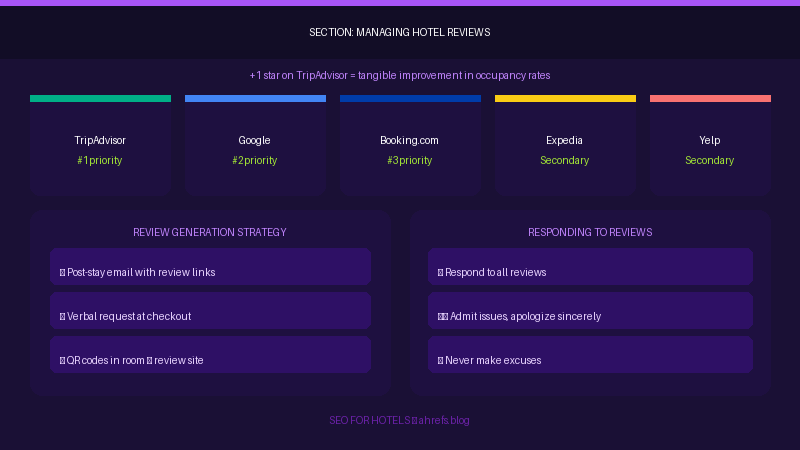
Online reviews are among the key determinants in hotel reservations. The positive effect of one star on the TripAdvisor rating leads to tangible improvements in occupancy rates.
Review Platforms Priority for Hotels
- TripAdvisor (Still the Most Checked for Hotel Reviews)
- Booking.com (Reviews show up on their site and get picked up by Google)
- Expedia
- Yelp
Review Generation Strategy
- Post-stay email: “Thanks for staying with us! We would really appreciate feedback about your stay: [TripAdvisor link] [Google link]”
- Check-out at the front desk: “Would you like to leave a TripAdvisor or Google review?”
- Room cards or QR codes directing you to the review websites
Responding to Reviews
Always respond to all comments whether positive or negative.
In case of a negative response, admit that there is a problem, offer your sincere apologies, tell what was done and will be done to solve it, and finally invite the guest to stay with you again.
Do not ever make any excuses when responding to a complaint.
The TripAdvisor Management response is very crucial because people who may visit later check it out.
SEO for Hotel Packages and Promotions
Hotel packages can be used as SEO content ideas.
Romance Packages
“Romantic Getaway in [City] Package”
For those who are going on romantic holidays.
Family Packages
“Families Vacation Package: Kids Stay Free” For families going on vacations.
Spa Packages
“[Hotel Name] Spa & Stay Package”
For health-conscious people.
Corporate Packages
“Corporate Rate and Meeting Package”
Appeals to business travelers.
Each package should be assigned a unique landing page focused on SEO-related keywords.
Technical SEO for Hotel Websites
Technical SEO is important for hotel websites.
Booking Engine Integration
Ensure that the pages within the booking engine are indexable or canonical/non-indexed in order to avoid any thin content problems. A lot of third-party booking engines are known to cause crawlability and duplication problems.
Image Optimization
Hotels require many high-resolution images. Ensure that lazy-loading is enabled in addition to the WebP image format and responsive images.
Structured Data
Use Hotel schema, Room schema, AggregateRating schema, and Offer schema for Google Hotel Search Results rich snippets.
Mobile Booking Flow
Mobile bookings account for a large percentage of bookings. The booking experience needs to be smooth from search through to confirmation on mobile.
Measuring Hotel SEO ROI
The success of hotel SEO is closely linked with direct booking revenue.
Track
Primary
- Direct booking revenue driven by organic traffic (GA4 e-commerce tracking)
- Improvement in direct booking rate
- Comparison between direct and OTA bookings
Secondary
- Organic traffic to booking page
- Organic traffic to individual room types and amenities
- Growth in brand search volume
GBP Metrics
- CTR from impressions to bookings
- Call volume from GBP
- Direction requests
RevPAR Context
Keep track to see if there are increased RevPAR during SEO-induced periods compared to OTA-induced ones due to an increase in direct bookings.
Conclusion
The bottom line of hotel SEO is lowering OTA dependence and making connections directly with hotel customers. Each direct booking for the maximum price without an OTA taking a cut of 15%–30% is a major margin gain. Over the long run, such customers tend to be more loyal, leave reviews, and bring even more value to a hotel business than those found via OTAs.
Claim your brand’s online presence. Rank on experience-related and local keywords. Create lots of great reviews. Produce content that helps travel enthusiasts plan their trip. Hotels which consistently achieve all that end up getting increasingly more direct bookings and less dependent on OTAs, which is the most desirable result in hotel distribution.