SEO for Doctors: How Medical Practices Can Rank Higher on Google

SEO for Doctors:
Doctors are sought out by patients in the same way they seek restaurants; they visit Google, browse through their results in the neighborhood, read reviews, and then make a choice. Practices that perform well in such search engine results always have busy appointment books. While others depend on referrals and listings they cannot control.
Medical SEO, or ensuring the online presence of your medical practice is optimized for search engines, can be one of the most valuable investments you can make.
What Is Medical SEO?
Medical SEO is the process of enhancing a healthcare practice’s web presence such that it ranks high in search engines whenever patients look for their services. This includes optimization of Google Business Profile, website on-page SEO, building citations, reputation management, and content marketing under the strict guidelines set by the healthcare industry.
If done properly, it increases your visibility among patients looking for your services.
Why Doctors Need SEO
Traditional methods to attract new patients included referrals from other doctors and network listings through health insurance plans. While both are still effective, patient behavior has changed dramatically. Research proves that more than 70 percent of patients research a doctor online first and close to 60 percent base their choice upon online reviews.
If patients find you via Google, then they have a high degree of intentionality, and they’re essentially self-referred. What’s more, when patients search for something specific, such as your practice, via Google, they’re doing so out of personal interest.
Google Business Profile for Medical Practices
Your GBP determines how visible you are in the Local Pack on Google Maps, which is the set of three businesses that appear when users search for something such as “nearby internist,” “pediatrician in [city],” or “dermatologist taking new patients.”
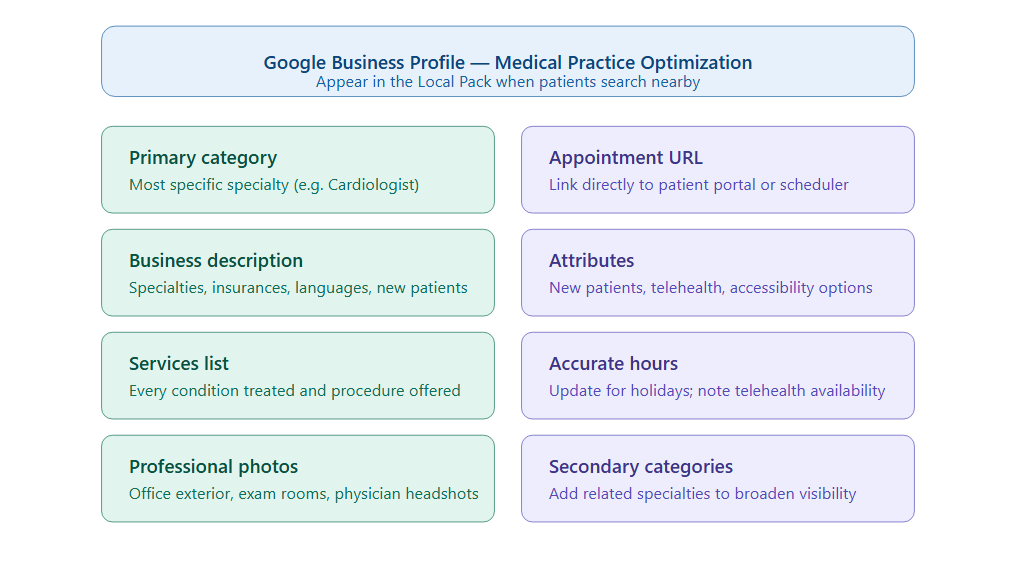
GBP Optimization Checklist for Doctors
Primary Category
Most specific medical specialty that applies. Examples:
- “Internist”
- “Pediatrician”
- “Dermatologist”
- “Cardiologist”
- “OB-GYN”
- “Family Practice Physician”
Secondary Categories
List other related categories. The list of categories for an internal medicine doctor can be supplemented with “General Practitioner”.
Business Description
Specify the areas that you specialize in; the diseases that you treat; who your typical patients are; what insurances you accept; which languages you speak (this is important to attract a wide patient audience); and whether you accept new patients.
Services
Provide a full list of conditions treated and services provided. In case of primary care:
- Annual Exams
- Chronic Disease Management
- Prevention
- Vaccinations
- Laboratory Tests
- Telemedicine
Photos
Outside appearance of the office (so that patients can identify it upon arrival), reception area, exam rooms, physicians’ pictures, nurses’ pictures. Professional photographs instill trust.
Appointment URL
Direct link to your patient portal or online scheduler.
Attributes
- New Patients Welcome
- Accepted insurances
- Accessibility accommodations
- Telehealth services
Hours
Keep up-to-date for holidays. Indicate telehealth availability on individual pages if applicable.
Medical Practice Website SEO
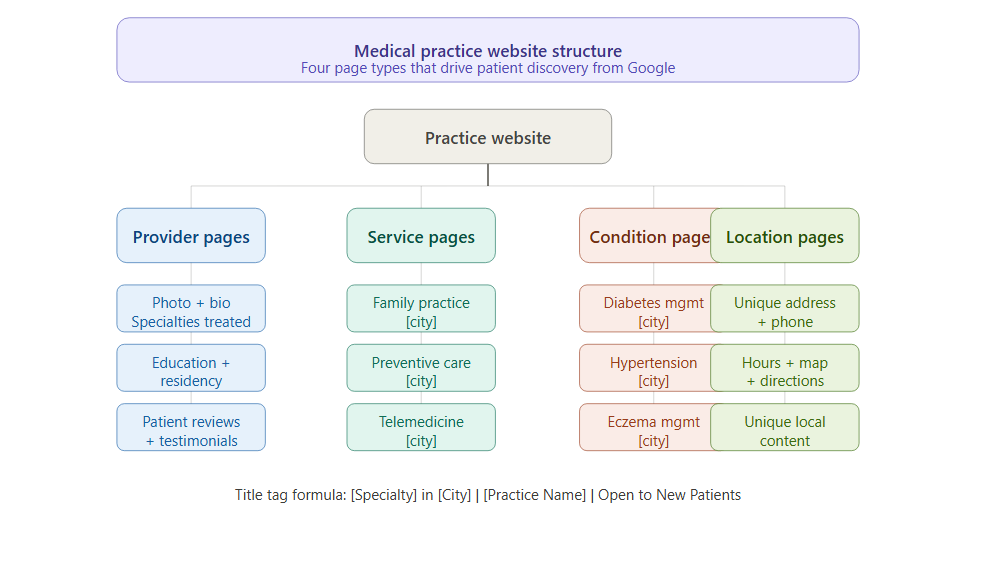
Website Structure for Doctors
Provider Pages
Individual pages need to be set up for each doctor at your practice, which includes: photo, educational background, residency, specialization, diseases treated, treatment philosophy, and patient testimonials for each doctor.
Pages can rank for search queries such as
- “[doctor name]”
- “cardiologist”
Service/Specialty Pages
One full page per important service or specialty offering:
- Family Practice
- Preventive Medicine
- Chronic Condition Management
- Telemedicine Services
(Or for specialty offices: Dermatology, Cardiology, OB-GYN services, etc.)
Conditions Pages
For specialty practices, it is important to have separate pages devoted to your most common specialties:
- “Diabetes Management”
- “Hypertension Management”
- “Eczema Management”
Location Pages
When running multiple office sites, every office should have its own customized page with unique content, unique address, unique phone number, unique hours of operation, and directions.
On-Page SEO for Medical Practices
Title tags:“[Specialty] in | [Practice Name] | Open to New Patients”
H1:“Compassionate [Specialty] Care”
Meta description:Emphasize the unique features of your practice, insurance accepted, and new patients welcome.
HIPAA Compliance in Medical SEO
Medical Search Engine Optimization takes place under HIPAA regulations. Major requirements:
Patient Information
Marketing materials should never reference any information regarding patients without HIPAA-compliant written permission. This will include testimonials, reviews, images, and case studies.
Review Responses
Do not confirm whether the reviewer is a patient in any way nor reveal any other treatment information in response to any review. Your responses should be general such as:
“We thank you for your complimentary remarks and are happy that you enjoyed your experience with us.”
Website Forms
HIPAA data security guidelines should be met by any patient intake form or contact form that is created. Work with a HIPAA compliant web form service.
Healthcare Keyword Strategy
Words used in online searches by patients are not necessarily medical terms. Patients will search for “high blood pressure treatments” not “hypertension management.”
High-Intent Keywords (Ready to Book)
- “[Specialty] near me”
- “[Specialty]”
- “doctors taking new patients”
- “walk-in clinic]”
- “[Condition] specialists”
Informational Keywords (Building Trust)
- “causes of [condition]”
- “managing [condition]”
- “when should I see a doctor for [symptom]”
Medical Directory Citations
In addition to GBP, your medical practice must be found in healthcare-oriented directories. Not only will these help to cite your medical practice for Google’s verification purposes but also serve as referral sources for patients.
Essential Healthcare Directories
- Healthgrades
- Zocdoc
- WebMD Doctor Directory
- Vitals
- US News Health
- Castle Connolly
- Doximity (directory for physicians)
- InsiderPages
- RateMDs
Insurance Network Directories
Make sure your listings are up-to-date in all insurance network directories that you are listed in. They generate considerable patient traffic from these directories.
Managing Online Reviews for Doctors
Positive reviews have a major impact on patients’ decision-making. Reviews having more than 20 and scores over 4.5 stars perform much better.
Ethical Review Generation
- If there is good interaction with patients, one can make an oral reference to the significance of online reviews for the practice but cannot offer any rewards or coercion to patients.
- Include a link to your website where patients can read reviews in communication after their visit.
- Address all the reviews, be it negative or positive.
Handling Negative Reviews
No need to react defensively; react professionally:
“We value all comments from our patients and always strive to deliver top-notch services. We will be happy to discuss any issues you have regarding this. Please call our patient relations department at [phone].”
Content Marketing for Medical Practices
Educational health articles benefit both your audience and your search rankings.
Content Formats That Work for Medical Practices
Condition Guides
“Educational Article Title Goes Here,” Educational, SEO-friendly, makes your medical facility a recognized authority on the subject matter.
Symptom Guides
“When Should You See a Doctor for Your Chest Pain?”, Attracts patients who are at the initial stage of learning about their health issue.
Procedure Explanations
“What to Expect From a Colonoscopy”: Deals with anxieties, ranks for specific questions.
Preventive Health Guides
“Yearly Medical Check-Up List: What to Tell Your Doctor”: Educational material that focuses on healthy individuals looking for preventive services.
Local Health Topics
“Seasonal Allergies Management in [City]: All You Should Know”: Health information that is location-specific.
E-E-A-T in Medical Content
Since Google employs the most stringent measures for medical-related content, it undoubtedly belongs to the category of YMYL (Your Money Or Your Life).
Your Content Must Demonstrate
Experience
First-hand practical experience in treating diseases mentioned.
Expertise
Relevant qualifications, education, and expertise.
Authoritativeness
Acknowledgement by fellow professionals through citations.
Trustworthiness
Precise and cited data; transparency about the practice and doctors.
Every article regarding health must either be reviewed or written by qualified doctors.
Measuring Medical SEO Success
Key Metrics for Medical Practices
New Patient Inquiries from Organic
Form leads and calls generated through natural visitors in Google Analytics.
Appointment Bookings from GBP
GBP Insights displays calls, website visits, and booking visits generated from the listing.
Local Pack Rankings
Keep tabs on the ranking for “[specialty]” and “doctor near me” keywords.
Review Count and Rating Trend
Keep track of review growth month-over-month.
Provider Page Traffic
Page views per physician reveal how well you rank for provider-specific queries.
Conclusion
Medical SEO is an investment that compounds its returns over time. When people seek out your services on Google, they are self-referring, highly intent, and may not be in your current referral pool.
Begin by setting up a Google My Business listing. Optimize your website around patient-focused keywords. Grow your directory presence. Collect reviews in a way that’s ethical and professional. Create content of expertise value. Those that engage in these SEO practices systematically will be hard to beat locally over the course of a year or two.