Selling SEO: How to Win Clients and Set Expectations

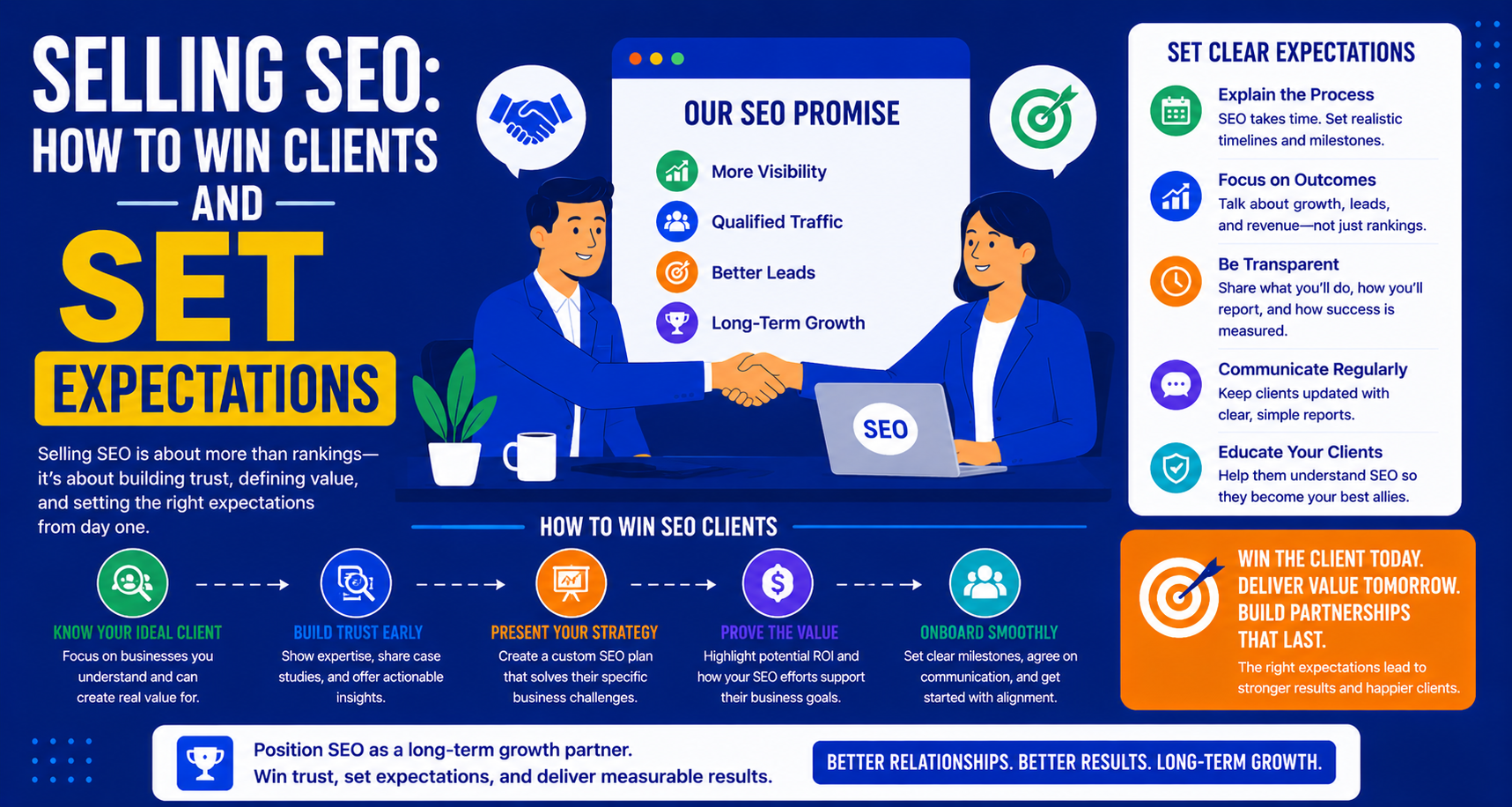
SEO sales are hard to come by. When pitching SEO services, you’re asking for an investment of $1,000 to $3,000 monthly in a platform that will take 6–12 months to start paying off, and one in which there are no guarantees and skepticism is high, due to many shady practitioners in the space.
However, SEO is arguably one of the most profitable forms of digital marketing out there.
Why Selling SEO Is Hard
In contrast to paid search advertising where one pays $5,000 for impressions and clicks to occur instantly, SEO involves an investment with no instant gratification.
This ROI is tangible and accumulates without pause after payments cease and frequently represents the most cost-effective method to acquire visitors.
The Trust Problem
Adding to the problem: The SEO industry has always had its fair share of shady individuals who made unrealistic promises, applied questionable strategies that worked against them, or provided no real value at all.
They’ve likely been burned more than once already.
When pitching SEO, it’s not enough to educate prospects on SEO; you must first restore their faith in the marketing medium itself.
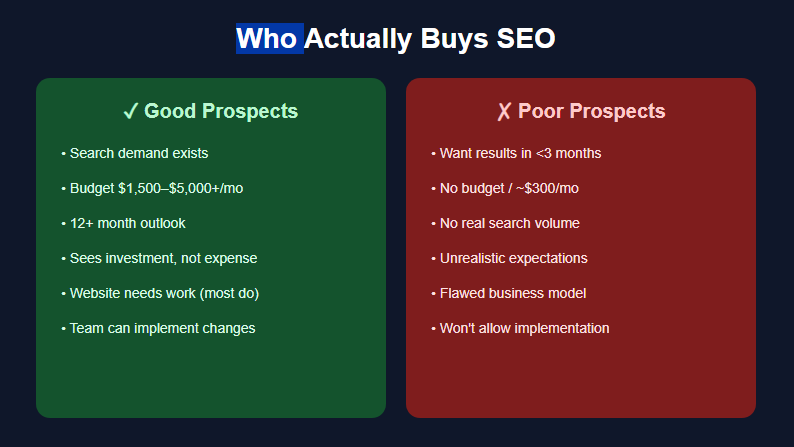
Who Actually Buys SEO
Knowing your ideal customer helps you tailor your pitch.
Good SEO Prospects
- Have a product or service with search demand
- Have a budget to actually make a difference ($1,500–$5,000+/month)
- Have a 12+ month outlook for success
- Understand your executive-level people know investment from expense
- Have a website that needs work (which most do)
- Have a relationship with your team that allows for implementation
Poor SEO Prospects
- Want to see results in less than three months
- Have no money or need SEO for $300/month
- Are working in an industry with no search volume
- Are unrealistic about your expectations and nothing can change that
- Have a business model that is inherently flawed
Disqualifying prospects from the get-go benefits everyone.
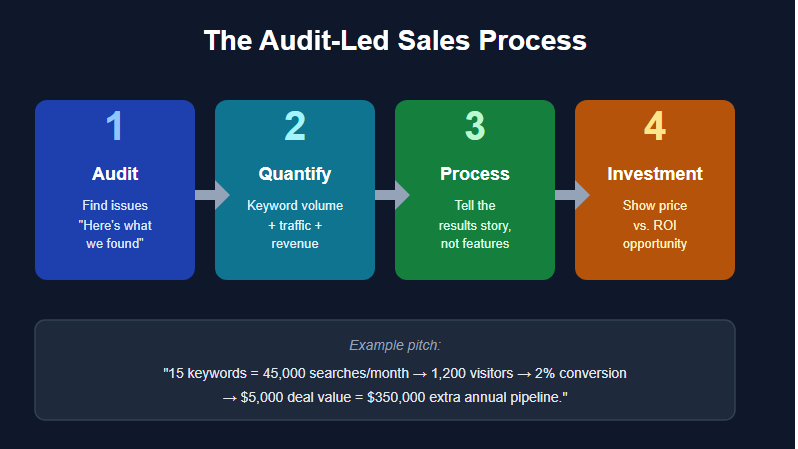
The Audit-Led Sales Process
SEO is best sold by providing value before any monetary transaction occurs.
Step 1: Offer a Free or Paid Preliminary Audit
This will involve a 30-60 minute assessment of their website to find out the exact issues affecting their rankings and traffic.
These can be identified using the following Ahrefs features:
- Competitor domain rating comparison
- Current organic traffic versus potential organic traffic
- Website issues affecting their rankings
- Opportunities for keywords that they may have missed
Format as follows:
“Here’s what we found.”
Not:
“Here’s why you should hire us.”
Step 2: Quantify the Opportunity
The Traffic and Revenue Opportunity slide is the best in any SEO presentation.
With the help of Ahrefs Keywords Explorer, select 10-20 keywords for which the prospect needs to rank but is not ranking.
Show:
- Search volume of keywords
- Position they hold currently (not ranking or ranking poorly)
- Projected traffic if ranked 3
- Revenue generated from projected traffic
Example
“The above-mentioned 15 keywords attract 45,000 searches every month to websites such as yours. You’re converting around 1,200 visitors from them. With your conversion ratio of 2% and the average deal value at $5,000, optimizing for these keywords translates into an extra $350,000 of annual pipeline.”
It’s hard to ignore that kind of number.
Step 3: Show Your Process, Not a Feature List
Customers don’t pay for SEO services.
They pay for results.
Rather than focusing on your activities (technical analysis, content writing, link building), focus on the problem solving and results you will provide.
Example Process Narrative
“First, we’ll correct the technical problems that are stopping Google from correctly indexing your valuable pages. After that, we’ll optimize your most important existing pages – this usually takes 30–60 days before we can expect results. After that, we’ll develop content around the keyword opportunities identified in our analysis. And at the same time, we’ll earn you those all-important links.”
This is a story, not a list of services.
Step 4: Present the Investment With Context
Pricing should always be shown in conjunction with the opportunity.
Now, having just reviewed the fact that the opportunity from the keyword has an annual pipeline of $350,000, your retainer of $3,000 per month ($36,000 annually) is clearly a case of ROI.
Example
“If you capture only 10% of this opportunity, conservatively, your return is $35,000 from an investment of $36,000. Most of our clients achieve 3 to 5 times ROI within 18 months.”
Always compare price annually with revenue potential annually.
Handling Common Objections
“We Tried SEO Before and It Didn’t Work.”
This is the most frequent criticism.
Do not ignore this. Recognize it.
Example Response
“That happens a lot more often than you might realize, and let me tell you, the industry deserves it. What exactly went wrong for you? Was it technical efforts that failed to boost rankings? Poor content production that failed to generate any traffic? Bad links?”
This way, you can explain to them what makes you different.
“Can You Guarantee Results?”
No guarantees about rankings.
Example Response
“I cannot guarantee that Google will position you in Position 1 for any particular keyword because no one controls their algorithm. But what I can assure is that we’ll implement proven strategies, remain open about our progress, and you’ll be able to see exactly how we’re performing every step of the way. What I can do is show you concrete results that we’ve achieved for other clients in similar positions.”
Make sure to have case studies ready.
Details trump promises.
“How Long Until We See Results?”
Be upfront about timeline expectations.
Indistinct timelines lead to the expectation issues that ruin client relations.
Example Response
“Most sites will see technical improvements show up in 4 to 8 weeks. Rankings improvements for less challenging keywords will occur somewhere between months 3 and 4. Impact on traffic from quality content and backlinks will be seen in months 6 to 9. Meaningful, cumulative results should happen after one year.”
Some will not be interested since they want faster results.
That is fine; they are not right for us.
“Why Is SEO So Expensive?”
Typically, this shows that the client does not understand the process.
Inform without patronizing.
Example Response
“SEO seems easy on the surface but actually entails constant, technical, and creative work. We are looking for problems with your website monthly, monitoring many ranking changes, creating optimized content, outreach to get links, and analyzing what is successful. To do all this properly, one needs a special set of skills in multiple areas. The metaphor I draw from here is that although you can mow your grass with scissors, you save time by investing in our professional services.”
In terms of expense relative to its paid counterpart.
For those spending $10,000 per month on Google AdWords, an SEO campaign costing $3,000 a month for sustainable organic rankings is simple ROI math.
“We’ll Just Do This In-House.”
Example Response
“Yeah, that’s certainly possible; but it depends upon having the right person fully focused on it and having the necessary skillset. The suggestion that I have for you is the true cost of an SEO person, which includes a full time SEO specialist in your market who costs between $80,000 and $130,000 per year, including software ($5,000–$15,000/year) – along with the efficiencies of working in-house.”
Setting Up for Success After the Sale
The closing of the sale is just the start, not the finish.
It’s how well you do in the first 90 days that will tell you if you can keep the client.
Onboarding
In the first two weeks, be sure to:
- Run an audit
- Develop benchmarks
- Look for immediate wins
- Develop dashboards
Your client must have the impression that you’ve started working on something.
Communication Cadence
Monthly reporting calls are the bare minimum.
Daily check-ins (even short emails), during the first 90 days, help build trust when there is nothing to show yet.
Quick Wins
List 2-3 things you will fix in the next 30-60 days that will send a clear positive signal.
Here are a few examples:
- Cure a major crawl error.
- Improve title tags of important pages.
- Fix canonical issues
These early victories build trust, allowing more time to work on other things.
Managing Expectations Proactively
Don’t wait for the client to become frustrated.
Handle the situation where “It’s been 3 months and I haven’t seen anything” before it arises.
Document expectations in the contract.
Review the timeline during the 2-month review.
The Difference Between Good and Great SEO Sales
Good SEO sales reps will sell their services and close business.
Great SEO Salespeople Educate Prospects
The customers that know about SEO make better clients, have more realistic expectations, and stay longer.
Educate your potential clients.
Great SEO Salespeople Qualify Out Bad Fits
As opposed to over-promising and under-delivering, saying,
“I don’t think we’re the right fit for your timeline”
brings more credibility and trustworthiness.
People will refer others to you because you helped them, not because you failed to do so.
Great SEO Salespeople Underpromise and Overdeliver
- Under-promise on conservative traffic estimates, then over-deliver
- Be truthful about time frames, then under-deliver on them
- Establish a reputation through consistently delivering
A good reputation is established through hundreds of little overdeliveries.
Great SEO Salespeople Are the Expert, Not the Salesperson
The best way to close during an SEO consultation process is proving your knowledge about the client’s situation with regard to SEO outshines theirs.
The proof of knowledge gained through the audit and opportunity analysis sells itself.
Conclusion
SEO selling needs patience, education, and honesty.
Your leads will be those who grasp the investment aspect of the medium and have reasonable timeframes for the work..
The audit-driven approach helps you identify such leads and get factual arguments based on real data.
Promise little and deliver much.
It is through such approaches that you can create an SEO business that gets referrals from past clients.