PhD Project Management Online: How to Structure Your Doctorate From Start to Finish

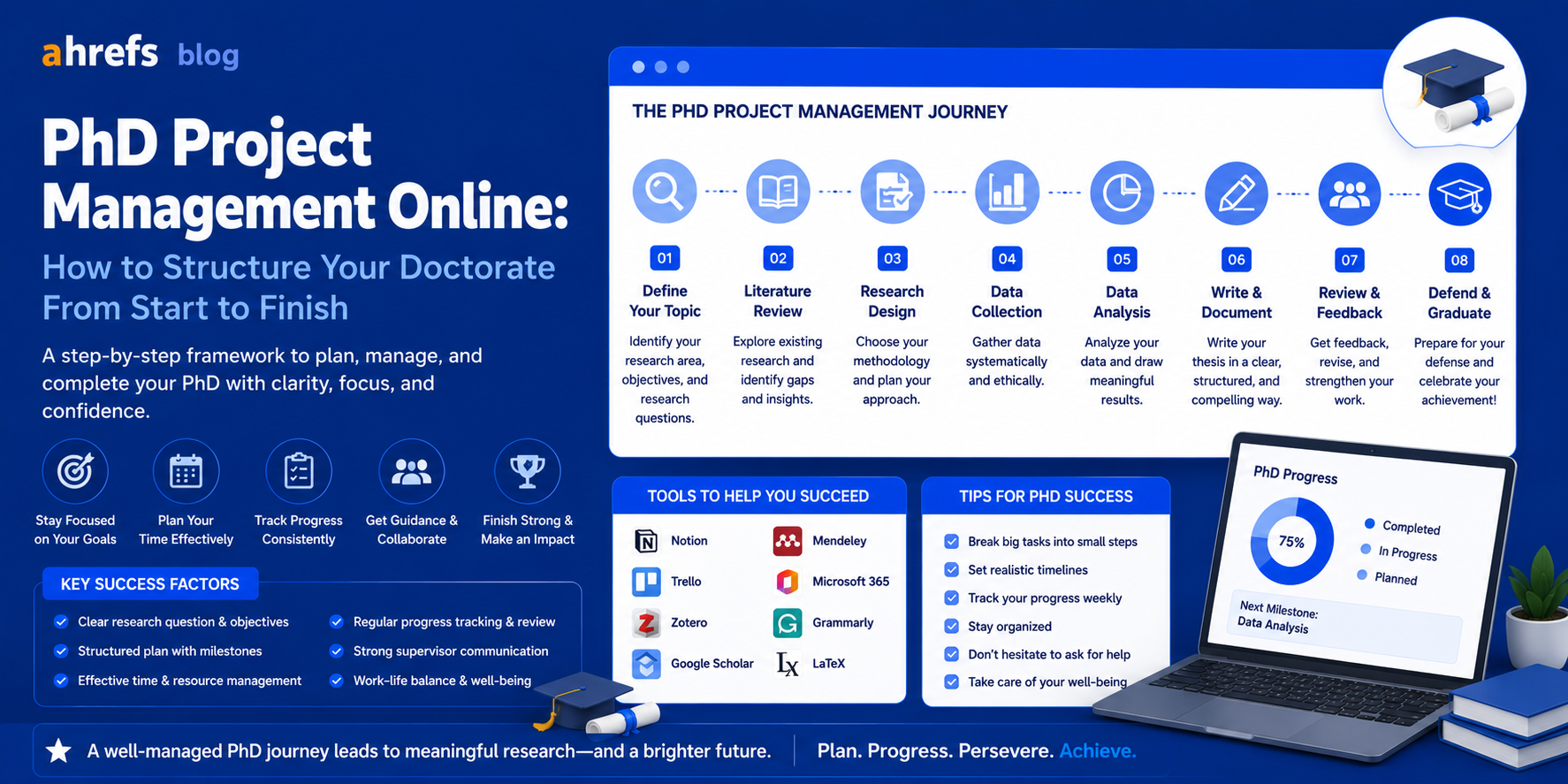
PhD is among the most complex of the self-managed projects most people will undertake, and it is multiyear, loosely supervised, has moving targets and no defined schedule if you don’t define your own. In the case of an online PhD, this task is further complicated by having to do all this without the physical prompts of a university campus, library or other research group. This is how to manage a PhD as a project.
Table of Contents
- Why Should PhD Students Have Project Management Skills?
- The Basic Steps of a PhD Project
- The Best Tools for Managing Online PhD Projects
- Creating Your Own Weekly Routine
- Handling Your Supervisor Relationship
- PhD Project Management Problems to Avoid
- Conclusion
Why PhD Students Need Project Management Skills
PhD courses offer a framework of structure: classes followed by comps, followed by the dissertation. In reality, however, most of the work is done in the middle, during an unstructured research stage, where little is demanded outside the student’s own self-imposed pressures, and the possibilities seem endless. Those who view their dissertation as a monolithic “project” invariably have a harder time than those who divide their work into stages and deadlines.
This is particularly true of the online PhD, which has no face-to-face lab meeting discussions, random hallway chats with advisors, and physical campus presence to enforce it.
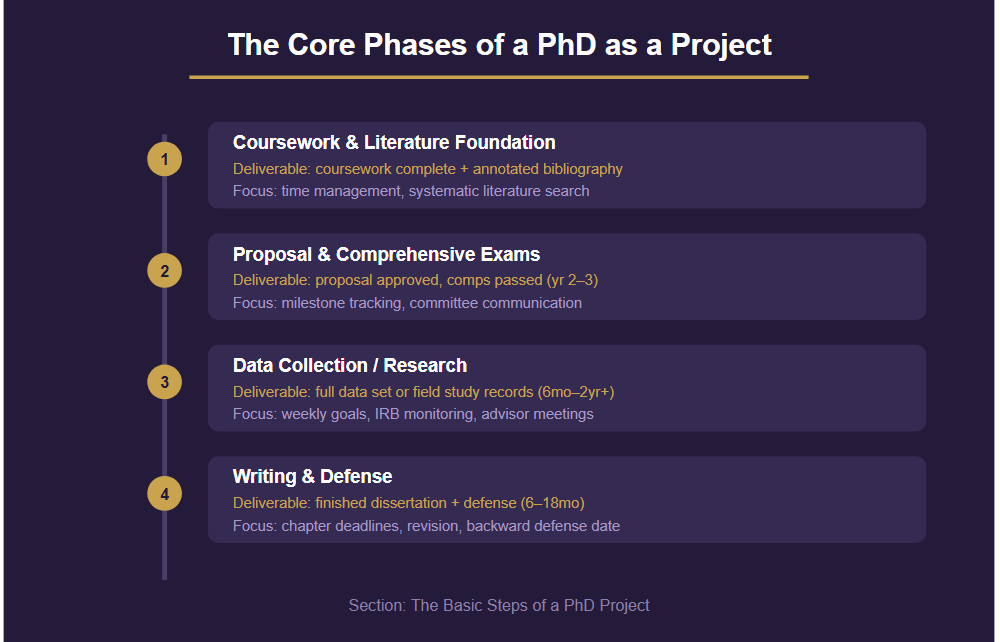
The Core Phases of a PhD as a Project
Phase 1: Coursework and Literature Foundation
Deliverable: Completion of coursework along with annotated bibliography/literature review
Timeline:As per the program requirements
PM Focus: Time management in terms of completing coursework on time and systematic literature search
Phase 2: Proposal and Comprehensive Exams
Deliverable: Dissertation proposal is approved and has passed qualifying/comprehensive examinations
Timeline: Usually end of year 2–3
PM Focus: Milestone tracking for proposal defense, committee communication and meeting deadlines
Phase 3: Data Collection / Research
Deliverable: Whole data set, experimental findings, or field study records
Timeline: Very inconsistent, 6 months to 2 years+
PM Focus: Weekly production goals, IRB monitoring, regular meetings with advisor
Phase 4: Writing and Defense
Deliverable: Finished PhD dissertation + defense
Timeline: Depends on the subject, 6 to 18 months
PM Focus: Chapter by chapter deadlines, submission, revision and finalization, defense date backward calculation
Tools That Work for Online PhD Management
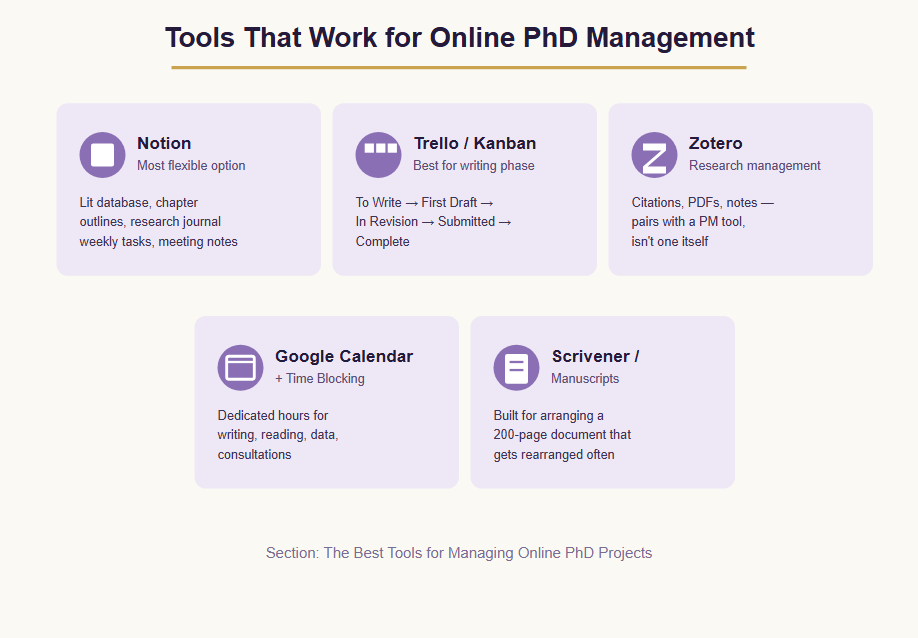
Notion
PhD Management, Most Flexible Option
Use this for: Literature Database w/ Tags, Outline for Chapters, Research Journal, Weekly Task List, Meeting Notes w/ your supervisor. The Database aspect of this software is especially helpful for managing sources.
Trello or Kanban Boards
Works well for the writing phase. A board with columns like “To Write,” “First Draft,” “In Revision,” “Submitted to Supervisor,” and “Complete” makes chapter progress visible at a glance.
Zotero (Research Management)
Not a Project Management tool, but absolutely necessary to have in addition to one.
Organizes your citations, pdfs, and notes; clears your mind to focus on research management rather than citation hell.
Google Calendar + Time Blocking
When considering online PhDs, the most appropriate way of getting things done is by time blocking. This involves scheduling particular hours for various activities such as writing, reading, gathering data, and consultations.
PhD-Specific Tools: Scrivener or Manuscripts
Dissertation tools which help arrange chapters, notes, and sources all in one place. Much better than Google Docs for your 200 pages document which will be rearranged many times.
Building Your Weekly System
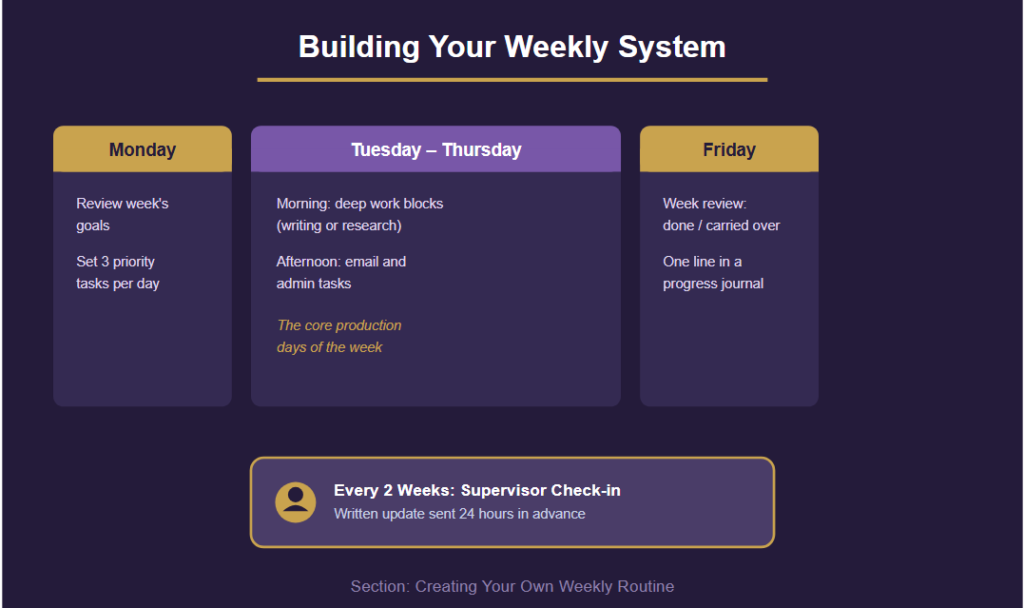
The most effective organization of your PhD on the Internet is based on the weekly cycle, not the daily one:
- Monday: Review the week’s goals, set 3 priority tasks per day
- Tuesday–Thursday: Deep work blocks (writing or research) in the morning; email/admin in the afternoon
- Friday: Week review, what was completed, what’s carried forward, one line in a progress journal
- Every 2 weeks: Supervisor check-in with a written update sent 24 hours in advance
It is very important to write a pre-meeting status update. It compels you to describe the achievements (or non-achievement) prior to the meeting, thus making the discussion with your supervisor more effective and holding you accountable for your goals.
Managing Your Supervisor Relationship
Your supervisor is your primary external accountability structure. Online PhD students fail to take advantage of this partnership since low-friction interaction does not exist in this case.
Instead of this, you should:
- Organize regular meetings at least twice per month
- Provide written updates on your progress before each meeting
- Prepare clear questions rather than vague progress reports
- Use a single document where your supervisor will be able to see the state of your current chapter without e-mailing
Managing up is a project management skill. Your supervisor is busy; it should be convenient for him to help you.
Common PhD Project Management Mistakes
Writing a To-Do List Instead of a Project Plan
“Working on Chapter 3” is not a task; “draft section 3.2 methodology narrative (800 words)” is. You need to be concrete about what “done” means.
Treating the Dissertation as One Project
You shouldn’t have to. Every chapter is a project. Every section in that chapter is a task. Decompose it to the point where you can schedule it.
Skipping the Weekly Review
This week’s delay turns into next month’s delay turns into ABD. The 15-minute Friday check-in will nip delays in the bud.
Underestimating Revision Cycles
PhD students always make time for writing but never for revision, which frequently takes just as much time as the first draft itself. Schedule in the revision process.
Final Thoughts
PhD programs are long processes, without specific criteria, a target that constantly changes, and lack accountability on a daily basis, and can be considered as some of the most difficult project management challenges that one will face in their life. Online students who create a system (specific criteria, pattern, means of communication with the supervisor, and tools applicable to their subject matter) usually finish the assignment much faster and with reduced stress levels compared to online students depending only on their motivation.