Performance Management Software: Moving Beyond the Annual Review

Introduction
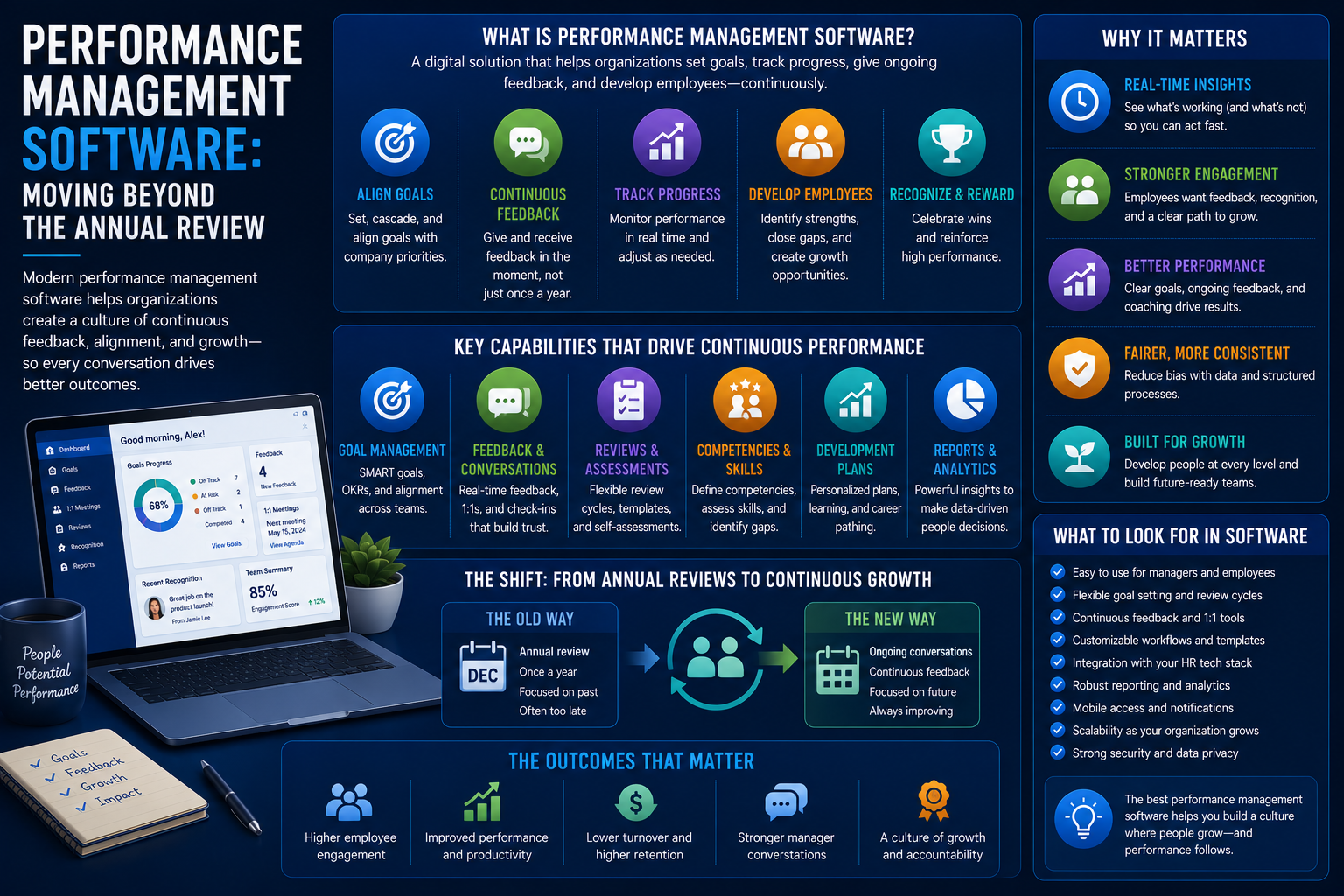
It is the responsibility of performance management software to help companies plan the process of goal setting, feedback collecting, and performance evaluation by changing the annual and usually feared evaluation into a more constant process.
Why Traditional Performance Reviews Fell Short
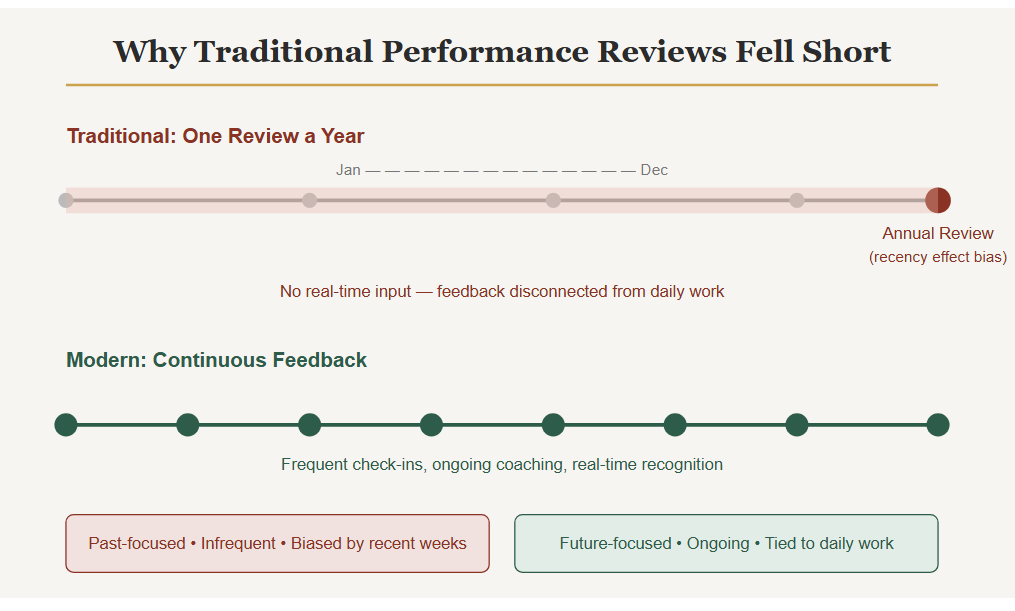
The traditional annual appraisal method, which involved only one review discussion and rating per year, has faced a lot of criticism for its failure to relate to the daily operations of employees, its emphasis on past performance assessment instead of future development, and the phenomenon of recency effect, whereby the last few weeks determine the whole year’s appraisal.
The performance management software was developed mainly to overcome those shortcomings.
Core Functionality of Performance Management Software
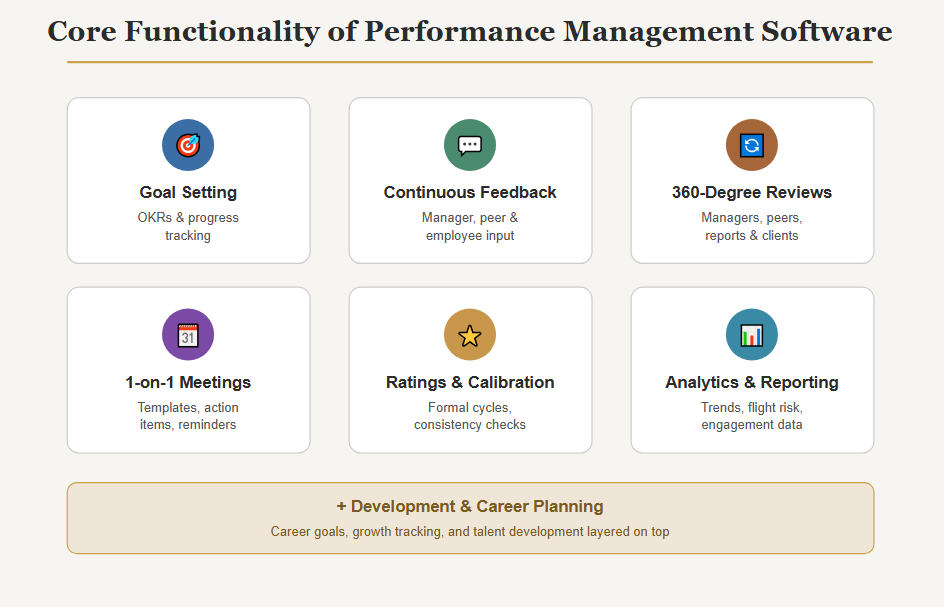
Goal Setting and Tracking
Having individual and team goals (usually through OKRs: Objectives and Key Results), and then monitoring the achievement of those objectives on an ongoing basis, rather than just setting one line item goal per year.
Goal Management Features
- Individual goal setting
- Team goal tracking
- OKR management
- Progress monitoring
Continuous Feedback Tools
Encouraging ongoing and informal feedback between managers, colleagues, and direct reports during the year, as opposed to collecting feedback at one single formal review session.
Continuous Feedback Features
- Manager feedback
- Peer feedback
- Employee feedback
- Ongoing performance discussions
360-Degree Reviews
Collecting feedback from several sources, including managers, colleagues, direct reports, and sometimes even clients, to have a fuller view of the person’s performance than what the manager sees.
Feedback Sources
- Managers
- Peers
- Direct reports
- Clients (where applicable)
One-on-One Meeting Support
These platforms can provide tools for creating structured and monitored one-on-one meetings for managers and employees to take place on a regular basis, which will help to make sure that they actually take place and are meaningful.
One-on-One Meeting Features
- Meeting templates
- Discussion tracking
- Action items
- Follow-up reminders
Performance Ratings and Calibration
When formal reviews do occur, structuring them as well as helping managers calibrate themselves in bigger organizations to ensure that they are on the same page with regard to consistent rating criteria.
Performance Review Features
- Formal review cycles
- Performance ratings
- Calibration sessions
- Consistency tracking
Development and Career Planning
Some applications take performance management beyond merely reviewing employee performance by tracking career development goals and progress.
Career Development Features
- Career planning
- Development goals
- Growth tracking
- Talent development
Analytics and Reporting
Providing visibility to HR and management on performance trends within the organization, determining flight risks, high-performers or teams with uncharacteristically low engagement during the review process.
Analytics Capabilities
- Performance trends
- Identification of high-performers
- Flight risk analysis
- Engagement reporting
Popular Approaches and Platforms
Applications such as Lattice, 15Five, and Culture Amp have gained popularity precisely because they focus on continuous feedback and engagement along with performance appraisal, which is an indication of moving away from the purely evaluative process of appraisals.
Enterprise HR applications like Workday and SAP SuccessFactors have performance management components too.
Choosing Performance Management Software
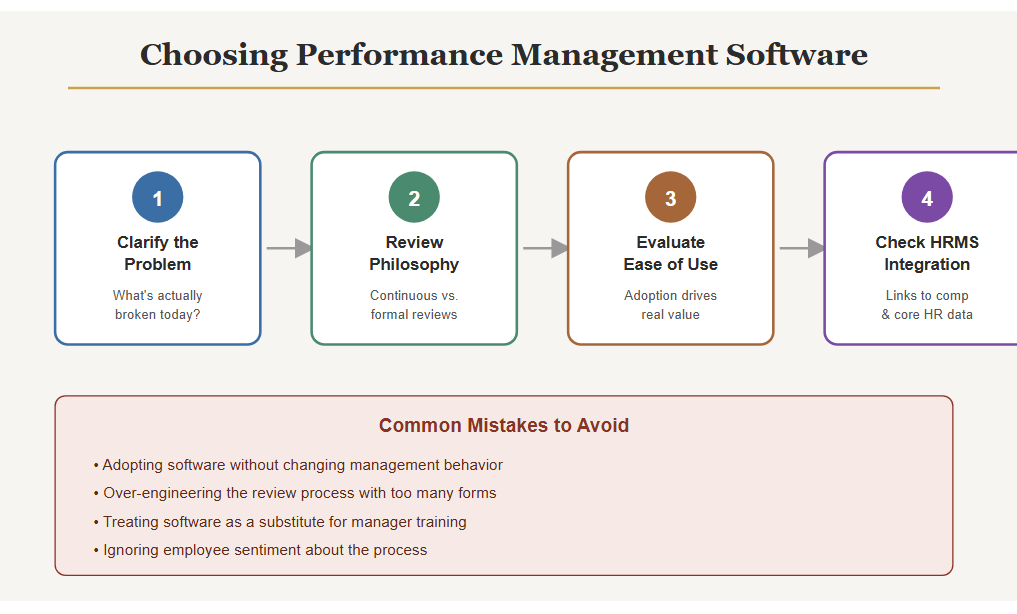
1. Clarify What Problem You’re Actually Solving
A business suffering from irregularities in feedback by their managers will have different requirements compared to a business which is mainly concerned about formal reviews.
2. Consider Your Organization’s Review Philosophy
Some businesses would like continuous feedback whereas some businesses might be requiring more formal, structured and compensation-based reviews.
The ideal software would be the one which fits your requirements, not the other way around.
3. Evaluate Ease of Use
Tools for performance management heavily rely upon the adoption of the software itself. A difficult-to-use interface that prevents managers from using it makes the whole tool meaningless irrespective of the features it has.
4. Check Integration with Your Core HRMS
Performance information usually has to be linked up with compensation information and hence integration becomes an important consideration here.
Common Mistakes with Performance Management Software
Adopting Software Without Changing Management Behavior
Implementation of a continuous feedback process without changing the management’s way of working or their mindset, leading to the existence of the feature yet not being utilized.
Over-Engineering the Review Process
Complicating the feedback process by having too many forms and processes that overshadow the real value of feedback.
Treating Software as a Substitute for Manager Training
Using the software as a replacement for managerial training, even though providing valuable feedback is more important than the software.
Ignoring Employee Sentiment
Ignoring employees’ opinion regarding the feedback process, missing out on the cues that the system is a burden to them.
Bottom Line
Performance management software should be employed to facilitate true change towards more regular and valuable feedback rather than to digitize an old-fashioned annual review approach.
Pick a product that will reflect your company’s performance philosophy in practice and put equal efforts into training managers and building the right culture.