Pangram AI Detector: What It Is and How It Differs From Other Tools

Introduction
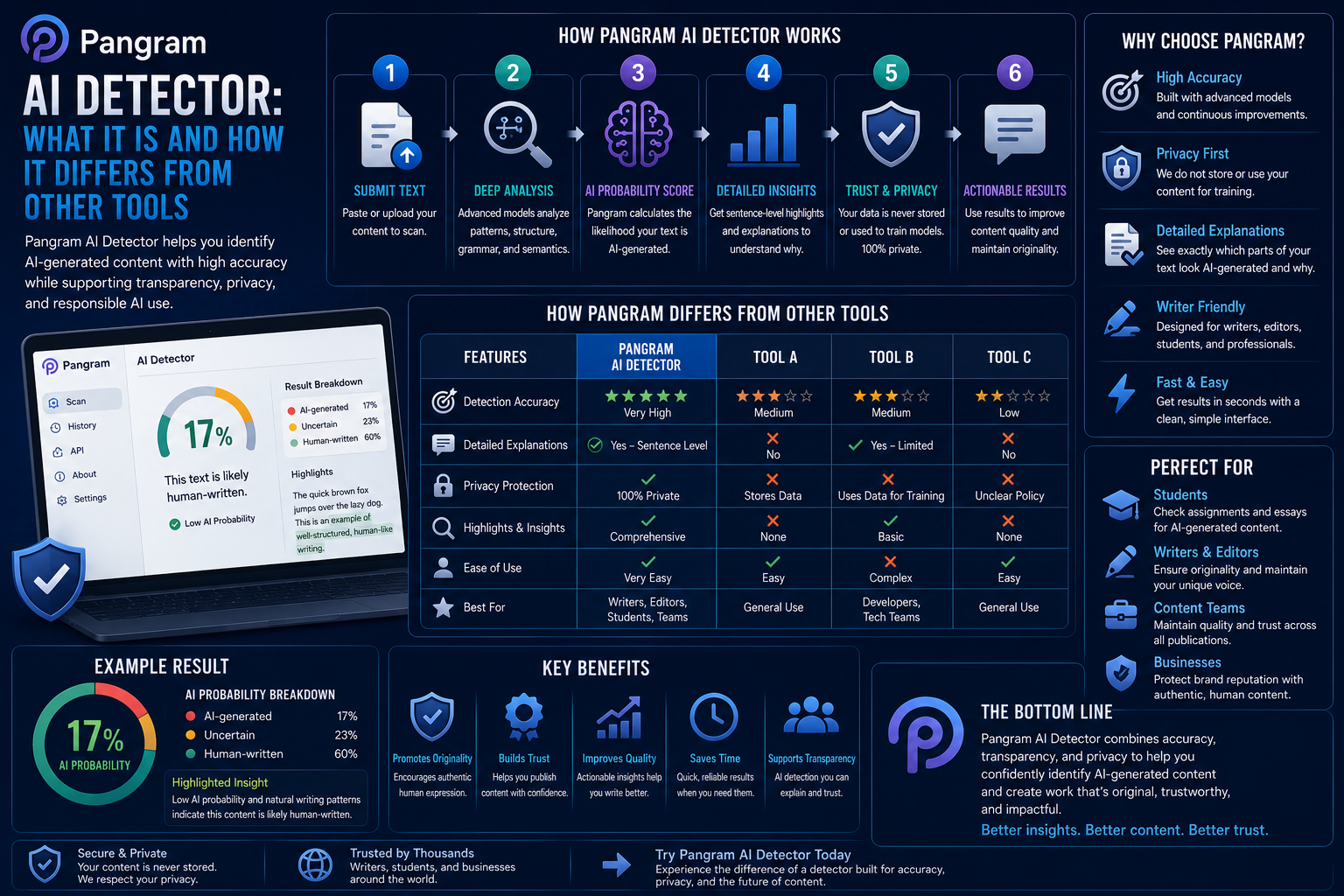
The Pangram text detector is an artificial intelligence-based tool designed for detecting text, with an aim of achieving maximum accuracy and reducing false positives. This paper gives a comprehensive explanation of the Pangram AI Detector, explaining its working process and what makes it unique, among other things.
What Pangram Is
Pangram is an AI detection platform designed for those who are looking for something more reliable than what previous, less specialized tools from the same category offered. This product is positioned for users who are particularly worried about false positives and the possibility of correctly written content being detected as generated by AI, as the problem of false positives has always been one of the main drawbacks of the entire category.
On a different note, Pangram appeared a bit later than GPTZero and Originality.ai, with its positioning strongly focused on solving problems that were already known to these products.
How Pangram Works
Pangram is similar to other classifiers in that it utilizes a classification algorithm developed to recognize the difference between human-written texts and AI-written texts using statistical language techniques.
Training on a Broader and More Diverse Dataset
The goal is to lower the possibility of false positives due to writing styles that have traditionally had a higher chance of being classified incorrectly by previous detectors.
Frequent Model Updates
Aimed at keeping up with the new models of language that emerge, since the detection performance decreases as the models become more advanced in generating realistic output.
A Focus on Precision Over Recall
Preferring a low rate of false positives over more accurate AI detection, even if it implies conservatism in detecting ambiguous cases.
Why False Positive Rate Has Become a Central Selling Point
Criticism of the AI detection technology, in general, is usually based on the problem of false positives that are often seen in the field of education and can lead to drastic consequences for the student. The criticism gained much popularity at the early stage of developing this category as a number of popular detectors were independently tested and reported to have been more prone to flagging texts written by non-native speakers. Pangram, for example, has been using it as the main distinguishing feature of its product.
How Pangram Compares to Other Detectors
Against GPTZero and Originality.ai
GPTZero and Originality.ai have been in existence for a longer period of time and enjoy greater familiarity in addition to having feature sets tailored to specific scenarios, namely academia and content marketing, respectively. The uniqueness of Pangram’s product is based only on its improved accuracy and reduced number of false positives.
Against Free Consumer Tools
ZeroGPT and the QuillBot Detector are examples of free tools that can be used by an individual person casually. Meanwhile, Pangram tends to address those people and organizations for whom the accuracy of detection is a priority, like institutions or publishers.
Against Academic-Integrated Tools Like Turnitin
The strength of Turnitin is that it can be directly integrated into the institution’s system, something that Pangram, being relatively new and relatively independent of other companies, is not able to do yet, even though Pangram has formed some partnerships.

Accuracy Considerations
It is important to point out that, in spite of Pangram’s assertions of its accuracy and emphasis on minimizing false positives, one cannot fail to mention that, like all providers of this product category, there are no independent, universally accepted standards which could be used for assessing the accuracy of detectors on the market. Statements of their superiority in terms of accuracy must be viewed with the same skepticism as any other self-assertions of detector’s accuracy.
Who Uses Pangram
Educational Institutions
The detector is used in educational institutions which have deliberately searched for one with better history when it comes to minimizing false positives, possibly due to the poor performance of the former tool.
Publishers and Content Platforms
This is used by companies that require a dependable detection system for editorial purposes, in which case an incorrect rejection due to a false positive may occur.
Organizations Prioritizing Detection Accuracy Specifically
Any company or organization that values the accuracy of detection results more than a wide array of features or cost would use this software.
Bottom Line
As far as positioning, Pangram falls into the AI detection type by virtue of accuracy and false positives’ elimination as compared to some older, more recognized services which were criticized for that very reason. It is important to take this into account while considering Pangram’s claims since all of these detectors should be approached with skepticism owing to the absence of industry standards and benchmarks but, again, Pangram focuses on what seems to be the main problem of all such services.