Offsite SEO: How to Build Authority Beyond Your Website

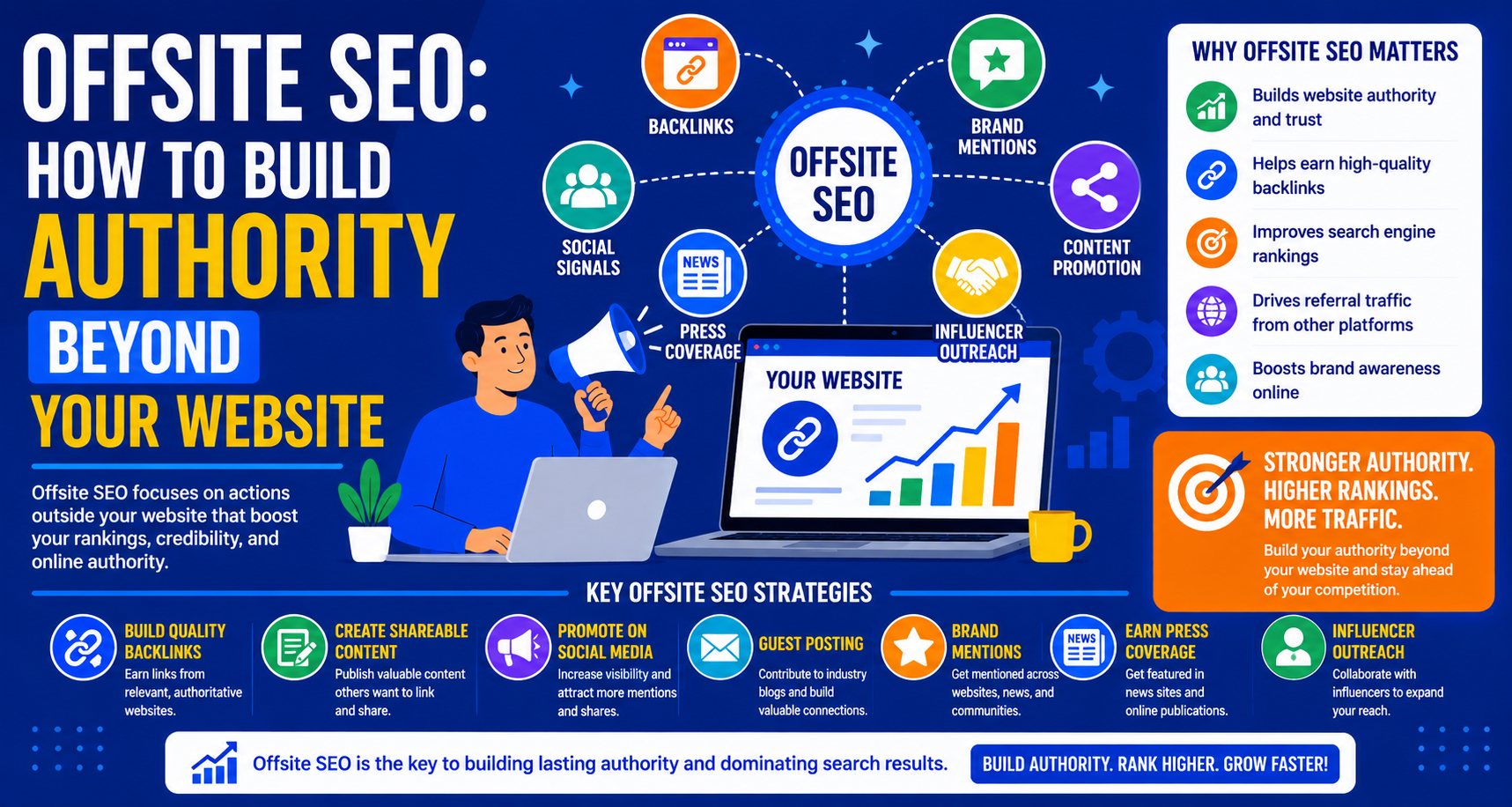
You could optimize everything on your website, from your title tags to your comprehensive content, fast loading speeds, and even then find yourself lacking in rankings.
This is because rankings are dependent not only on how your site looks, but what everyone else on the internet thinks of it.
This is the concept behind offsite SEO.
What Is Offsite SEO?
All optimization techniques performed outside your website to help boost search rankings are considered offsite SEO.
The first thing to do is generate backlinks, links to your site from another site, since they carry a lot of weight in Google’s ranking algorithms.
Other aspects of offsite SEO include:
- Brand mentions
- Social signals
- Local citations
Backlinks, however, are the backbone of offsite SEO.
Why Do Backlinks Matter?
A backlink to your website is like a vote of confidence from another site.
Having a link from an industry publication indicates that your content is worthy and credible.
Google recognizes a webpage with lots of backlinks as being more authoritative and deserving of better ranking as compared to a webpage with fewer or no backlinks.
This is the reason why pages with almost identical content rank differently based on the number of authoritative backlinks they have.
Types of Backlinks
All backlinks are not the same.
Knowing the different qualities will assist you in acquiring good backlinks.
High-Quality Backlinks
Below are some of the main characteristics of quality backlinks:
- Backlinks from high DR sites
- Topically related sites
- Editorial placement
- Backlinks from sites that receive organic traffic
Example
An SEO blog’s backlink from another SEO blog holds much greater value than a backlink from an SEO blog on a website that belongs to an entirely different niche.
Low-Quality or Harmful Backlinks
These include:
- Backlinks from sites having extremely low Domain Authority with no organic traffic.
- Backlinks from irrelevant domains.
- Paid Backlinks.
- PBN backlinks.
- Exact match anchor text backlinks.
Goal
Create an increasing footprint of authoritative backlinks from varied referrer sites.
Why Offsite SEO Takes Time
Off-site SEO can sometimes be the part of SEO that takes the longest time.
You can:
- Publish content today
- Fix technical issues today
However, building links from highly authoritative sites may take weeks or months.
It involves:
- Building relationships
- Promotion of content
- PR activities
- Outreach activities
This is the reason SEO gets better each passing month.
Each passing month of offsite SEO creates authority that cannot be duplicated by competitors.
The Main Offsite SEO Strategies
Content-Based Link Earning
The most sustainable strategy is creating content valuable enough that others naturally link to it.
Content Types That Earn Links Naturally
Original Research and Data Studies
This is because the most sustainable approach is creating content worth linking to without even trying.
Example:
“After analyzing 5,000 websites, we concluded X.”
It’s common for publishers to quote original statistics.
Free Tools and Calculators
Tools that prove useful usually attract links on resource pages and blogs.
Comprehensive Ultimate Guides
The most comprehensive source on any topic is usually used as a reference.
Infographics and Visual Assets
Excellent visual content can get embeds and citations.
Original Frameworks or Methodologies
Develop a new and original structure
Whenever anyone cites this, there is always a reference to the original material.
Why It Works
Natural links generated are:
- Editorial
- Long term
- Uniquely difficult to duplicate by your competition
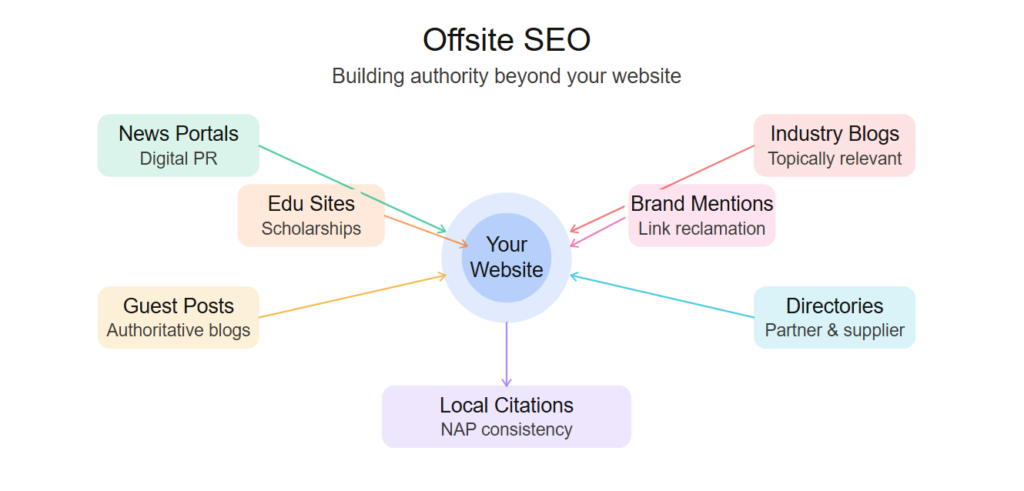
Digital PR
Digital PR integrates public relations with link building.
The objective here is to get press and link coverage from:
- News portals
- Trade journals
- Top-notch blogS
Effective Digital PR Tactics
- Research studies and surveys
- Analysis of current events by experts
- Trends reports
- Company announcements
- Product launches
Potential Impact
Just one successful campaign will result in:
- 10-30+ backlinks
- A boost in referral traffic
- Increased Domain Authority
Guest Posting
Guest blogging is a strategy whereby you write an article on behalf of another site in return for a link.
Best Practices
- Identify targeted sites
- Select authoritative sites
- Come up with fresh ideas
- Provide useful contenT
What to Avoid
- Bulk guest posting campaigns
- Low-quality content
- High volume of keyword-rich anchor text
A Useful Test
Asking yourself these questions:
Do you still see value in having your post appear here even without receiving a link?
A “yes” response means you are probably on track.
Broken Link Building
Broken link building benefits website owners and also generates backlinks.
Process
Step 1: Find Relevant Websites
Consider:
- Resource pages
- Industry blogs
- Educational content sites
Step 2: Identify Broken Outbound Links
Tools to use include:
- Ahrefs Site Explorer
- Ahrefs Link Intersect
Step 3: Match Relevant Content
Search for content on your website to replace the broken resource.
Step 4: Reach Out
Let the website owner know and recommend your website as a replacement.
Why It Works
You’re providing genuine value by helping fix broken pages.
Link Reclamation
Unlinked mentions are common for many brands.
This is an awesome opportunity.
Process
Step 1: Monitor Brand Mentions
Use Ahrefs Alerts or similar tools.
Step 2: Identify Mentions Without Links
Read articles that have references about your company.
Step 3: Request a Link
Kindly request the author to put a link back to your website.
Advantage
Conversion rate is always much higher compared to cold outreach since the author is already aware of your brand.
Scholarship Link Building
The creation of an authentic scholarship will help you get backlinks from the web pages of educational institutions.
Typical Scholarship Budget
- $500–$2,000 annually
Important Consideration
However, you should consider using this technique only if you intend to conduct your own authentic scholarship program.
An artificial scholarship is considered a violation of search engine guidelines.
Partner and Supplier Links
Many businesses currently have underutilized linking potential.
Potential Sources
- Partner directories
- Supplier websites
- Industry associations
- Awards sections
- Vendor directories
Action Item
Check your existing business contacts.
You could have more than enough backlink opportunities at your fingertips.
Local Offsite SEO
Citations become very important for businesses for offsite SEO.
Important Local Citations
- Google My Business Listing
- Bing Places Listing
- Apple Maps Listings
- Yelp Listing
- Special Industry Directories
- Chamber of Commerce Websites
NAP Consistency
Make sure that your:
- Name
- Address
- Phone Number
are always consistent everywhere.
Consistent citations build trust locally.
How to Measure Offsite SEO Progress
Domain Rating (DR)
Check DR every month.
An increase means that you have more powerful backlinks.
Referring Domain Growth
Watch how many different sites link back to you.
An increase shows that your influence is growing.
Ahrefs Rank
Check the authority of your website against other websites.
The smaller your Ahrefs Rank, the greater your authority.
Keyword Rankings
In the end, backlinks need to enhance ranking.
Make comparisons of keyword ranks through:
- 3 months
- 6 months
- 12 months
Search for connections between the linking process and rankings.
Common Offsite SEO Mistakes
Chasing Quantity Over Quality
Ten good links are better than a hundred bad links.
Exact-Match Anchor Text Over-Optimization
Natural Backlink Profile Consists of
- Branded anchors
- URL anchors
- Generic anchors
Too many exact match anchors will look spammy.
Ignoring Relevance
Relevance is important along with authority.
Sometimes relevance beats the authority of the backlink.
Short-Term Thinking
Don’t use:
- Link networks
- PBNs
- Paid links
- Link trading
This creates ongoing risks.
Failing to Track Backlinks
Without tracking, you cannot:
- Evaluate your efforts
- Spot toxic links
- Refine your process
Building an Offsite SEO Workflow
An organized process ensures consistency with link acquisition.
Week 1: Content and PR Creation
- Upload linkable resources
- Develop research articles
- Determine PR possibilities
Week 2: Outreach
- Submit article pitches
- Undertake broken-link outreach
- Seek out partner links
Week 3: Follow-Up and Monitoring
- Perform outreach follow-up
- Analyze newly acquired backlinks
- Backlink analysis
Week 4: Analysis and Planning
- Check for DR Trends
- Evaluate Growth in Referring Domain
- Check Ranking Improvements
- Plan Strategy for Next Month
Conclusion
Offpage SEO is definitely one of the most difficult areas of SEO, but at the same time, it’s the most effective one.
Two sites with comparable onsite SEO performance can still get wildly varying rankings based only on how good their backlinks are.
Concentrate your efforts on acquiring quality links in a genuine way
- Generating high-quality content
- Digital PR
- Link reclamation
- Guest blogging
- Forming business alliances
The power you generate will build up and make for one of the best competitive advantages possible.