Inventory Software Development Services, What They Are and When You Need One

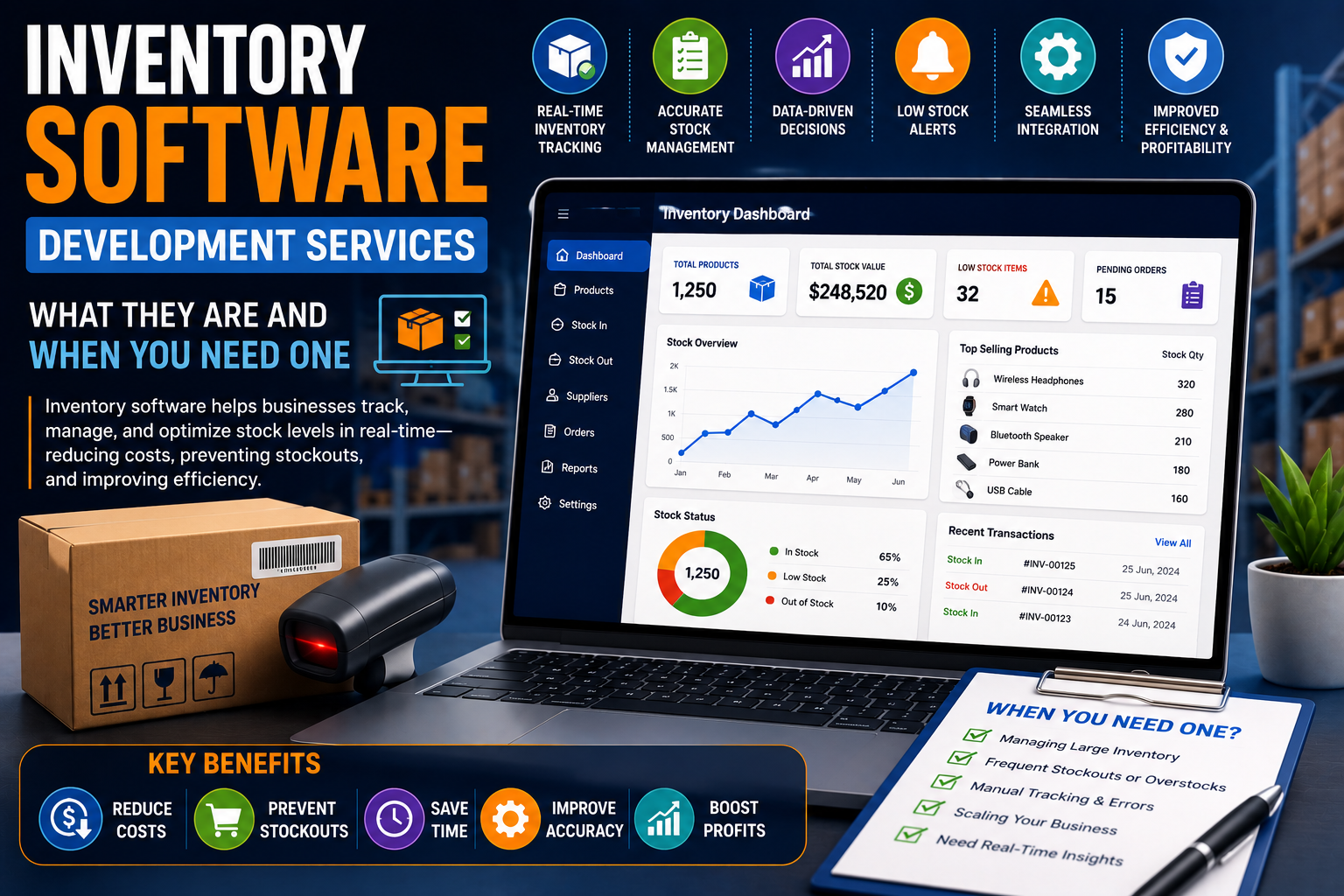
Ready-made inventory management software suits companies that follow typical business processes. As soon as you have complex operations, several warehouses, custom item parameters, connection to a proprietary ERP system, or real-time tracking of thousands of SKUs, these restrictions cost a lot of money very quickly.
These are the situations in which you need to turn to custom inventory software development services.
Here is everything you need to know about such services.
What Is Inventory Software Development?
Inventory management software development involves creating customized software solutions for managing the inventory of a particular organization. This means keeping track of what is there, where it is, when it should be ordered and its movement along the supply chain.
This differs from buying off-the-shelf products such as QuickBooks Commerce and Fishbowl because these products are customized based on your business requirements.
What Does Custom Inventory Software Typically Include?
Scope depends on the business, but in general, customized inventory systems include:
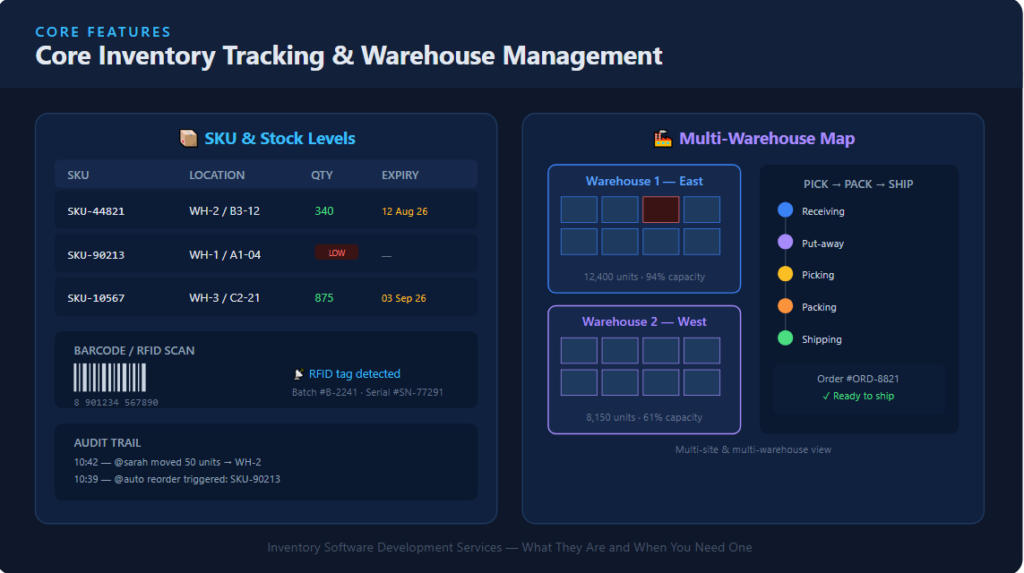
Core Inventory Tracking
- Current inventory levels in all sites
- SKU and barcode/RFID management
- Tracking of batch and serial numbers
- Expiration date control (particularly for foods, pharmaceuticals, and medical products)
Warehouse Management
- Bin and shelf location tracking
- Picking, packing, and shipping process flows
- Receiving and put-away procedures
- Multi-warehouse and multi-site management
Order and Procurement Management
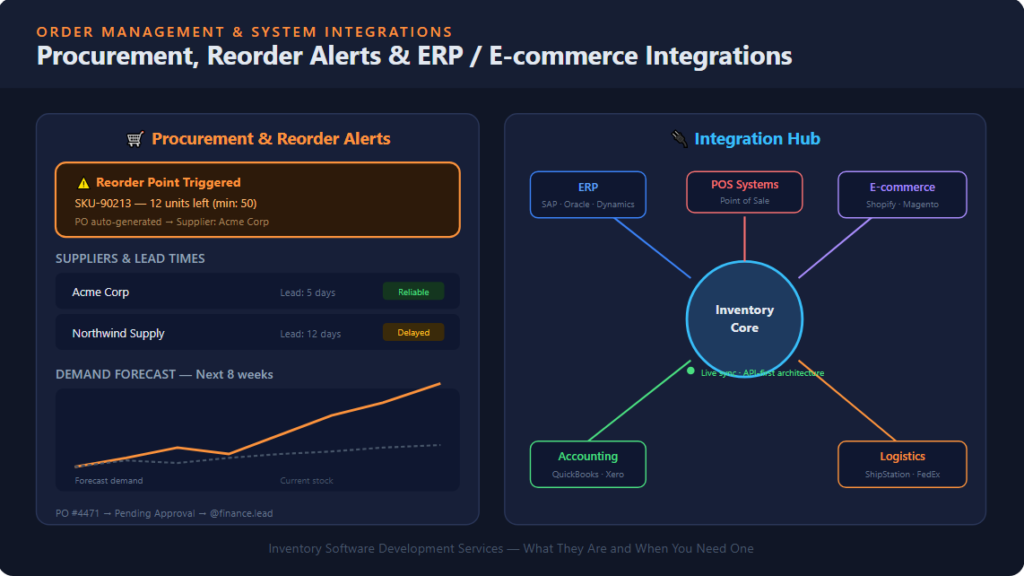
- Order creation and approval process
- Supplier management and lead times
- Automatic reorder points and inventory alerts
- Demand forecasts
Reporting and Analytics
- Turnover ratio and carrying costs
- Dead stock identification
- Losses and shrinkages
- Operations & finance dashboards
Integrations
- ERP solutions (SAP, Oracle, Microsoft Dynamics)
- E-commerce systems (Shopify, WooCommerce, Magento)
- Accounting packages (QuickBooks, Xero)
- Logistics solutions (ShipStation, FedEx, UPS)
- Point of sale (POS) systems
Who Needs Custom Inventory Software Development?
The best fit for customized inventory software would be companies which have:
- Outgrown the capabilities of off-the-shelf software and have resorted to manual workarounds
- Work in a multi-warehouse/regions/multi-sales-channel environment
- Product characteristics which cannot be handled by standard software solutions (lot management, serial numbers, custom product variations)
- To integrate inventory software into proprietary systems
- Are part of an industry where standard software cannot satisfy regulatory requirements (pharmaceuticals, aerospace, medical devices industry)
- Developed their own proprietary inventory software solution
Key Features to Build Into Custom Inventory Software
And here are the features that you might be underestimating when building your own inventory software:
Audit Trail and Traceability
Every move of your inventory has to be registered by time, user and reason. That’s the only way to comply with regulation requirements and helpful for everybody else.
Role-Based Access Control
Different people on your team must see and do different stuff. Warehouse workers, buyers and financial directors have their own needs and level of access to information.
Mobile-Friendly Interface
They don’t sit at desks. Your inventory management system must perform well on tablets and barcode scanners, in addition to desktop web browsers.
Offline Capability
In warehouse situations where WiFi is spotty, you need to be able to work offline and sync up when the connection is re-established.
Scalability
The inventory system must be able to support ten times the current load without any rewrites. You’ll want to ensure your developers have this in mind from the beginning.
What to Look for in an Inventory Software Development Partner
Supply Chain Domain Experience
Inventory applications aren’t simple CRUD applications but require advanced logic for lots, first-in-first-out/last-in-first-out costing, ordering, and product serialization. Your development partner must be fluent in all these concepts.
Integration Expertise
Integration with other systems is inevitable for inventory management software. Find a partner who has the track record of integrating ERP, e-commerce, and logistics systems.
Scalable Architecture
The architecture your team adopts should be scalable to the growth of your company, cloud-native, and API-first. The database structure must be optimized for heavy transactional workloads.
Industry-Specific Experience
If your company is in pharmaceuticals, food and beverage, or medical device manufacturing, your partner needs to have knowledge about compliance in your industry (FDA, GMP, GDP, etc.).
Build vs. Buy: When Does Custom Make Sense?
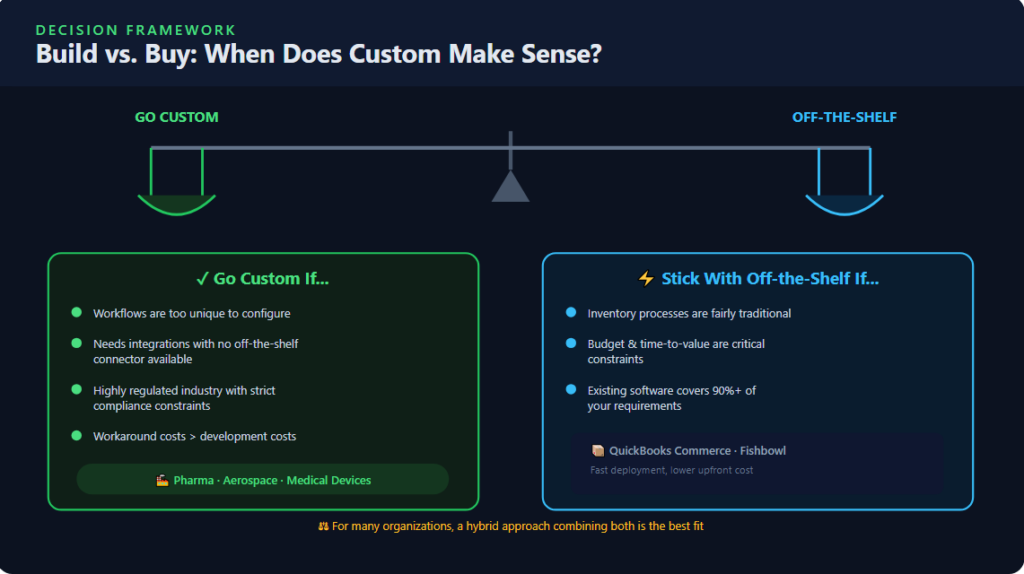
Sometimes custom inventory software is not the best solution. Let’s consider the following quick decision framework:
Go Custom If:
- Your workflow processes are truly unique and cannot be configured using any existing software.
- Your business requires integration with software which doesn’t have off-the-shelf connectors available.
- You’re in a highly regulated business with certain compliance constraints.
- The cost of the workaround solutions and process automation outweighs the cost of development.
Stick With Off-the-Shelf If:
- Your processes related to your inventory management are quite traditional.
- Budget constraints and time-to-value is what’s critical.
- An existing piece of software meets 90%+ of your requirements.
For many organizations, a hybrid solution is the best approach to take.
Bottom Line
In terms of cost, customized inventory software development solutions can prove to be quite expensive. However, for enterprises with complicated internal processes or those which have certain peculiarities in their workflow, customized inventory software solutions can be a game changer.
The critical point is selecting the right development provider, someone who is aware that inventory management is a challenge that is solved through software and not the other way around.