How to Start Email Marketing: A Step-by-Step Guide for Beginners

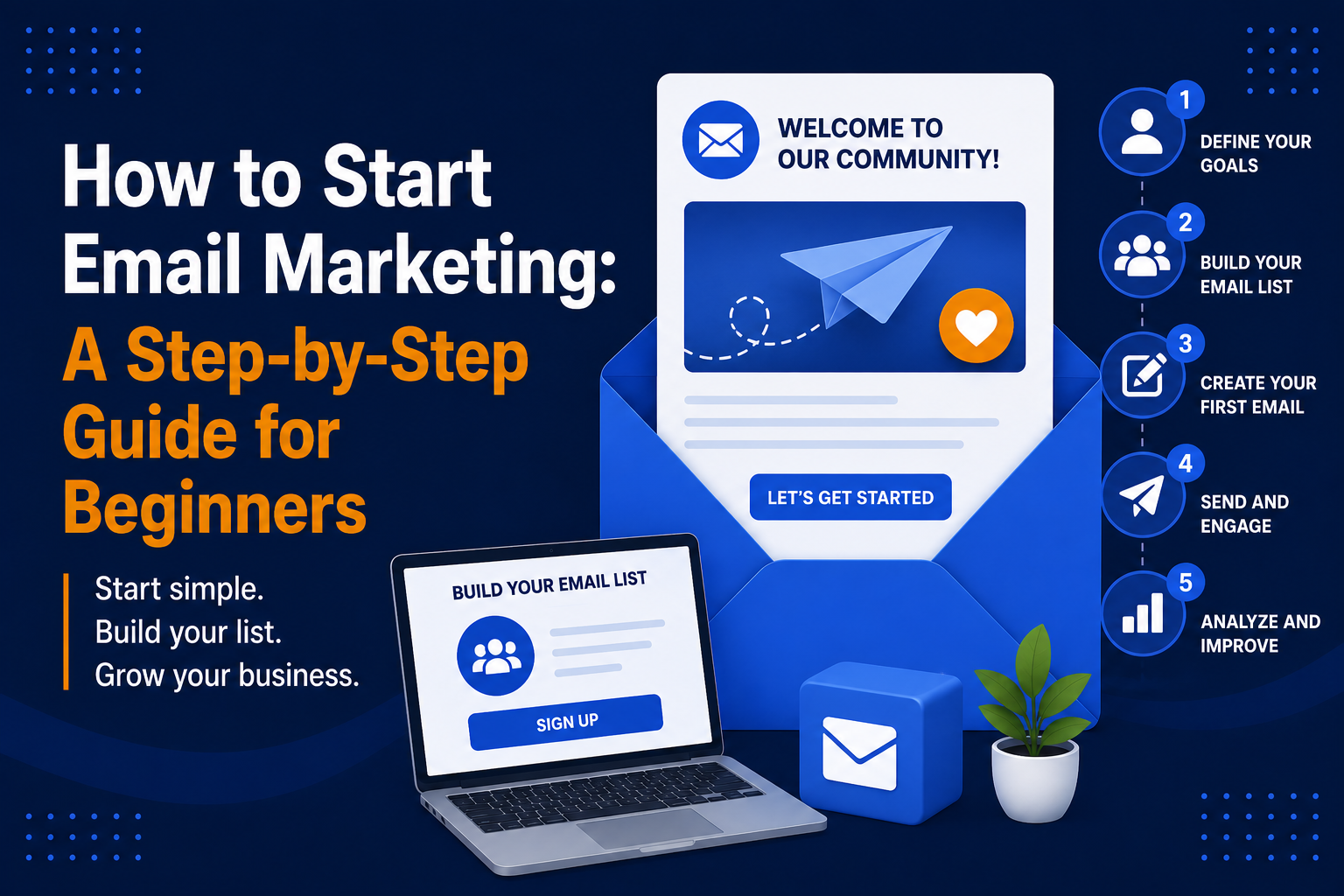
Email Marketing Campaigns are one of the smartest ways to spend your money on your company, however, sometimes it may seem very daunting when you do not have any experience with it before. How do I do it? What software should I use? Where can I get subscribers?
All your questions will be answered in this guide. You will learn how to create an email marketing campaign from scratch.
Why Start Email Marketing?
Here’s why you should think about email marketing first before you even get to the how:
- ROI between $36–$45 for each $1 invested
- List is yours (no algorithm can take away your access to it)
- Access to those who have already expressed interest in your business
- It works for any company of any size or any industry or budget
- Can be automated and thus bring income even when you’re sleeping
If you haven’t started doing it, then you’re losing money.
Step 1: Choose an Email Marketing Platform
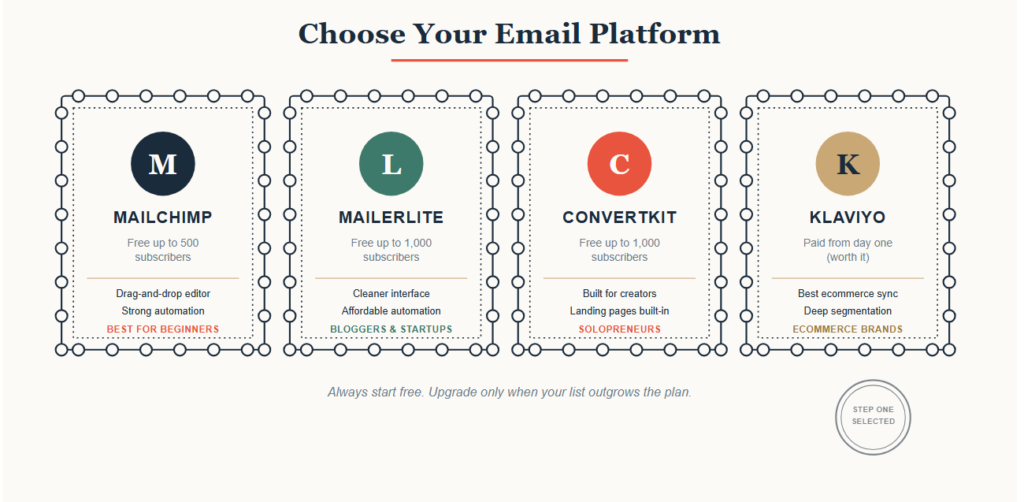
The first step is choosing the right email service platform, which can also be referred to as an ESP (Email Service Provider). It will enable you to create the list, design the emails, and send the campaign.
Best Options for Beginners
Mailchimp
- Free up to 500 subscribers
- Drag-and-drop email editor
- Great automation tools at higher plans
- Ideal for: Small businesses and beginners
MailerLite
- Free plan for up to 1,000 subscribers
- Has a cleaner interface than Mailchimp
- Great automation features at cheaper rates
- Ideal for: Bloggers, creatives, and startups
ConvertKit
- Free plan for up to 1,000 subscribers
- Made for creative individuals (newsletter, online courses)
- Landing pages, automation features available
- Ideal for: Solopreneurs, coaches, creatives
Klaviyo
- Paying from day one (but worth it)
- Best ecommerce integrations in the industry
- Awesome segmentation and automation features
- Ideal for: Ecommerce companies
Always start with a free plan. Then you can move on to paid plans if needed.
Step 2: Define Your Goal and Audience
Before creating your list, make sure you know two things:
1. Who Are You Emailing?
Who is your perfect customer? What is their biggest problem? What do they wish to learn or achieve? How can you get them interested in reading your emails?
2. What Do You Want Email to Do for Your Business?
- Sell more products at your online store
- Find more clients for your service company
- Attract subscribers for your blog or newsletter
- Keep existing customers loyal to your brand
This will affect all the choices you will be making later, from the lead magnet you will offer to the email copy you will write.
Step 3: Build Your Email List
It’s impossible to write email campaigns without having any subscribers. This is the way you can build up an audience from scratch:
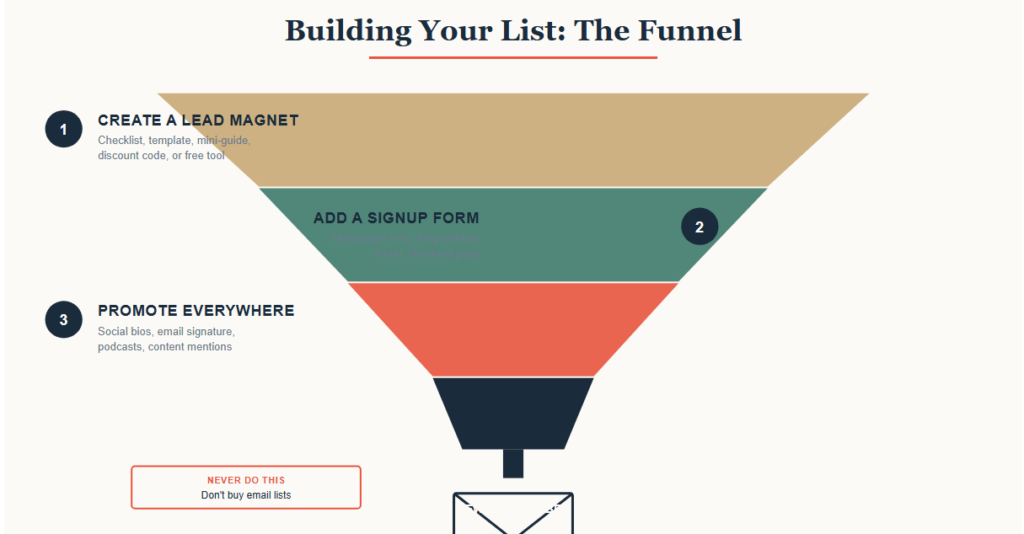
Create a Lead Magnet
Lead magnet is some kind of valuable content provided by you for someone’s email. The best lead magnets are always very specific and useful.
Proven Lead Magnet Ideas
- Checklist (“10 Point SEO Audit Checklist”)
- Template (“Free Email Campaign Calendar Template”)
- Mini-guide (“Beginner’s Guide to Facebook Ads”)
- Discount code (“Get 15% off your first order”)
- Free tool / Calculator
- Email course (“5 Day Instagram Growth Challenge”)
Add a Signup Form to Your Website
Insert a sign-up form in the following high visibility places:
- Hero section or pop-up on homepage
- Sidebars on blog and end of blog post
- About Us page
- Footer of contact page
- Checkout page (if ecommerce site)
Promote Your List Everywhere
- Place sign-up link in social media profiles’ bios
- Discuss your newsletter on your content
- Place sign-up link in your email signature
- Discuss your email list on the podcasts/videos you guest on
Never ever purchase an email list. It does not work, harms your sender reputation, and is against the law.
Step 4: Set Up Your Welcome Email
The welcome email will be the most significant email that you will ever send. You send it when the interest is at its highest, right after people subscribe. The open rate for the welcome email is 50 to 80 percent.
Your Welcome Email Should:
- Thank the subscriber for signing up
- Deliver the lead magnet you offered (if there was one)
- Greet the new subscriber and introduce your brand
- Create some context around how the relationship will progress
- Provide at least one action for the new subscriber to take
It should be brief and personal. You want to build trust, not make a hard sell.
Step 5: Plan Your Email Content
Lack of ideas is one of the reasons why businesses decide to stop using email marketing. Below is an easy formula for ensuring that you have plenty of content:
The 80/20 Rule
80% of the emails you send should contain value-added material (insights, tips, educational content, etc.), while the other 20% can be promotional emails.
Content Types That Work
- Guides useful for your audience’s struggles
- Tales behind the scenes from your business
- Product or service launches
- Success stories of your customers
- Recommendations of tools, books and articles
- Personal stories linked to your business or audience
- Themed content
Create a basic content calendar, even if it is only an Excel sheet with your next 4 weeks of emails mapped out. Consistency is better than perfection.
Step 6: Write Your First Emails
It’s not necessary for you to be an experienced copywriter to send effective emails. Just be clear, helpful, and human.
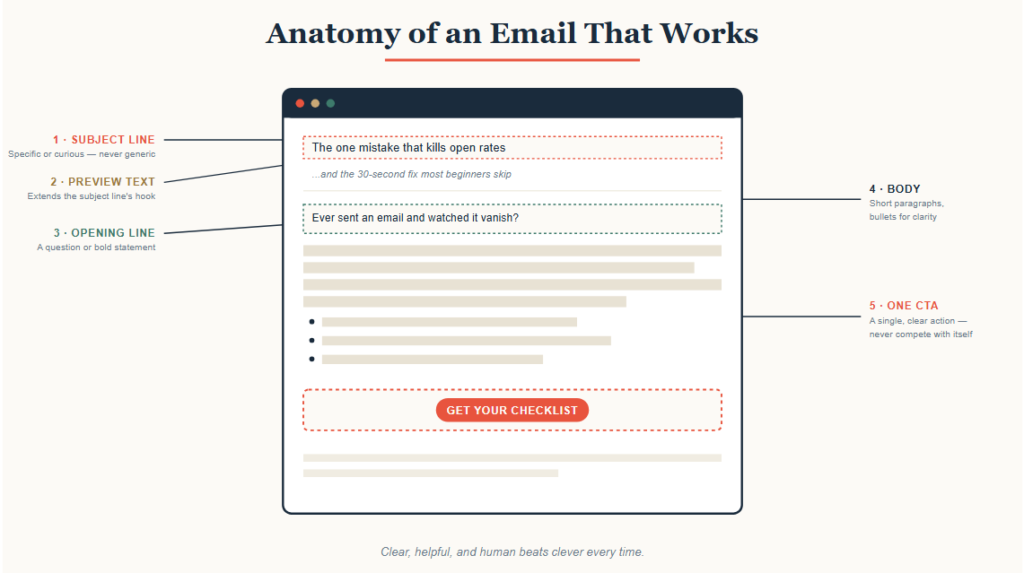
Email Structure That Works
1. Subject Line
The first task of yours is to have your emails opened. So, you should either be specific and benefit-oriented or create curiosity. (“The one mistake that kills email open rates” beats “Newsletter #12”).
2. Preview Text
The preview text that comes up in your inbox. Use it as an aid to the subject line.
3. Opening Line
Get their attention right from the beginning. Raise a question, give a strong assertion, or begin with a situation.
4. Body
Offer your value proposition. Limit paragraphs to two or three sentences. Employ bullet points if they help clarify your points.
5. Call to Action
A single, distinct action for the recipient. Including multiple CTAs in one email doesn’t work as well as including only one.
Step 7: Set Up Basic Automation
Automation ensures that your marketing emails run when you do anything else. Here are the first two:
1. Welcome Sequence (3–5 Emails Over 1–2 Weeks)
Following your first email after subscription, send out a short email campaign that:
- Features your best content or most valuable resources
- Promotes your products or services in a values-led manner
- Bolsters trust with stories or testimonials
- Concludes with a soft pitch or a call to action
2. Abandoned Cart Sequence (For Ecommerce)
For customers who abandon their carts on your site, an automated campaign recovers 5-15% of potential losses.
Step 8: Send Consistently and Track Results
Consistency fosters trust. Decide on a sending schedule and stick with it:
- Weekly – an excellent starting schedule for most businesses
- Bi-monthly – for businesses where subscribers are expecting less frequent contact
- Daily – for media sites, newsletters, and highly active subscribers, but high content output is necessary
Track These Metrics Monthly
- Open Rate – Do they open your emails? (Goal: 25-40%)
- Click Rate – Do they click your links? (Goal: 2-5%)
- Unsubscribe Rate – Keep it below 0.5%
- Revenue or Leads – The one that counts the most
Take advantage of what you find out. Test your subject lines. Experiment with different types of content. Test different schedules. Little changes make a big difference over time.
Final Thoughts
Getting into email marketing does not have to be hard. Select a platform, create a basic lead magnet, make a sign-up form, draft a welcome email, and deliver something of value to your subscribers every week or two.
The companies that succeed in email marketing aren’t those with the most advanced software or largest budget; they’re those that show up regularly, write emails worth reading, and treat their list with the respect it deserves.
Begin now. Your future self and bank account will thank you for it.