How to Create an SEO Plan That Actually Gets Results

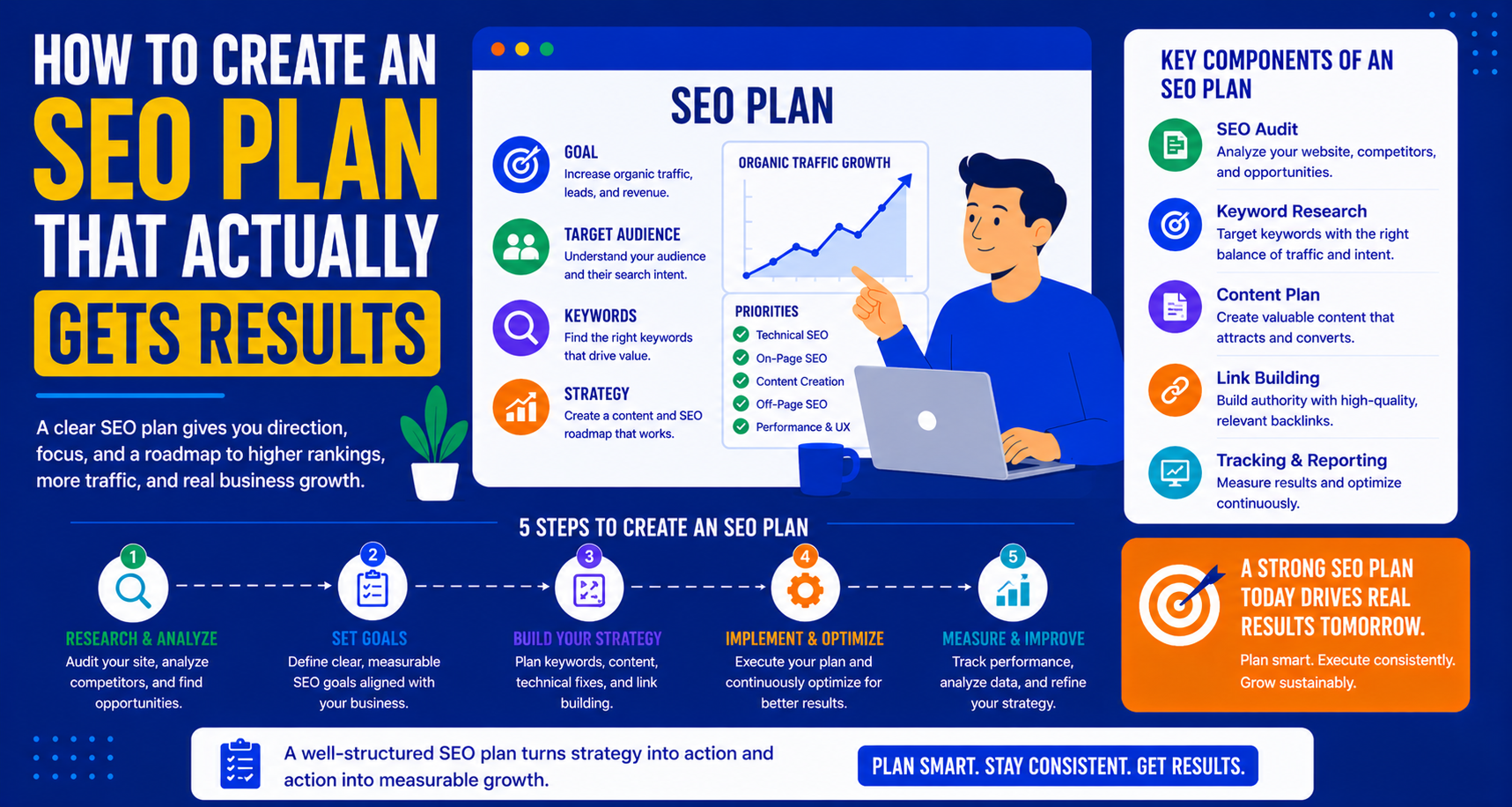
It’s very common for SEO strategies to fall apart even before the first page has been optimized. This can happen either because there is too much vagueness in the strategy, which doesn’t lead to measurable tasks, or because there is an emphasis on tactical activities without consideration of the strategic perspective..
This document will help you formulate an effective SEO strategy for your company.
What Is an SEO Plan?
The SEO plan refers to a document that outlines what you will be doing to achieve your SEO targets such as creating content for your website, technical SEO changes to improve the ranking of your website, keyword targeting and linking strategies among others.
An SEO plan should never be static; in fact, you should be reviewing the SEO plan every quarter.
Why Most SEO Plans Fail
Here are the things that you must keep in mind before creating a plan for yourself:
No Connection to Business Goals
“Increasing organic traffic by 20%” is a metric and not a business goal.
“Generating 200 qualified leads/month via organic search” is linked to revenue generation.
Projects that lack business context lose their priority in case there is scarcity of resources.
Too Much Scope
Attempting to resolve all technical problems, produce content on 50 keywords, and establish links will result in performing these activities with 50% effort.
Focused plans outperform comprehensive ones.
No Prioritization
Not all SEO efforts are going to be equally effective.
An approach that weighs missing meta descriptions equally with Core Web Vitals issues isn’t an approach; it’s just a checklist.
No Measurement Framework
Without first establishing what success looks like, you won’t know if you’re making progress or if adjustments are needed.
Step 1: Define Your Business Goals
Your SEO strategy is built based on the business objective that you are trying to reach through your SEO metrics.
Common Business Goals That SEO Supports
- Generate more qualified leads (business to business)
- More ecommerce sales revenue
- Lower customer acquisition cost
- Brand awareness in a new market
- Dependence on paid search reduction
From the above business objectives, we will formulate the SEO metrics needed as:
Organic qualified leads = Organic traffic × Conversion Rate × Lead Quality
You now know what to optimize for.
Step 2: Audit Your Current State
Knowing where you are going starts by knowing where you are
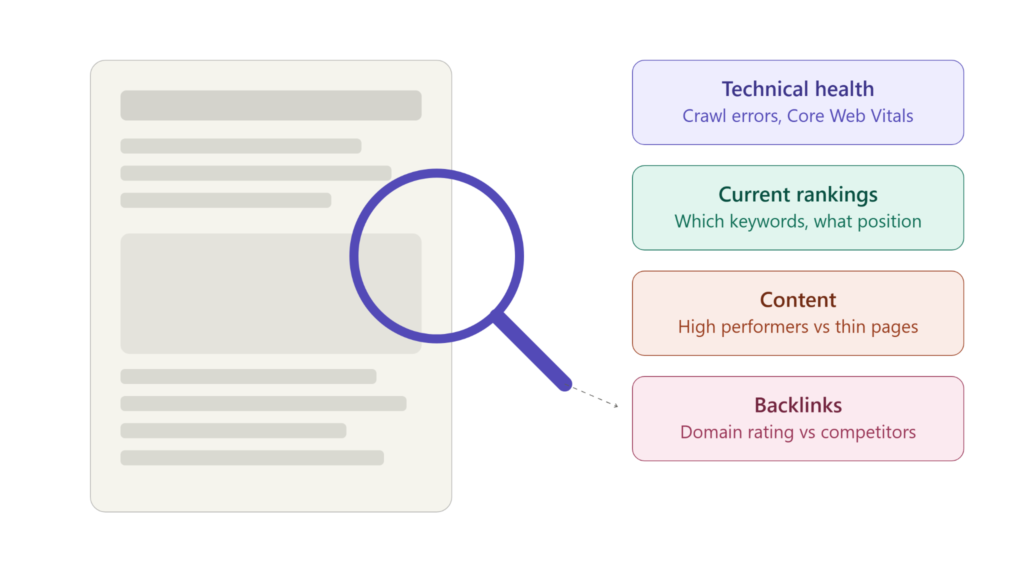
Conduct an SEO Audit Covering
Technical Health
- Crawling Errors
- Core Web Vitals
- Mobile Usability
- Indexation Problems
Current Rankings
- Which keywords are you ranking for?
- Where are your rankings?
Content
- Which pages have high performance?
- Which pages lack relevant content?
Backlinks
- Domain rating?
- How do you stack up against your competitors?
Recommended Tools
- Technical analysis using Ahrefs Site Audit
- Search performance using Ahrefs Site Explorer
- Indexation and Core Web Vital data using Google Search Console
The output of the site audit is your list of prioritized technical improvements for your plan’s first 60-90 days.
Step 3: Identify Your Keyword Opportunities
Keyword research dictates all: your content creation, your page optimization, and even how you define success.
Start With Seed Topics
What subjects revolve around your industry?
What challenges do your prospects struggle with when searching online?
Use Ahrefs Keywords Explorer
Build out your seeds into keyword lists.
For every keyword, record:
- Monthly searches
- Keyword Difficulty (KD)
- Type of Search (Informational/Commercial/Transactional)
- Current Position (if applicable)
Prioritize Keywords by Opportunity Size
Consider the following criteria when assigning keywords:
- High search volume
- Moderate keyword difficulty
- Relevant to your business
Create a Keyword Map
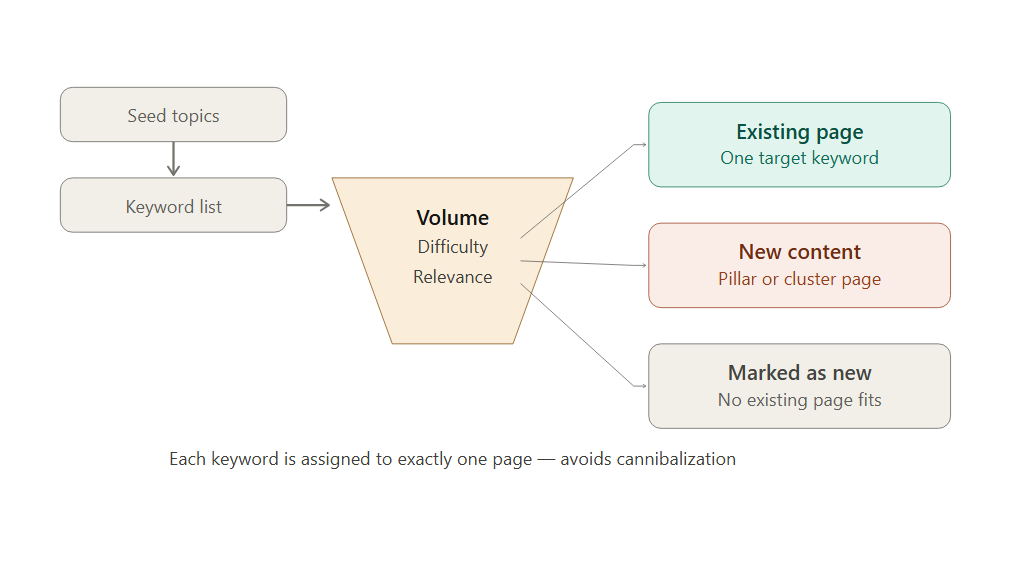
Each target keyword should be assigned to one specific existing page (or marked as new content).
This approach avoids cannibalizing keywords and makes sure that each one is accounted for in some way.
Step 4: Categorize Your Work
There are three types of SEO services.
You need to cover all of these three aspects within your plan.
Technical SEO
Identify any technical issues that affect the crawlability, indexability, and rankability of your pages by Google.
They can be very fast solutions and yield significant results.
Examples
- Crawl errors
- Core Web Vitals issues
- Canonicalization issues
- Redirects issues
- XML sitemap
Timeline
Technical solutions will generally be at the forefront during the first 30-60 days of your SEO program.
On-Page and Content SEO
Optimizing current web pages and creating new ones to target specific keywords.
Existing Page Optimization
- Updating your title tag and meta description
- Improving H1/header tag optimization
- Increasing content quality and freshness
- Implementing schema markup
- Better internal linking
New Content Creation
- Write articles, guides, or landing pages using non-ranking target keywords.
- Develop a topic cluster (pillar page + related cluster pages) based on topics.
Timeline
On-going process guided by content calendar.
Off-Page SEO (Link Building)
Attract good backlinks to enhance domain authority and ranking capabilities.
Strategies to Include in Your Plan
Digital PR
Conduct data analysis or research to attract editorial backlinks
Content-Based Link Earning
Create link-worthy assets (software tools, templates, detailed guide pages).
Partner Outreach
Build links through industry groups, partners, and suppliers.
Broken Link Building
Look for broken links on related sites and propose your content as an alternative.
Timeline
Link building requires patience and persistence.
Allocate 20-30% of SEO time to this activity.
Step 5: Build Your 12-Month Roadmap
Organize your plan for the year in four quarters.
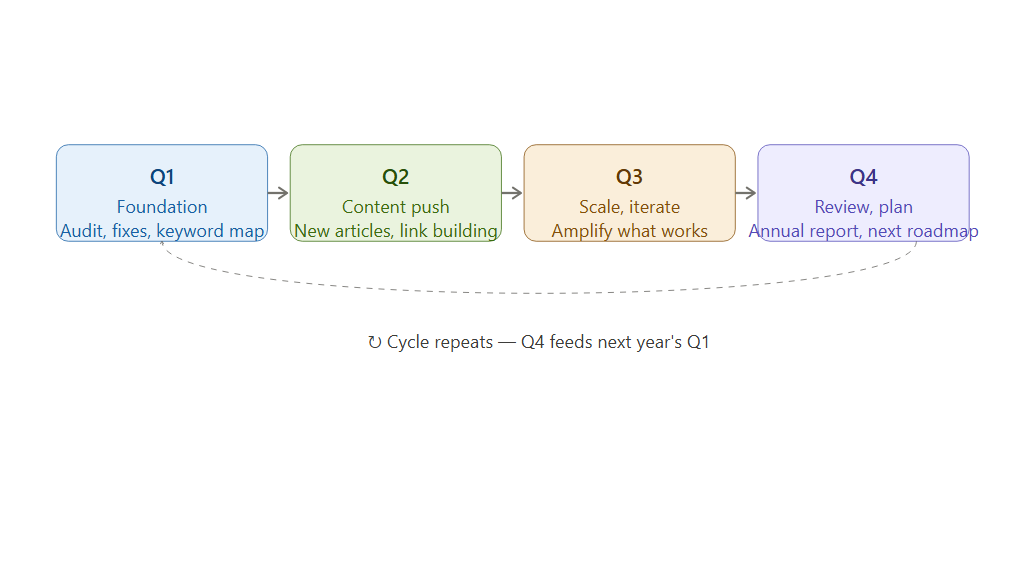
Q1: Foundation
Focus
Resolve all critical and high-priority technical problems.
Do a complete keyword analysis.
Plan your content marketing calendar.
Set up your benchmarks.
Deliverables
- Technical audit done
- Critical fixes completed
- Keyword map ready
- Content calendar prepared
Q2: Content Push
Focus
Release the first batch of new articles on fast-win low-difficulty keywords.
Optimize the top-performing existing articles.
Start link building efforts.
Deliverables
- 10-20 new articles released
- 10 existing top-performing articles optimized
- Link building process started
Q3: Scale and Iterate
Focus
Continue content marketing.
Find out what works in Q2 and amplify it.
Create links for high-performing new content.
Deliverables
- Evaluate gains in ranking
- Develop more content around strong-performing areas
- Use secondary keywords on optimized pages
- Link build
Q4: Review and Plan Next Year
Focus
Evaluate the annual performance against the targets.
Identify deficiencies.
Develop Q1 of the next fiscal year’s plan.
Deliverables
- Annual SEO report
- Keyword research update according to market changes
- One year roadmap
Step 6: Assign Resources and Owners
An SEO plan with no budget is wishful thinking.
Allocate the following to each stream of projects:
- Who will be in charge of implementation
- How many hours per week are available
- What resources are required
For In-House Teams
Understand that there will be limits.
Almost all SEO tasks get sidelined when higher priority activities take over.
A strategy based on 40 hours/month would be easier than the one relying on 200 hours/month.
For Agencies or Contractors
Define Scope of Work, Deliverables, and Reporting Frequency.
Make sure they have access to Search Console, Ahrefs, and your CMS.
Step 7: Define Your Measurement Framework
Before moving forward, determine what will be considered successful.
Set Up Primary KPIs (Tied to Business Goals)
- Organic leads / organic revenue generated (GA, goal setup)
- Organic revenue contribution (for ecommerce sites)
Set Up Secondary KPIs (SEO Health)
- Organic search sessions (Google Search Console)
- Keyword ranking for your target keywords (using Ahrefs Rank Tracker)
- Domain Rating / number of refdomains (Ahrefs)
Track Leading Indicators (Early Signals)
- Indexed pages
- Number of crawl errors (ideally to be approaching zero)
- Pass rate of Core Web Vitals
Review Cadence
Weekly
- Check ranking drop
- Fix crawl errors
- Analyze traffic trends
Monthly
- Assess content performance
- Analyze link building
Quarterly
- Against your targets
- Update roadmap
Example SEO Plan Structure
And here is how your SEO plan will look like:
- Business Objectives and SEO KPIs
- Current State Overview (audit results)
- List of Prioritized Keywords with Intent and Difficulty
- Keyword to Content Mapping
- Technical Issues and Fixes (Critical/High/Medium/Low Priority)
- Content Marketing Calendar (yearlong, 1 article per row)
- Backlinking Plan and Target Websites
- 1-Year Plan (quarterly)
- Resource Management Plan (hours/budget/owners)
- Measurements and Reporting
Conclusion
An ideal SEO strategy should be targeted, prioritized, resource-based, and aligned with business objectives.
It understands that fixing issues, creating quality content, and link-building go hand-in-hand since all three elements are interrelated.
It changes according to the information collected.
The best time to create an SEO strategy would be before conducting any SEO.
The second best time would be immediately now.