GRC Platform: How to Evaluate One for Your Organization

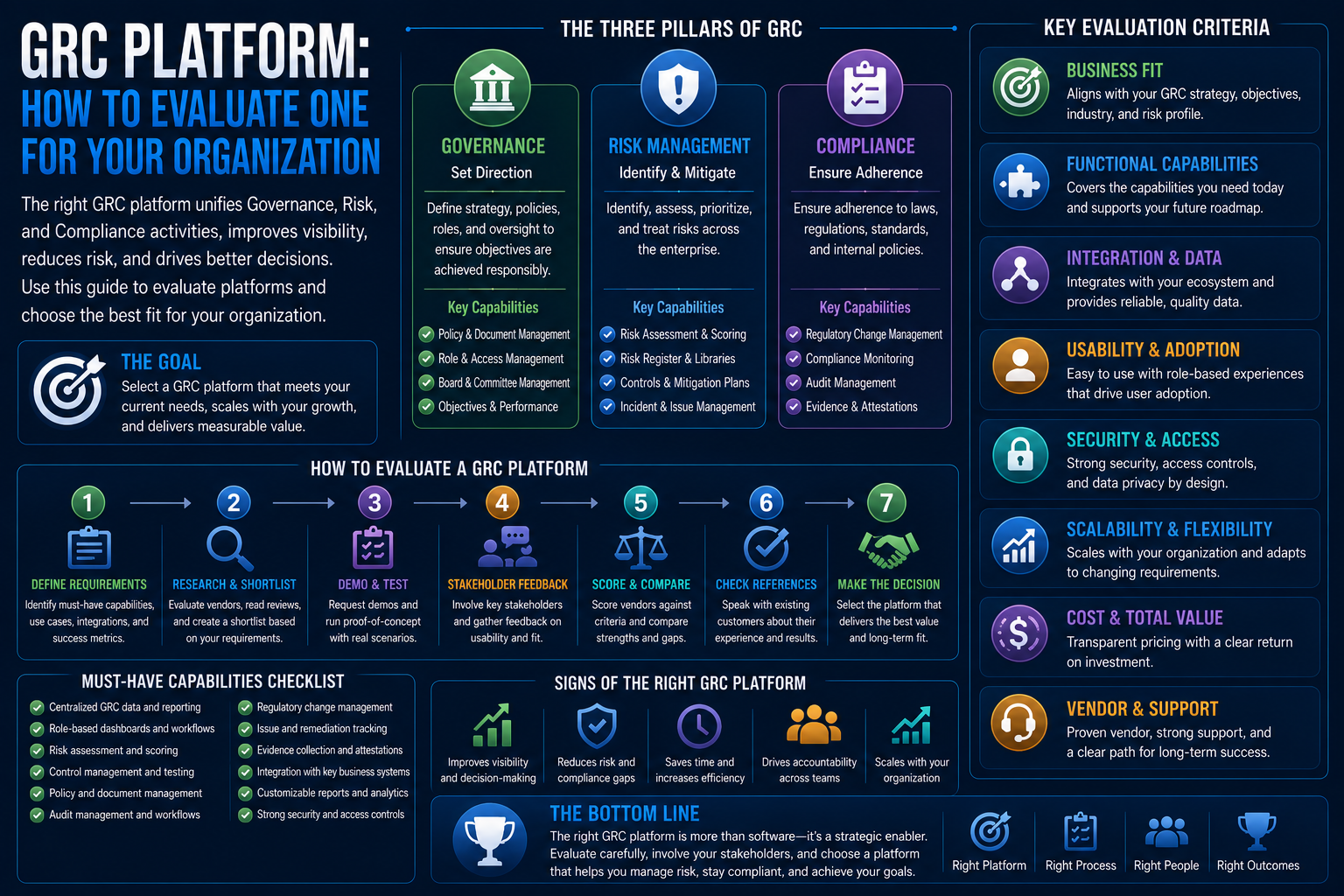
A GRC system is the level where all activities relating to governance, risk, and compliance, risk registers, policies, controls, audit information, and reports are integrated into one place rather than having each component managed independently. This is how a GRC system works, and what makes one suitable and another unsuitable.
What a GRC Platform Is Built to Solve
With the increase in regulatory requirements, data protection legislation, industry regulations, and increasing need for security framework by customers and partners, it has become hard for businesses to manage GRC in a manual way through spreadsheets. The purpose of GRC is to provide an integrated picture of the risks and compliance status as opposed to different departments managing everything separately.
Core Capabilities of a GRC Platform
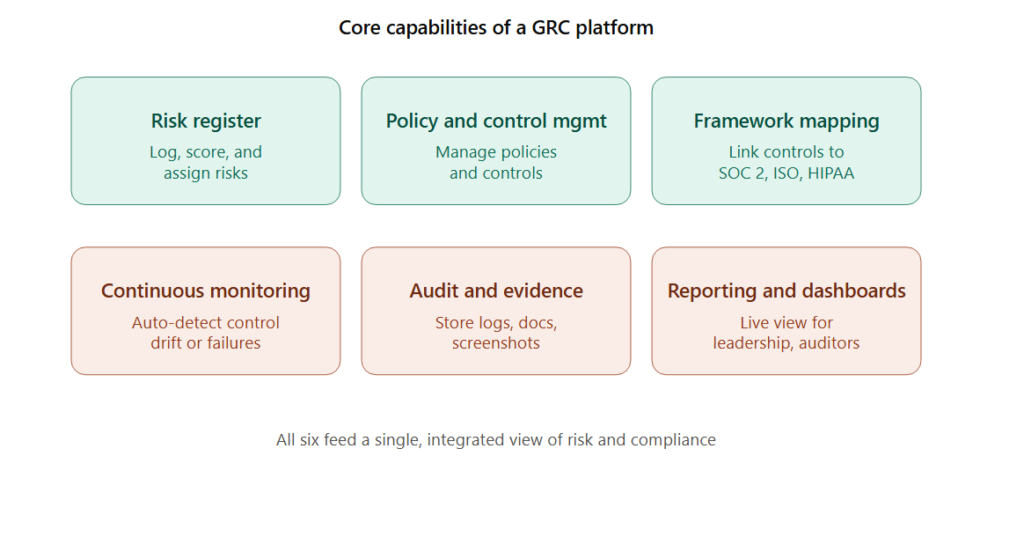
Centralized Risk Register
One location to record the various risks in the organization, evaluate probability and impact, determine owners, and manage risk mitigation efforts through time.
Policy and Control Management
Controlled access to the organization’s policies and the various controls that must be implemented in order to comply with the policies.
Framework and Regulation Mapping
Establishing a correlation between specific controls and the requirements that they fulfill in accordance with frameworks such as SOC 2, ISO 27001, HIPAA, and GDPR, thus enabling a quick overview of compliance level in relation to each specific framework.
Continuous Monitoring
A more sophisticated platform is one that integrates with cloud infrastructure, identity provider, and other systems in order to automatically discover control failures or drifts instead of manually checking for them.
Audit and Evidence Management
Aggregating all the information that will be used to prove compliance, screenshots, logs, documents, to avoid a last-minute rush for gathering information during the audit process.
Reporting and Dashboards
Providing leadership, board members, and auditors with an up-to-date perspective on risks and the compliance posture of the organization without the need to prepare reports manually.
Categories of GRC Platforms
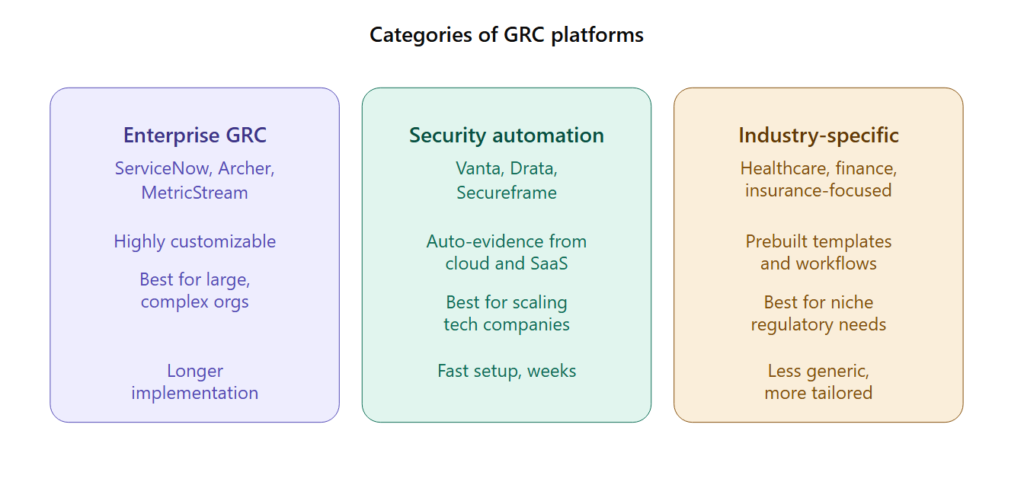
Enterprise GRC Platforms
These kinds of tools, such as ServiceNow GRC, RSA Archer, and MetricStream, suit large companies because of their complicated and diverse compliance requirements. Being highly customizable, they provide great capabilities but, usually, take longer to implement due to their complexity.
Security Compliance Automation Platforms
Vanta, Drata, and Secureframe specialize in security frameworks and are well-liked among rapidly scaling technology firms mainly due to their ability to automatically gather most of the evidence right from the cloud and SaaS solutions and implement themselves faster than enterprise-level solutions, usually to meet a customer’s security demands prior to closing a deal.
Industry-Specific Platforms
Some GRC solutions have been designed based on the unique compliance requirements of an industry such as healthcare, financial services, insurance, providing predefined templates and workflows to suit these requirements rather than a completely generic solution.
How to Evaluate a GRC Platform for Your Organization
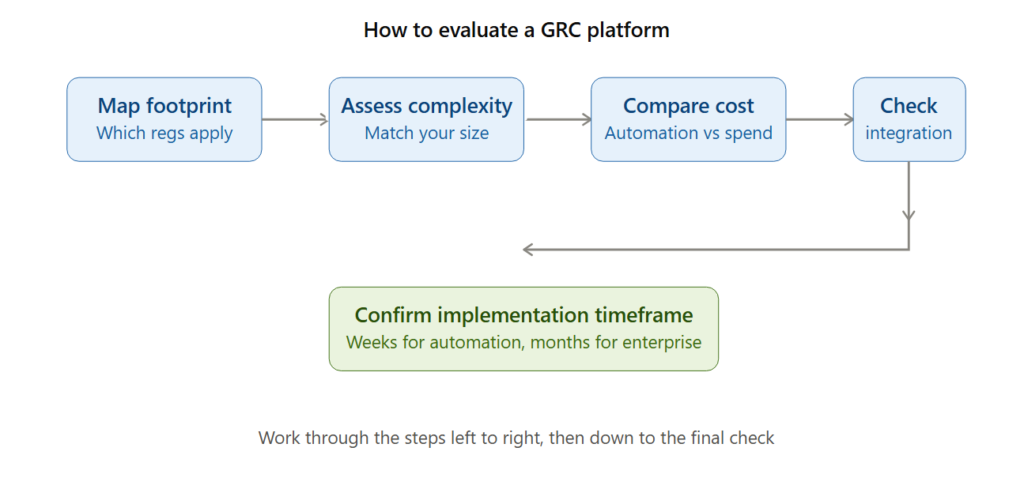
- Create an accurate regulatory footprint of your own first. Understand which frameworks and regulations really apply before choosing a platform, since this varies greatly from one platform to another.
- Evaluate your company’s level of complexity accurately. It is highly unlikely that a mid-size company working with a single framework requires the level of configurability (and cost, and implementation time) of a platform made for multinationals dealing with many overlapping requirements.
- Compare automation and costs. The more you automate the collection of your evidence, the less you need to do manually later, but the more expensive it is, and it’s worth it once manual collection is more costly.
- Consider integration with your systems. It is much better for the future when the platform can integrate natively with your cloud provider and tools, rather than doing everything manually.
- Understand your implementation time frame. Enterprise platforms require months for implementation, while compliance automation platforms are usually made to make a company ready for audits within weeks.
Common Mistakes When Choosing a GRC Platform
- Buying up more enterprise complexity than is necessary at that stage in the game
- Not recognizing the internal process and ownership commitment to maintaining accurate data within the platform over time
- Choosing the platform based on its brand name rather than what it actually covers and integrates with
- Seeing platform implementation as a project rather than an operational task
Bottom Line
The appropriate GRC solution would depend on the actual regulatory environment of your organization as well as its phase of development and current technology platform, rather than on the most robust solution in the market. Start-up organizations focusing on just a few security frameworks usually benefit from using more lightweight solutions that leverage automation, whereas larger or highly regulated companies need a more configurable enterprise GRC solution.