Grammarly AI Detector: How It Works Inside Grammarly’s Writing Assistant

Introduction
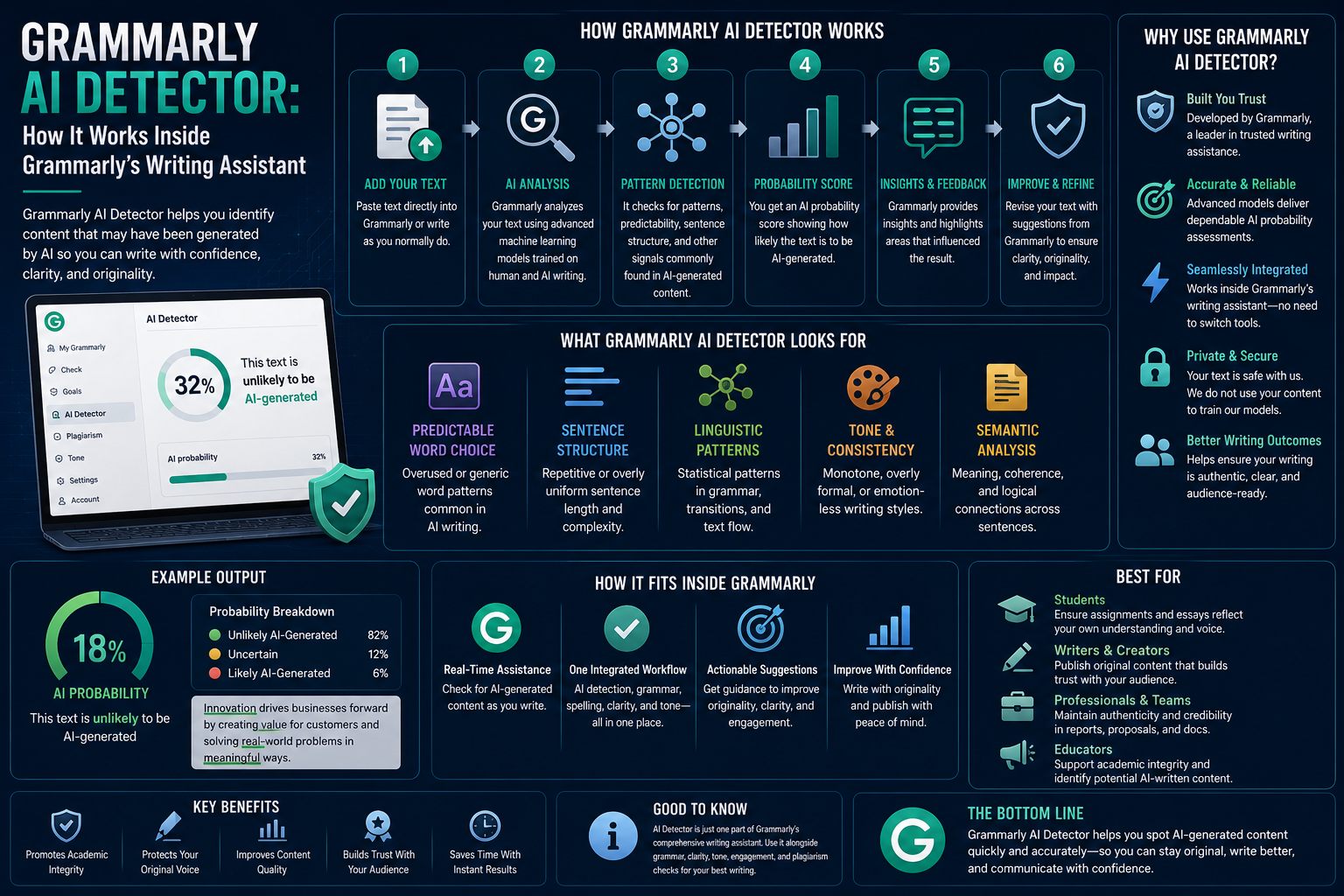
The AI detector in Grammarly is an AI detector technology that is part of the Grammarly writing assistance software package. It analyses submitted texts to estimate the extent to which those texts have been created using artificial intelligence technology. Contrary to the ZeroGPT and Originality.ai, the AI detector technology from Grammarly is not marketed as a separate product. Instead, it is just one component in a large suite of applications provided by Grammarly.
In this article, there will be a comprehensive discussion of the AI detector in Grammarly.
What Grammarly’s AI Detector Does
If a paper passes through Grammarly, the tool is able to point out the segments of the paper that might have been written using AI software, along with other suggestions for grammar, readability, and style issues.
It appears as:
- An estimation of the portion of AI-generated text in a paper
- Comments instead of just an overall rating
Meanwhile, Grammarly’s approach seems to be quite unique compared to the detection tools, because Grammarly is also providing AI tools for writing and text creation.
In that sense, Grammarly is just like QuillBot.
How Grammarly’s AI Detection Works
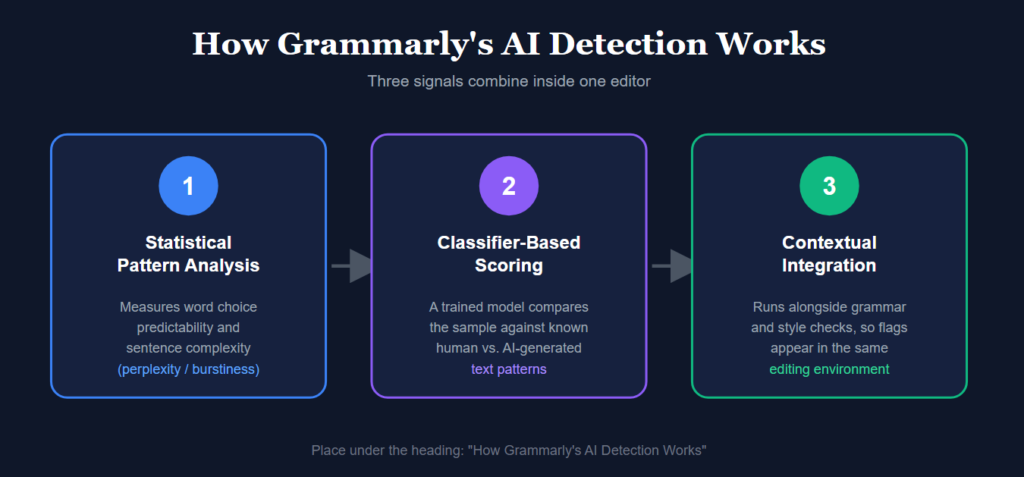
The Grammarly detection tool uses the same type of signals that are commonly used by other AI text detectors.
1. Statistical Language Pattern Analysis
Word choice predictability and sentence complexity evaluation using the same type of signals called perplexity and burstiness in the detection field.
2. Classifier-Based Scoring
This involves using an already trained model to analyze the patterns in the sample provided against those typical of both human and AI-generated texts.
3. Contextual Integration
Since the detection process occurs concurrently with all the other text check functions offered by Grammarly, the flagged parts appear in the same editing environment as the grammar and style suggestions.
Where Grammarly’s AI Detector Fits Within the Platform
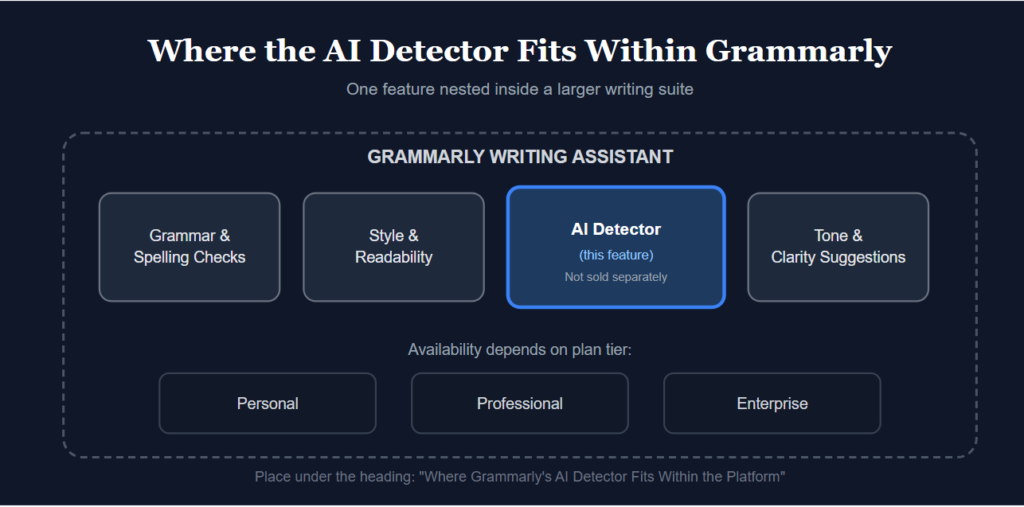
Grammarly’s services come in different tiers, and the inclusion of an AI detector will depend on the specific tier, which could either be personal, professional, or enterprise-oriented.
Generally, the service is considered as one of the features provided by Grammarly to their users, and not a separate standalone product.
This is contrary to how other companies such as Originality.ai or GPTZero market their services.
How Grammarly’s Detector Compares to Standalone Tools
Against Dedicated Detectors Like Originality.ai or GPTZero
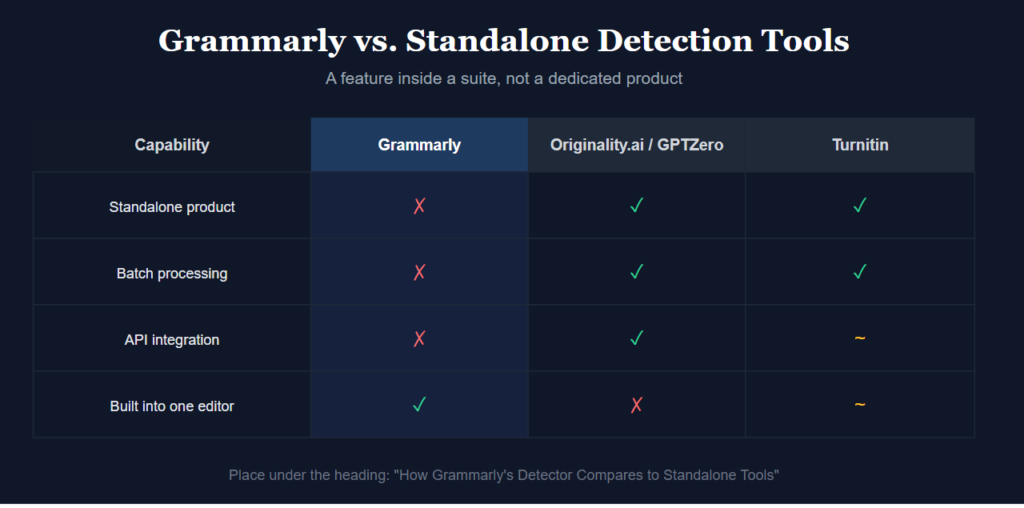
Independent detection systems typically come equipped with:
- Advanced reporting features
- Batch processing capability
- API integration
The above characteristics are designed for publishers, teachers, and other professionals who are testing large volumes of content. Grammarly’s tool is better suited for use as one step in the larger process of editing an individual piece of content.
Against QuillBot
Grammarly and QuillBot share the same space:
- Companies most famous for something else
- AI detector only as an additional feature
Neither uses AI detectors as their main product like ZeroGPT and Originality.ai do.
Against Academic-Specific Tools Like Turnitin
In addition to being trained on academic writing, Turnitin is built into institutional learning management systems, providing a more specific application than the general grammar checking capabilities offered by Grammarly.
Accuracy Considerations
Like all AI detectors available today, it is very typical that Grammarly’s detection feature may provide false positives and false negatives, especially in the case of:
- Highly modified or rewritten AI-generated content, which will not meet the detection criteria despite being produced by a language model.
- Non-native English writing, which might have some similarities with AI-generated writing.
- Short pieces of text, where there is not enough text for statistics to be reliable.
No information about the exact figures related to the accuracy of this detection feature, provided by Grammarly, has been made public yet.
Who Uses Grammarly’s AI Detector
Professional Writers and Editors
As part of a larger editing effort, since this is done in conjunction with other recommendations regarding grammar and clarity that the user is looking at.
Students
In an informal way among students already using Grammarly to check grammar, who are now using the plagiarism checker as part of their regular workflow process.
Business and Enterprise Users
Used by those teams that are already on Grammarly’s business plans as an extra tool for reviewing their internal and external documents without having to go for a new detector software.
Why This Matters for Users Already on Grammarly
For those individuals who use Grammarly for correcting grammatical errors, the integration of the detection process within Grammarly will save the time and effort involved in copying the text into another tool.
This is the primary benefit offered by this tool compared to independent detectors although the report generated by this software cannot be compared to that offered by detection tools.
Bottom Line
The AI detection tool by Grammarly works as an extra layer in their existing writing assistant and not as a separate product in itself, using the same statistical methods of identifying language patterns as the rest of the category does.
This gives the advantage to the user who is already working within the Grammarly editor interface, but it cannot match the features that other specific products offer in terms of batch processing and APIs.
Like all detectors, its results can be considered just one data point in the larger process of editing.