Generative AI and Chatbots: How the Technology Actually Connects

Introduction
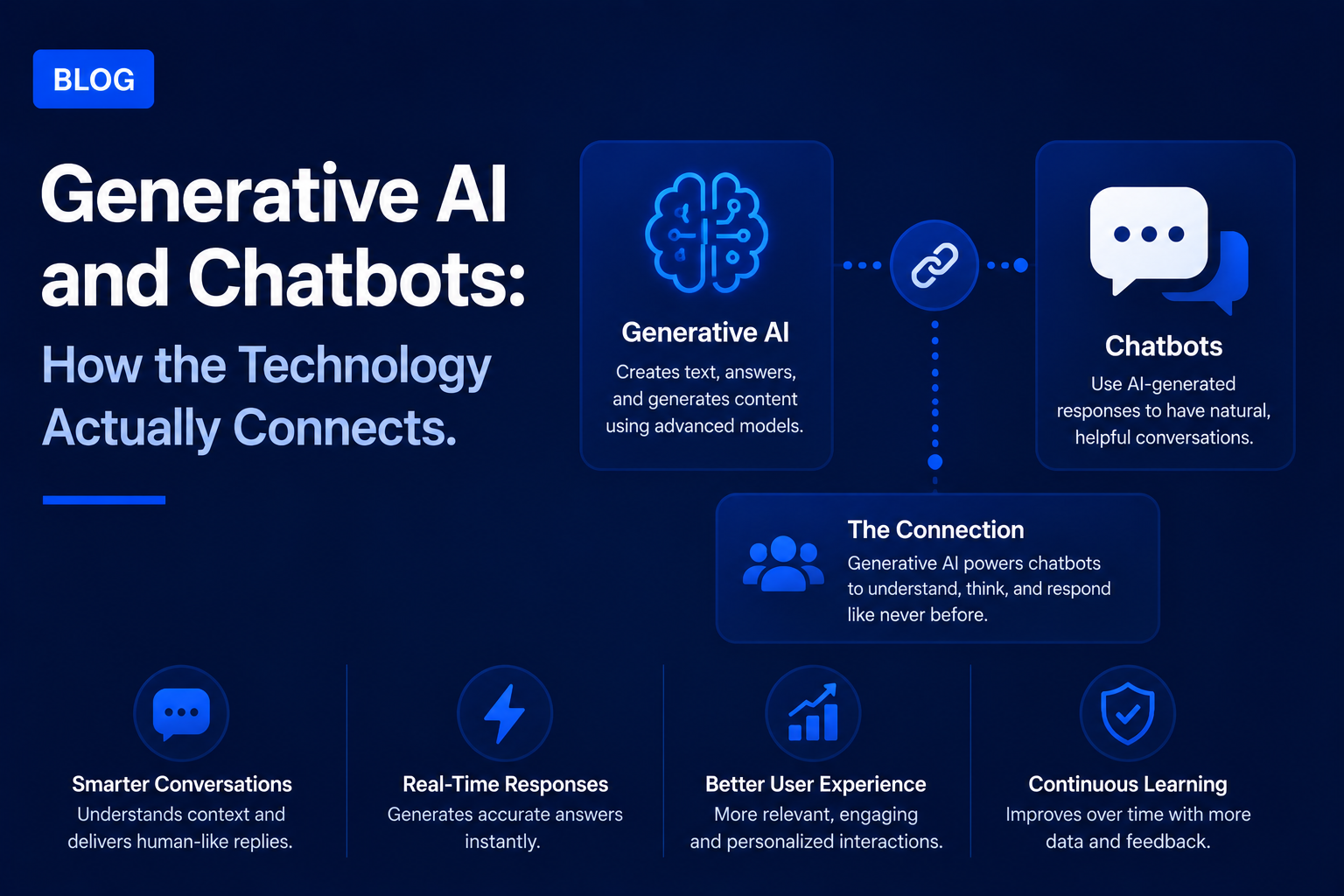
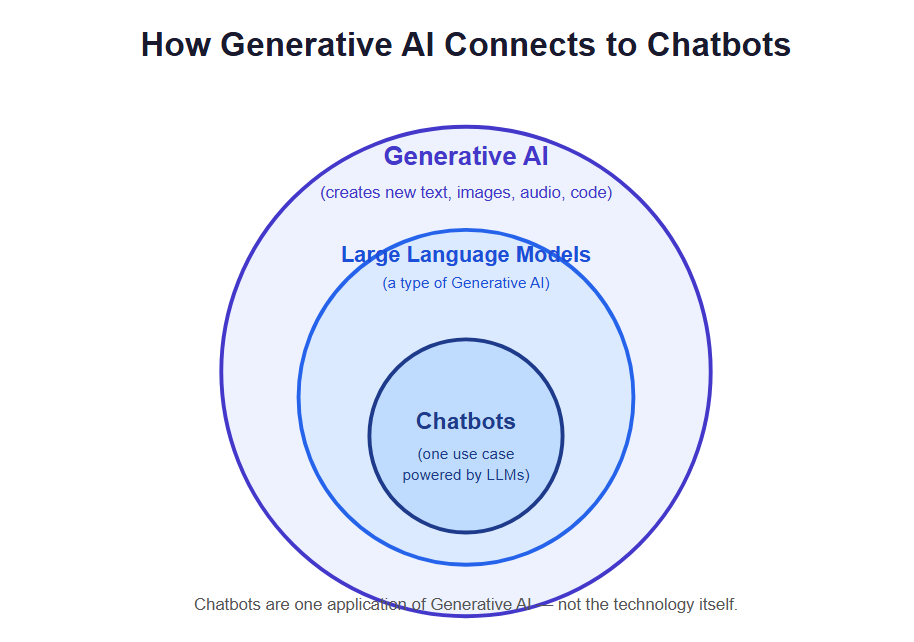
Generative AI and chatbots are discussed together so frequently that the connection appears to be self-evident; however, it pays to know exactly what that connection is: Generative AI is the technology itself while chatbots are only one of its uses.
This is how they are linked together.
What Generative AI Actually Is
What is meant by Generative AI?
Generative AI means a set of models that are trained to create new content, either text, images, audio, and even code. They do not just classify or analyze the content that already exists. Large language models or LLMs are one of the types of Generative AI. They power most of the modern chatbots today.
How Generative AI Changed What Chatbots Can Do
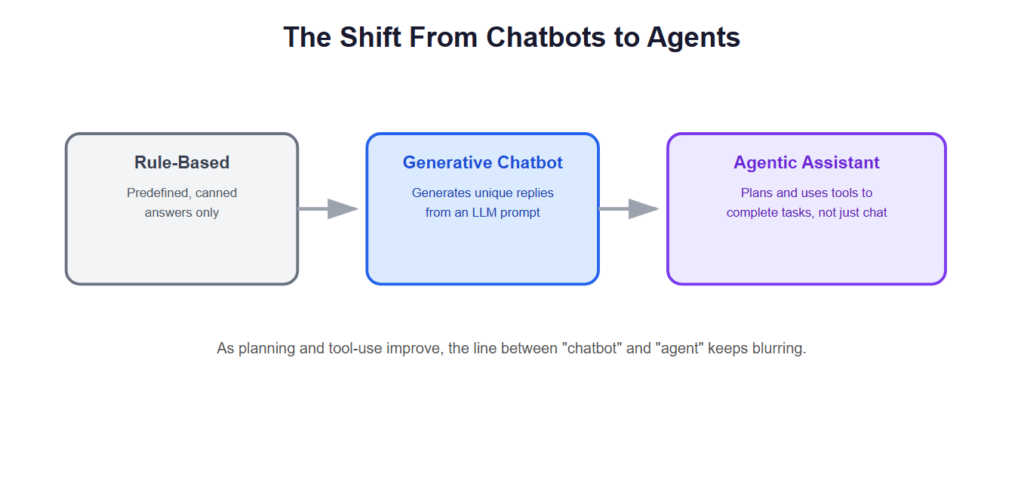
Before it became feasible to use generative AI, the chatbots had to use rule-based or retrieval-based approaches, choosing predefined responses for each user input, or even using canned answers stored in advance.
They were suitable for simple and predictable conversations, but did not work properly in any other cases.
Generative AI provided a breakthrough here.
While traditional chatbots would have to pick up a predefined answer, a modern chatbot powered by LLM would generate a unique piece of text, based on a prompt given.
It is the main difference that made chatbots finally become efficient conversational assistants.
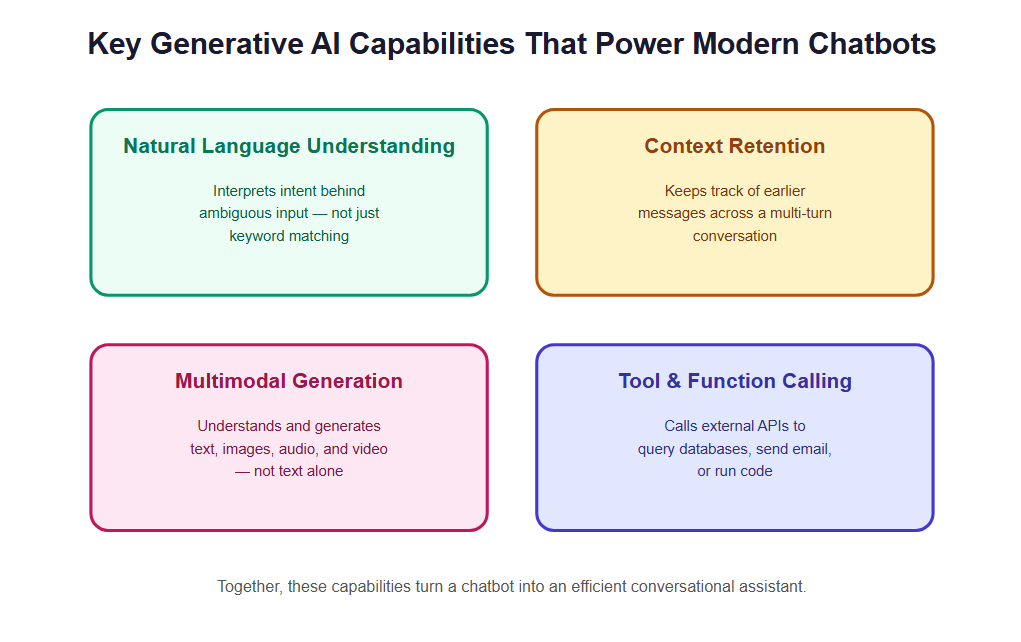
Key Generative AI Capabilities That Power Modern Chatbots
Natural Language Understanding
Interpretation of the intention of diverse and even ambiguous user input, rather than an exact match of keywords.
Context Retention
Understanding consistency throughout a multi-message dialogue, where previous messages of the dialogue are considered, rather than just the current message.
Multimodal Generation
Not only is the capacity of a generative AI model to understand and output text, but it now has the capability of understanding and generating images, audio, and video too.
Tool and Function Calling
Contemporary generative AI models have the capability to prompt their responses through the use of outside functions or APIs, thus making a chatbot do more than just interact by:
- Accessing a database
- Sending an email
- Running code
Where Generative AI Introduces New Challenges for Chatbots
Hallucination
Generative models can create information that sounds plausible but may not be true at all. It could become an issue if you use chatbots in areas where factual correctness is necessary, like customer service, medical advice, legal advice, or financial advice.
That is why grounding your bot’s replies in up-to-date sources is much more important than just training the model.
Consistency
Since the responses are generated by the model each time anew, the question may receive different answers depending on the context and even the session. This makes evaluation and testing of the bot much more difficult.
Cost and Latency
Creating responses using big models requires more processing power than just finding a suitable reply in the database.
How Businesses Are Applying Generative AI-Powered Chatbots
Examples include:
- Customer service (helping customers with their queries and solving their problems based on their internal knowledgebase)
- Sales help (conversing with leads and answering any product queries)
- Productivity helpers (assist employees to search for information or do simple tasks)
- Also, more and more agentic assistants that allow the bot not only to answer the queries but to perform multiple tasks through access to the tools.
The Shift From Chatbots to Agents
With the increased competence of generative AI systems, especially when it comes to planning and utilizing tools, the distinction between a “chatbot” (conversing with humans) and an “agent” (task completion) has started fading.
It is quite evident that many services which are being called chatbots today are actually exhibiting agentic behaviors and taking actions rather than just having conversations through text generation.
Bottom Line
The technology that is responsible for the evolution of chatbots is known as Generative AI, which made chatbots less robotic and more fluid in their communication.
This same capacity of being generative is driving the chatbots even further to perform actual work, but at the same time creating issues of accuracy and consistency that organizations have to deal with.