GDPR Data Protection: What It Actually Covers and Why It’s Easy to Get Wrong

Introduction
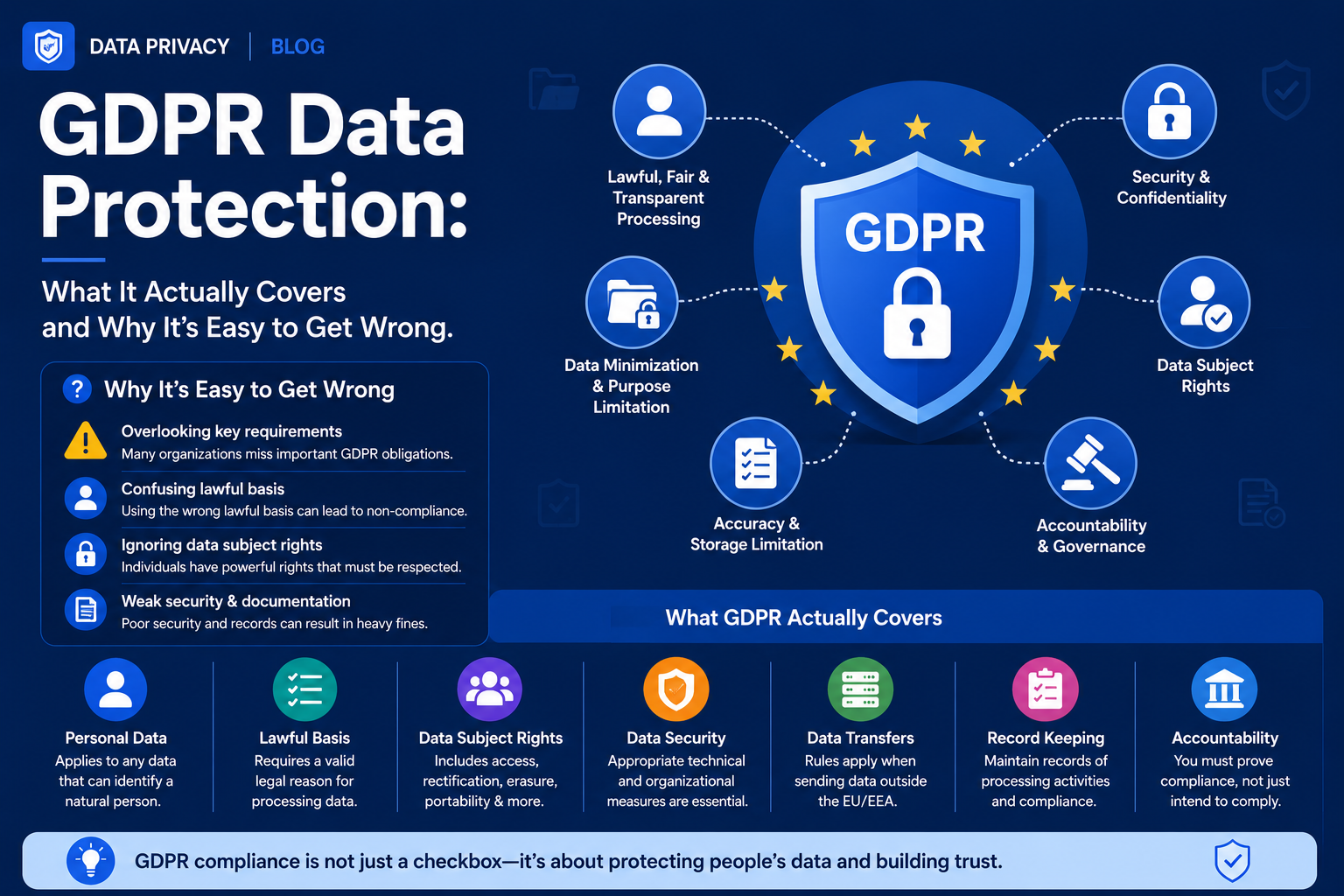
Compliance with data protection under the GDPR requires the assurance that the processes used by the firm to manage its data comply with the principles and standards set out in the GDPR rather than taking for granted that being GDPR-compliant is an all-encompassing process.
While this might seem rather simple at first glance, it should be noted that the numerous core principles that make up the regulation are often misunderstood by firms.
Why GDPR Data Protection Is More Complex Than It Appears
GDPR data protection regulations are not something monolithic but a set of regulations that include the following:
- Principles for regulating data processing procedures
- Regulations according to the kind of data and activities performed by the company
- Obligations of accountability as a continuous proof of compliance, and not just an initial evaluation
There are many companies considering GDPR compliance as a project that ends with a certain deadline, and this perception does not take into account the regulation’s requirement of continuous and demonstrated accountability.
In case a company deals with different kinds of data, the application of GDPR principles should be done separately for each procedure, since the same basic principle may imply completely different implementation according to particular data and activity.
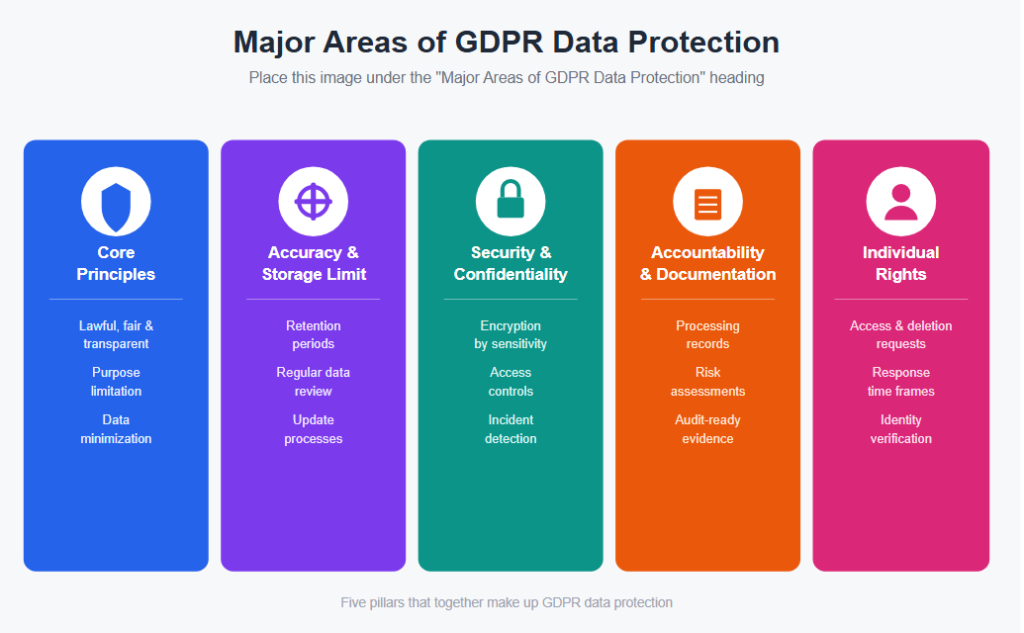
Major Areas of GDPR Data Protection
1. Core Data Protection Principles
Rules Governing
- Processing that is legal, fair, and transparent
- Purpose restriction, limiting data usage for intended purposes
- Data minimization, collecting only what is truly needed
Excessive data collection compared to what is truly needed is one of the most common and expensive violations of these principles, as it could lead to:
- Higher risk exposure due to unnecessary data storage
- Difficulties in defending the need to collect data
- More damage in case of a security breach due to excess data storage
2. Accuracy and Storage Limitation
Data protection under GDPR generally involves the need for companies to uphold data quality, which means that the processes involved must ensure that the data is accurate and not stored beyond the time period required.
Storage Limitation Often Involves
- Retention periods of data by categories
- Regular review and destruction of old personal data
- Processes to update inaccurate data
3. Security and Confidentiality Requirements
However, handling involves more than just the commitments of policies; it includes the growing demand for security practices to be demonstrated.
Those Security Measures Usually Vary in Many Respects Including
- Encryption that is suitable for the level of sensitivity of the data
- Access controls that restrict who has access to the personal data
- Incident detection and response mechanisms
4. Accountability and Documentation
GDPR data protection frequently demands:
- Processing activity records kept up-to-date continuously
- Risk assessments recorded for increased-risk processing
- Evidence of compliance that is easily accessible for inspection by the regulator
The extent of documentation necessary varies based on the size and risks associated with the data processing operations.
5. Individual Rights Implementation
A number of GDPR data protection programs require the capability to perform certain operations which include the following:
- Access, Correction and Deletion Request Processes
- Time Frame for Responding to Individual Rights Requests
- Identity Verification of the Requester
Such capabilities are essential to be performed as mere documentation of policy without processes fails to meet GDPR practical requirements.
Why GDPR Data Protection Efforts Fall Short Even With Genuine Commitment
True GDPR non-compliance rarely occurs since the organization fails to take GDPR seriously.
Instead, it might occur because:
- Compliance is seen as something that is done and not a process.
- Data minimization is not considered, and data collection is conducted just in case.
- The processes for exercising rights are present, but have never actually been put to the test.
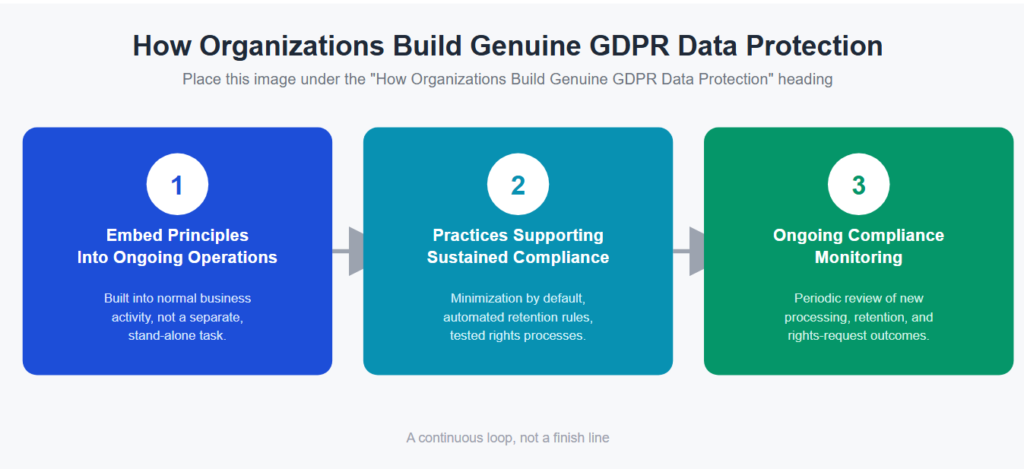
How Organizations Build Genuine GDPR Data Protection
1. Embedding Principles Into Ongoing Operations
For bigger companies, GDPR data protection may be included into normal business operations and not seen as a stand-alone activity in situations where new data processing activities start often.
2. Practices Supporting Sustained Compliance
Some ways of GDPR data protection include:
- Using data minimization as a default setting for new processes
- Scheduling automated retention and deletion according to the schedule wherever possible
- Testing processes of handling individual rights requests in realistic conditions
3. Ongoing Compliance Monitoring
Organization conducts reviews periodically on:
- Assessment of new data processing activities
- Retention of data in accordance with the schedule
- Timeliness and results of individual rights requests
Periodic review will help organizations ensure that GDPR data protection is still alive rather than a one-time task..
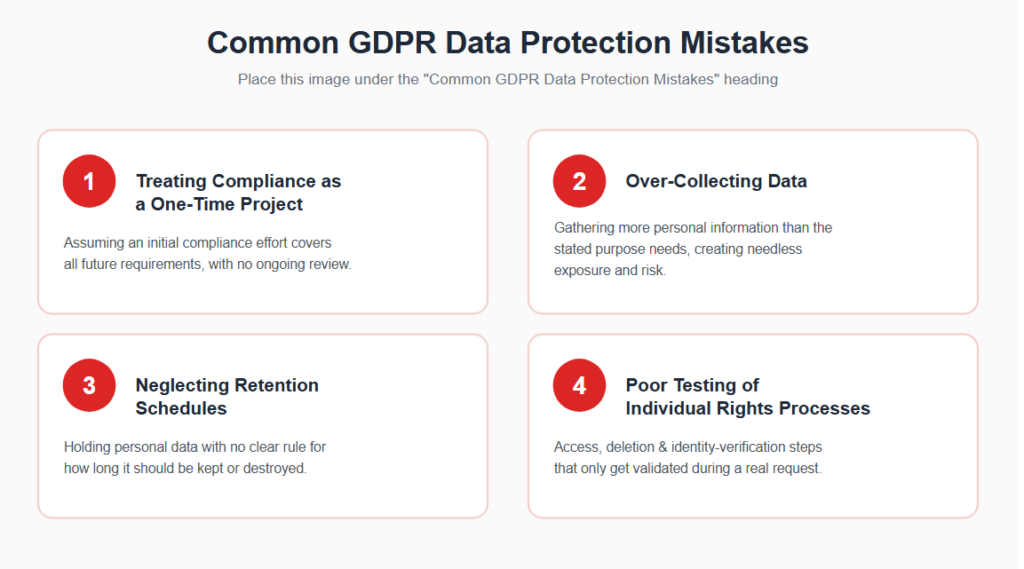
Common GDPR Data Protection Mistakes
1. Treating Compliance as a One-Time Project
Assuming that an initial effort to comply meets all future requirements without further consideration.
2. Over-Collecting Data
Gathering more personal information than is truly needed for the stated purposes, exposing oneself needlessly to risk.
3. Neglecting Retention Schedules
Retention of personal data without any clear guidelines on how long it must be retained or destroyed.
4. Poor Testing of Individual Rights Processes
Insufficient validation of:
- Whether the processes for making access requests work within the required time frame
- Deletion request processing in all systems containing the data
- Procedures used to verify identity in order to prevent unauthorized requests
Improper testing may result in failure to comply found only during a real request or audit.
Bottom Line
Data protection under the GDPR is actually very broad and includes a range of factors such as the principles, accuracy and retention, security, accountability documentation, and individual rights.
Given that the amount required by the GDPR involves continuous practice rather than an achieved state, it would have been better for the organizations to adopt these principles through their normal business processes.