eSign Documents: What the Process Actually Covers and Why It’s Easy to Get Wrong

Introduction
The process of e-signing entails capturing a legal electronic signature in a variety of document formats and workflow processes, and not just one particular process confined to PDFs alone.
Although this may appear straightforward on the surface, the many different types of documents and processes involved have made it an area where businesses often struggle for consistency.
Why eSigning Documents Is More Complex Than It Appears
Digital signing of documents is not a homogeneous procedure but a structure composed of the following aspects:
- Different document types necessitating different signing procedures
- Different degrees of legal formality that depend on the nature of a particular document
- Workflows linking signed documents to broader business processes
Some companies employ one and the same signing procedure irrespective of document type, but this approach ignores differences between particular documents.
For a company that uses several types of documents, it is necessary to choose a signing procedure individually for every document type, since internal policy acknowledgment has totally different requirements compared to customer agreements or other forms.
Major Areas of eSigning Documents
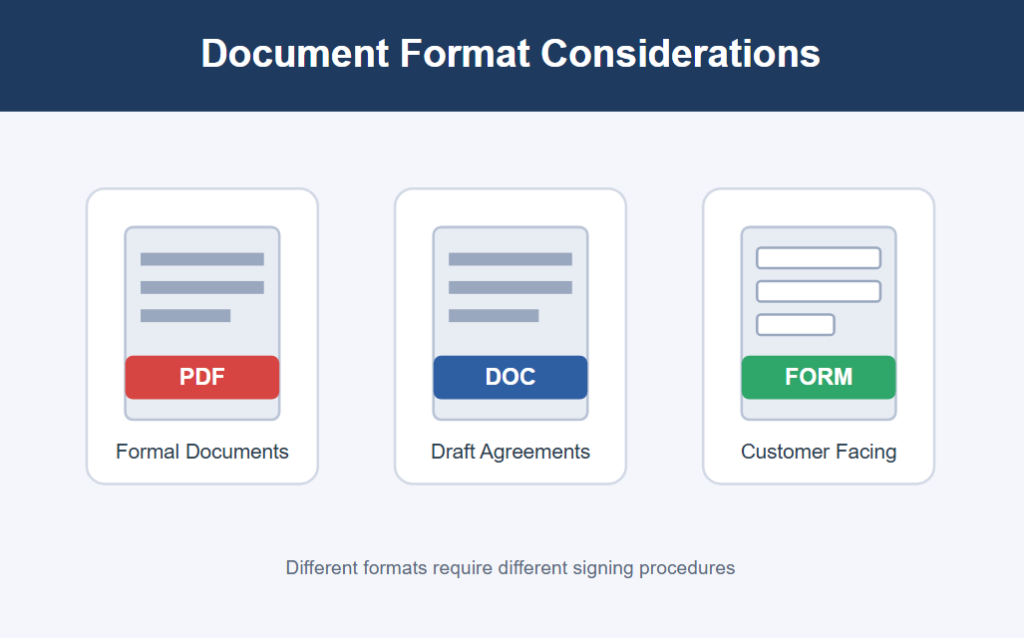
Document Format Considerations
Rules Governing
- Signing of PDF documents, the most commonly used type for formal documentation
- Signing of Word documents, which are used for draft agreements
- Signing of web forms, which are widely used to interact with customers
The use of incorrect format and signing technique is one of the most common problems since it can lead to:
- Documents that lose their formatting after being converted for signing
- Different signing experiences for various types of documents
- Uncertainty regarding which version is the signed final document
Legal Formality by Document Type
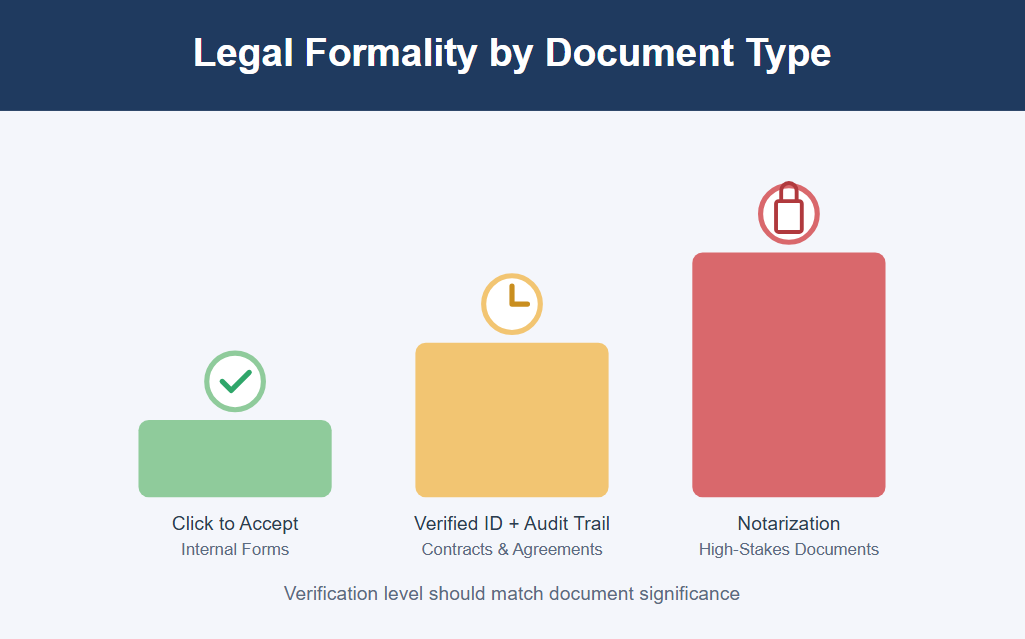
Signing of documents normally involves balancing formality and significance where high levels of verification must be employed in order to fit the level of formal documents involved.
Formality Considerations Often Include
- Click-to-accept signature for less formal internal acceptance forms
- Verified identification and audit trails for formal agreements and contracts
- More formal steps like notarization for certain kinds of documents
Workflow and Business System Integration
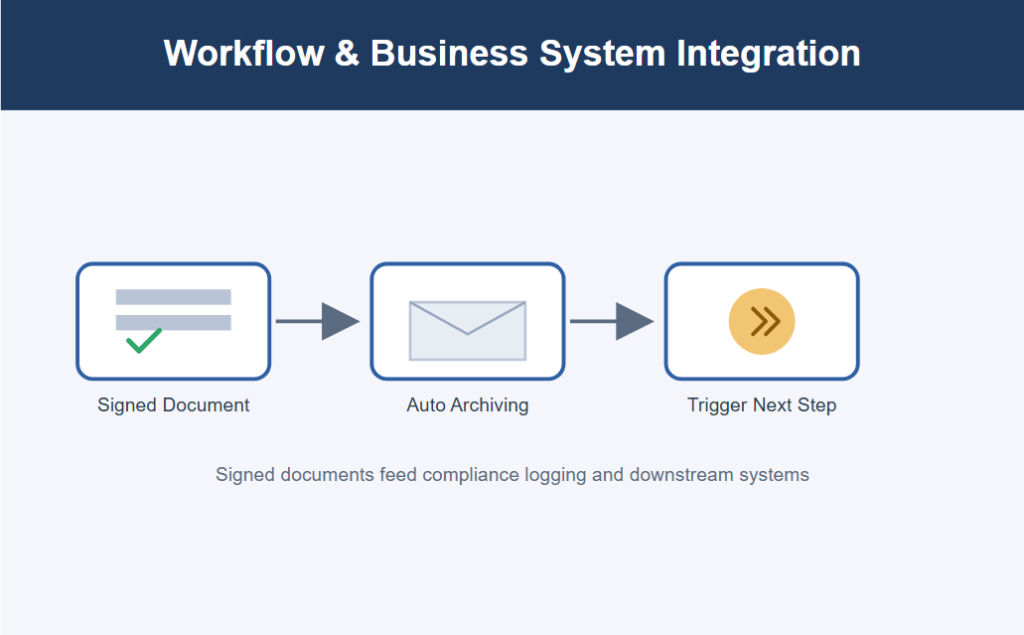
The process also goes beyond simply signing the documents, involving the growing importance of how the documents that have been signed fit into business processes.
Those Integrations Usually Vary in Many Respects Including
- Automatic archiving of the signed document to document management systems
- Starting of other processes after signing of a particular document
- Compliance notifications and logging
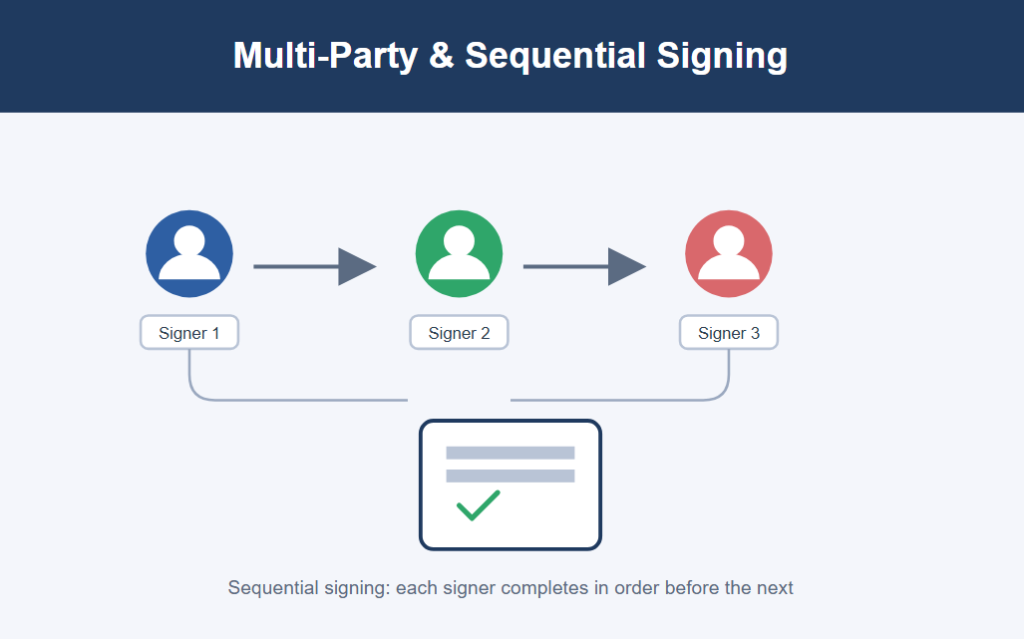
Multi-Party and Sequential Signing
Signatures using e-signing methods include:
- A number of signers in a prescribed sequence
- Parallel signing where there is no sequence
- Workflows that involve internal approvals prior to actual signing
The degree of workflow complexity varies with the number of stakeholders in the process.
Retention and Compliance Requirements
There are some eSigning procedures that entail certain practices such as:
- Document signing retention periods depending on their nature
- Protection of sensitive signed agreements from any possible breaches of security
- Retention of audit trails adequate enough to prove the authenticity of the signature in case of a dispute.
These practices need to be enforced due to the fact that documents of various natures have varying retention periods.
Why eSigning Processes Break Down Even at Organized Companies
An inability to manage eSigning of documents rarely arises from an absence of proper means within a business.
Indeed, this can occur because:
- Various departments have different approaches towards signing of similar documents.
- There is no systematic incorporation of the signed documents within the document management system.
- There are no set retention policies for the signed documents.
How Organizations Manage eSigning Documents Effectively
Standardizing Approaches by Document Category
For larger firms, it is possible to specify signing requirements according to types of documents, especially in situations where several departments deal with identical document types on their own.
Practices Supporting Consistent Document Signing
- There are certain approaches which allow for more consistent treatment of documents through:
- Matching the level of signature validation with document importance
- Automatically incorporating signed documents into respective business systems
- Establishing retention policies for each document type
Ongoing Process Reviews
Organizations should undertake periodic audits of:
- Consistency of sign-off procedures across all departments
- Correct operation of integration procedures according to design
- Compliance with retention requirements of already-signed documents
Such periodic audits help organizations ensure that e-signing procedures stay consistent and compliant amid increasing numbers of documents.
Common eSigning Documents Mistakes
Applying One Method to All Document Types
Use the same sign-on procedure for all documents irrespective of their financial and legal importance.
Inconsistent Departmental Practices
Enable multiple departments to sign-off similar documents using different approaches for signing and storing the documents.
Neglecting System Integration
Treat the act of electronic signing in isolation from document management or compliance systems.
Poor Retention Policy Enforcement
Lack of:
- Retention period defined for different document types
- Safeguarding and access to documents required in future
- Review of the actual implementation of the retention policies
The lack of proper enforcement of retention policies can result in compliance issues and challenges in retrieving the signed documents when necessary.
Bottom Line
Document eSigning comes in wide range and involves many factors like document formatting, formality, workflow integration, multi-party signing, and retention policies.
Given the amount that a one-size-fits-all solution fails to recognize the inherent differences between different document types, it seems like a better practice to implement the signing procedure on a per-document basis.