Enterprise GRC: Managing Governance, Risk, and Compliance at Scale

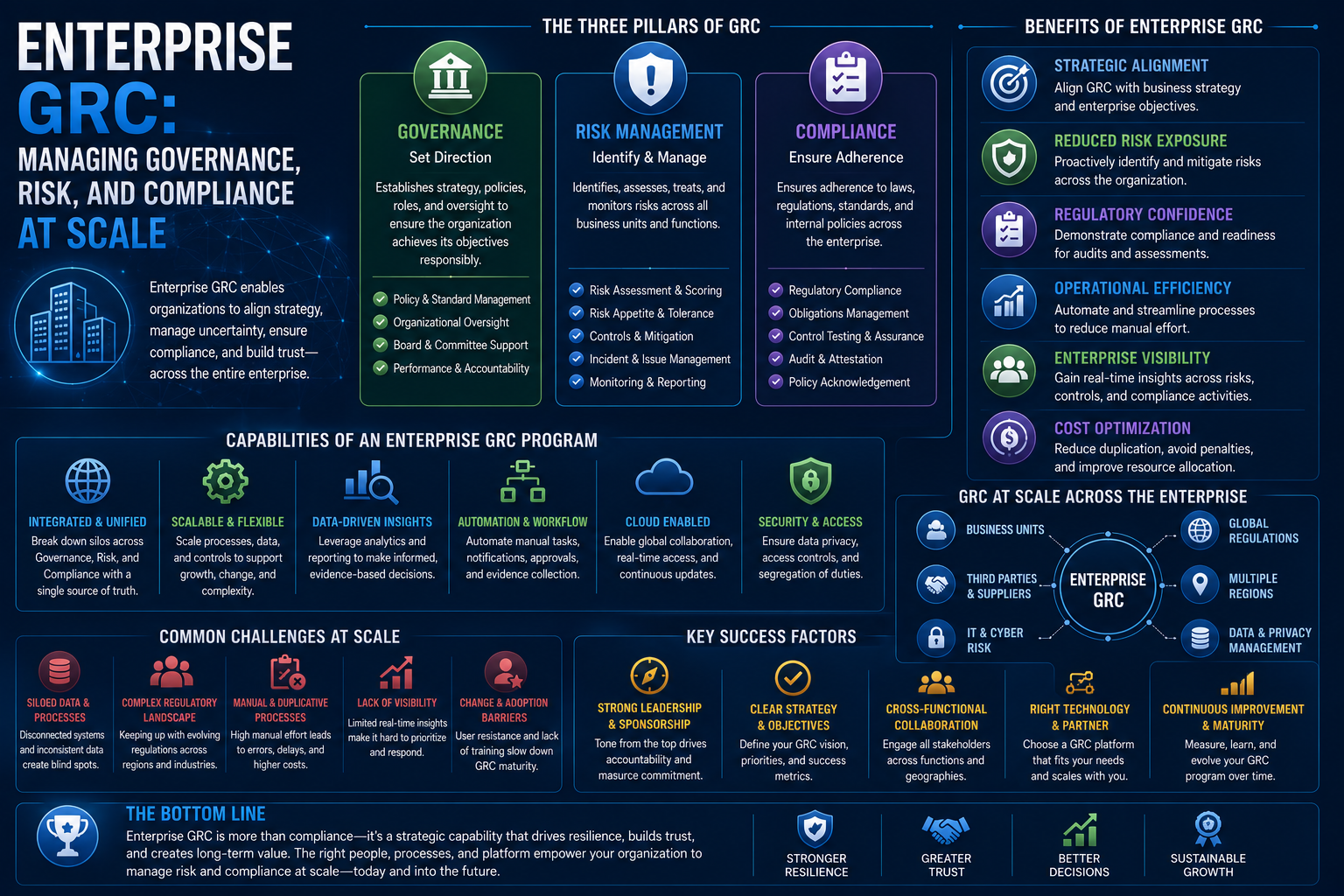
Enterprise GRC is the approach that big companies follow to handle governance, risks, and compliance across multiple business units, geographic locations, and regulatory environments. While the underlying core principle of GRC remains the same, everything else about enterprise GRC is quite different when compared to GRC for any other company.
Why Enterprise GRC Is More Complex
A smaller or medium-sized business could be working with just one or two compliance systems and a limited number of risks.
However, a large corporation could be working with tens of requirements, different regulations in different countries, different regulations in the industry, security standards required by their customers, corporate standards for different business units, and all of that needs to be managed in a coherent way.
That is the reason why enterprise GRC usually requires special software and special leadership such as a Chief Risk Officer or Chief Compliance Officer.
Core Components of an Enterprise GRC Program
Centralized Risk Management Across Business Units
Instead of each business division managing its risks individually, GRC solutions for enterprises use a single risk taxonomy and reporting model whereby the executives get an aggregate risk picture of the whole organization rather than disjointed and inconsistent reports from different divisions.
Multi-Framework Compliance Mapping
Big companies require the implementation of several different frameworks at the same time – SOX for accounting purposes, GDPR, or any regional privacy law, some industry-specific frameworks, and customer requirements such as SOC 2 or ISO 27001. Enterprise GRC solutions usually implement a single control for all frameworks simultaneously, mapping it to all frameworks that it covers instead of repeating the process for each one.
Board and Executive Reporting
The corporate governance reporting framework must ensure that reports are provided in a clear and timely manner to the board of directors and management, who are ultimately responsible for organizational risk and governance despite the efforts of specialized employees.
Third-Party and Vendor Risk Management
Large businesses deal with hundreds to thousands of vendors, each carrying the risk element (especially pertaining to data security). The typical enterprise GRC solution would incorporate an assessment and monitoring process for vendor risks, rather than just doing due diligence once when engaging with a vendor for the first time.
Business Continuity and Operational Resilience
In large enterprises, the business continuity and disaster recovery planning processes are formalized as part of the GRC program due to the possible level of operational disruptions and the regulatory requirements regarding organizational resilience.
Enterprise GRC Platforms
Due to the level of complexity involved here, the typical approach for organizations is to have their own enterprise-level GRC systems such as ServiceNow GRC, RSA Archer, or MetricStream. Such platforms take some time to be implemented (months) but offer the necessary transparency and audit trail that is not possible in a manual spreadsheet-based approach.
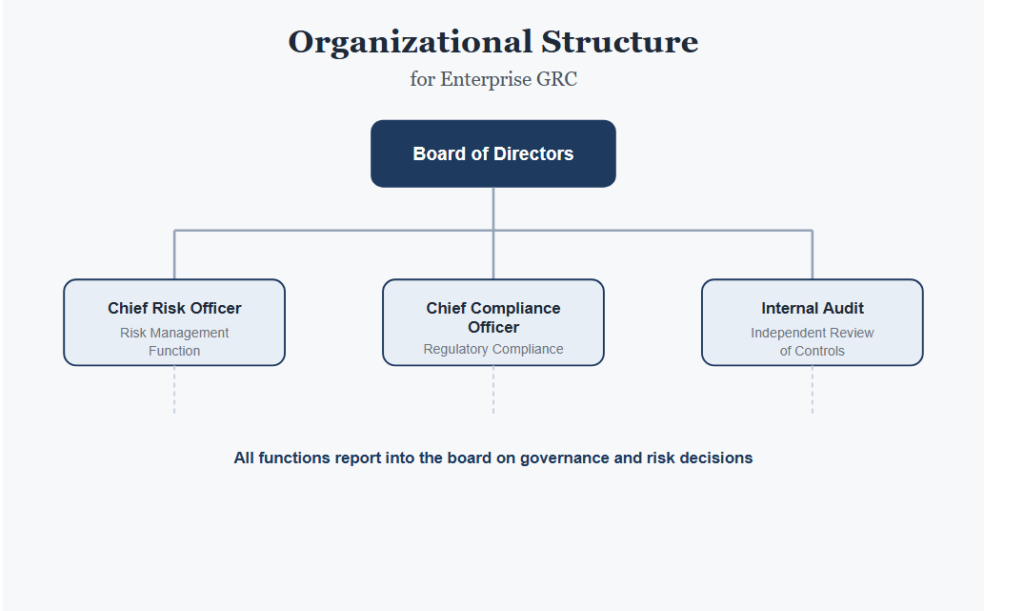
Organizational Structure for Enterprise GRC
GRC within large organizations is formalized through:
- An organizational function for risk management, often headed by a Chief Risk Officer.
- An organizational function for compliance, often headed by a Chief Compliance Officer, which is charged with ensuring regulatory compliance.
- An internal audit function, which is an independent review of whether control mechanisms are operating effectively.
- Reporting lines into the board for GRC, especially governance and risk decisions.
Common Challenges at Enterprise Scale
Data Silos Between Business Units
Individual divisions or regions tend to measure risks and compliance issues separately prior to the implementation of an integrated GRC strategy, thus making it hard to get an overall picture without reconciling data points.
Framework Proliferation
Whereas companies venture into new markets or industries, the quantity of regulations involved increases faster than the ability of processes to adjust to such regulations, except through a deliberate mapping process.
Cultural Adoption
An enterprise GRC system can only fall short if there is no real engagement by the business units in the process, where GRC reporting is perceived as simply going through the motions to comply with requirements.
Bottom Line
Organizations using Enterprise GRC will implement the governance, risk, and compliance concepts in the same manner as they would in any business entity; however, the level of coordination, use of tools, and organizational framework is far higher. Success with Enterprise GRC is just as dependent on the organizational commitment to the process as it is on the technology selected for its support.