Email Marketing for Nonprofits: How to Build Donor Relationships and Drive More Impact

The difficulty with nonprofits is that they have to communicate with many different people including donors, volunteers, beneficiaries, and partners with only a small staff and very little money. This is where email marketing becomes an ideal solution.
In this guide, we cover all aspects of email marketing for nonprofits, from creating a list to writing donor letters that will work.
Why Email Marketing Is Especially Powerful for Nonprofits
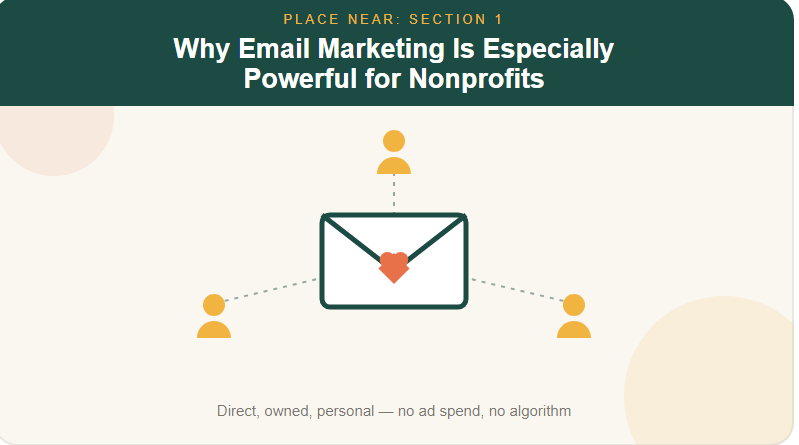
E-mail provides non-profits with a means of communicating directly and personally with supporters without having to pay for ad space or battle against social media algorithms to get seen.
The Case for Nonprofit Email Marketing
- Donor retention: E-mail marketing is one of the best ways to keep donors active between donation periods.
- Cost-effective: Many e-mail systems provide non-profit discounts or even a free plan if your list is small.
- Trackable: You can see who opened, who clicked and who donated, and improve on that.
- Owned: Unlike social media fans, the people on your e-mail list belong to you.
- Versatile: It handles donations, volunteers, programs, events, and advocacy all through one channel.
Marketing through emails for non-profit organizations is producing greater donor retention rate and lower cost-per-donor acquisition compared to those who use social media only.
Choosing the Right Email Platform for Your Nonprofit
Most email service providers provide discounts to nonprofits.
Best Email Marketing Platforms for Nonprofits
Mailchimp
- Discount for nonprofit organizations (15% on paid plans)
- Free for up to 500 contacts
- Robust design and automation tools
- Suitable for: Small and midsize nonprofit organizations with basic requirements
Constant Contact
- Nonprofit discount up to 20-30%
- Good customer support and easy-to-use interface
- Event management capabilities
- Suitable for: Nonprofit organizations conducting frequent events
Salesforce Marketing Cloud (via Salesforce.org)
- Free licenses to eligible nonprofits via Power of Us program
- Automation at the enterprise level with CRM integration
- Suitable for: Large nonprofits or those who use Salesforce CRM
Klaviyo
- No particular nonprofit discount but excellent segmentation capabilities
- Suitable for: Nonprofits requiring advanced segmentation of their donors
Brevo (formerly Sendinblue)
- Budget-friendly pricing without any nonprofit discount but competitive pricing
- Great automation capabilities considering its pricing
- Suitable for: Budget-strapped nonprofits requiring good automation
Building Your Nonprofit Email List
Expanding your list should be a continuous process.
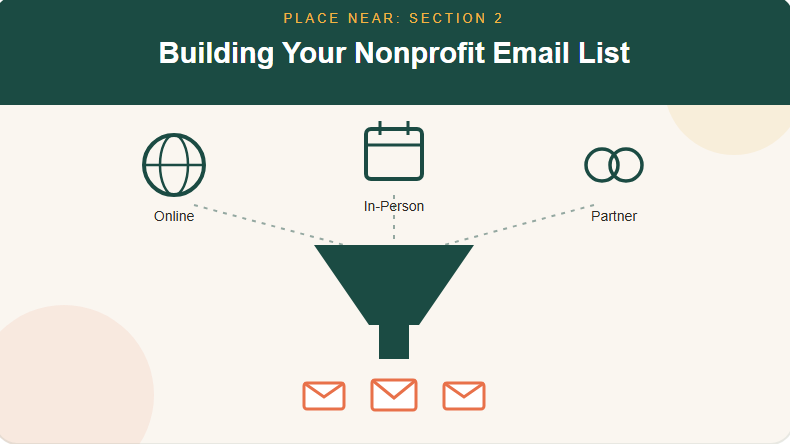
Online List Building
- Add a prominent subscription box to your website home page and donation page
- Design a lead magnet that is relevant to your mission (impact report, guide, research report)
- Ask for social media fans to subscribe by giving them a good reason
- Add a subscription opt-in form to your donation and volunteer forms
In-Person List Building
- Gather email addresses at events, galas, and fundraisers
- Use a sign-in sheet or tablet check at community presentations
- Train employees and volunteers to encourage people to subscribe to your list
Partner List Building
- Work with compatible organizations for mutual promotion
- Develop content that appeals to both audiences
Another important point to remember is that you need to have permission from everyone on your list. Otherwise, it’s against the law to use their addresses.
The 4 Core Email Types for Nonprofits
1. Donor Newsletters
Your routine touchpoint with your supporters. Inform your donors about your programs, success stories, and other news within the organization. Your objective here is to strengthen the bond, not just raise funds.
Frequency
Monthly or quarterly
Content
- Success stories
- Program updates
- Staff highlights
- Volunteers highlights
- Upcoming events
2. Fundraising Appeals
Appeals for financial donations. Should have emotional appeal, details on need, and what a donation will do for you.
Frequency
Major fundraising appeals 2–4 times per year (year-end, matching gift campaign, and others)
Content
Example: Specific story about a donor, problem statement, specific request along with impact ($50 buys water for one family for one month)
3. Event Invitations and Reminders
Events like galas, volunteer days, webinars, awareness day events, community events
Best Practice
Send save-the-date 4–6 weeks in advance, send a full invitation 2–3 weeks in advance, and a follow-up one day before.
4. Advocacy and Action Alerts
For those nonprofits working to effect change through policy or advocating in the community, action alerts help rally your supporters into signing petitions, contacting legislators, and participating in campaigns.
Writing Fundraising Emails That Convert
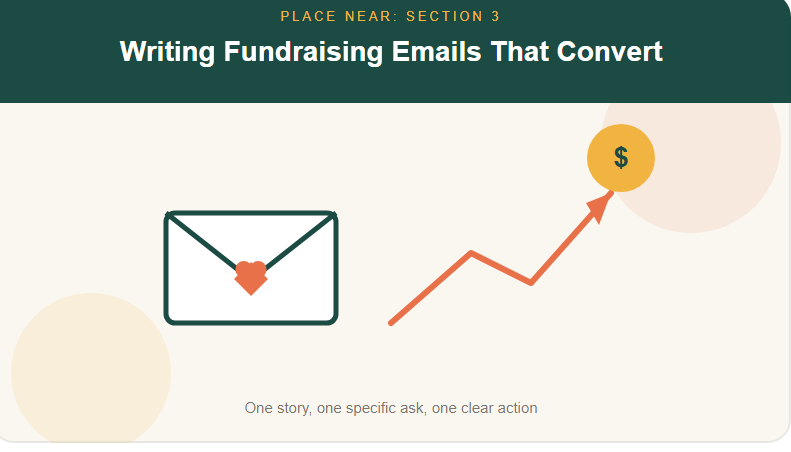
Fundraising emails rise or fall based on their capacity to generate an emotional connection and action.
Key Principles for Effective Fundraising Emails
Lead With a Specific Story, Not Statistics
“While ’37 million people lack access to clean water,’ this is a statistic which can be overlooked. ‘Amara is 7 years old and she walks 3 miles every day to fetch water for her family'”
Make the Ask Specific and Tangible
“A gift of any size” is ineffective. “A gift of $75 means a week of school meals for one child” relates the donation amount to an outcome that can be understood easily.
Use the Word “You” More Than “We”
Your emails should be centered around the impact the donation makes rather than around the activities of the nonprofit. “Thanks to donations such as yours, 500 families now have safe homes” sounds more impactful than “This year we have provided homes to 500 families.”
Include One Clear Call to Action
Avoid asking donors to donate, share and sign a petition all at once. The one-ask rule works best.
Urgency and Deadlines Work
“‘Donations will be matched until midnight’ provides an incentive to make a decision right away rather than procrastinate.”
Email Automation for Nonprofits
“Automation helps you form connections on a massive scale without having to work harder.”
Must-Have Nonprofit Email Automations
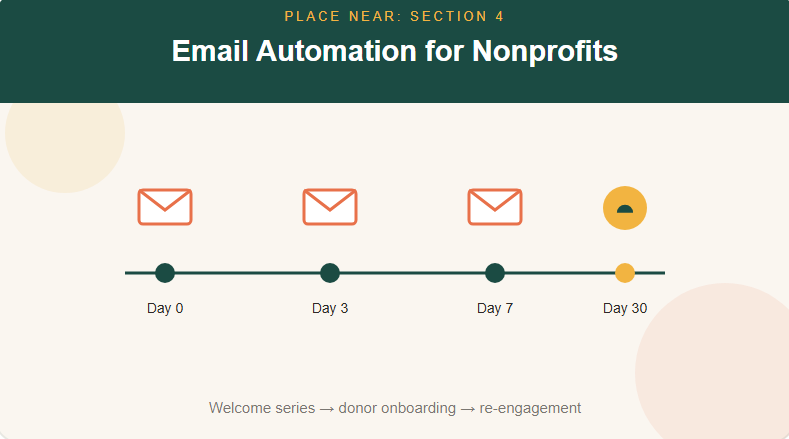
Welcome Series (For New Subscribers)
- Email 1 (immediate): Thank them for subscribing and tell them about your organization’s mission through a compelling story
- Email 2 (Day 3): Show an impact story
- Email 3 (Day 7): Provide information on how to engage (volunteer, donate, share)
New Donor Onboarding Series
- Email 1: Instant thank-you with donation confirmation
- Email 2 (Day 3): Update on impact and give them a glimpse of how their donation is making a difference right now
- Email 3 (Day 14): Story about someone who was impacted by donations similar to theirs
- Email 4 (Day 30): Opportunity for them to get more involved (volunteer, connect socially, attend an event)
Lapsed Donor Re-engagement
For those who haven’t donated in over a year. Tell them what’s different, what’s been achieved, and then ask personally for support.
Birthday or Anniversary Emails
Send out a tailored email to celebrate the one-year anniversary of their first donation. It makes all the difference!
Measuring Email Marketing Success for Nonprofits
Key Metrics to Track
- Open Rate: Benchmark for nonprofit organizations is 26%-28% (better than the average)
- Click through Rate: Benchmark is 3%-5%
- Conversion Rate: % of the email recipients who have taken the desired actions (made a donation, subscribed, signed a petition)
- Average Donation per email: Donation made by email attributed divided by total emails sent out
- Donation Retention Rate: Do your subscribers make repeated donations more often than those not on your list?
Common Nonprofit Email Marketing Mistakes
1. Only Emailing During Fundraising Campaigns
Donors that only contact you when they need money are called lapsed donors. Keep in touch throughout the year with impact information.
2. Treating All Donors the Same
The major donor that gave $10,000 should not get the same email as someone who gave $25. Segment your mailing list and target them accordingly.
3. Focusing on Organizational Accomplishments Instead of Donor Impact
Your donors would like to know what their donations have enabled you to do, not what you have done.
4. Neglecting Mobile Optimization
More than 60% of all emails are opened from mobile devices. Go for single-column layout with large fonts and big buttons.
5. Not Testing Subject Lines
The open rate of your appeals may differ by 20-30% depending only on the subject line. Don’t forget the A/B test!
Final Thoughts
Email marketing for nonprofits is the most effective use of money that an organization can put into building its communication framework. It helps build donor relationships, generates funds for the nonprofit through its fundraising activities, motivates the volunteering process, and maintains community interest when not involved in any big campaign. You should begin by having a clean email list, an interesting welcome campaign series, and a resolve to send useful information on a regular basis, and not just fundraisers. Nonprofits that use email marketing to build relationships rather than to solicit donations always come out better.