Email Marketing Best Practices 2024: What’s Working Right Now

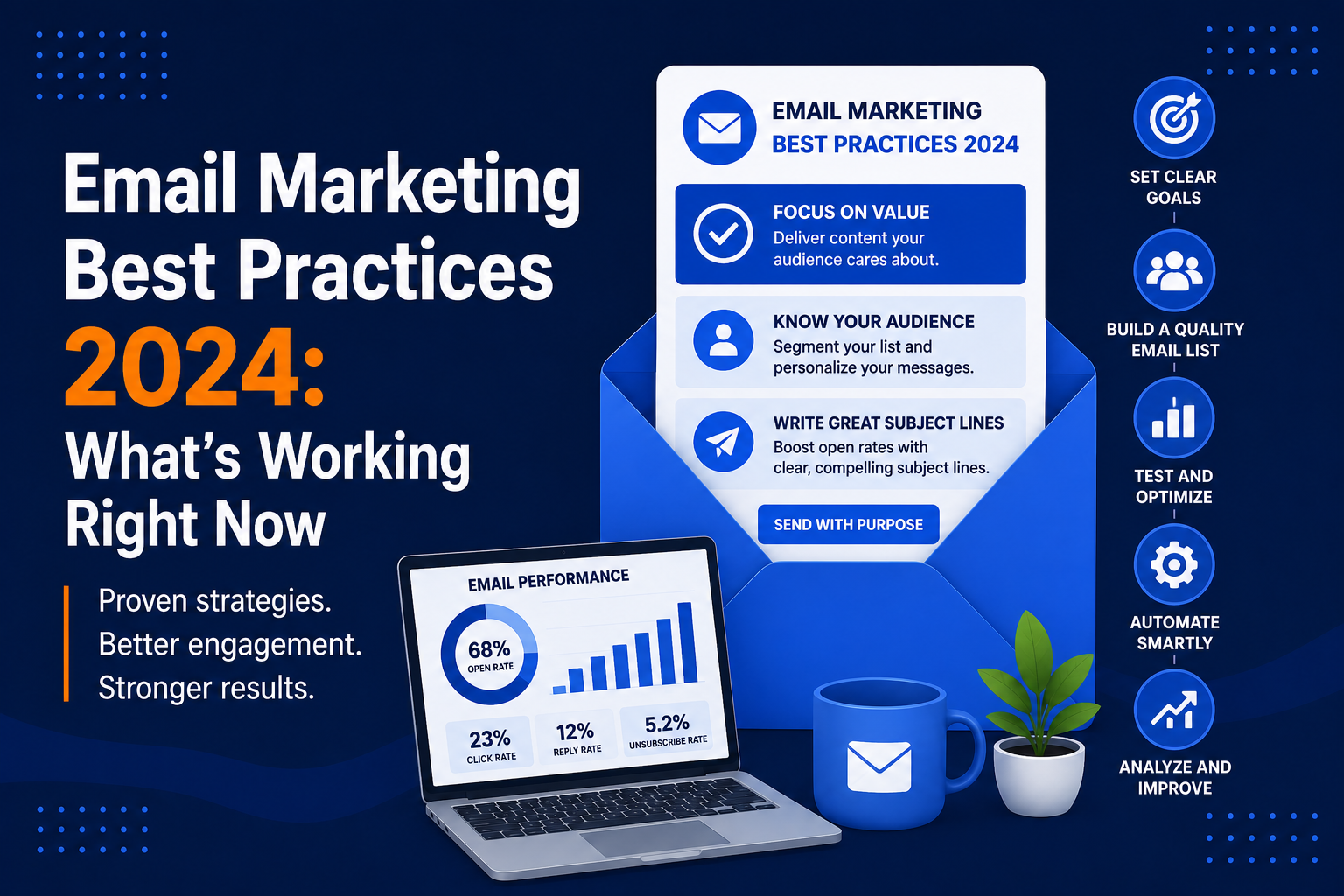
From all marketing strategies, the most frequently pronounced “dead” is email marketing. Yet, it is far from being dead, as it is one of the most efficient tools used by businesses, being their primary ROI strategy. Nevertheless, there is no guarantee that the same methods and approaches will be effective in today’s conditions.
This guide will provide you with the most effective email marketing techniques of 2024, proven by the results of the research conducted.
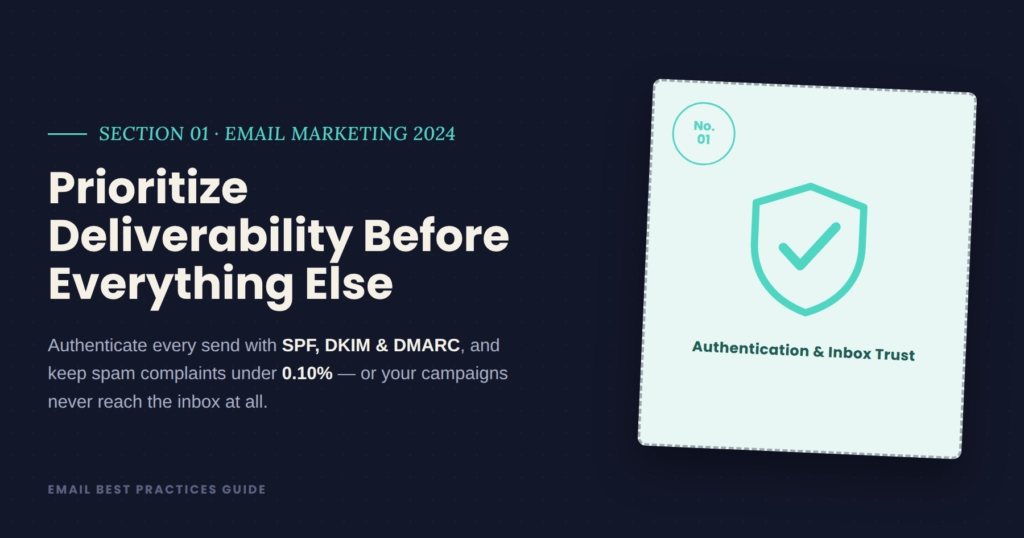
1. Prioritize Deliverability Before Everything Else
All the efforts you put into creating your email marketing strategy are in vain if your emails go to the spam folder. It has never been easier for you to send emails to people’s inboxes in 2024.
What You Must Have in Place
- SPF, DKIM, and DMARC Authentication properly configured
- Unsubscribe link included in all commercial emails
- Unsubscription rate less than 0.08% (requirement by Google for bulk emailers)
- Spam complaints less than 0.10%
- List hygiene practices, bounce removal, re-engagement campaigns
Bulk Senders (Over 5,000 Emails to Gmail Daily) – Google’s Requirement for 2024 is to Have One Click Unsubscribe. Make Sure Your Email Platform Supports This.
2. Send to Engaged Subscribers Only
The biggest shift in email best practices in the last several years, having a small and active list is better than large lists all the time.
There are 20-40% of subscribers on almost all email platforms which have not opened emails for 6+ months. Emailing to them:
- It harms your sender’s reputation
- It results in lower open rates and click-through rates (affecting your whole program)
- Wastage of money in paying the fees to your platform for nothing
Best Practice for List Hygiene
- Develop a re-engagement campaign for non-engaged subscribers for 90 days
- Suppress the subscriber if there is no response to 2-3 tries
- Conduct clean-up drives of your subscribers list at least once in six months
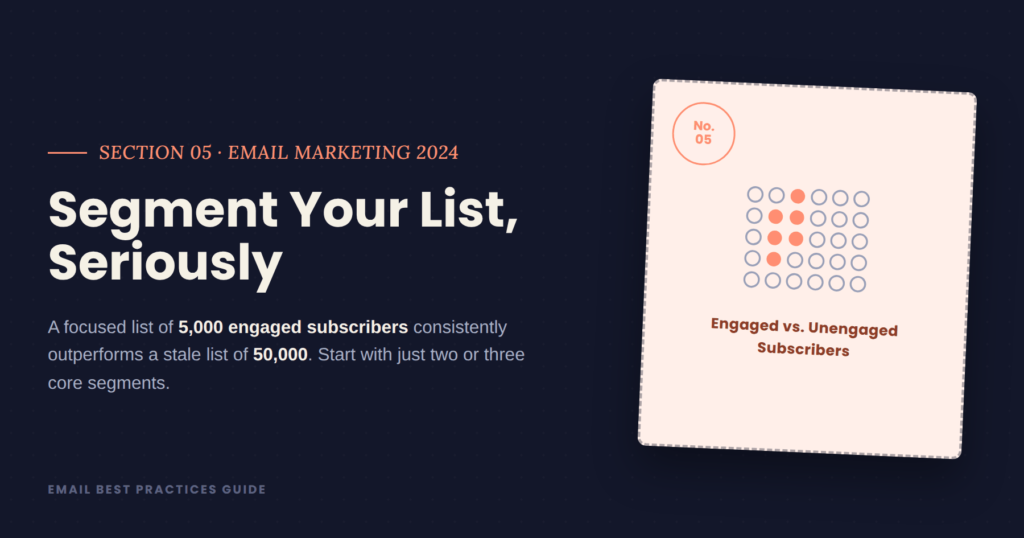
The 5,000 engaged email list will always do better than the 50,000 unengaged list.
3. Nail Your Subject Lines With Specificity
It’s no longer time for subject lines that use clickbait. The filters have become more intelligent and so are the subscribers. At this point, you have to be more specific and deliver value.
Subject Line Best Practices in 2024
- Be specific: “3 ways to lower churn rate at SaaS firms” beats “Tips to improve your business.”
- Write the body of the email to correspond with the subject line.
- Subject lines should be shorter than 50 characters for mobile (mobile is where the majority of emails are read).
- Avoid using spam trigger words: “FREE,” “URGENT,” “ACT NOW,” excessive exclamation marks.
- A/B tests are mandatory for big campaigns; they determine open rates mostly.
What’s Working Right Now
- Email subject lines:
- “How are you getting this email wrong?”
- “Numbers: the 5 automation essentials for every e-commerce business”
- Creative personalization: “Hey [first name], I was thinking of you when I saw this…”
- Unusual angles: “How we stopped testing subject lines (and what happened next)”
4. Personalization Must Go Beyond the First Name
Using a first name in the subject line by 2024 would have been table stakes, not personalization. Personalization happens through behavior and situation.
What Effective Personalization Looks Like
- Sending product recommendations based on browsing or purchasing activity
- Recommendations of products based on browsing or purchasing activities
- Sending content based on the person’s downloads
- Tailoring frequency of sends based on their activities
- Tailoring messaging based on subscriber’s situation (“As a new customer on our startup plan…”)
- Sending at optimal time when that person opens emails (send-time optimization)
This type of personalization can be accomplished using Klaviyo, ActiveCampaign, or Braze.
5. Segment Your List, Seriously
Using the same message for all your contacts is possibly the most common, and the most costly mistake in email marketing. Campaigns that are segmented generate substantially more income than campaigns that aren’t segmented.
Start With These Core Segments
- Contacts that have opened or clicked within the past 30/60/90 days
- New subscribers (subscribed contacts within the past 30 days)
- Purchasing behaviors (in case of e-commerce: new customer vs. returning customer)
- Interest in products (decided on the basis of page views/downloads of content)
- Location (good for localized marketing)
You don’t need 50 segments right off the bat; two or three will be enough.
6. Mobile Optimization Is Non-Negotiable
More than 60% of all emails are opened from mobile devices. If your emails are not mobile responsive, you leave out more than half of your potential audience.
Mobile Email Best Practices
- Single column layout.
- Subject line under 40 characters to avoid truncation on smaller screens.
- Larger tap targets (CTA buttons must be at least 44 x 44 pixels in size).
- Font size from 14px to 16px.
- Use minimal images because they may not load on mobiles owing to slow connectivity.
- Testing on real devices is essential.
Make use of tools such as Litmus and Email on Acid to check how your emails will appear across different platforms and devices.
7. Automate Your Core Lifecycle Campaigns
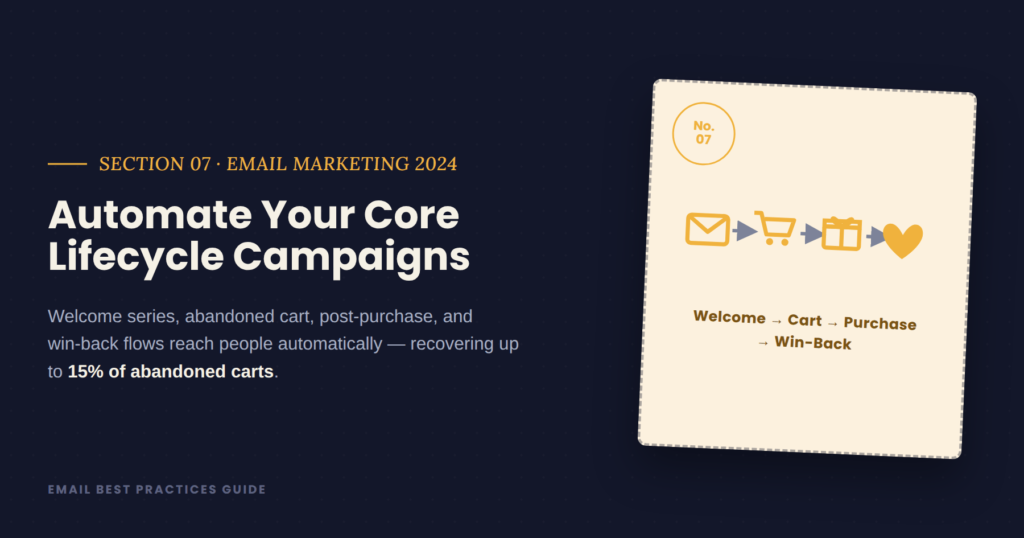
A one-off campaign would always be outmatched by an automated campaign. With automation, the message gets to the right audience at the right time, something that’s not possible with broadcast communication.
The Automations Every Email Program Needs
Welcome Series (Send Immediately After Signup)
Your most engaging timeframe. You can use it to send your lead magnet, promote your business, and guide your client toward making their first purchase.
Abandoned Cart (Ecommerce)
The highest ROI generating automation in ecommerce. The three email strategy (1 hour/ 24 hours / 72 hours) would give you 5% to 15% of your abandoned carts back.
Post-Purchase
Content about reviews requests, upsells, and how to do what they just bought. Start building loyalty from their first purchase.
Re-engagement
For those subscribers who have not checked in over 60-90 days. A proper “We miss you” campaign with an offer can return 10-15% of inactive leads.
Win-Back (For Customers Who Haven’t Purchased in 90+ Days)
Not the same as re-engagement marketing (for email subscribers) – only former customers.
8. Test Relentlessly, But Test the Right Things
A/B testing makes sense only in case of testing something that matters.
Highest-Impact Elements to Test
- Subject line (could be the most effective open rate driver)
- Length of email (short or long)
- One call-to-action versus multiple calls to action
- Plain text email versus HTML email
- Sending time of email (AM/PM or weekday/weekend)
- Personalization techniques (first name personalization versus behavior-based personalization)
Best Practice
Test one variable at a time, use a sample size that is sufficiently large to be statistically significant, and test for an adequately long period of time to gather meaningful data. At least 1,000 email recipients per test variant are needed on most platforms to make your tests meaningful.
9. Align Email With the Full Customer Journey
Email marketing is not done in isolation. The most effective email marketing is part of the broader marketing landscape and the customer experience.
Practical Integration Points
- CRM integration: Synchronize email open timing with the sales team
- Personalization: Use email clicks to influence on-website behavior
- Retargeting: Retarget on Facebook/Google based on email engagement data
- Content marketing: Email should help market your best content
- Customer support: Customer support conversations should prevent promotion emails
Those firms that make the biggest profit from their email marketing strategies consider it to be a way to create an experience instead of just sending out emails to promote themselves.
10. Track the Metrics That Connect to Revenue
While vanity metrics such as open rates and subscriber numbers might make you feel good, they do not tell you anything about how well your strategy is working.
Track These Metrics Instead
- Email revenue per email = total email revenue / number of emails sent. North Star metric.
- Email conversion rate = percentage of people who did what was intended after receiving the email (bought a product, subscribed, scheduled an appointment).
- Annual email revenue per subscriber = annual email revenue / number of subscribers. Shows how well your program is doing now.
- Email revenue that is attributed = total revenue that is attributed to email efforts. (Use UTM parameters for better modeling).
- Email list growth rate = are you getting more subscribers or losing them?
Final Thoughts
The email marketing advice for 2024 is very easy indeed: Send less emails, but send smarter and more relevant ones. Clean your email list. Segment like mad. Personalize like a pro. Automate key interactions. And be obsessed about metrics that make you money.
The greatest email marketers of 2015 will not be the ones sending the most emails. The greatest ones will be those whose emails feel personally crafted for their recipients.