Dwell Time: What It Is and How to Improve It

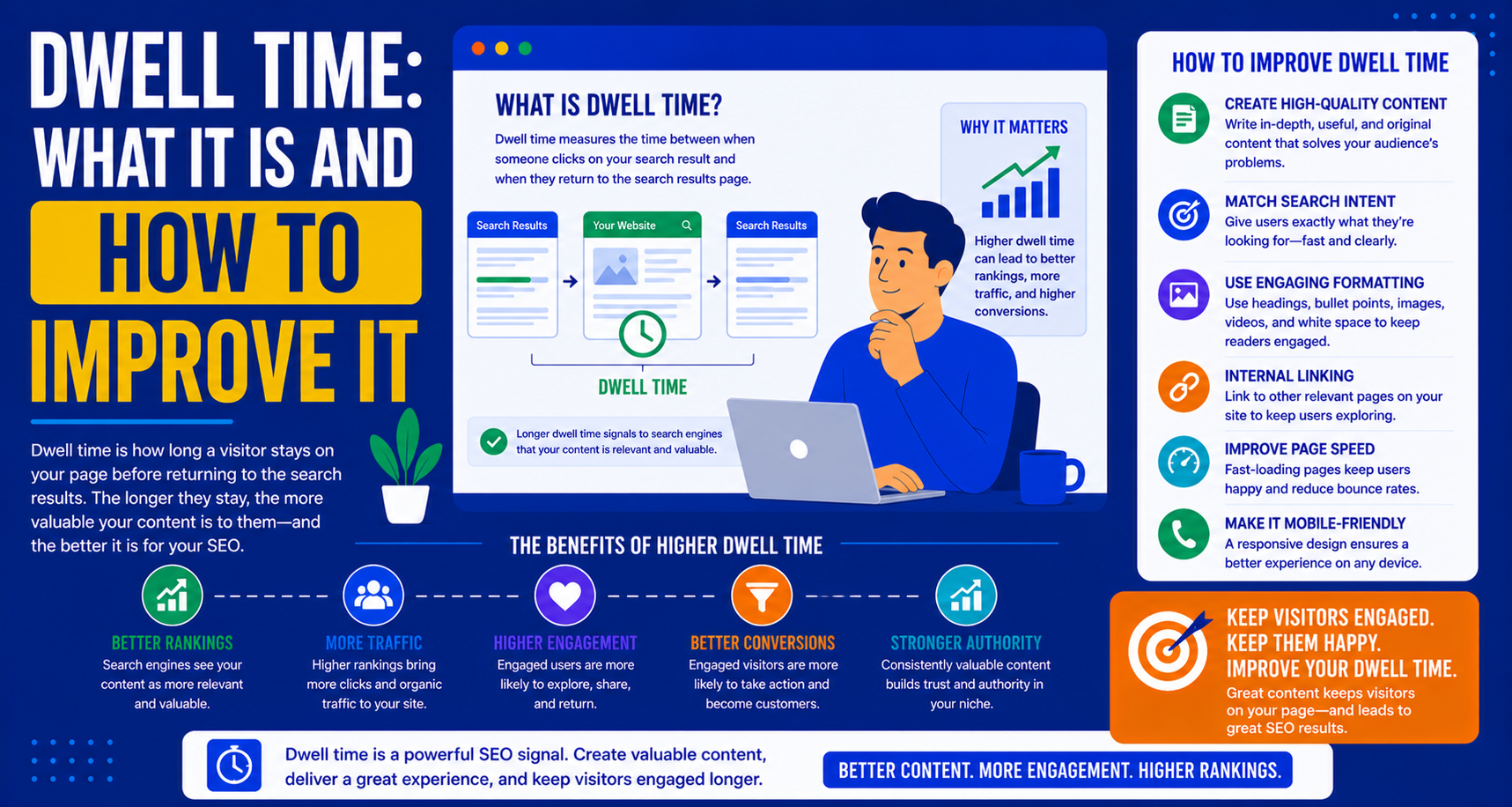
Dwell time is one of those SEO terms that is talked about often but poorly comprehended. Many SEOs will tell you that dwell time is a ranking factor. Other SEOs tell us it’s not even something that exists. Like many things in SEO, the truth lies somewhere in between.
What Is Dwell Time?
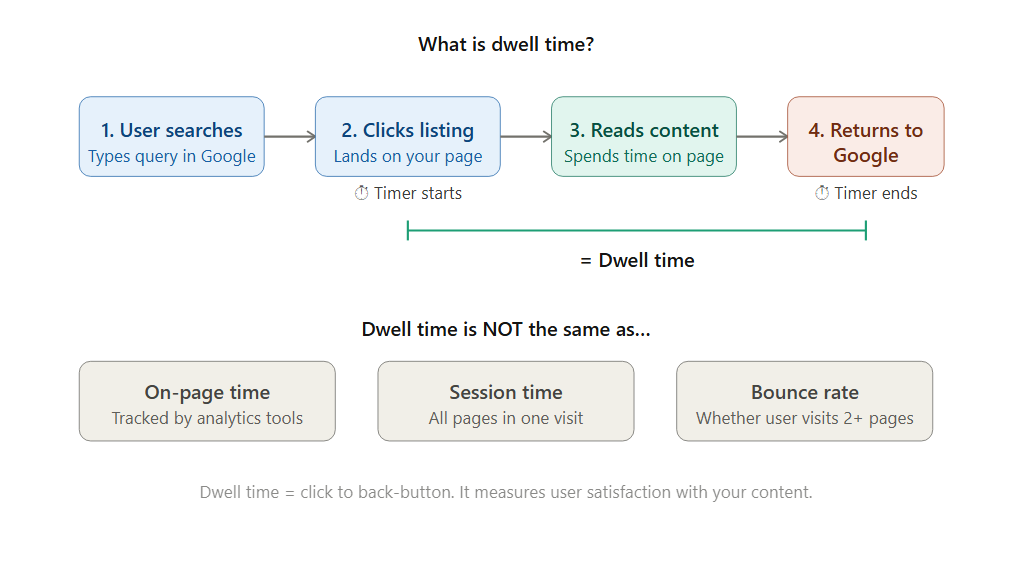
Dwell Time refers to the amount of time that a user stays on your website after clicking through from a search result, before clicking back to the search engine results page (SERP).
Here’s How It Works in Practice
- User performs search for “tips on how to optimize Core Web Vitals”
- User clicks on your listing
- User spends 4 minutes browsing your webpage
- User clicks back to Google
This time span constitutes the dwell time.
Dwell Time Is Different From:
- Dwell time (tracked via analytics, begins when page loads)
- Duration of Session (amount of time spent on all pages during one session)
- Bounce Rate (single-page view vs. multiple-page views, not time spent on a page)
Is Dwell Time a Google Ranking Factor?
Despite Google’s official refusal to confirm its influence on the ranking process, there is significant indirect evidence pointing toward its importance:
- A former employee of Google, Duane Forrester, referred to long clicks as a signal indicating high quality of content from Google’s perspective.
- Panda update was especially oriented towards increasing the user experience quality.
- “Dwell time” is also known under another name, “user satisfaction signals”.
Even more important is the fact that although dwell time does not impact ranking, the qualities that help increase dwell time will positively influence rankings, since they will more effectively satisfy the search intent.
Conclusion: You should focus on improving your dwell time because you are actually meeting the needs of your readers, not because of any indirect impact on ranking.
What Affects Dwell Time?
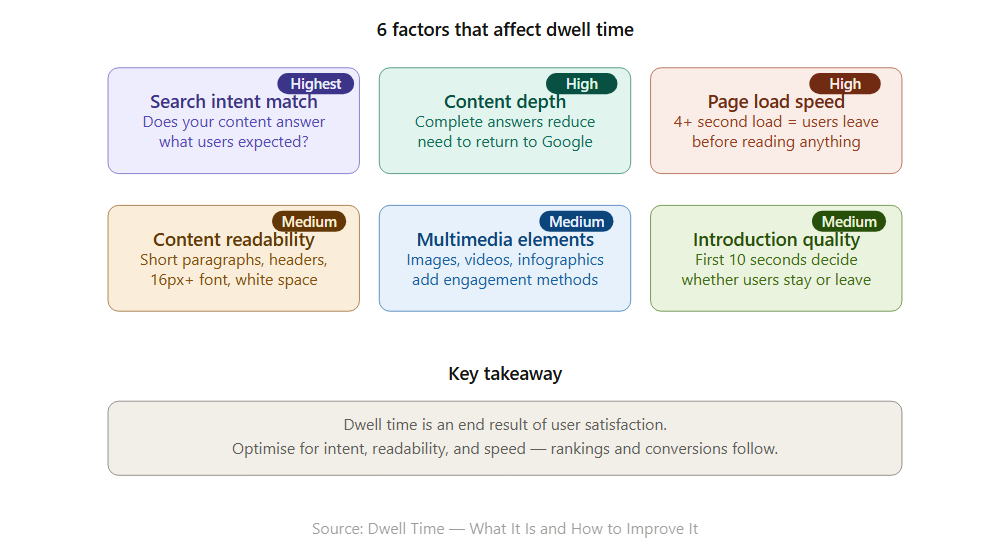
Dwell Time is a result of satisfaction from the user side. There are multiple aspects which affect the likelihood of the user to stay.
Search Intent Match
Firstly, the most important thing about dwell time is if your site meets the needs of users.
For example, when people search for an SEO audit checklist with an expectation that they will see a structured numbered list, and find your page with a 3,000-word article without a hint of structure, they’ll immediately go away.
Match Your Content Format to the Intent
- How-To searches → step by step guidance
- What Is searches → definition in the first paragraph followed by depth
- Comparison searches → comparison tables with recommendation
- List searches → lists
Content Depth and Comprehensiveness
People who find everything they are looking for in one post don’t have to go back to Google in search of other answers.
Dense information will increase consumption time and improve dwell time.
However, length alone isn’t what we’re trying to achieve; we want completeness.
For example, a 500-word post that contains all the necessary information is going to perform better than a 3,000-word post that dilutes its information.
Page Load Speed
Users bounce from websites where the pages take too long to load.
A web page that takes more than 4 seconds to load on mobile devices will show a falsely low dwell time not because of its poor content but because of users bouncing from the site even before accessing the content.
Dwell Time can be protected through optimizing Core Web Vitals.
Content Readability
Blocks of densely written text, smaller fonts, no headers, and no white space, all this makes reading more difficult.
A user who cannot easily comprehend what he or she is reading will stop reading the article entirely.
Improve Readability
- Write short paragraphs (2–4 sentences at most)
- Insert headers H2, H3 every several paragraphs of text
- Utilize bullet points and numbered lists
- Ensure that font size is at least 16 px
- Insert plenty of white space between sections
Multimedia and Visual Elements
The addition of pictures, graphs, diagrams, and videos provides the user with extra reasons to linger, and multiple ways to engage with your content.
An embedded educational video may easily add several minutes to dwell time for those who like learning through video.
However: all multimedia content should be fast-loading and valuable to the user.
Decorative stock images that make your website heavier without any informational content detract from your LCP and do nothing for dwell time.
Introduction Quality
The decision on staying is made in under ten seconds.
A good introduction that conveys that “you have arrived where you need to be, you have your answer here” cuts out pogo-sticking (returning to Google immediately).
Poor Introduction Pattern
Too much information and too little focus on the question.
Strong Introduction Pattern
Start with addressing the user’s concern immediately.
What will be covered in the post.
A justification for reading on.
How to Improve Dwell Time
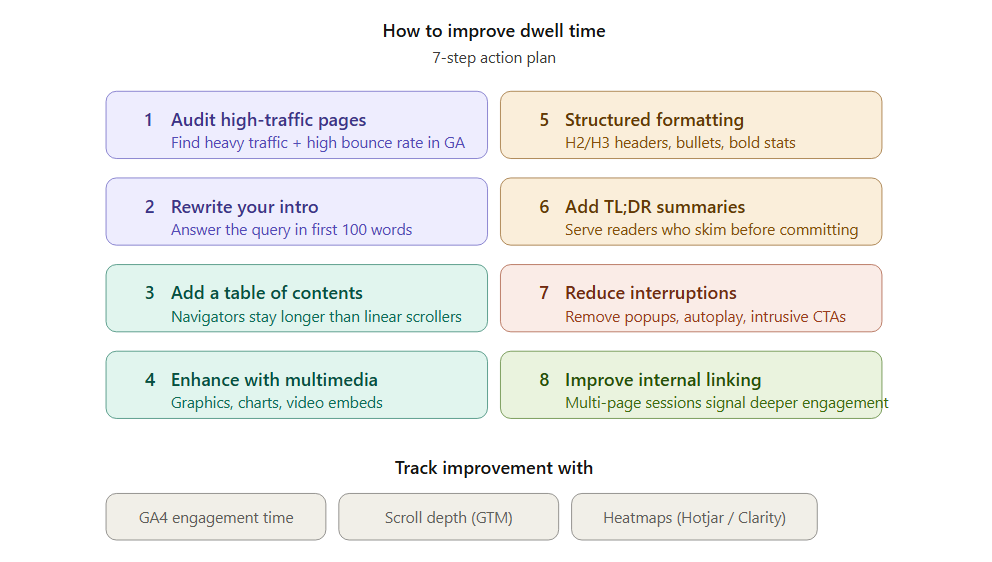
Audit Your Highest-Traffic Pages First
The Google Analytics tool can help you identify pages with high organic traffic but high bounce rates or low time on page.
These are the main targets.
They’re receiving lots of visitors but are failing to deliver.
Start With the Opening Paragraph
Rewrite your introductions to immediately answer the user’s question.
Your opening paragraph should say,
“Here’s what you’ll find out about the topic you asked about.”
Avoid long introductions.
Add a Table of Contents
In longer guides, a table of contents can be included near the top to help the reader understand how comprehensive the guide is.
Users who use page navigation spend significantly more time on the site compared to those who simply scroll through the content.
Enhance With Multimedia
Use unique images:
Flowchart
Infographics
Website screenshots
Video snippets
This ensures content diversity and enables people to interact using different options.
Images that are unique can be used for backlink building too.
Implement Structured Formatting
Review your page to make sure that:
- A separate H2 heading is included for every major topic
- Lists are employed wherever possible in your content
- Important facts and figures are highlighted (bold text or callout boxes)
- Steps are enumerated in your content rather than written in paragraphs
Add a Summary or TL;DR
The quick answer first and then the decision about reading on is what some visitors want.
The use of summary or takeaway sections is useful for them and also prevents their abandoning the page right away.
Reduce Interruptions
Pop-ups, autoplay videos, aggressive sticky CTA buttons, and intrusive ad placement all contribute to a high bounce rate and low dwell time.
An interruption always increases chances of abandonment.
Reduce them, particularly on information-oriented pages where the reader is not in buying mode.
Improve Internal Linking
Add external links to relevant stories in your content itself.
When users click on internal links, they form multiple-page sessions.
If they leave the original page, they still continue engaging with your website, which is what you want to achieve.
Dwell Time vs. Bounce Rate: What’s the Difference?
The bounce rate indicates if the visitor has seen only one page of your website.
It tells nothing about the time he or she spent.
Someone who read all 2,500 words of your article in eight minutes and left your site to return to Google would register as a “bounce,” but this person is very satisfied because they read your entire story.
That’s precisely what dwell time captures.
And this is the main reason why relying too much on bounce rate may mislead.
A More Useful Metric Combination
- Time spent on the page (by analytics)
- If users scroll far down into the content
- If they click through internal links
Measuring Dwell Time Improvement
Google does not reveal the dwell time stats.
Proxy It With:
Google Analytics
Time on page (average time per page in GA4/average time on page in UA).
Track any changes after content optimization.
Scroll Depth Tracking
Utilize Google Tag Manager for tracking user scrolling on your pages.
More scrolling means more consumption of content.
Exit Rates
The rate at which people exit from your site from a particular page
Decreased exit rate could mean increased satisfaction level of visitors to your content pages..
Heatmap Tools (Hotjar, Microsoft Clarity)
Heat maps of user clicks and scrolling.
Pinpoint where exactly people are leaving your content.
Conclusion
Dwell time serves as a measure of user satisfaction.
People who find everything they’re looking for, who can easily read it, and who get full answers will spend more time on the page.
All of these methods for boosting dwell time, intent matching, structure, speed, multimedia, also boost rankings, conversions, and branding.
By optimizing for dwell time, you’re optimizing for quality.
First, start with your most trafficked pages with the highest bounce rate.
Revise the introduction.
Structure it.
Use multimedia.
See what the effect is.
These changes will cascade into your overall SEO.