DeepCrawl vs Ahrefs: Which Is Better for Site Audits?

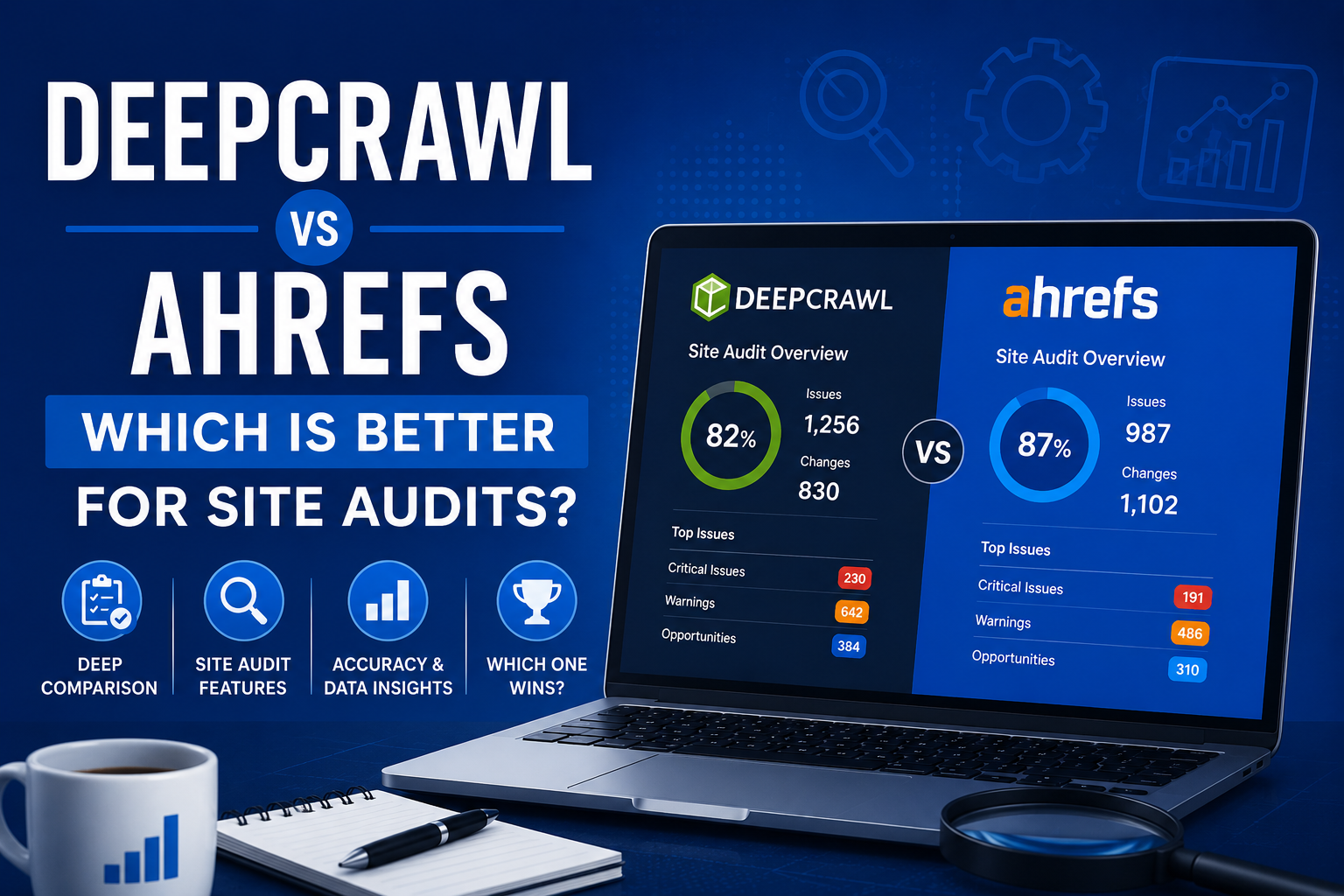
It often happens that when comparing two technical SEO and site audit tools, people mention such platforms as DeepCrawl (DeepCrawl is now known under the brand name of Lumar) and Ahrefs, which are both intended for different things in the first place. The knowledge of their main differences will help to choose the appropriate tool.
Below we will see how to compare DeepCrawl and Ahrefs and understand which one suits better.
DeepCrawl and Ahrefs at a Glance
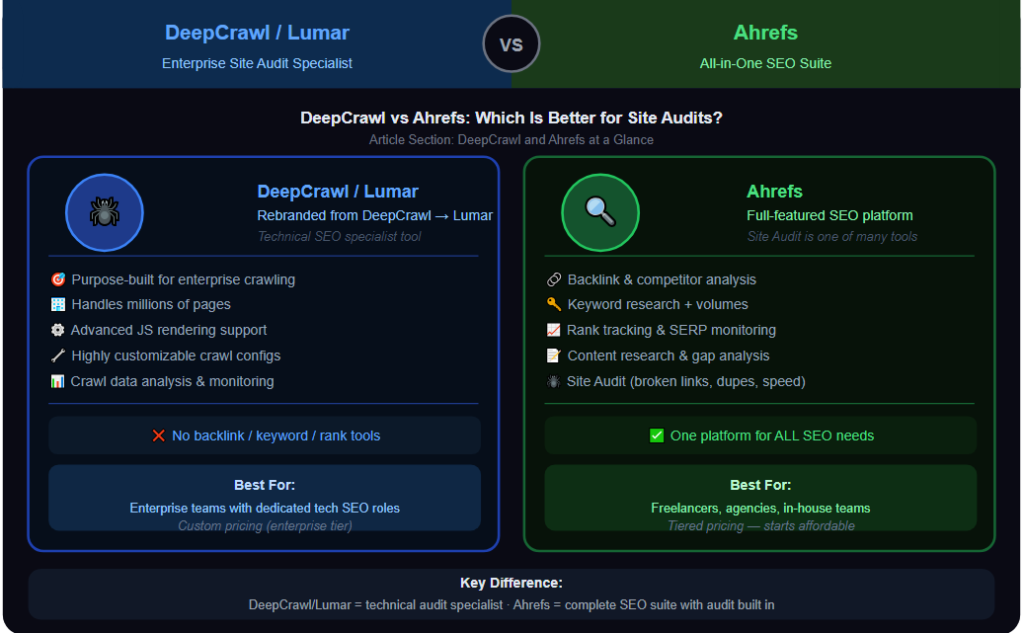
DeepCrawl (rebranded to Lumar) is an advanced SEO auditing and site auditing tool created exclusively for enterprise-scale crawling and detection of technical SEO issues. The tool was created exclusively for technical SEO site audits.
Ahrefs is a comprehensive SEO suite containing several core tools, including keyword research, backlinks research, content research, ranking research, and site audit. The site audit feature is a good part of the platform, yet Ahrefs has more features to offer.
The main difference: DeepCrawl/Lumar specializes in technical site audits, and Ahrefs is a comprehensive SEO solution which contains site audit as one of its components.
Site Audit Depth and Crawl Capability
DeepCrawl/Lumar
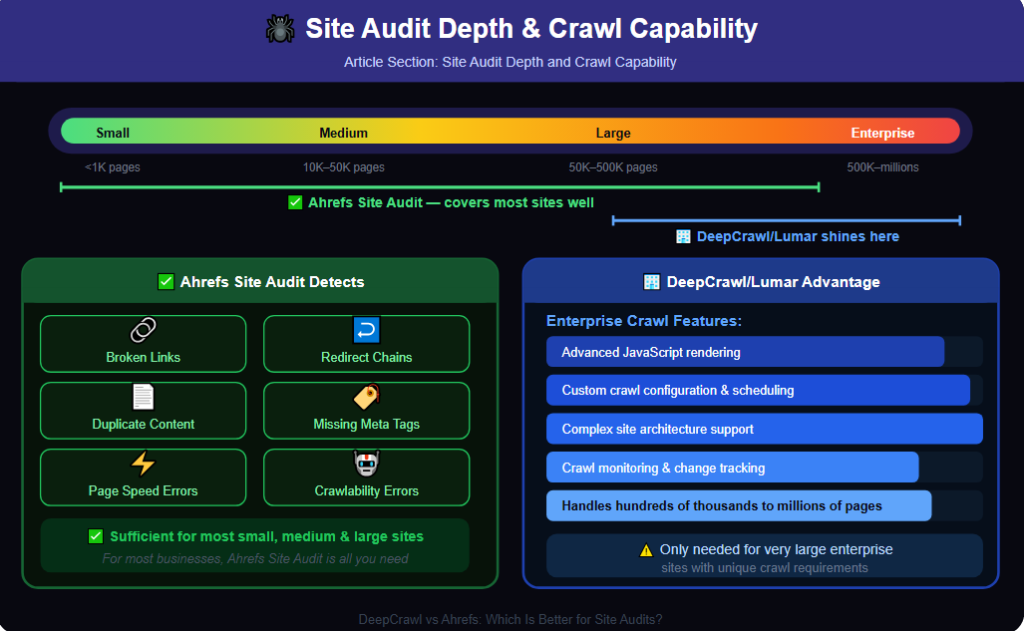
It was designed especially for crawling large and complicated sites, such as enterprise-class sites that have hundreds of thousands to millions of pages. This bot supports highly customizable configuration options, sophisticated JavaScript rendering, and special crawling support for complicated site architecture.
Ahrefs Site Audit
Able to crawl large websites as well, with reliable detection of technical errors in all of the usual categories:
- Broken links
- • Redirect chains
- • Duplicate content
- • Missing meta tags
- • Page speed errors
- • Crawlability errors
While the Site Audit by Ahrefs is usually more than enough for most midsize and smaller sites and even some very large websites, DeepCrawl/Lumar might have an advantage when it comes to crawling very large, complicated enterprise-level websites that require unique crawl configurations.
In most cases, however, Ahrefs’ Site Audit will do just fine.
Beyond Site Audits: What Each Tool Offers
This is where the comparison moves away from “which one is better” and towards “which is suitable for you overall.”
Ahrefs’ Broader Toolset
Other features of Ahrefs beyond site audit include:
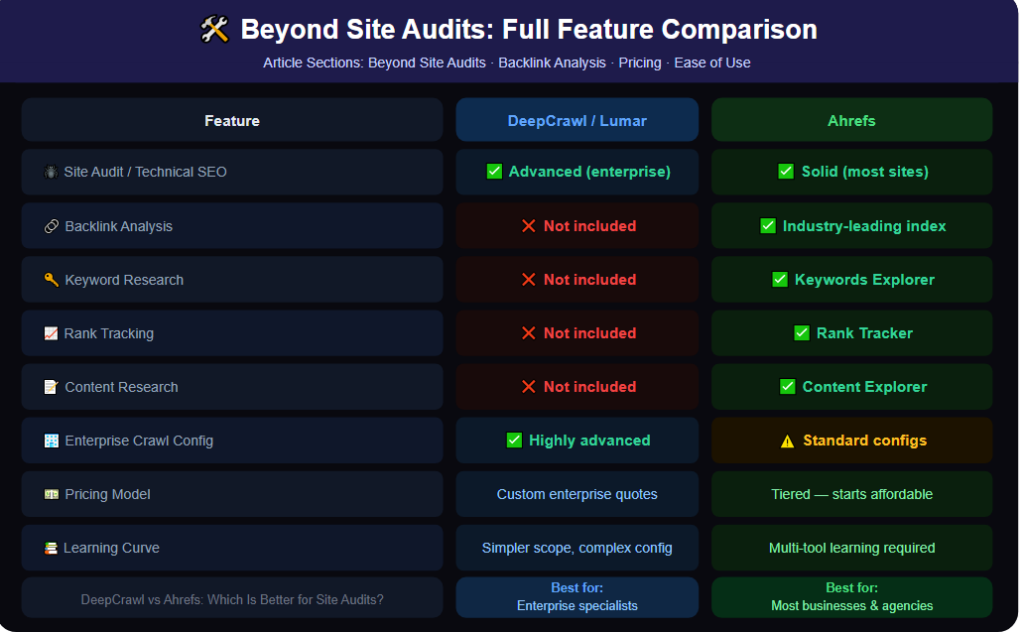
- Site Explorer, for detailed backlink and competitor analysis
- Keywords Explorer, for keyword research and search volume information
- Rank Tracker, for tracking positions of keywords
- Content Explorer, for content research and competitive content analysis
Ahrefs will meet all your SEO requirements because, in addition to technical SEO audits, which is required by almost every business or SEO company, it offers a complete solution for the whole SEO process.
DeepCrawl/Lumar’s Focused Approach
Lumar (DeepCrawl) addresses technical SEO audits, website monitoring, and crawl data analysis. It has limited additional features related to website monitoring and change tracking. It is not as comprehensive as Ahrefs in terms of keyword and backlink research and ranking tracking.
Backlink Analysis: A Clear Differentiator
In case you use any kind of backlinks research and building in your SEO campaign, it is an important distinguishing factor. Ahrefs operates one of the biggest and most up-to-date backlinks indexes in the industry, which is one of the key advantages of this tool which is not offered by DeepCrawl/Lumar as it is not included in their main features.
If you require a combination of deep technical analysis and backlinks analysis, you have to use both tools or prefer Ahrefs as a more convenient alternative in this case.
Use Case Comparison
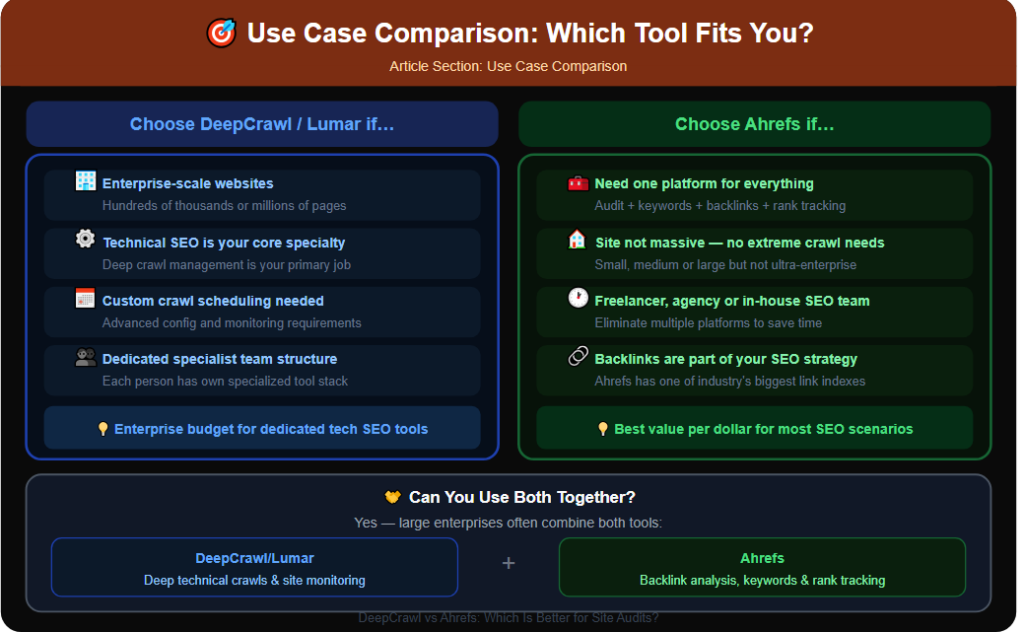
Choose DeepCrawl/Lumar if:
- You have enterprise sites with hundreds of thousands or more pages.
- Technical SEO and crawl management is your core and specialist competency.
- You have a high need for detailed crawling configuration and schedule.
- You work as a member of a team where each specialist has his/her own specialized tool to perform a different function. (Technical SEO, Content, Link Building etc.)
Choose Ahrefs if:
- You need one platform to handle technical audit, keyword research, backlink analysis, and rank tracking
- Your site is not necessarily huge but you do not need the most advanced crawl settings for an enterprise
- You work as a freelancer, small agency or in-house SEO team and need SEO tools which save time by eliminating multiple platforms
- Backlink analysis and link building form part of your SEO tactics
Pricing Considerations
DeepCrawl/Lumar is usually marketed towards enterprise clients and may require customized discussions around pricing, based on crawling volume and individual requirements.
On the other hand, Ahrefs comes with tier-based pricing, starting with an entry-level one that is comparatively affordable, all the way up to enterprise plans.
If you have a clear-cut enterprise budget dedicated specifically to technical SEO, then you may consider using the unique pricing offered by DeepCrawl/Lumar. In all other cases, Ahrefs’ superior features per dollar spent make it a better choice.
Ease of Use and Learning Curve
While both of the tools require some amount of time to learn due to the sheer amount of technical data that they offer, there is a difference between the two.
Ahrefs
Ahrefs requires one to learn how to use various tools in conjunction with each other (Site Audit, Site Explorer, Keywords Explorer, Rank Tracker).
DeepCrawl/Lumar
DeepCrawl/Lumar’s narrower scope in terms of technical auditing can present a less steep learning curve if you only require technical SEO, although the level of configurations that DeepCrawl offers for enterprise-scale crawling may present a complication in that particular area.
Can You Use Both?
For very large firms that have their own technical SEO experts, it is normal practice to make use of DeepCrawl/Lumar solely for deep technical crawls and monitoring, and Ahrefs for backlinks analysis and keyword research. It is not essential for all companies, but it is the way some larger enterprises utilize their SEO tools differently.
Final Thoughts
DeepCrawl (Lumar) and Ahrefs are not exact duplicates; Lumar is an advanced, deep technical SEO and crawl management system whereas Ahrefs is a full-featured SEO system in which Site Audit is just one of many strong modules included in one package.
For most small, medium, and even large businesses, freelancers and agencies, the technical SEO capabilities offered by Ahrefs Site Audit will be enough for them, together with other valuable features such as backlink analysis, keyword research and rank tracking available in one product. For really large enterprise websites with specific technical crawl requirements, DeepCrawl/Lumar’s advanced depth might be justified by its unique positioning and cost.
The selection of the appropriate tool will depend upon the scale of technical SEO requirements and if one needs to use one tool only or build a complete toolchain from various specialized solutions.