CRM Platforms Examples: What They Actually Cover and Why Choosing One Is Easy to Get Wrong

Introduction
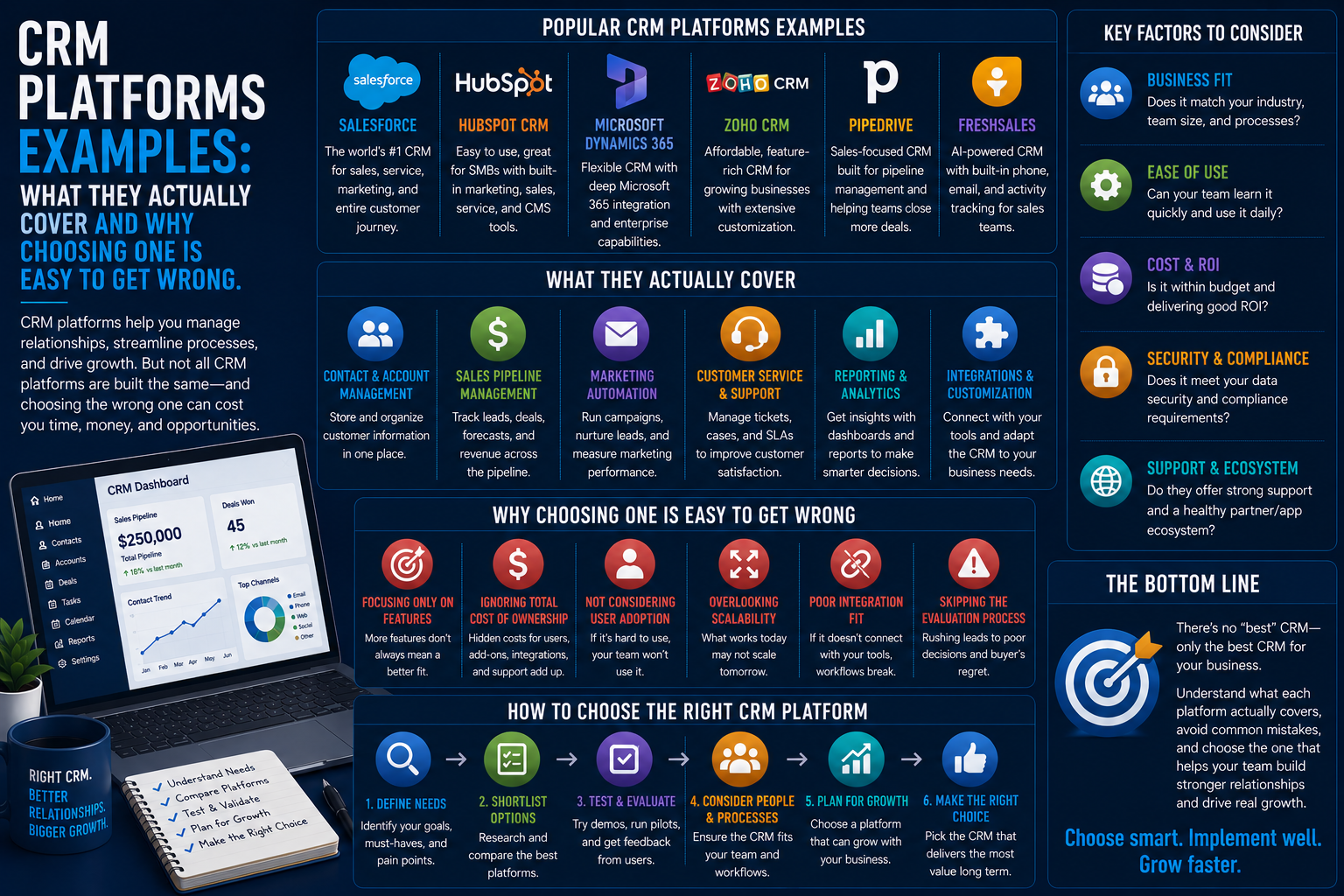
The examples of CRM platforms cover a broad spectrum of applications that are suitable for various sizes of enterprises and for specific industries and sales motion, rather than one standardized type of software solution applicable to all businesses equally.
It may appear relatively easy; however, the diversity of categories in CRM is what often confuses the enterprises during comparison.
Why CRM Platform Categories Are More Complex Than They Appear
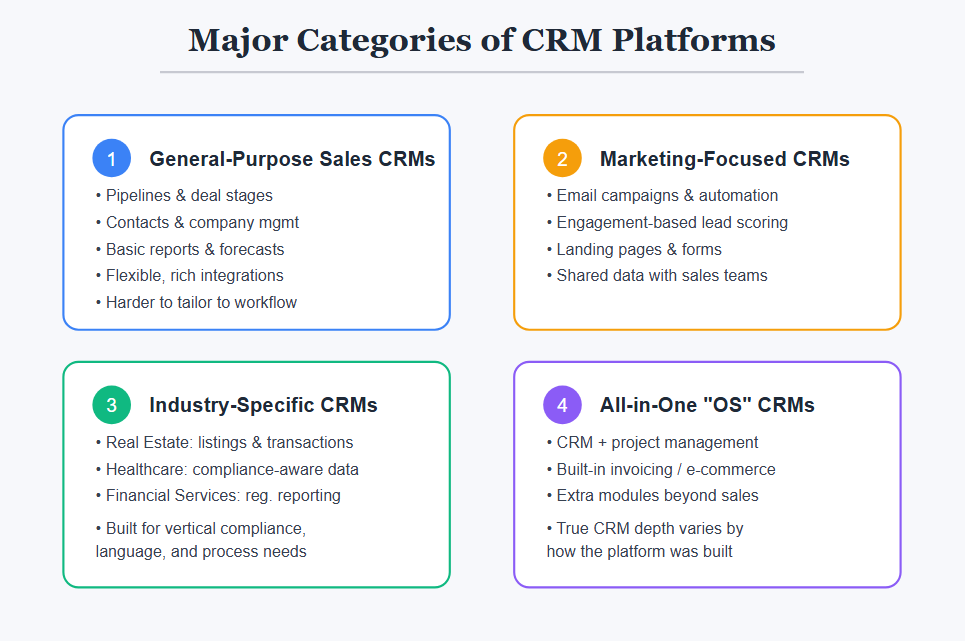
CRM industry is not a uniform entity; rather, it comprises of the following categories:
- Sales CRMs for general purposes
- Marketing CRMs
- Sector specific CRMs
- Operating system style CRMs
Some customers evaluate platforms simply on the basis of price or name recognition, without realizing whether the actual architecture of the platforms suits their sales cycle or not.
When considering multiple CRMs, a company has to analyze category requirements separately for each platform since a CRM designed for enterprise sales cycles functions quite differently than one designed for high transactional volume sales.
Major Categories of CRM Platforms
General-Purpose Sales CRMs
Rules Governing
- Pipelines and stages of deals
- Contacts and companies management
- Basic reports and forecasts
Opting for a general purpose CRM without any requirements from a particular industry is one of the most popular strategies, since it can bring the following advantages:
- High flexibility for all use cases
- Rich ecosystem of integrations
- Higher complexity of integration with particular workflows
Marketing-Focused CRMs
CRMs for marketing purposes usually have integrated marketing campaigns and contacts management, which means that marketing departments have to operate within the framework of common information shared by salespeople.
Marketing CRM Features Often Include
- Creating email campaigns and their automation
- Generating lead scores through engagement
- Building landing pages and forms
Industry-Specific CRMs
Handling encompasses not only general interaction and deal management but also the growing use of tools designed to cater specifically to the requirements of a vertical in terms of compliance, language, and processes.
Industry-Specific Examples Usually Include
- Real Estate CRMs with listing & transaction management
- Healthcare CRMs with compliance-aware patient data management
- Financial Services CRMs with regulatory reporting
All-in-One Operating System CRMs
Others have positioned themselves as more comprehensive business operating environments, which include:
- CRM in addition to project management
- Inbuilt invoicing/e-commerce features
- Modules other than the conventional sales relationship management
The extent of true CRM capability in such platforms varies according to the extent to which the system was built for sales relationship management.
Enterprise Versus Small Business CRMs
The following are some of the scale assumptions made by various CRM software solutions:
- Permission structure and roles
- Degree of customization
- Team-based pricing structures
These assumptions must be carefully considered due to the risk of enterprise-level complexity overwhelming a smaller team, or limited functionality restricting an expanding business.
Why Choosing the Wrong Category of CRM Happens Even at Careful Companies
Poorly matching CRM platforms are not chosen by businesses that conduct no research at all.
Actually, poor matches are possible for the following reasons:
- Purchasers evaluate feature lists without putting any workflow to test.
- Marketing of a platform talks about flexibility and does not specify its key capabilities.
- The tool is lightweight for a growing team very fast.
How Organizations Evaluate CRM Platform Examples
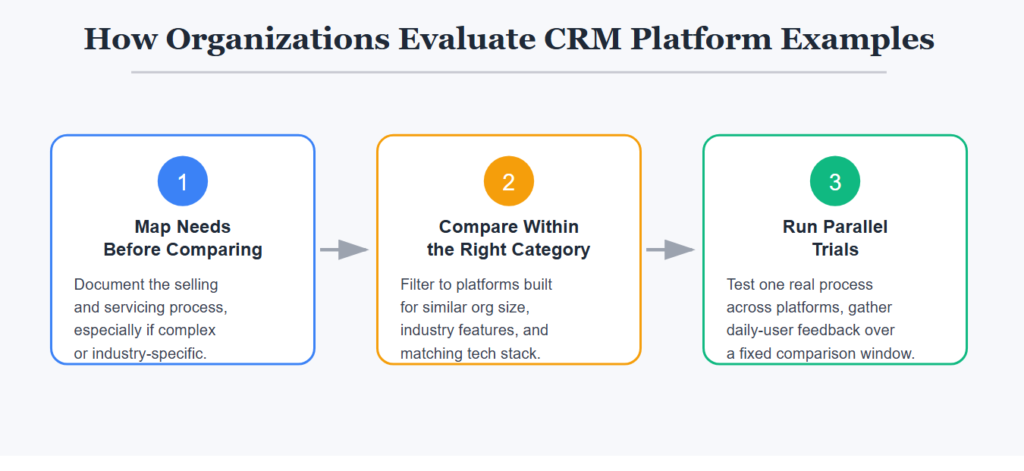
Mapping Needs Before Comparing Tools
Organizations with bigger sizes could write down the process of selling and servicing in detail, more particularly if their workflows are complicated or industry-specific.
Comparing Within the Right Category
There are evaluation processes that reduce the number of choices to:
- Platforms designed for a similar organization size
- Industry-specific platform features
- Integration with similar technology stacks
Running Parallel Trials
Organizations run trials involving:
- A single actual process that is tried out on various platforms
- Views of the team members who would be using the system on a regular basis
- A set period of time used for comparison before making a choice
Conducting parallel trials allows organizations to ensure that the chosen platform meets their needs, rather than merely being listed as having certain features.
Common Mistakes When Comparing CRM Platform Examples
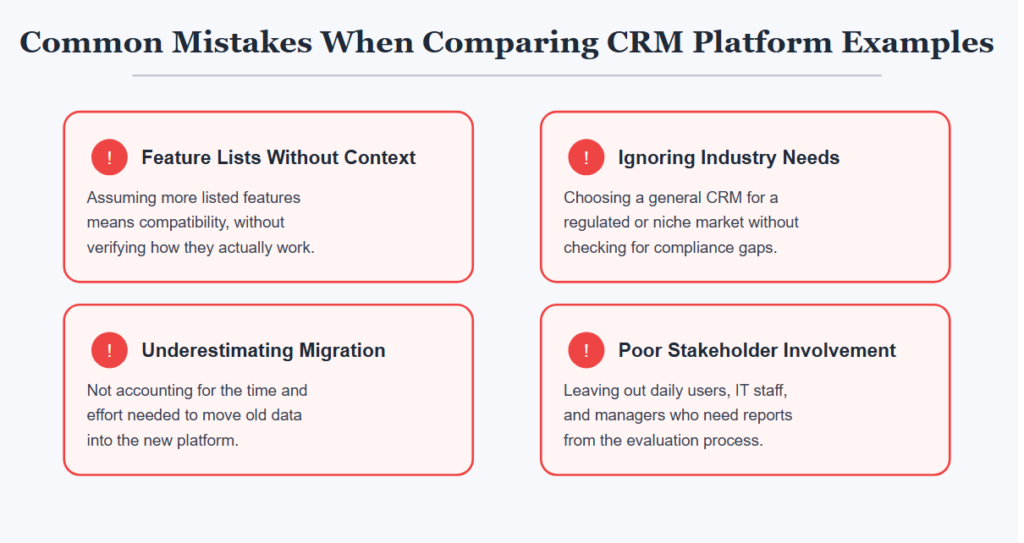
Comparing Feature Lists Without Context
If having more features listed in the CRM system necessarily implies compatibility, without verifying their actual functioning.
Ignoring Industry-Specific Needs
Choosing a general CRM solution for a regulated or niche market without verifying if there are any compliance gaps.
Underestimating Migration Effort
Not taking into consideration how much time and effort is involved in migrating the old data to the new platform.
Poor Stakeholder Involvement
Insufficient participation of:
- The people that use the system every day, the sales or customer service reps
- IT personnel who do the integrations
The people from management who have a need for a report.
Bottom Line
Examples of CRM software include those that belong to many categories such as generic, marketing, industry-oriented, and all-inclusive. Given the differences in terms of design and intention between these categories, it would be better for companies to define their workflow first before making comparisons based on features only.