CPM in Project Management: What the Critical Path Method Is and How to Use It

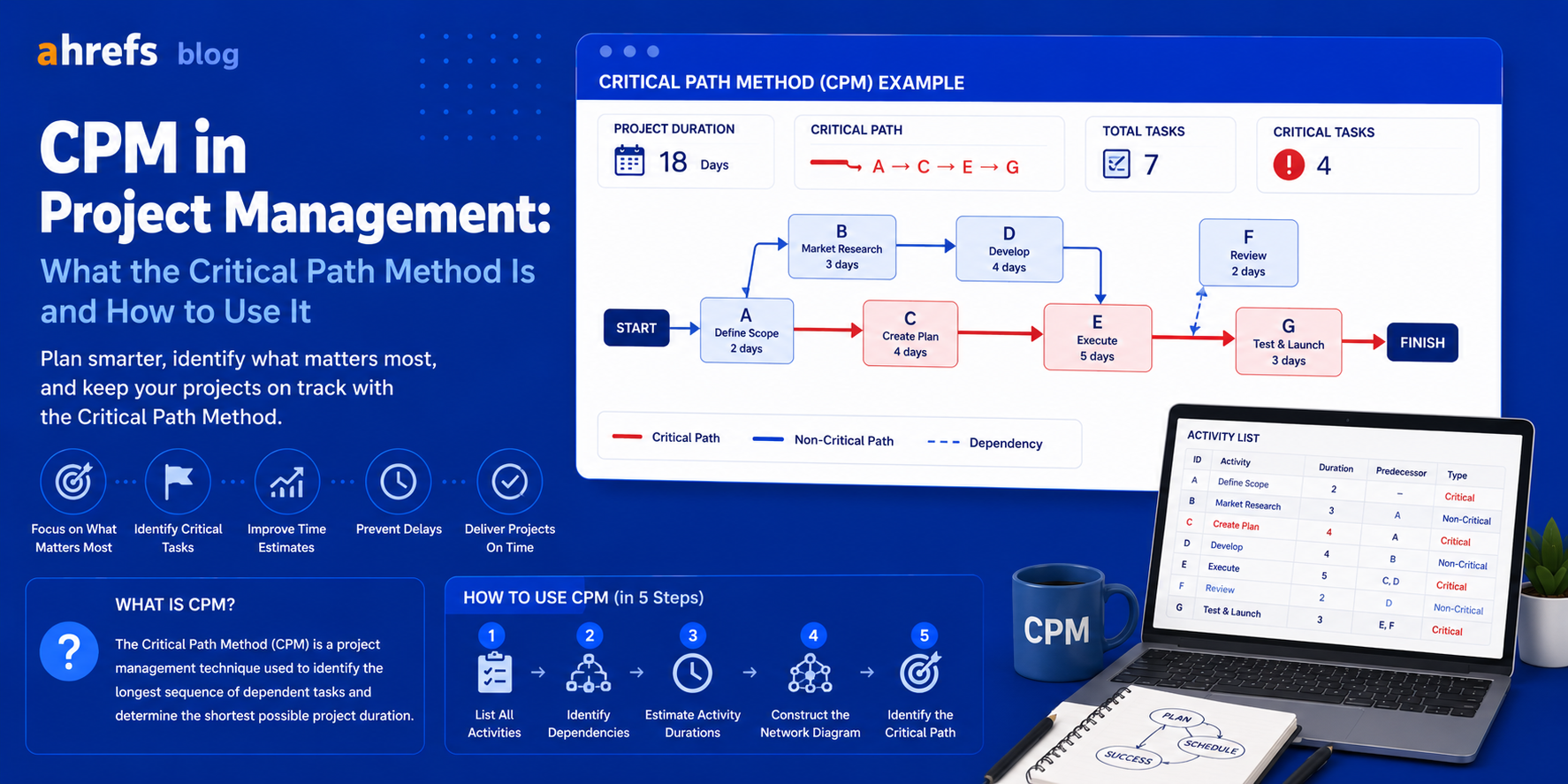
All projects will always have some activities that can be delayed with no impact on the completion date, while there are other activities that if they are even delayed by one day, they delay the whole project. CPM is what is called to determine which activities belong to each category.
Table of Contents
- What Is CPM in Project Management?
- Key CPM Concepts You Must Understand
- Calculating Critical Path Using CPM
- Differences between Critical Path and Float
- Using CPM in Practical Example
- Software that Helps Implement CPM
- CPM vs PERT
- Conclusion
What Is CPM in Project Management?
Critical Path Method (CPM) is a scheduling technique which looks for the longest chain of activities that have dependencies in any given project – the chain that dictates the shortest duration that can be taken to complete the whole project.
Any delay in an activity that lies on the critical path will result in delay in the completion of the project. All other activities have some amount of ‘float’ time; i.e., some extra time when these activities can be delayed without delaying the whole process.
CPM originated in the 1950s (at the same time at DuPont and the US Navy; although Navy’s version was PERT).
Key CPM Concepts You Need to Know
Activity (Task)
Any individual activity in the project that has a specified duration. Duration is necessary for computing the critical path, as per the CPM method.
Dependency (Logical Relationship)
Depends on the sequencing between activities.
The Four Types
- Finish-to-Start (FS): Activity B can’t start until Activity A finishes. (Most common)
- Start-to-Start (SS): Activity B can’t start until Activity A starts.
- Finish-to-Finish (FF): Activity B can’t finish until Activity A finishes.
- Start-to-Finish (SF): Rare; B can’t finish until A starts.
Early Start (ES) and Early Finish (EF)
The earliest start and finish for an activity, considering its dependencies.
Late Start (LS) and Late Finish (LF)
The latest start and finish time for an activity that does not affect the project completion.
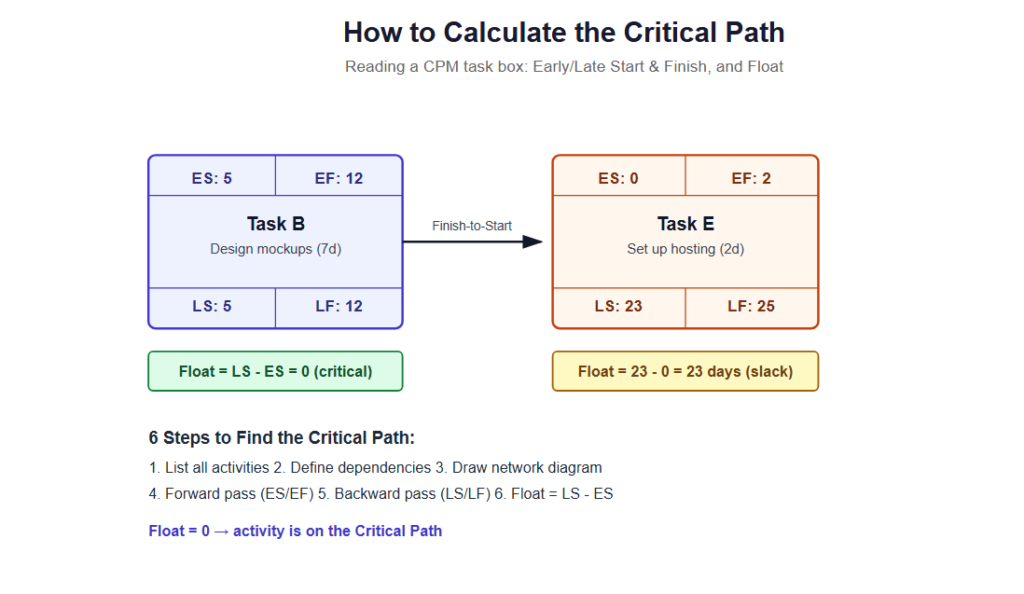
Float (Slack)
The amount of time an activity can be delayed without affecting the project finish date.
Formula:
Float = LS − ES (or LF − EF)
Critical Path
List the activities with Float = 0.
These are the activities that cannot be delayed without increasing the duration of the project.
How to Calculate the Critical Path
Step 1: List All Activities
Determine all activities involved in completing the project, along with their duration estimates.
Step 2: Define Dependencies
Identify the tasks that need to be completed prior to the completion of each task.
Step 3: Draw the Network Diagram
Draw a diagram consisting of all tasks and the dependencies among them using arrows.
Step 4: Forward Pass, Calculate Early Start and Early Finish
From the start of the project onwards:
- ES for the first task = 0 (or the start date of the project)
- EF = ES + Duration
- ES of the next tasks = EF of the preceding task
Step 5: Backward Pass, Calculate Late Start and Late Finish
From the end of the project:
- LF for last activity = its EF
- LS = LF – Duration
- LF for each prior activity = the LS of its next activity (take the earlier LS if there are more than one successor)
Step 6: Calculate Float
Float = LS – ES for each activity.
Activity with Float = 0 lies on the critical path.
Critical Path vs. Float
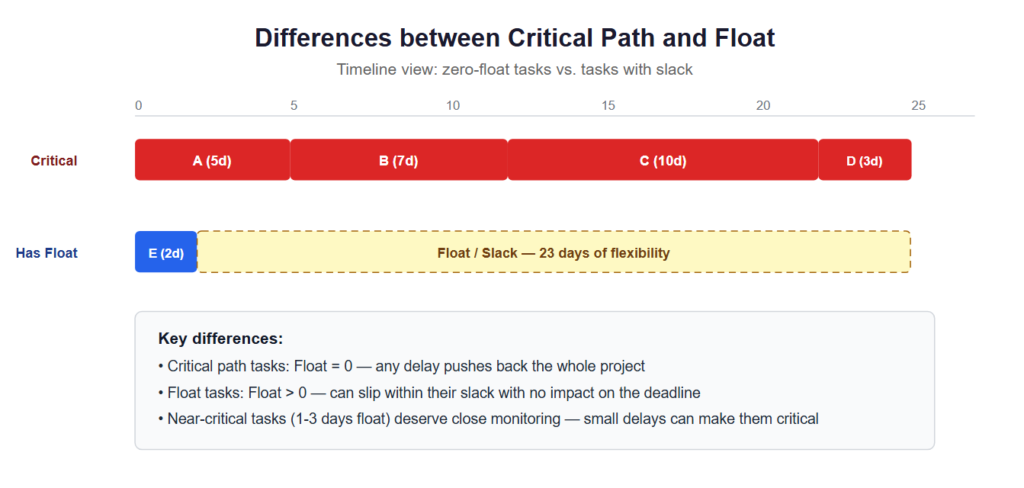
These two concepts are related to each other:
- In the critical path, all activities are without any float
- Activities in the non-critical path have positive float
- Near critical path activities include those that have little float (1-3 days) and need careful observation as even a small delay can make them a part of the critical path
CPM in Practice: A Simple Example
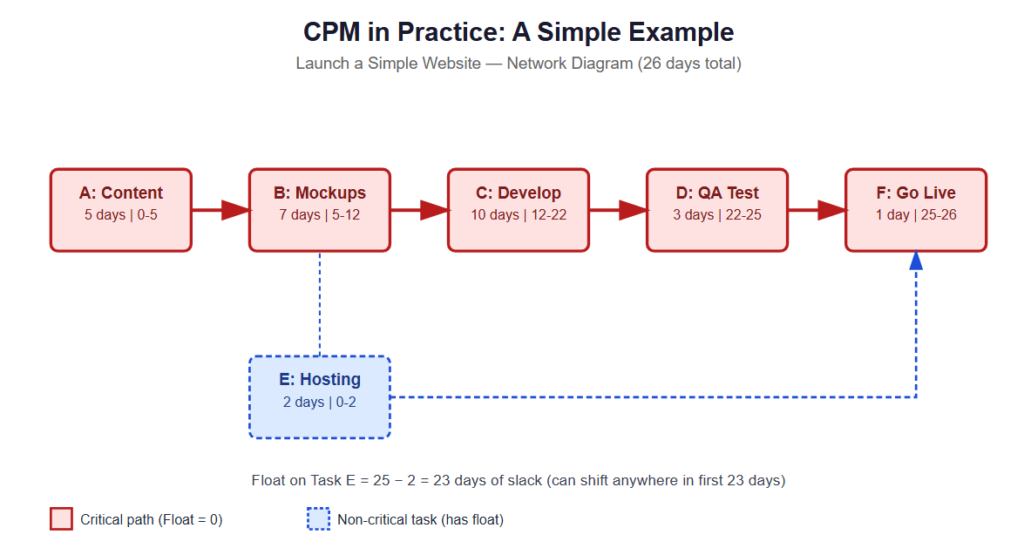
Project: Launch a Simple Website
Tasks
- Task A: Finalize content, 5 days (no predecessors)
- Task B: Design mockups, 7 days (depends on A)
- Task C: Develop site, 10 days (depends on B)
- Task D: QA testing, 3 days (depends on C)
- Task E: Set up hosting, 2 days (no predecessors, runs in parallel)
- Task F: Go live, 1 day (depends on D and E)
Forward Pass
- A: ES = 0, EF = 5
- B: ES = 5, EF = 12
- C: ES = 12, EF = 22
- D: ES = 22, EF = 25
- E: ES = 0, EF = 2
- F: ES = 25, EF = 26 (uses latest predecessor EF, Day 25 from D, not Day 2 from E)
Critical Path
A → B → C → D → F (26 days total)
Float on Task E
25 − 2 = 23 days
E can be performed at any time during the first 23 days without influencing the launch date.
Tools That Support CPM
Microsoft Project
Standard for CPM scheduling. Critical path, float calculation and Gantt charts generation along with dependency visualization are performed automatically.
Primavera P6 (Oracle)
A go-to solution for big construction and engineering projects with CPM needs.
Smartsheet
Has good Gantt charting and dependency management features, critical path is highlighted. More user-friendly than MS Project.
ClickUp, Monday.com, Asana
While these tools facilitate dependencies and timeline calculations, they do not calculate formal CPM (no float is shown). Adequate for most projects but not suitable for formal schedule management on construction and engineering projects.
CPM vs. PERT
Both approaches make use of network diagrams and dependencies, but are different in how they calculate duration.
CPM
Make use of single point estimation (duration estimate per task only).
PERT
The method relies on three-point estimates (optimistic, most probable, and pessimistic) and computes the weighted average, which makes it more appropriate for projects with uncertainties concerning task times.
In practice, both methods are frequently used together and referred to as CPM/PERT.
Final Thoughts
The Critical Path Method is useful not because it’s complex, but because it forces clarity: which tasks actually control the project’s end date, and which ones have scheduling flexibility? Even a rough CPM analysis on a simple whiteboard changes how a project manager thinks about where to focus attention and where delays actually matter. For any project with meaningful dependencies and schedule pressure, CPM is worth learning and applying, even informally.