Clinical Trial Project Management: How to Keep Complex Studies on Track

Clinical trials are some of the most complicated projects in any sector, being multi-locational, highly regulated, scientific, and conducted under very tight schedules because delay equals a patient’s inability to access the treatment. Project management in clinical trials is more complicated than in any commercial PM environment. This is how it is done.
Table of Contents
- Clinical Trial Project Management Characteristics
- The Clinical Trial Stages as PM Model
- Project Management Process in Clinical Trials
- Regulatory Aspects in the PM Process
- PM Tools in Clinical Trials
- Problems with Clinical Trial PM
- Conclusion
What Makes Clinical Trial PM Unique
Project Management in Clinical Trials Is Different in Many Ways from General Project Management.
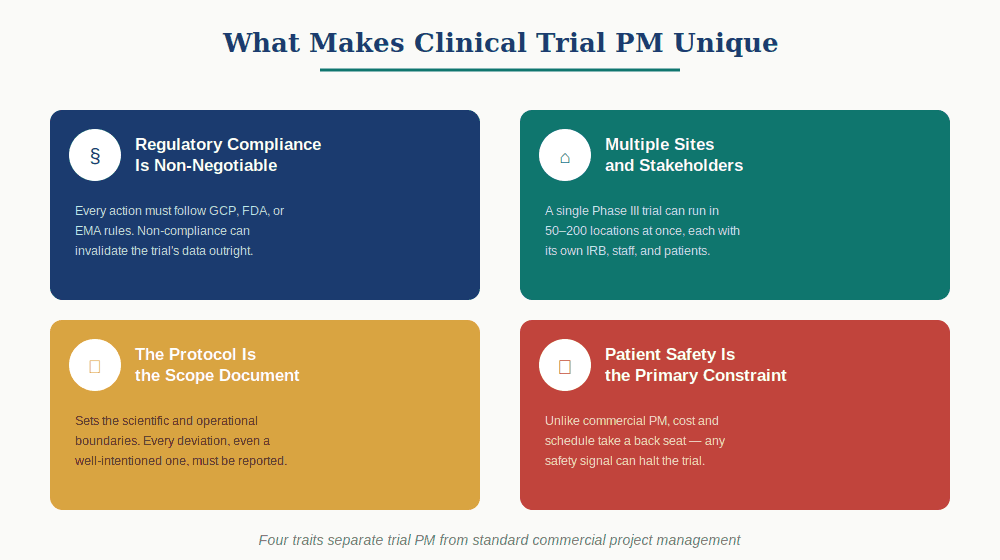
Regulatory Compliance Is Non-Negotiable
Everything needs to be documented according to the rules of GCP, FDA, or EMA depending on what markets the trial covers. Failure to do this does not only put the project at risk but also makes the data from the trial invalid.
Multiple Sites and Stakeholders
One single Phase III trial could be conducted in 50 to 200 locations in different countries at once with their respective IRB committees, personnel, and patient population.
Protocol Is the Scope Document
The trial protocol sets out the scientific and operational boundaries of the clinical trial. Protocol deviations, even those for good operational reasons, are official occurrences and need to be documented and reported.
Patient Safety Is the Primary Constraint
Unlike commercial PM in which cost and schedule constraints are paramount, patient safety is of utmost importance in clinical trials. Any safety signal can halt or modify a trial, irrespective of its schedule and budgetary constraints.
The Clinical Trial Phases as a PM Framework
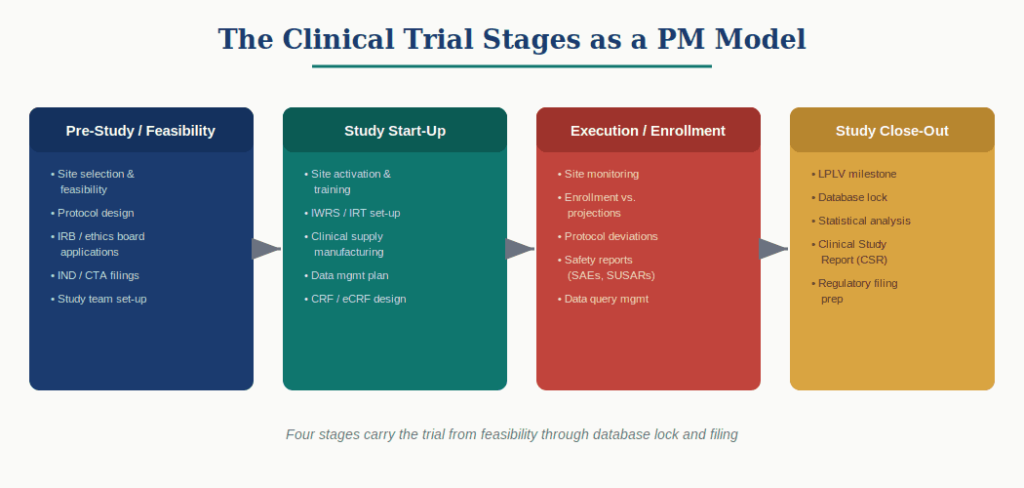
Most clinical trials proceed through an established process that involves specific project management phases.
Pre-Study / Feasibility
- Site selection and feasibility evaluation
- Protocol design and revisions
- IRB/ethics board applications
- Regulatory body applications (IND, CTA)
- Setting up the study team and training
Study Start-Up
- Site activation (contracts, budget, training of site staff)
- Setting up IWRS/IRT (randomization and drug supply systems)
- Manufacturing and distribution of clinical supply
- Developing data management plan
- Design of CRF/eCRF
Execution / Patient Enrollment
- Monitoring the sites (on-site and remote monitoring)
- Comparison of patient enrollment vs. projections
- Deviation from protocol
- Safety reports (SAEs, SUSARs)
- Data query management and resolution
Study Close-Out
- LPLV milestone achievement
- Database lock
- Statistical analysis
- Authoring Clinical Study Report (CSR)
- Preparation of regulatory filing
Core Project Management Functions in Clinical Trials
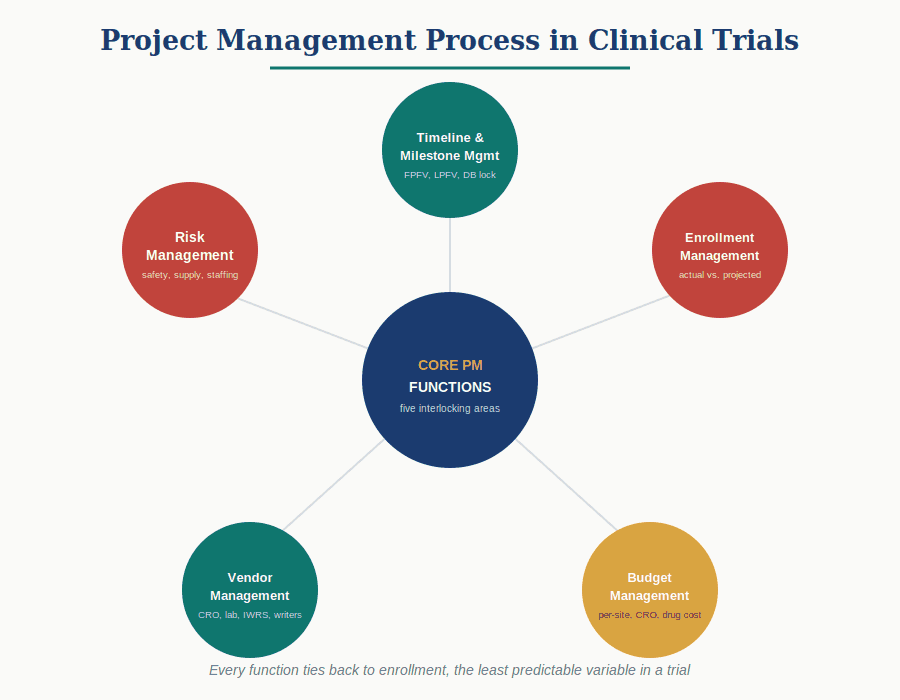
Timeline and Milestone Management
Clinical trial studies follow a timeline that is set against various milestones such as first patient first visit (FPFV), last patient first visit (LPFV), database lock, and regulatory submission. Every milestone has several dependencies including number of sites activated, enrollment rate and data cleaning cycle. The timeline management includes monitoring and forecasting based on enrollment rate.
Enrollment Management
The least predictable factor in clinical trial implementation is the enrollment process. The project manager monitors the actual enrollment process versus the projected one on a weekly basis to determine which sites are performing poorly and add sites/protocol changes when the enrollment process is behind schedule. Delay in enrollment is the most frequent cause of time extension in the clinical trial timeline.
Risk Management
The following are some of the risks associated with the clinical trial project management process:
- Data Quality Issues Related to Protocol Deviations
- Safety Signals that May Require Protocol Changes
- Logistics and Supply Chain Issues for Investigational Product
- Regulatory Hold or Requests for Information from Regulatory Agency
- Staffing Issues at Important Study Sites
Budget Management
Clinical trials budgets are complicated with per patient and per procedure costs negotiated by sites, CRO costs, laboratory costs, drug costs, and study overhead. Budget Management includes comparing real vs. estimated costs per site, dealing with changes with CRO, and calculating total budget of the study on its completion based on enrollment numbers.
Vendor Management
Clinical studies generally have more than one vendor; CRO for the entire trial management process, central lab for analyses, IWRS vendor for randomization, and medical writers for the creation of regulatory documents. In most cases, the role of the sponsor’s PM entails vendor management alongside site management.
Key Regulatory Considerations for PMs
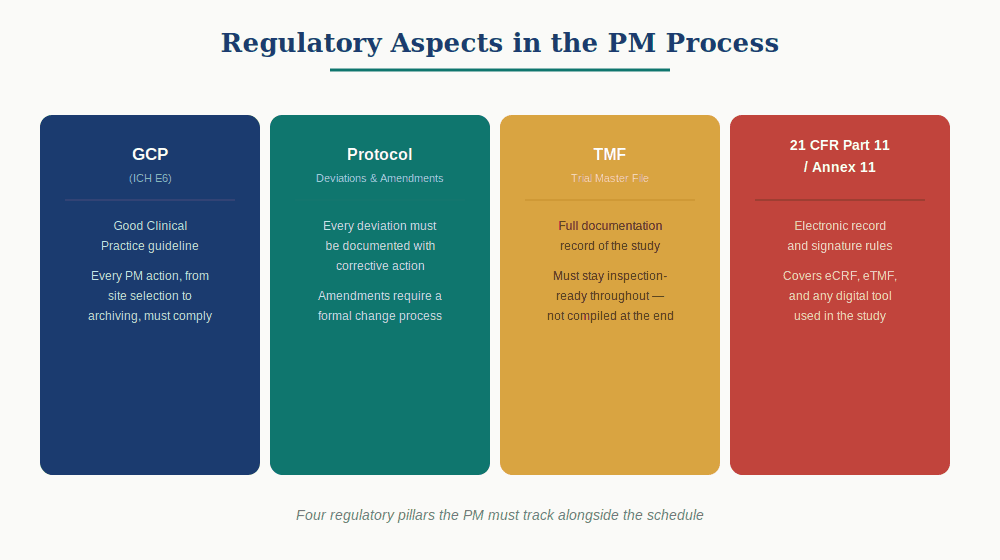
GCP (ICH E6)
GCP guideline for conducting clinical trials. All the actions of the PM, from selecting sites to archiving documents, must conform to the GCP guidelines.
Protocol Deviations and Amendments
All deviations from the protocol must be documented and corrective actions taken. Amendments to the protocol can only be done through a formal amendment process.
TMF (Trial Master File)
Full documentation record of the study. Regulatory bodies require the TMF to always be in an inspection-ready state, rather than compiled at the conclusion of the trial. One of the tasks of PM is to ensure TMF completeness is monitored throughout the study.
21 CFR Part 11 / Annex 11
Electronic record and signature requirements, related to eCRF, electronic TMF and any digital tool that is employed in the conduct of the study
Tools Used in Clinical Trial Project Management
Clinical Trial Management Systems (CTMS)
Trial Management Platforms:
- Veeva Vault CTMS: Leading CTMS platform used by big pharmaceutical companies
- Medidata Rave CTMS: Most frequently used; compatible with Medidata Rave EDC
- Forte Research Systems (OnCore): Popular among academic medical centers
- Florence eBinders: Electronic TMF and site management
Electronic Data Capture (EDC)
Trial Data Entry, Monitoring, and Management Systems:
- Medidata Rave
- Oracle InForm
- REDCap (popular in academia)
General PM Tools Adapted for Trials
Smartsheet, MS Project, or ProjectLibre are commonly used by CROs and Sponsors for tracking milestones and managing timelines along with other clinical systems.
Common Clinical Trial PM Challenges
Enrollment Shortfalls
Most common problem. Mitigation: proactive feasibility study, realistic enrollment modeling, streamlining the protocol to ease the patient’s job, and having backup sites on standby.
Protocol Amendments Mid-Study
Changing or adding new endpoints midway through the trial brings about a chain effect on CRFs, site training, regulatory timelines, and possibly enrollment predictions. Changes need a formal change control process.
CRO Oversight
Effective management of the CRO partnership includes setting clear scope expectations, escalation mechanisms, and governance meetings, rather than just expecting the CRO to handle everything.
Site Staff Turnover
Site changes of key investigators or coordinators will effectively freeze recruitment until the issue gets sorted out. Training of backup personnel and creating SOPs specific to each site would help minimize the disruption.
Final Thoughts
Project management of a clinical trial takes place right at the junction where scientific method meets complicated regulatory process and stakeholder coordination – making it one of the most challenging PM fields in any industry. Successful PMs in this environment have solid project management skills and understanding of the intricacies of the project along with knowledge of GCP and the dynamics of site management/recruitment.