Business Website Builder: What Established Businesses Actually Need (2026)

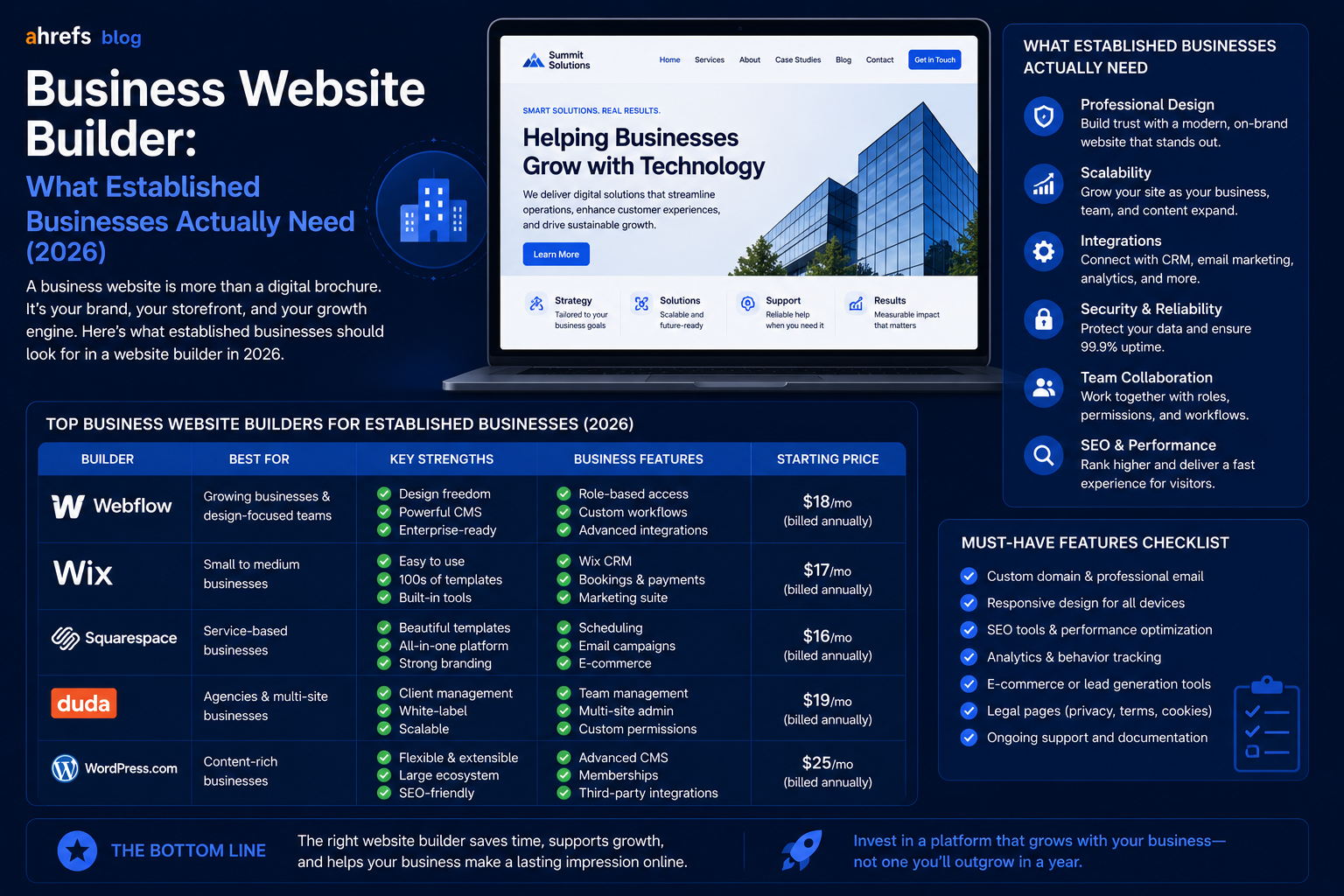
Making a website functional is one issue. Making a website that actually helps an already existing business, complete with actual customers and revenue and all the complexity that entails, is an entirely different matter.
For expanding companies, the issue isn’t just “is it possible to make a website there?” It’s more about “can this platform support what I need?”
This guide tells you everything you need to know when building a business website.
Table of Contents
- What Makes a Good Business Website Builder Differ from a Regular One
- Top Business Website Builders for 2026
- Paying Extra for These Features in a Business Website Builder
- Questions to Consider before Selecting a Business Website Builder
- Conclusion
What Separates a Business Website Builder from a Basic One
Website needs for a startup or existing business vary from those of a basic online presence.
Ecommerce
Can you sell your goods, stock items, handle payments, and ship products using the same site?
Business Integrations
Is it integrated with your customer relationship management system, email marketing tools, bookkeeping software, and booking application?
Team Access
Can there be more than one editor for the website who has different levels of access?
Analytics and Conversion Tracking
Are there goals, tracking of visitor source, and conversion rates of pages offered by the service?
SEO Capabilities
Is there management of SEO, custom meta tags, structured data, canonical URL, and optimization of page speed?
Scalability
Can the system survive under high traffic conditions? Is it robust enough to accommodate thousands of product pages or blogs?
Best Business Website Builders in 2026
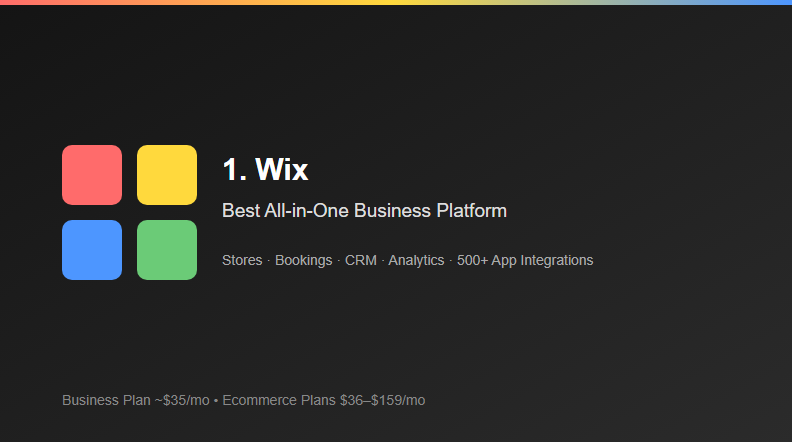
1. Wix, Best All-in-One Business Platform
Today, Wix offers much more than a simple website builder. In fact, the most useful aspects for existing businesses are the following:
- Wix Stores: Complete solution for building an ecommerce website with product pages, inventory, delivery options, and abandoned cart recovery feature
- Wix Bookings: Appointment booking system with payments
- Wix CRM: Built-in contact management and leads tracking
- Wix Analytics: Single platform to monitor traffic, conversions, and revenues
- Wix App Market: Over 500 different integrations including Mailchimp, HubSpot, QuickBooks, and many others
All-in-one approach is the key selling point of Wix for businesses.
Pricing
The cost of a business plan is approximately $35 per month, while the price for an ecommerce plan varies between $36-$159 per month.
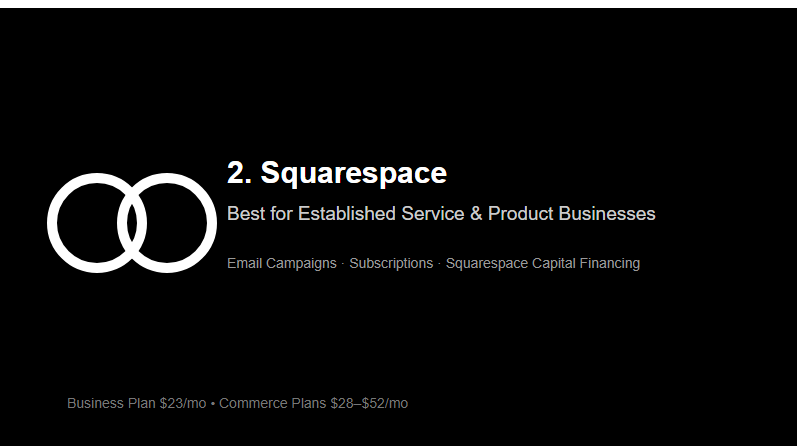
2. Squarespace, Best for Established Service and Product Businesses
Squarespace has grown to become one of the most developed platforms in terms of the business opportunities it provides. Squarespace can deal with physical items, digital goods, services, and even with subscriptions. The built-in email marketing service (Squarespace Email Campaigns) allows managing your contact list right in the system without using additional software.
Another great option provided by Squarespace to established companies is the Squarespace Capital financing program for businesses depending on their transaction history on the platform. This is an exclusive opportunity not provided by any other website builders.
Enterprise level tools offered by Squarespace are very good but this service is especially beneficial to businesses that sell based on the way their brand looks.
Pricing
Business plan at $23 per month; Commerce plans at $28-$52 per
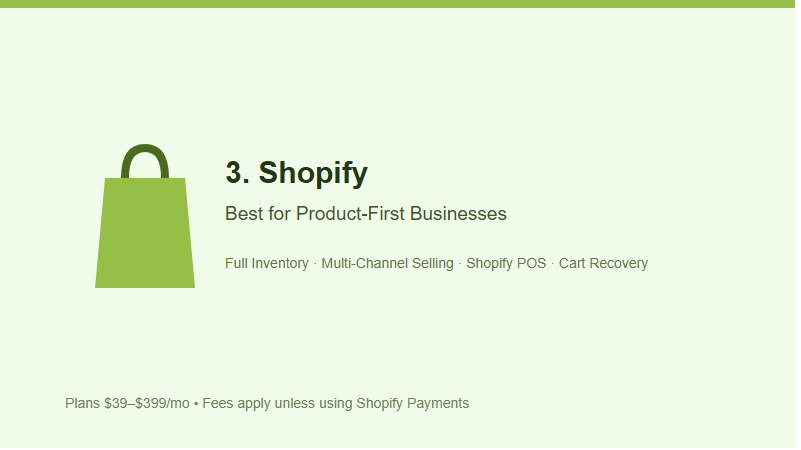
3. Shopify, Best for Product-First Businesses
If you have an ecommerce business, Shopify is still your best bet. It was made for selling online right from the start, and it shows:
- Full scale inventory management for thousands of SKUs
- Multi-channel selling on one platform (your website, Amazon, Instagram, TikTok, etc.)
- Full shipping and fulfillment integrations
- Shopify POS for brick and mortar
- Unparalleled abandoned cart recovery and customer segmentation
For a business whose primary function is selling, the Shopify ecommerce functionality beats any other builder.
Pricing
Plans range from $39 to $399 per month; transaction fees are charged unless you go with Shopify Payments.
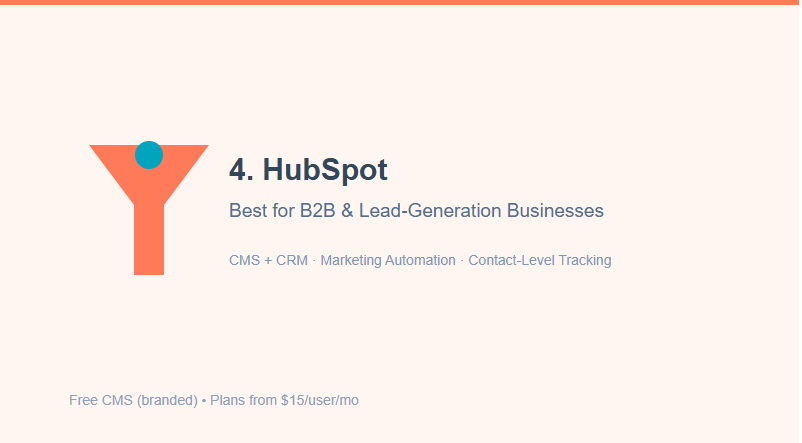
4. HubSpot, Best for B2B and Lead-Generation Businesses
The CMS built into HubSpot is not very popular as a website builder, yet for B2B companies engaged in lead generation, it is extremely useful. Everything on the site is seamlessly connected with HubSpot’s CRM, marketing automation, and sales software.
Each form fill-out, each page view, and each email click will be logged against a contact profile. It’s easy to track which pages the prospect looked at before requesting a demo or submitting a contact form.
And for businesses using a sales team rather than an online shopping cart, such information is far more important than any design element.
Pricing
Free CMS with HubSpot branding; $15 monthly per user subscription plans available.
Features Worth Paying for in a Business Website Builder
Multi-User Access with Roles
It is common practice for many companies to have multiple users working on the site. It is important to ensure that the software offers varying permission levels.
Priority Support
If your site is down when you launch a new product, you require immediate assistance. Ensure that the package you are using offers such support.
Advanced Analytics
Google Analytics free version is great but an even better one would be built-in analytics along with ecommerce conversion rates, top earning pages, and customer lifetime value.
Custom Domain and Email
Your email should be appropriate to your domain name. Usually, most platforms offer business emails or are compatible with Google Workspace.
SSL Certificate
No negotiation on this one. All good website builders automatically give SSL (or “https” in your URL) for free. If not, leave them.
Questions to Ask Before Choosing a Business Website Builder
1. Will This Platform Handle My Volume?
For sites that will have tens of thousands of products, millions of visitors per month, or hundreds of blog articles, try it out at scale.
2. Can I Migrate Away If I Need To?
Some platforms allow for an effortless export of your data. Other platforms make it incredibly hard. Get to know how you can get out of there before getting stuck.
3. What Does the Total Cost Look Like in 12 Months?
Add up all your costs starting from the platform itself, to the domain name, business email, premium apps, and any transaction fees.
4. Does It Integrate with What I Already Use?
Your website builder does not have to do everything, just seamlessly integrate with the tools you already use.
Final Thoughts
The website building service that once functioned merely as an outlet for your firm’s data is now the source of sales, marketing, customer support, and operational functions.
Select according to the true nature of your business activities, not those of a platform. For selling goods, try Shopify or Wix. For lead generation, choose HubSpot. When branding sets you apart, consider Squarespace.
Use a site that suits your business and watch the money come in. Use one that doesn’t, and you’ll be limiting yourself.