AI vs Automation: What the Distinction Actually Covers and Why It’s Easy to Get Wrong

Introduction
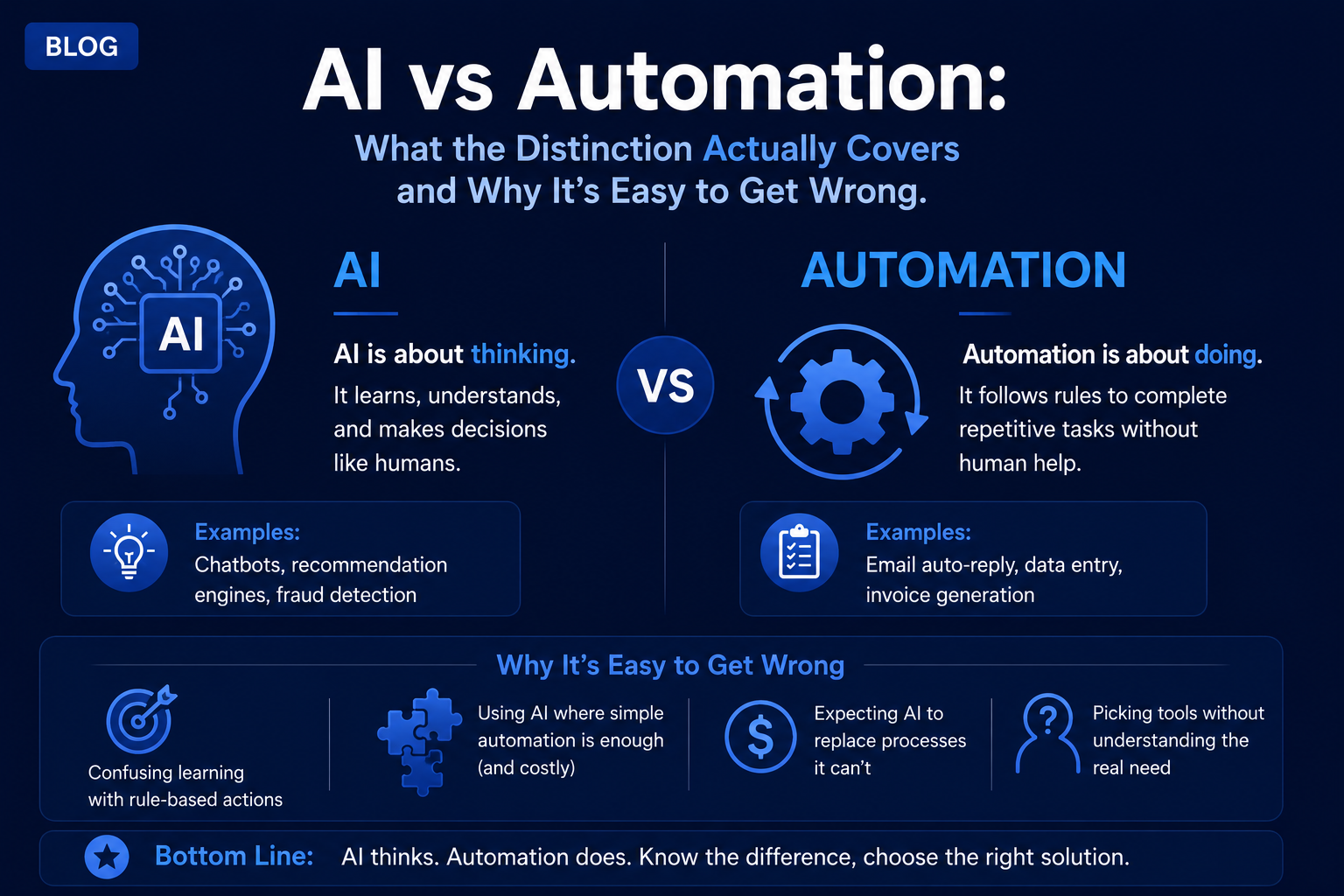
AI and automation are not quite synonymous; rather, automation is the use of systems which perform based on pre-set rules, whereas AI is the use of systems which can learn, predict, and make judgments.
It seems like it could be straightforward enough; however, the sheer amount of hybrid systems using both of these methodologies is where confusion comes into play for companies assessing technologies.
Why the Distinction Between AI and Automation Is More Complex Than It Appears
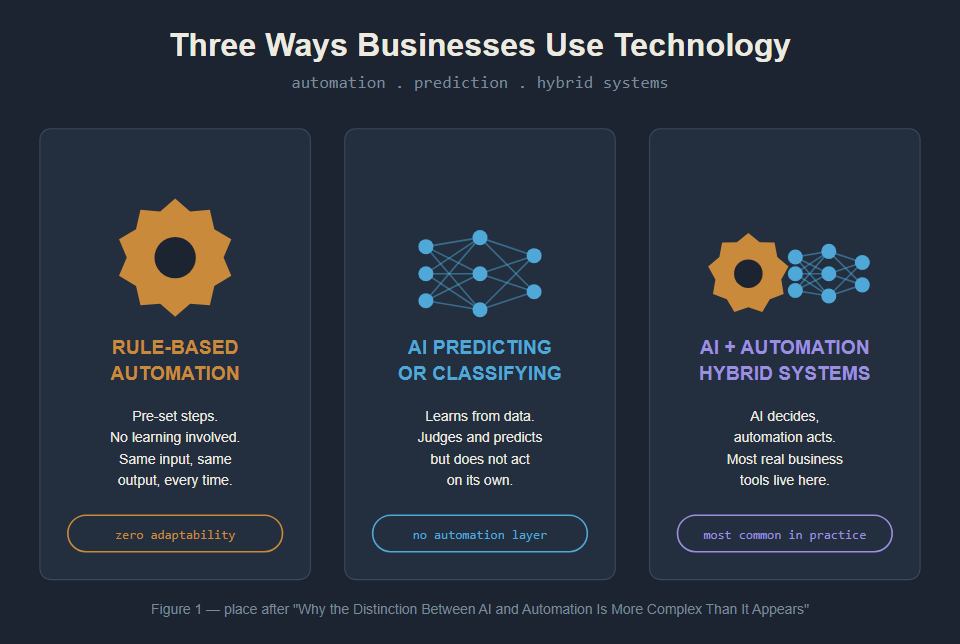
The modern technology for business is not one homogeneous notion; it consists of several elements, which are listed below:
- Fully automated technology without any learning
- AI technologies predicting or classifying without automating anything
- AI technologies combined with automation
There are some vendors that sell pure rule-based solutions using the notion of “AI” only for marketing purposes, and it causes misunderstanding concerning the real capability provided to the business.
In case a business considers a new solution, each underlying mechanism should be considered separately, since the technology that follows rigid rules operates differently from the one that uses fresh data.
Major Distinctions Between AI and Automation
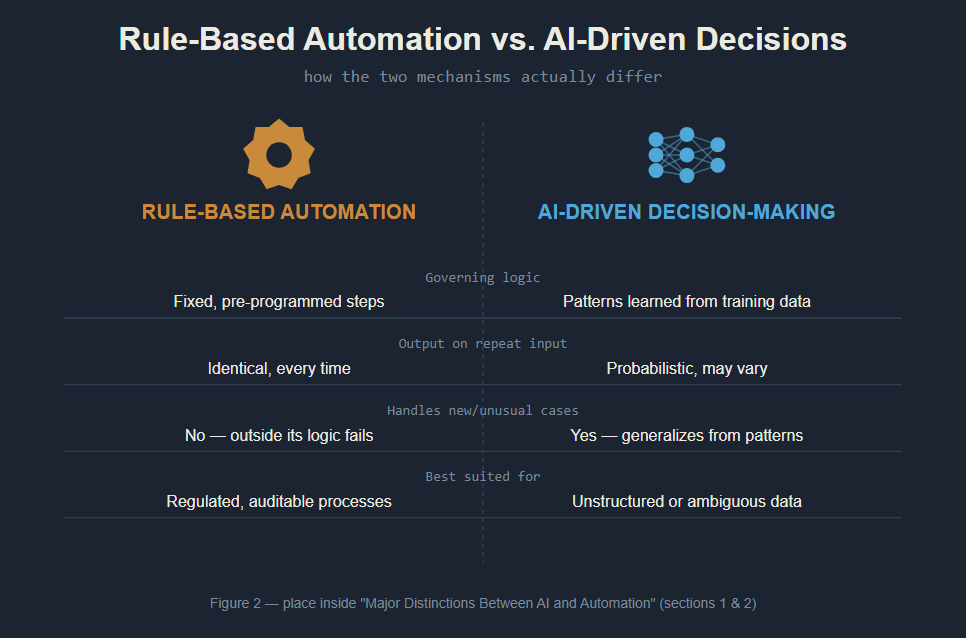
1. Rule-Based Automation
Rules Governing
- Set of pre-programmed steps, initiated due to certain criteria
- Predictable, uniform output from the same input always
- Cannot respond to cases that go beyond its pre-programmed logic
Complete automation is one of the most simple ways since it can lead to:
- Very predictable results in the case of clear procedures
- Facilitates troubleshooting due to clearly laid down logic
- Limited use where the process has some uncertainties
2. AI-Driven Decision-Making
These AI programs will provide solutions of pattern recognition and prediction by using enough training data.
AI Capabilities Often Include
- Learning from previous data to enhance continuously
- Dealing with ambiguous and unknown situations
- Probabilistic predictions as against deterministic results
3. Hybrid AI-Automation Systems
Dealing involves not only the pure rules or the pure AI, but also the increasing trend of combining the two approaches, AI decision making followed by automation.
Those Hybrid Systems Usually Vary in Many Respects Including
- How much is done using AI and how much is rule-based
- When human review is added to the process
- What happens when the AI makes a low-confidence prediction
4. When Pure Automation Is the Better Choice
Automated rule-based systems tend to be more suited to:
- Highly regulated processes which require predictable and auditible reasoning
- Simple repetitive tasks that have no room for ambiguity
- When the process demands explainability
It depends on the degree of judgment involved in the process itself.
5. When AI Adds Genuine Value
AI technologies can be useful for several specific cases such as:
- Process handling unstructured data such as text or images
- Cases when predictions need to be made based on complicated patterns
- Cases when rules are too many or too complicated to define
These cases would benefit from AI because the rule-based approach would have difficulties with variability.
Why Confusion Between AI and Automation Persists Even Among Informed Buyers
It rarely fails to differentiate the technologies due to ignorance on the buyer’s side.
Indeed, the reason for this may be that:
- The marketing material refers to “AI-driven” irrespective of the technology used.
- There is a hybrid of both technologies in reality.
- The buyer thinks a more advanced technology is definitely a better one.
How Businesses Choose Between AI and Automation
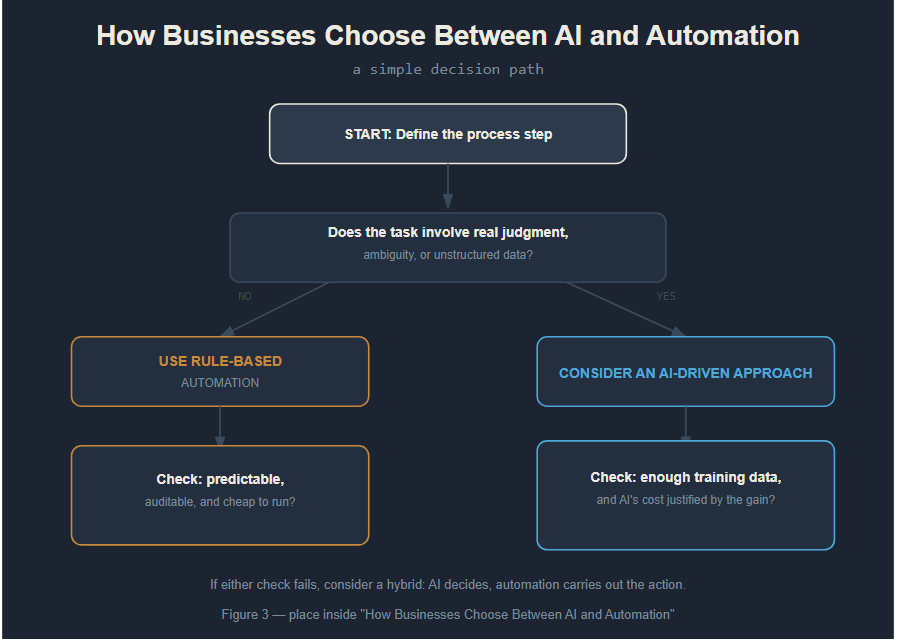
1. Assessing the Actual Nature of the Task
Large organizations can consider whether the process actually contains any ambiguity or decision-making component, particularly in situations where a process may appear easy but actually has underlying difficulties.
2. Approaches Supporting the Right Technology Choice
A number of evaluation methods involve companies which:
- Directly ask the vendor if the process uses rules or is truly an AI application
- Determine how the system behaves when presented with unusual edge cases
- Select the most basic solution that actually solves the problem
3. Avoiding Technology for Its Own Sake
Evaluation methods include those which are concerned with:
- The end business goal, not the technology used
- Comparing costs and complexities of AI versus other technologies
- Maintainability of the selected approach
Not using technology for its own sake means that companies can be assured that they are not over-paying for AI capabilities; an automated solution would work just as well.
Common AI vs Automation Mistakes
1. Choosing AI When Simple Rules Would Suffice
Using a complicated and expensive AI solution for functions that can be easily managed by a simple rule-based system.
2. Assuming All “AI-Powered” Tools Are Genuinely Intelligent
Assuming the hype surrounding marketing terminology and assuming the tool learns without checking on it.
3. Underestimating AI’s Data Requirements
Aim for AI capability without taking into account the amount of data necessary to deliver on that promise.
4. Poor Matching of Technology to Task
Neglect of:
- The actual need for judgment or prediction in the process
- Need for explainability and predictability of the process
- Costs of running AI relative to simpler automation
Poor alignment may result in over-engineering or inability to cope with complexity.
Bottom Line
The difference between AI and automation is quite broad-ranging and includes things like rule-based logic, predictions made by AI, mixed systems, and appropriate technology matching the task being done.
Since there is a lot of marketing hype around these two terms, it would be better if companies tried to look at the real essence of their task and chose the most suitable technology to solve it.