AI Video Detector: How Generated and Deepfake Video Gets Identified

Introduction
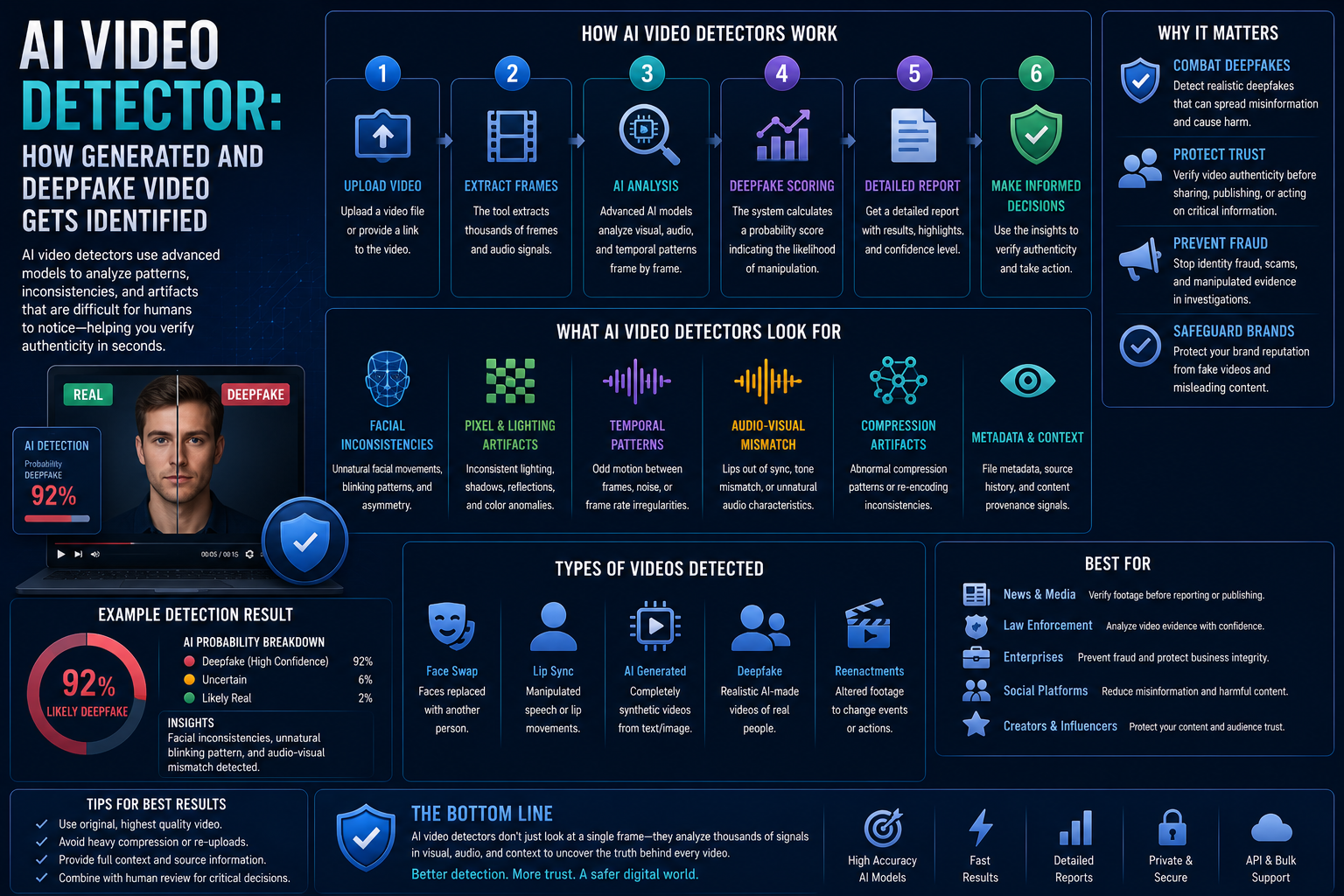
AI video detector refers to an instrument designed to detect and determine whether a particular video content has been either created, altered, or partially constructed by using AI, including AI-generated videos and deepfake videos where faces and voices are changed in existing videos. This article will offer a complete exploration of AI video detectors, how they function, why they remain less advanced compared to text and image detection, and how they are being applied today.
Why Video Detection Is the Least Developed Category
As far as the development stage is concerned, AI video detection is less mature than text detection or image detection, as video involves not only many of the same issues that image detection has, but also adds another layer of complexity due to the motion, audio, and temporal issues that arise. Video analysis is also much more complex than analyzing a single image or piece of text, as video files are much bigger than images and text blocks.
In addition, the recent emergence of extremely realistic AI video that ranges from videos generated completely by AI to deepfakes that modify existing videos has made AI video detection a rapidly developing field despite being still relatively immature compared to the other two detection techniques.
How AI Video Detectors Work
Frame-by-Frame Image Analysis
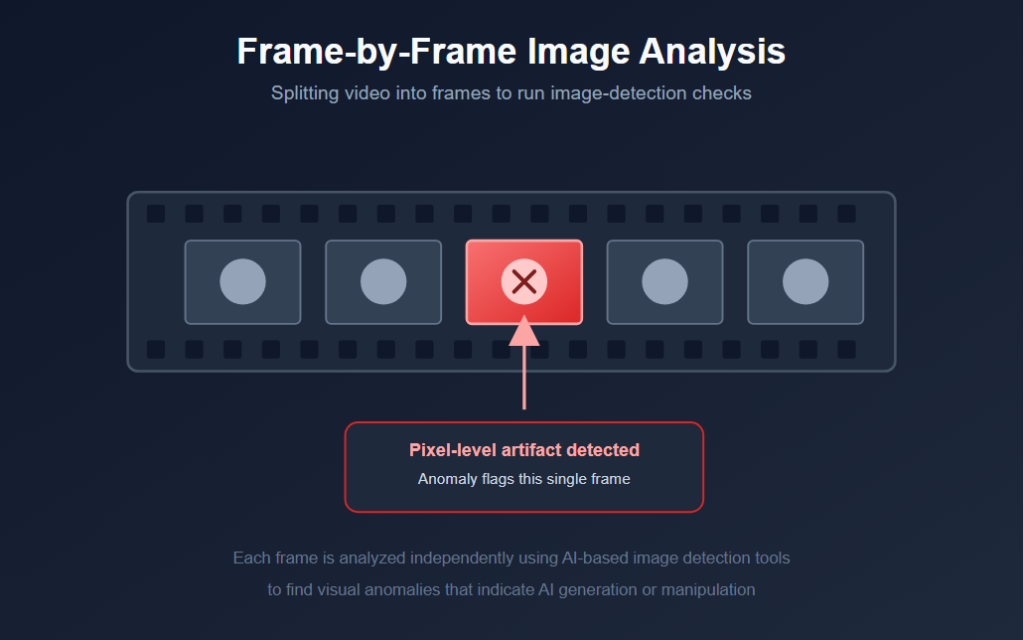
Many video detectors separate videos into their component frames and perform image detection on them using various approaches, including artifact detection at the pixel level, looking out for inconsistencies similar to those observed in AI-generated images.
Key Characteristics
- Separates individual frames from the video.
- Uses AI-based image detection tools on all frames.
- Detects visual anomalies that indicate AI modification.
Temporal Consistency Checks
As videos consist of multiple frames as opposed to one frame alone, there is an opportunity to check for inconsistencies across frames such as unnatural blinking behavior, flickering, or warping of a person’s face, which would never be seen in real videos but are frequently observed in fake videos.
What Is Examined
- Unnatural blinking behavior
- Flickering between frames
- Warping of faces
- Inconsistent movement
Audio-Visual Synchronization Analysis
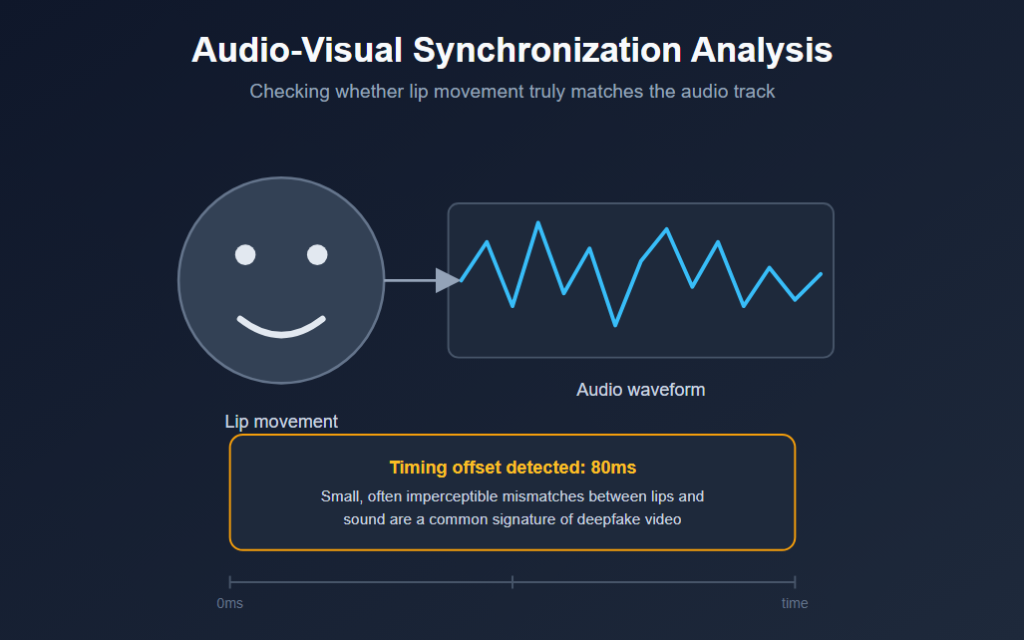
In relation to deepfakes, there are some detection methods that focus on determining whether the lip sync matches the audio perfectly, as sometimes there will be minor errors between the lip and audio synchronization that may not be obvious to a human observer.
Detection Focus
- Lip-sync accuracy
- Difference in timing
- Consistency of facial movement
- Alignment of audio
Metadata and Provenance Checks
Just like is done for images, there are some video detectors that look into file metadata or the provenance indicators encoded within a video using standards like C2PA, which some AI video creation tools and camera makers have begun supporting.
Information Reviewed
- File metadata
- Provenance embedded within file
- Edit history
- C2PA verification signal
Why AI Video Detection Is Particularly Difficult
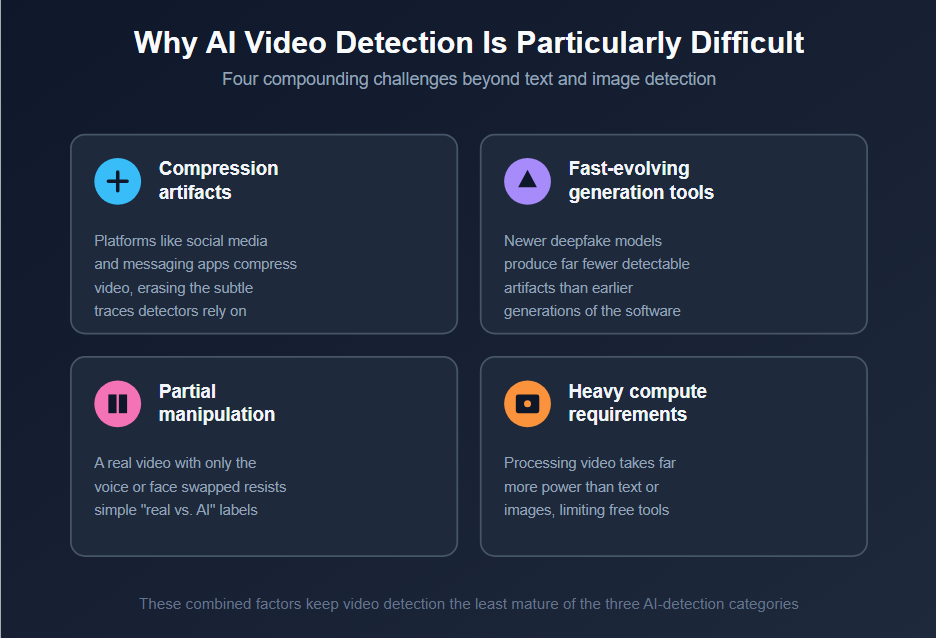
It is very typical for AI video detection to encounter problems that exceed those faced by AI image or text detection:
- The process of video compression that is widely used on social networks and messaging apps can destroy or eliminate the minor distortions that detectors use for spotting deepfakes, thus, making real videos more difficult to prove and synthetic videos more difficult to detect.
- The technologies of deepfake creation have undergone tremendous development; nowadays, the most sophisticated tools generate much less detectable artifacts than their predecessors.
- Partial manipulation (for example, a real video with AI-created voice or face replacement in a genuine video) cannot be easily classified as either “AI” or “real.”
- The processing of video consumes much more computer power than text and image recognition; therefore, there are significantly fewer free and lightweight tools in this field than there are text detectors.
Common Use Cases for AI Video Detectors
Journalism and Fact-Checking
Helpful in determining whether the videos that have been doing the rounds on the internet, especially during breaking news incidents, are genuine or fake before they are reported on or spread anymore.
Platform Moderation
Also increasingly becoming popular among social media and video-sharing websites to automatically mark videos that are either deepfake or generated through AI technology.
Legal and Security Contexts
This technology is employed in cases where verification of videos is required, like corporate investigations or legal cases where there can be a dispute regarding the authenticity of video footage.
Election and Public Figure Protection
This technology is used to monitor any kind of deepfakes related to politicians and public discourse because of the real-life consequences of such misleading videos at that particular time period.
Who Builds and Uses These Tools
Whereas the field of text detection consists of a large number of consumer-oriented tools that are free to use, video detection in artificial intelligence is dominated mainly by niche providers, academic organizations, and social media companies’ built-in systems in their moderation infrastructure. Some wider platforms for digital forensic analysis and content verification have incorporated video detection capabilities, but dedicated consumer-grade tools are significantly less widespread compared to text detection solutions.
Limitations to Keep in Mind
Like every other type of AI detection software, there is no video detection software today that provides full assurance of accurate detection, and this is seen as a much bigger problem in the case of video as opposed to texts or images, considering the relative infancy of this particular category of AI. The process of detecting even a high-quality deepfake is not easy even for specially designed software.
Bottom Line
AI video detection involves a combination of image analysis, temporal consistency, and audio-visual sync verification methods; however, it is considered the least developed among the three branches of AI detection technologies due to the availability of fewer applications for consumers than the other two categories. Considering the importance of detecting fake videos in the context of journalism, security, and even social discourse, it is unlikely that accuracy in the field will ever reach perfection and become absolute.