AI Image Detector: How Generated Images Get Identified

Introduction
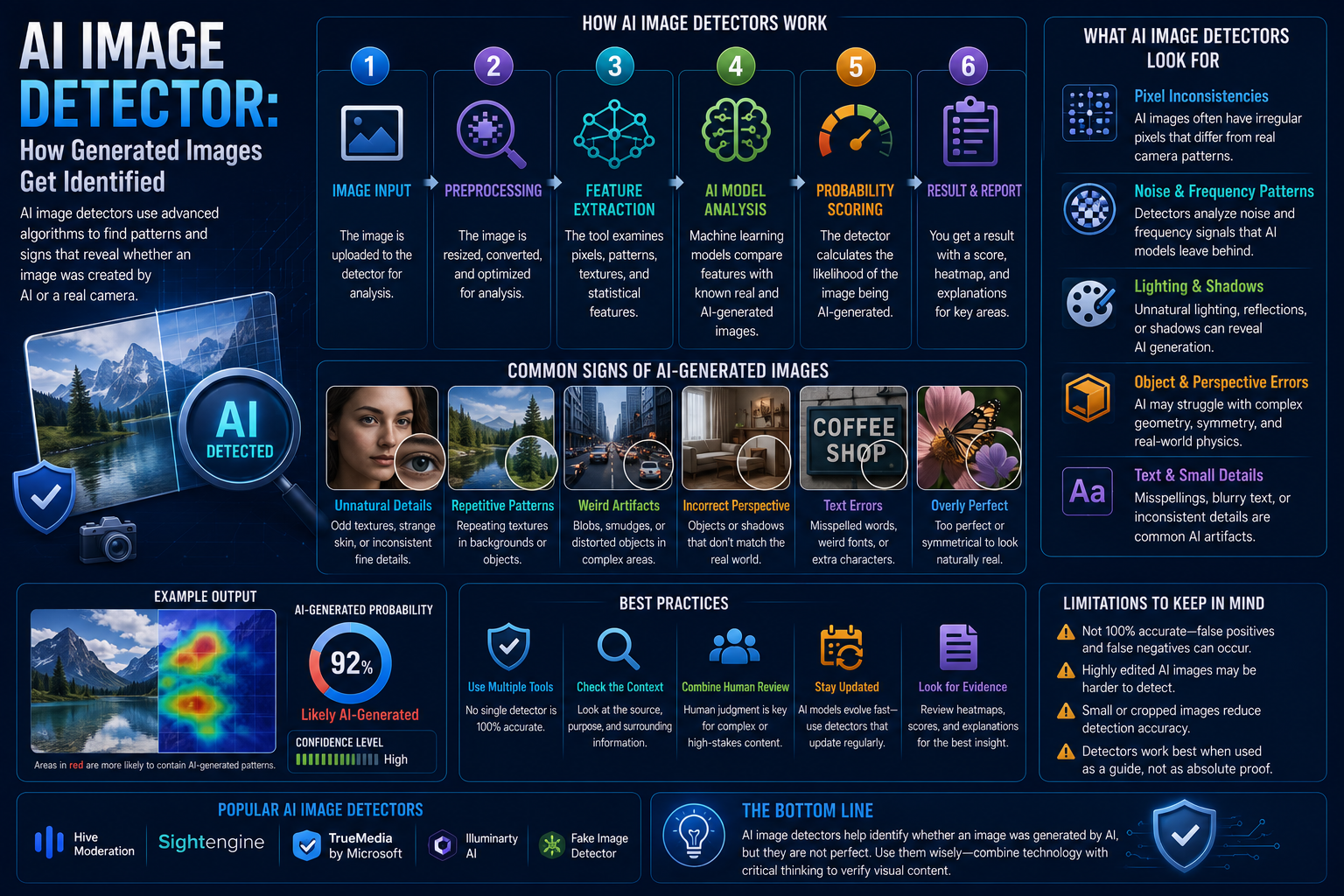
An AI image detector refers to software designed to analyze a stationary picture and predict whether the picture in question was generated or modified using a generative artificial intelligence system like Midjourney, DALL-E, and Stable Diffusion and not captured using a camera or generated using some other manual method. This article will provide an extensive analysis of AI image detectors with a focus on their differences with text detectors, the factors they depend on, and areas where they lack accuracy.
Why Image Detection Works Differently From Text Detection
AI text detectors make use of statistics about language, but there is no such linguistic basis for images, so AI image detectors usually look at pixel-based artifacts, inconsistencies, or metadata. This implies that the techniques used in detection are totally different from text detection techniques, despite falling into the general “AI detector” category.
Additionally, image generation models work based on a completely different principle compared to language models, and that is the diffusion technique.
How AI Image Detectors Work
Pixel-Level Artifact Analysis
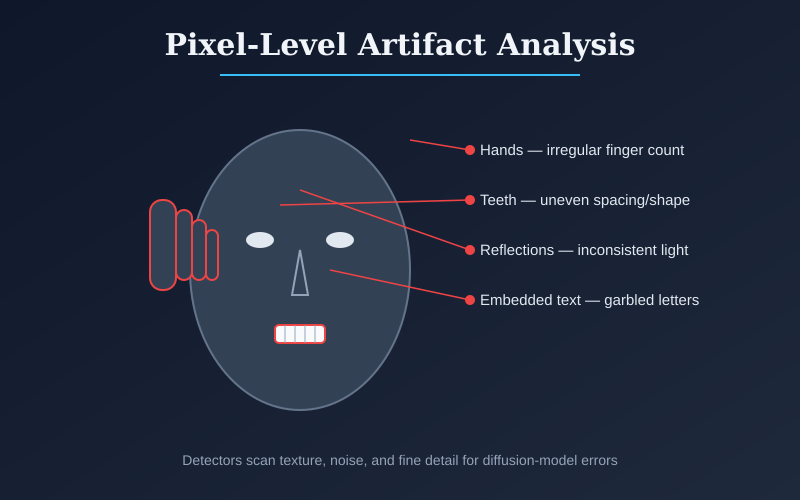
The inconsistencies created by the process of diffusion models are often minute and invisible to the naked eye. The detectors that are trained on huge databases of artificial intelligence-generated images detect such errors, which are usually centered around areas such as hands, teeth, text embedded in the images, and reflective surfaces.
Key Points
- Analyze Texture, Noise, and Fine Detail Inconsistencies
- Identify Artifacts That Usually Appear in Diffusion-based Image Generation
- Pay Attention to Hands, Teeth, Reflections, and Embedded Text
Frequency Domain Analysis
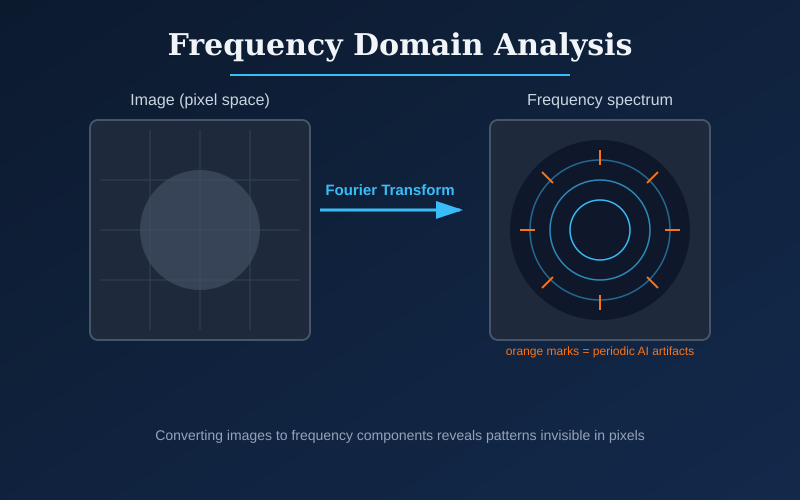
There are some detectors that transform an image into frequencies that aren’t visible in pixels but are often seen in AI-generated images because of the way diffusion models generate images.
Key Points
- Transforms images to their frequency components
- Finds underlying patterns that cannot be seen by human eyes
- Discovers artifacts that could have been generated while generating an image using diffusion models
Metadata Examination
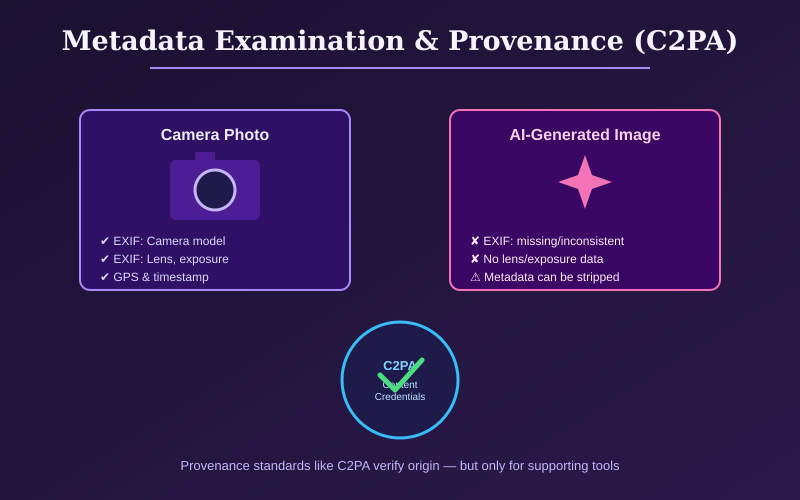
Most camera-acquired images include EXIF data like camera details, lens information, and exposure settings. AI-generated images do not have or inconsistently have EXIF data. An EXIF-based detector could identify images missing this information, but this information could be altered or deleted.
Key Points
- Examines EXIF metadata
- Looks for metadata related to the camera, lens, and exposure
- Examination of metadata by itself is not a valid approach since metadata can be stripped and even modified
Provenance and Watermarking Standards
Some image generating AI tools insert an imperceptible mark at the time of creation, while industry efforts like the C2PA (Coalition for Content Provenance and Authenticity) standard seek to add verifiable and immutable metadata about how an image was created and edited. Detectors that scan for this mark can detect AI-generated images with reasonably good accuracy, but this method will only work on images that were created using this kind of tool.
Key Points
- Detects watermarking and provenance markers
- Compliant with C2PA standard
- Operates exclusively with AI image generation platforms that have partnered with the service provider
Classifier-Based Detection
The same holds for images; many image detection tools rely on classifier models trained with pairs of real images and AI images to determine what makes each different from one another without being able to identify specific characteristics to the naked eye.
Key Points
- Based on machine learning classifiers
- Trained on dataset of real and AI images
- Distinguishes patterns that cannot be detected by humans
Why AI Image Detection Is Particularly Difficult
It is quite common for AI image detectors to fail in their work in manners that are completely different from how text detection fails:
- Image manipulations such as compression, rescaling, or adding effects to the image might erase or cover up the small differences used by detectors in their work, thus accidentally lowering their accuracy despite the absence of any deliberate evasion attempt.
- The newer generations of models generate images that are noticeably artifact-free compared to previous generations, shrinking the differences between them that detectors depend on.
- Images that are partly AI-created (for example, a real-life picture with an AI-created background or an AI-generated object inserted into it using inpainting) cannot be categorized as either “AI” or “real.”
- Detectors trained predominantly on the images created using one generation model, such as Midjourney, may fail at detecting those created with a different generation model.
Common AI Image Detector Tools
While stand-alone detectors developed for the purpose of image detection are not as prevalent or advanced as those developed for text detection, an increasing number of vendors provide image detection, either in stand-alone products or as a function in their content verification systems. The former category is designed mainly for individual users analyzing a particular image, while the latter is developed mainly for publishers, stock image websites, or social networks analyzing multiple uploaded images.
Who Uses AI Image Detectors
Publishers and News Organizations
To make sure that submitted images are genuine, especially in photojournalism, where hidden AI images or AI-edited images have a lot of credibility and legal implications.
Stock Photo and Marketplace Platforms
To make sure that any policies restricting the use of AI images or labeling them accordingly are being followed so that buyers’ trust is not compromised.
Social Media Platforms
Gaining more use on a large scale for the automatic tagging of AI-generated images as part of the overall fight against disinformation and authentication of content.
Individuals and Researchers
In an informal capacity, to determine whether a viral image circulating online is likely to be AI-generated.
Limitations to Keep in Mind
Like all categories of AI detectors, there is no image detection tool that will provide complete accuracy today, and there is nothing to prevent both false positives and false negatives. This is especially so for images that have been altered after being created, images that have been created by new generation models or those that combine elements of both. The use of provenance methods, such as C2PA, is more reliable than just using pattern recognition but is limited to images that have been created using supported tools.
Bottom Line
An AI image detector utilizes an entirely different approach from the text-based detection method, mainly focused on pixel-based artifact identification, metadata scanning, and provenance detection instead of pattern recognition of language. This kind of technology is still less developed and less accurate compared to AI text detection because of its ongoing struggles with advanced generative models and typical image manipulation processes. Like other types of detectors, the outcome from using this technique should not be considered a final one.