AI Detector Free: What’s Available Without Paying and What You Give Up

Introduction
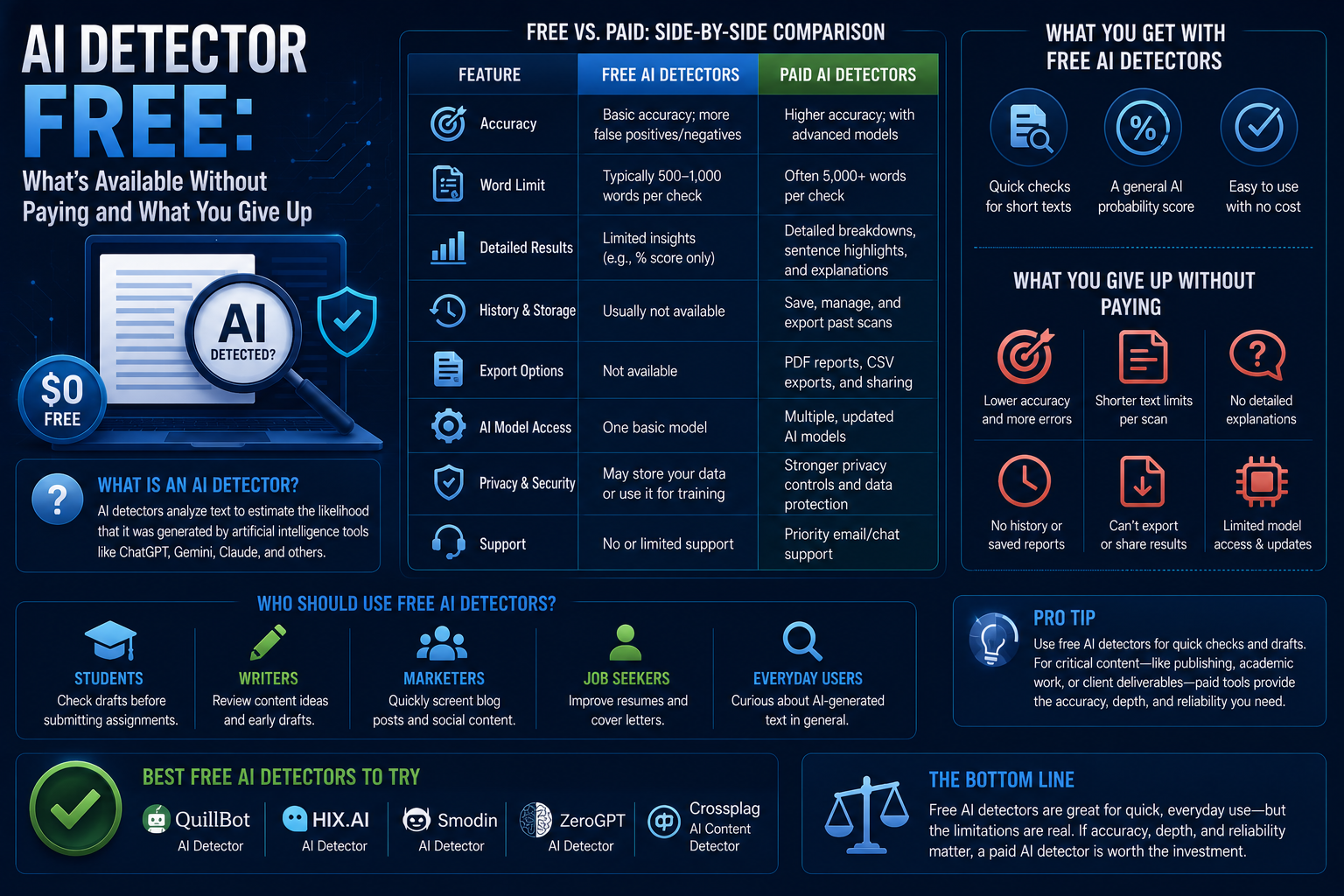
A free AI detector is any program that enables a user to detect whether the given piece of writing was created using artificial intelligence without having to pay for the service. It constitutes a significant portion of the entire AI detection market because most vendors provide a minimum free version along with more expensive versions designed for business purposes.
In this article, a detailed overview of free AI detectors will be provided, and it will include comparing free and paid detectors, as well as the limitations of using the former.
Why Free AI Detectors Exist
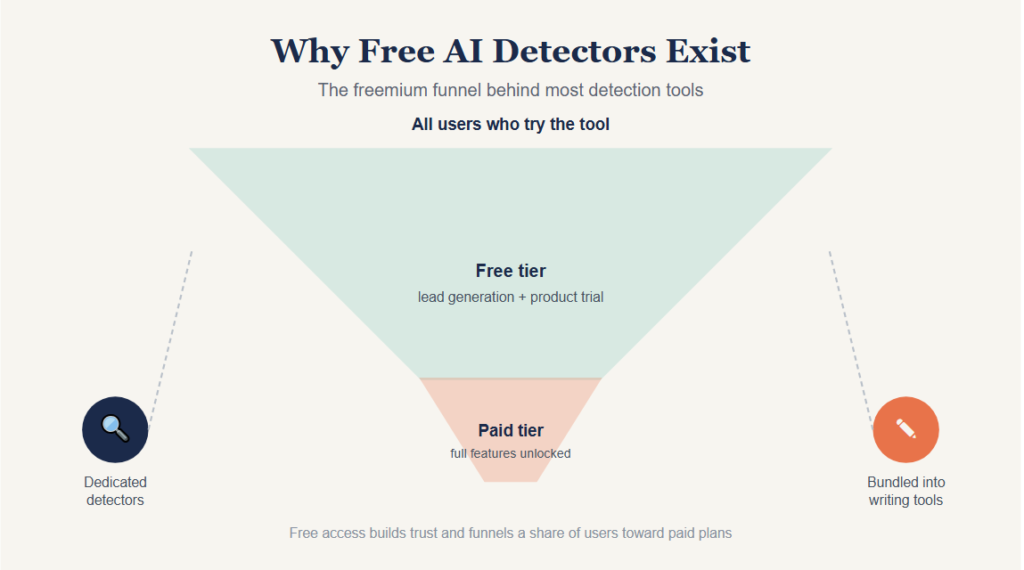
The providers in this industry mostly apply a freemium pricing strategy, in which case the free version of the tool acts as a lead generation channel and also allows users to see the value of the product, whereas the premium version unlocks more features without restrictions.
This is a standard pricing scheme applied to all the writing and content creation tools as a whole, and AI detection follows the same trend.
Also, there are examples of free AI detectors provided by businesses which have nothing to do with detection but operate in other industries; for instance, the paraphrasing tool by QuillBot or the writing assistant by Grammarly.
What Free AI Detectors Typically Offer
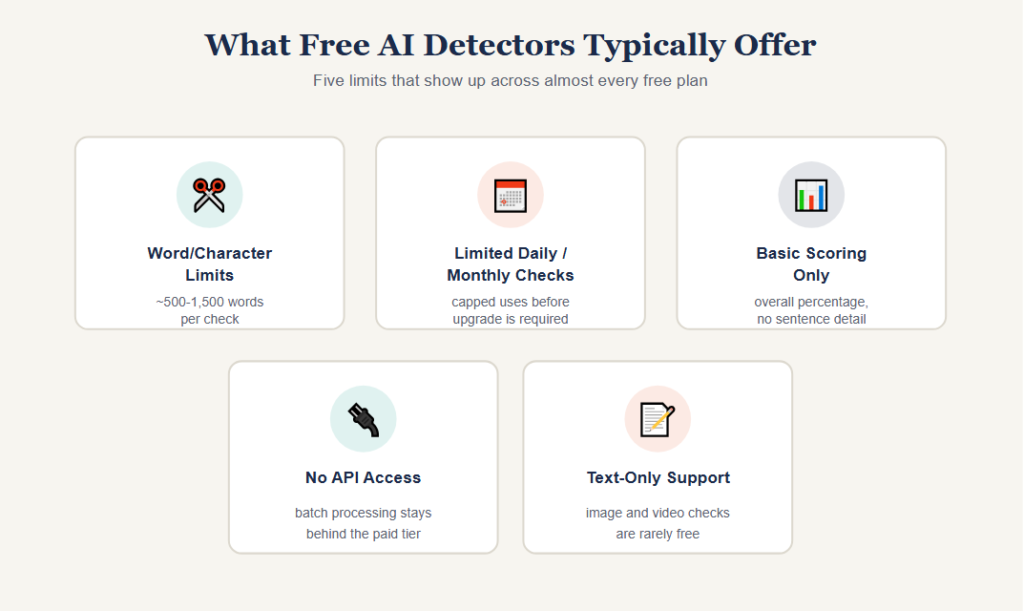
There exist limitations that most free plans under this type have in common, irrespective of the company offering them.
1. Word or Character Limits
Text checks are usually limited to the amount of text you can submit at one time, which could be around 500-1,500 words.
2. Limited Daily or Monthly Checks
A limit to the number of times the detector is used by the user in a certain period before the need to upgrade arises.
3. Basic Scoring Only
The free tier normally offers a general percentage score but does not offer a sentence level analysis as offered in the paid tier.
4. No API Access
Batch processing is usually offered through the paid tier.
5. Text-Only Support
Free detection of images and videos is far rarer than that of text, as both demand relatively greater computational efforts.
Commonly Used Free AI Detectors
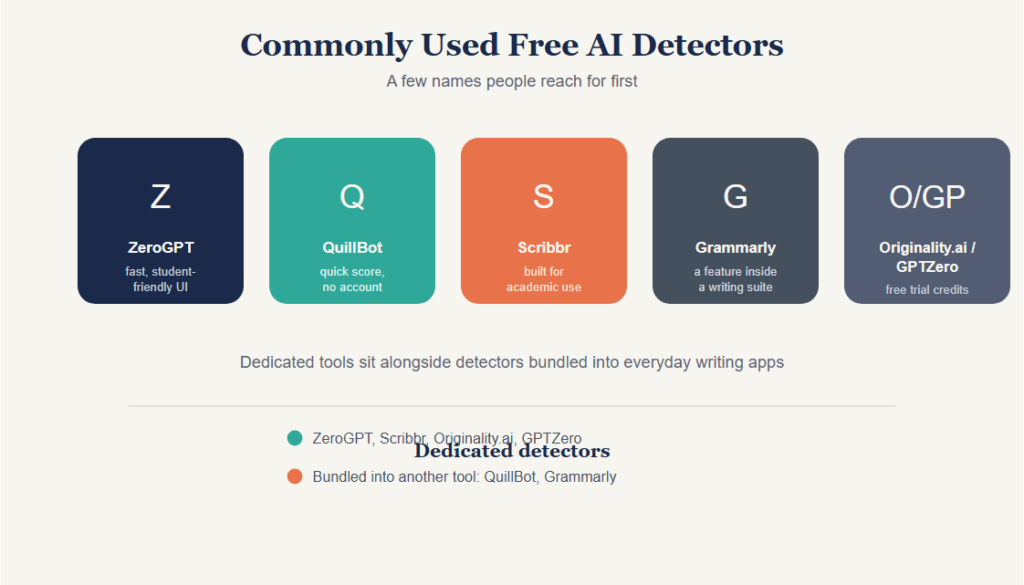
ZeroGPT
An example of a popular text detector that offers a user-friendly interface and fast performance, often used by students and individual authors.
QuillBot AI Detector
Part of the free QuillBot package, providing a quick percentage score without the need for an account.
Scribbr AI Detector
Tailored for use in academics, providing a free service to help students check their work before submitting it.
Grammarly’s AI Detection Feature
Included in the Grammarly basic service that acts as an overall grammar and writing assistant as opposed to a dedicated application.
Free Tiers of Paid Platforms
Services like Originality.ai and GPTZero, which have been designed mainly for corporate use, will usually offer a limited free scan or trial credits for individuals to try out the service before subscribing.
What You Typically Give Up With Free Tools
It is quite typical for free versions of AI detectors to provide less accurate or fewer features than their paid versions for the following reasons:
- The free version uses an older or less advanced version of the detector, while the more advanced version is provided exclusively to those who pay for the service.
- The possibility of bulk/batch processing, which is crucial for content publishers for testing large amounts of text, is never included in the free version.
- Advanced features such as detecting the exact AI used to generate some particular passage are included only in the paid version.
- The free version includes rate limitations making its regular use practically impossible.
When a Free AI Detector Is Enough
For one-off purposes such as when a student wants to detect plagiarism in one essay or a freelancer runs a check before sending out his or her work, the free version will do fine.
There really isn’t much difference in the underlying detection technology that is deployed in free versions and those in paid versions.
When It’s Worth Paying
Organizations who require scalability in checking content, need consistency and repeatability in their results, or require integration with a content management system or workflow will most likely find themselves best served by a paid option.
This is especially the case for:
1. Content Marketing Teams
Analysis of vast amounts of work submitted by freelancers or agencies.
2. Educational Institutions
The use of detection within an official academic integrity framework.
3. Publishers
When editorial policy calls for AI content to be reported or scanned before being published.
How to Evaluate a Free AI Detector
Accuracy is hard to guarantee in relation to all types of content, so there are some useful criteria to consider before using a free detector tool:
- Whether any information about accuracy is available from the provider, irrespective of independent verification.
- Whether the limit on word count offered by the free tier is adequate for checking the kinds of text usually analyzed.
- Whether the program is designed to be a dedicated plagiarism checker or only an additional feature of another product, given that dedicated software tends to receive more consistent updates.
- Whether the score indicates which areas of text have been highlighted.
Bottom Line
The free version of an AI detector can do just fine for personal, small-scale use but it certainly does come with its own set of trade-offs such as having restrictions on how many words one can scan or how much the program can be used overall.
As any AI detector, free or not, the outcome cannot be considered as accurate but only as an estimate.