AI Automation: What It Actually Covers and Why It’s Easy to Get Wrong

Introduction
AI automation refers to the application of artificial intelligence to perform jobs that otherwise need human intervention, and not rule-based automation that follows predetermined steps.
It may appear like a relatively straightforward concept; but due to the many overlapping technologies classified as “AI automation,” it is an area of technology that most companies fail to understand.
Why AI Automation Is More Complex Than It Appears
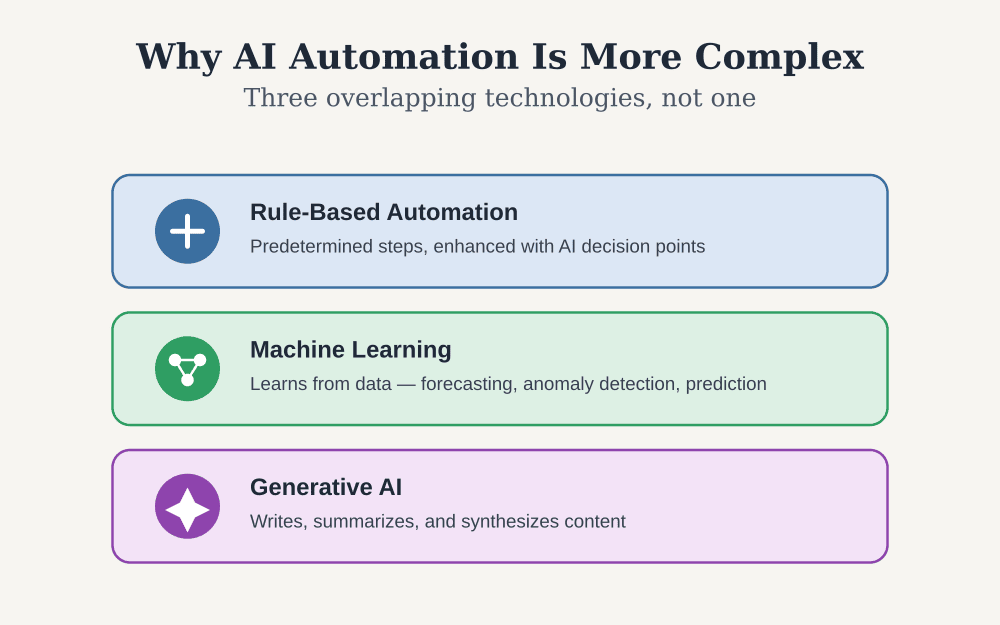
The technology of AI automation is not monolithic; rather, it is a combination of the following technologies:
- Automation based on rules supplemented by decision-making using AI technology
- Machine learning systems that learn over time with the help of data
- Generative AI managing content generation or summarization
There are many companies that regard all forms of automation as equally “intelligent” and thus create a false expectation of what this technology can accomplish.
In the case of the company that uses different kinds of automation in its processes, the technology should be evaluated separately, since a task appropriate for rules is completely different from a task involving judgment or prediction.
Major Areas of AI Automation
Rule-Based Automation With AI Enhancements
Rules Governing:
- Workflows that are initiated through particular events
- Integration of AI to enhance the decision-making process in a structured workflow
- Handling exceptions when the particular scenario does not fit into the rules
Misunderstanding rule-based systems as being intelligent systems is one of the most prevalent myths because it might lead to:
- Misinterpretation of the capabilities of the system
- Uncertainty in case of poorly-handled exceptions
- Disappointment in case the system fails to “learn”
Predictive and Machine Learning Automation
Automation through AI usually provides models that evolve with time and thus require enough historical data in order to make accurate predictions.
Predictive Automation Often Includes:
- Demand forecasting through historical data trends
- Anomaly detection through operational data
- Predictive maintenance through triggers in industry
Generative AI in Automated Workflows
Handling includes not just processing data in an organized manner but also the growing adoption of generative AI to write content, synthesize information, or chat.
Those Capabilities Usually Vary in Many Respects Including:
- How much review by humans is part of the process
- Whether the output is used as is or needs to be edited
- How well the AI performs when the input is ambiguous or incomplete
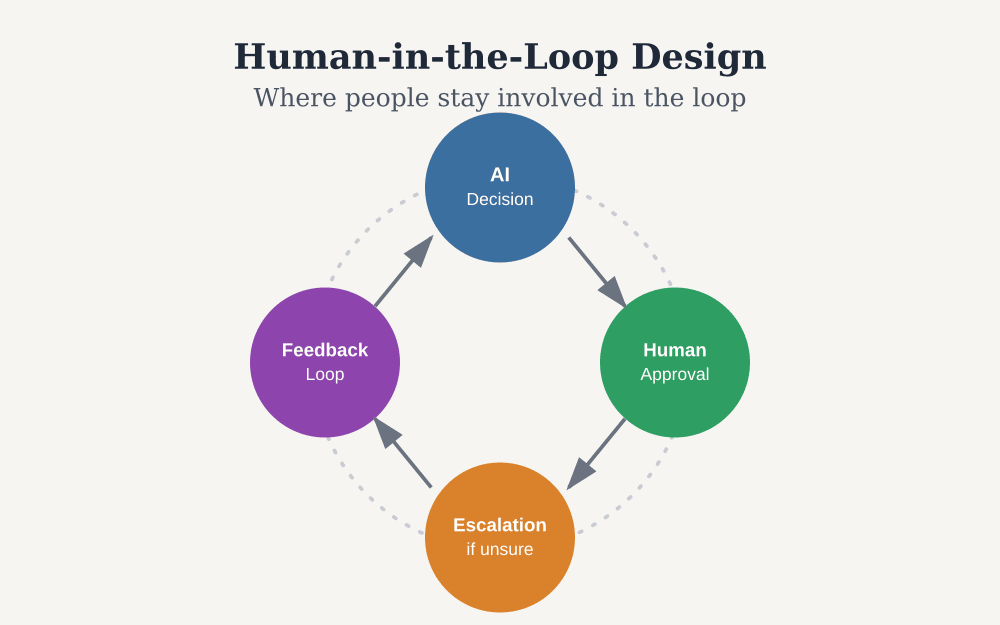
Human-in-the-Loop Design
Some features of automated AI systems include:
- Approval processes prior to the execution of crucial decisions
- An escalation plan if AI is not very confident about something
- Feedback loop processes for future improvements
Data Requirements and Model Performance
Various AI automation solutions need constant maintenance on the following grounds, which include:
- Amount of training data and its quality
- Monitoring of model drift on a continuous basis
- Measurement of metrics indicating improvements due to the use of automation
This is due to the fact that AI automation deteriorates in quality without data quality maintenance and continuous monitoring.
Why AI Automation Projects Fail Even at Well-Resourced Companies
Lack of results that can be achieved through automation of processes through artificial intelligence is rarely due to lack of ambition within an organization.
Instead, it is likely due to:
- The lack of clear definition of success before initiating a project.
- Poor quality of data being detected after the implementation of automation.
- Belief that there is no need for human intervention in AI automation after its implementation.
How Organizations Implement AI Automation Successfully
Starting With a Clear, Narrow Use Case
Large organizations can undertake the pilot testing of their automation process on one single well-defined process.
Automation Approaches Supporting Reliable Outcomes
The various implementation techniques include:
- Integrating the human review process in decisions that require criticality
- Constantly measuring performance after implementation
- Scaling up the process slowly as the organization gains confidence in the outcome
Ongoing Governance and Review
Organizations perform periodic reviews of:
- Accuracy and errors of automation
- Change in the business process itself
- Employee input regarding areas where automation helps and hinders them
Periodic reviews allow organizations to ensure that the value of automation is not lost under changing conditions.
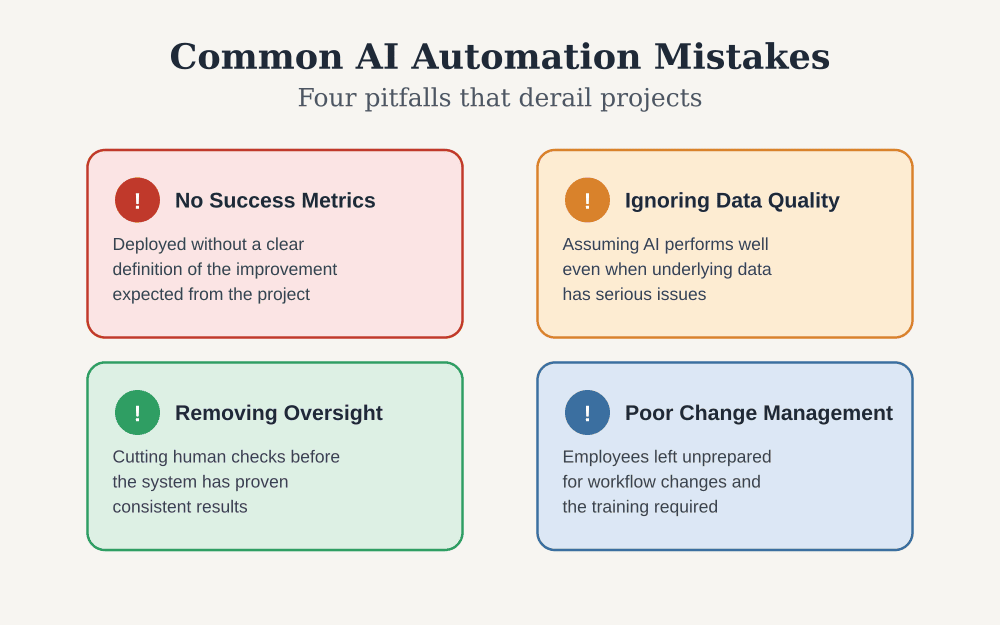
Common AI Automation Mistakes
Automating Without Clear Success Metrics
AI automation deployed without clear understanding of what improved result was expected from the project.
Ignoring Data Quality Issues
Taking for granted that AI is capable of performing well even if there are issues in the data.
Removing Human Oversight Too Quickly
Excluding human checking from the process before the system proved its consistent results.
Poor Change Management
Inadequate preparation for:
- The change in the workflow of the employees
- The training required for working with the AI automation system
- What the AI automation system will and will not do
Even an efficient automation system can be poorly managed and lead to resistance or abuse.
Bottom Line
AI automation is very diversified and includes several aspects like rule-based improvement, predictive analysis, generative AI, human-in-the-loop design, and data management. Taking into account that it is easy to expect more from the technology than it actually can provide, it would be better to start with narrow and clear use cases and incorporate human-in-the-loop design in the beginning.