AI Automation Services: What They Actually Cover and Why Choosing One Is Easy to Get Wrong

Introduction
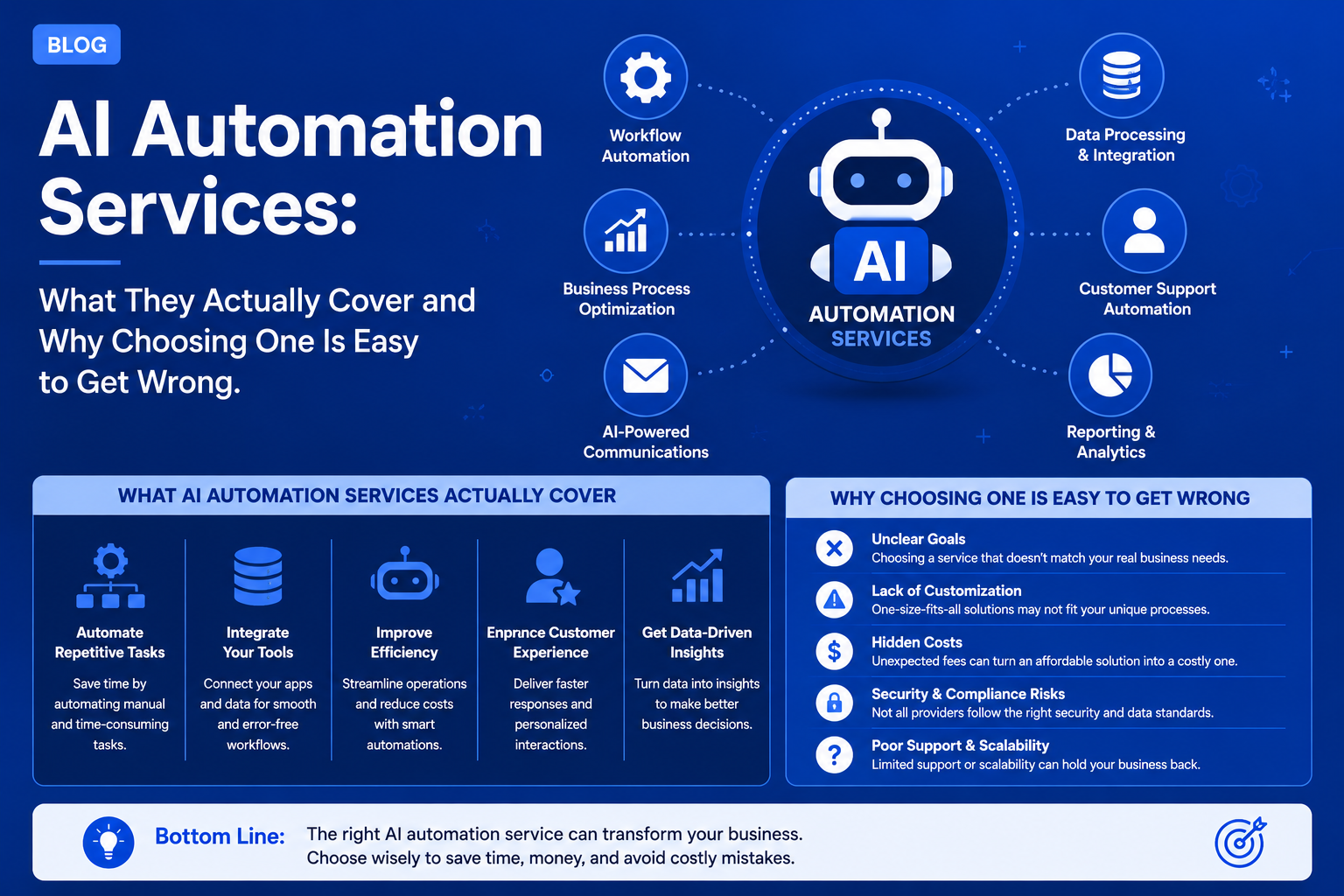
In terms of AI automation services, it refers to external vendors providing expert assistance for designing, developing, and managing AI-enabled automation for a business organization, as opposed to the latter using its own resources to develop automation.
This may appear pretty straightforward, but the sheer number of different service models available in this context means that this is often overlooked by business organizations.
Why AI Automation Services Are More Complex Than They Appear
AI automation services are not a single homogeneous product but rather a combination consisting of:
- Strategic consulting projects alone
- Implementation services, including both build and deployment
- Operation and optimization through managed services
It is the case that a number of vendors position themselves as AI automation services providers, without indicating what of these services they offer, and this confusion can cause discrepancies in expectations from the beginning of the project.
A company outsourcing such services would need to specify its scope of work per project since a consulting company may not be suitable for implementation and maintenance.
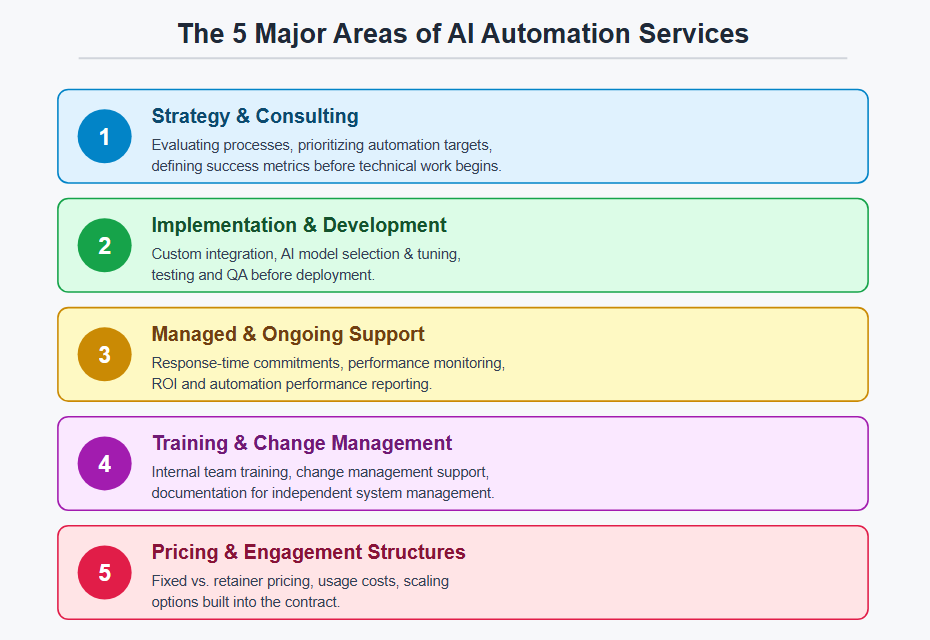
Major Areas of AI Automation Services
1. Strategy and Consulting Services
Rules Governing
- Evaluating current processes for potential automation
- Determining which processes should be automated first
- Developing metrics of success even before any technical work is done
Not doing any strategic assessment is perhaps one of the most common problems and the most expensive because it can lead to:
- Automating low value processes and missing out on high-value opportunities
- Implementing the technical solution without having a business case
- Having no way of knowing if the effort was worth it
2. Implementation and Development Services
The technical build associated with services that implement AI automation tends to be custom since providers need to follow the unique systems of the particular businesses as opposed to using templates.
Implementation Services Often Include
- Integration development of existing systems
- Selection of AI models
- Configuration/fine tuning of the selected AI models
- Testing/QA before deployment
3. Managed and Ongoing Support Services
Management includes not just deployment but also management since there is a need to continue monitoring the automated processes.
Those Managed Services Usually Vary in Many Respects Including
- Commitment on response time in case of any problems
- Performance monitoring and optimizations
- Automation performance and return on investment reports
4. Training and Change Management Services
These could include:
- Training sessions to assist internal teams in adapting to the automation process
- Change management assistance to handle any employee issues
- Documentation delivery to allow internal teams to manage systems on their own
The benefit of each of these services will depend largely on how technically savvy a company is internally.
5. Pricing and Engagement Structures
There are various issues that an organization should take into consideration during different AI automation service engagements, such as:
- Fixed pricing vs. retainer pricing
- Costs associated with the use of AI
- Scaling options within the contract
It is necessary to analyze all these issues very carefully since lack of clarity in the engagement model may result in scope creep.
Why AI Automation Service Engagements Underdeliver Even With Skilled Providers
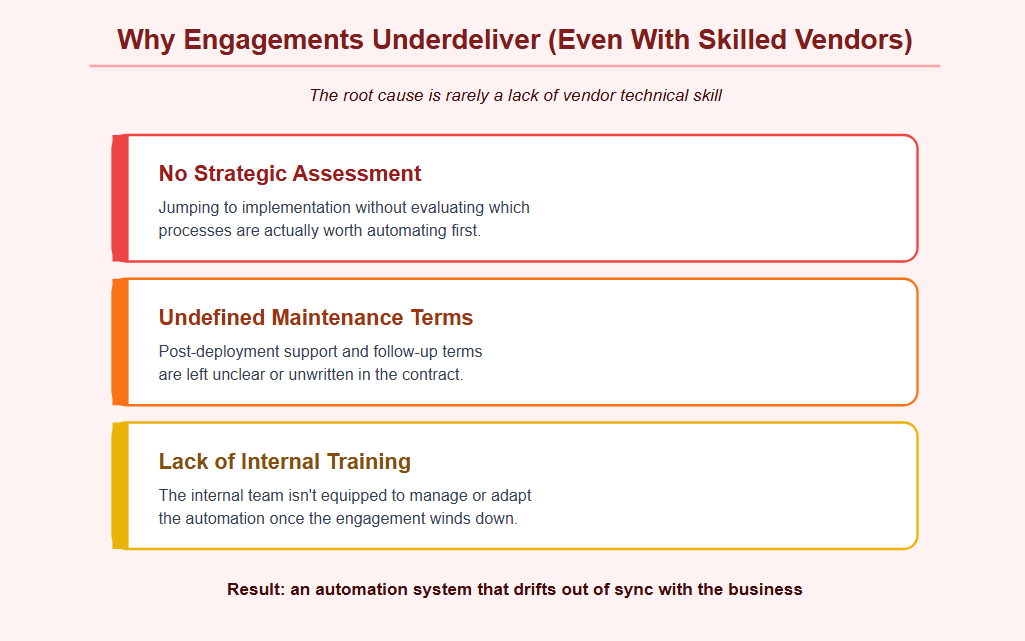
Underutilization of the benefits of automated solutions by the client is very rare in cases where the problem lies in the inadequacy of technical skills possessed by the vendor.
This is because such a scenario may arise due to the following reasons:
- Absence of strategic assessment before moving towards implementation.
- Terms of maintenance and follow-ups post-deployment remain undefined.
- The internal team does not have the necessary training in automations.
How Businesses Choose the Right AI Automation Services
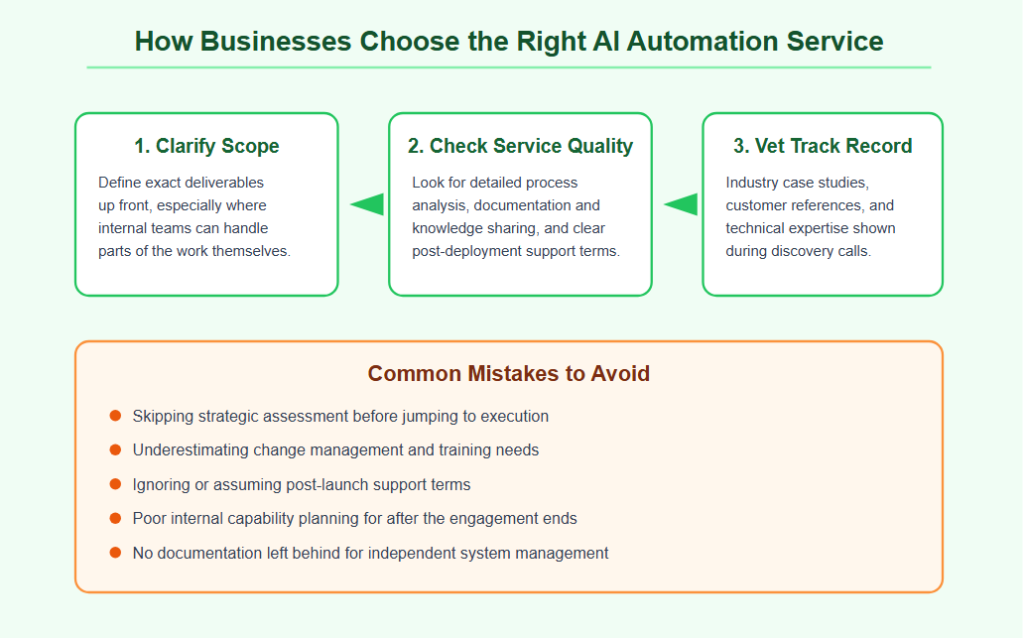
1. Clarifying Scope and Deliverables Upfront
Larger organizations might specify the exact kind of service model they require, particularly where internal teams are capable of doing certain parts on their own.
2. Service Qualities Supporting Successful Engagements
Some of the effective service engagements are those which provide the following:
- Perform detailed analysis of processes before offering solutions
- Ensure documentation and knowledge sharing during the entire engagement period
- Have well defined terms for ongoing support after deployment
3. Evaluating Provider Track Record
Organizations carry out evaluations on:
- Industry-specific case studies for the organization’s particular industry
- References from previous customers on both the implementation and follow-up service quality
- Technical expertise that is shown in discovery calls
Evaluating track record allows organizations to ensure that the provider delivers what it markets.
Common AI Automation Service Mistakes
1. Skipping Strategic Assessment
Jumping straight to execution without recognizing the most effective possibilities for automation first.
2. Underestimating Change Management Needs
A focus only on execution while ignoring the training and communication necessary for successful adoption within the organization.
3. Ignoring Post-Launch Support Terms
A presupposition that support and optimization will be provided without verifying this in the service contract.
4. Poor Internal Capability Planning
Failure to plan adequately for:
- Who will be responsible for running the automation internally once the services engagement ends
- How future changes to automated processes will be addressed
- Required documentation for independent management of systems going forward
Insufficient capability planning can result in an effective automation system becoming increasingly out of synch with the business.
Bottom Line
There are many aspects that the AI automation service offerings incorporate. Such factors as strategy consultancy, implementation, management, training, and pricing models can be included.
Given the level of vagueness in the way service providers advertise their offerings, it is better for companies to understand the scope of work involved and learn about the track record of the provider beforehand.