AI Agents: What They Are and How They Actually Work

Introduction
The AI agent has proven to be one of the most popular software categories in recent years, and certainly far more sophisticated than the mere notion of chatbot that most of us connect with AI. It’s time for a thorough look into exactly what an AI agent is and what the future holds for it.
What Defines an AI Agent
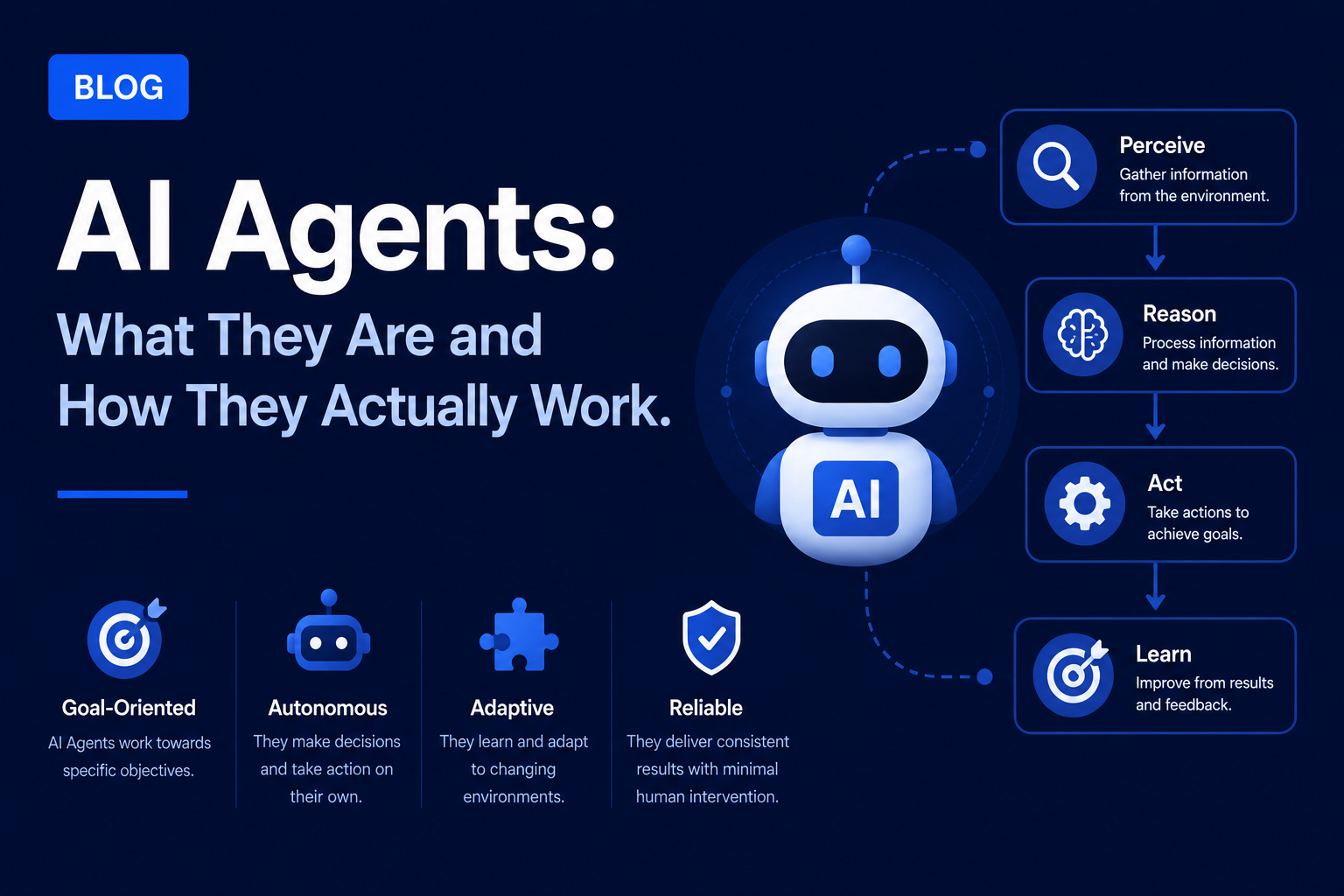
AI agents have capabilities that allow them to perceive their environments via inputs such as text and data, make sense of the information received and decide how to act, and ultimately perform an action independently of any human intervention.
This is the basic difference between an AI agent and a regular chatbot because while a chatbot responds to messages in a conversation, an AI agent can plan and take actions, adapting its actions according to results.
The Core Components of a Modern AI Agent
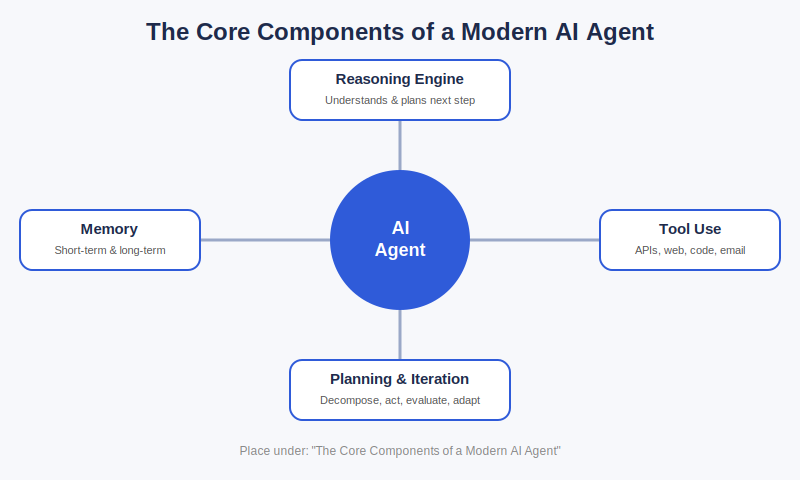
Reasoning Engine
The large language model is usually tasked with understanding the job, breaking it down into pieces, and determining the next step according to the present context and previous output.
Responsibilities Include
- Understanding the job
- Breaking the complicated tasks into small pieces
- Determining the next course of action
- Based on the present context and previous output
Memory
The capability of the agent to keep relevant data during a task or conversation either in short term (within the session only) or in long term (lasting between sessions) so that the agent does not forget about the context midway while doing some multi-step task.
Memory Can Be
- Short-term memory
- Long-term memory
Tool Use
The capability of calling up outside services and APIs, surfing the Web, querying databases, sending emails, running codes, thus moving out of the realm of just generating text to taking actual actions.
Common Tool Capabilities
- Surfing the Web
- Querying databases
- Sending emails
- Running codes
- Using external APIs
Planning and Iteration
This involves the ability to decompose a task, implement each part, evaluate outcomes, and change strategies should the implementation not be successful, rather than just stick to one method.
Planning Involves
- Decomposing a task
- Implementing the task
- Evaluating outcomes
- Changing strategies if need be
Common Types of AI Agents in Practical Use
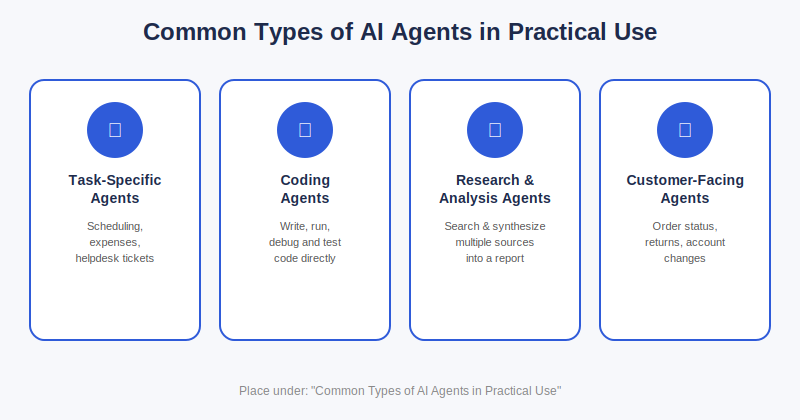
Task-Specific Agents
Tailored for a very specific purpose, namely the scheduling of meetings, processing of expense claims, resolving of helpdesk tickets with a specified scope.
They would be more reliable simply by virtue of having a limited scope.
Coding Agents
Specialized agents for writing and debugging and editing code, where the agent can execute the code and test the execution in addition to simply outputting the code text for a human operator to try separately.
Research and Analysis Agents
Agents that are capable of performing web searches or searches in internal documentation, synthesizing the information from multiple sources into some sort of summary or report, far more than a simple question-and-answer query.
Customer-Facing Agents
Agents operating in a customer service or sales environment that can respond to more complex queries, such as checking the status of an order, returning something, or editing one’s account information.
Why AI Agents Represent a Meaningful Shift
The automation of software requires programming all of the stages of the procedure beforehand.
The agents created using language models can reason through problems which cannot be solved by defining all scenarios beforehand, allowing them to solve situations that are more ambiguous and variable.
In other words, this allows such agents to do the job that couldn’t be done by traditional software.
Real Limitations to Keep in Mind
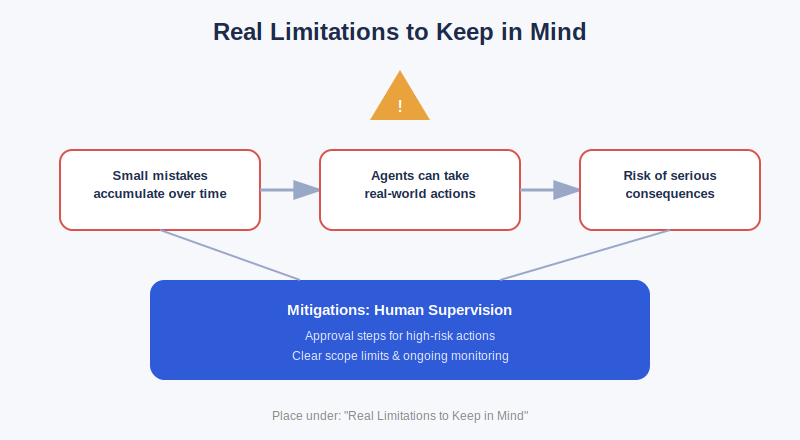
The agents may make mistakes, particularly when the task is lengthy and complex because little mistakes made at the beginning could accumulate over time.
In addition, agents may perform actions that could have serious repercussions (such as sending an email, altering a document, and spending funds), quicker than a human would notice a mistake, which is why proper supervision, approval steps for high-risk actions, clear scope limitations, monitoring, become critical in the case of agents compared to a mere chatbot.
Important Considerations
- Small mistakes could accumulate over time.
- Agents can perform actions in the real world.
- Human supervision becomes crucial.
- Approval steps prevent risks.
How Businesses Are Actually Using AI Agents Today
Current examples of usage are as follows:
- Customer support automation for well-structured types of requests
- Coding assistance to software developers
- Routine administrative processes such as scheduling, data entry, and report generation
- Sales and marketing operations such as researching leads and personalizing outreach
Successful implementation examples usually concern narrow and specific tasks, and not self-learning agents that can operate without any supervision in business areas.
Where AI Agents Are Heading
This field is changing rapidly in the direction of increasing autonomy, more advanced multi-agent collaboration, and agents who are able to perform over long periods of time without continuous human supervision.
However, the issues of reliability, safety, and proper regulation have not been resolved yet, and companies that currently employ agents usually do so in a rather limited scope and with certain human decision points built-in.
Key Trends
- Increased autonomy
- Greater complexity in coordination of multiple agents
- Extended autonomous workflow
- Further emphasis on reliability and security
- Increased human supervision of important decisions
Bottom Line
AI agents are more than conversation bots, in that they can use reasoning and memory and perform real actions via using tools, thus being able to perform multiple-step tasks with limited human intervention.
This technology is very advanced yet it’s developing; and the most successful application examples limit agents’ scope to specific tasks with proper supervision, rather than letting them deal with complex tasks autonomously.