AI Agents for Business: A Practical Overview of What They Can Actually Do

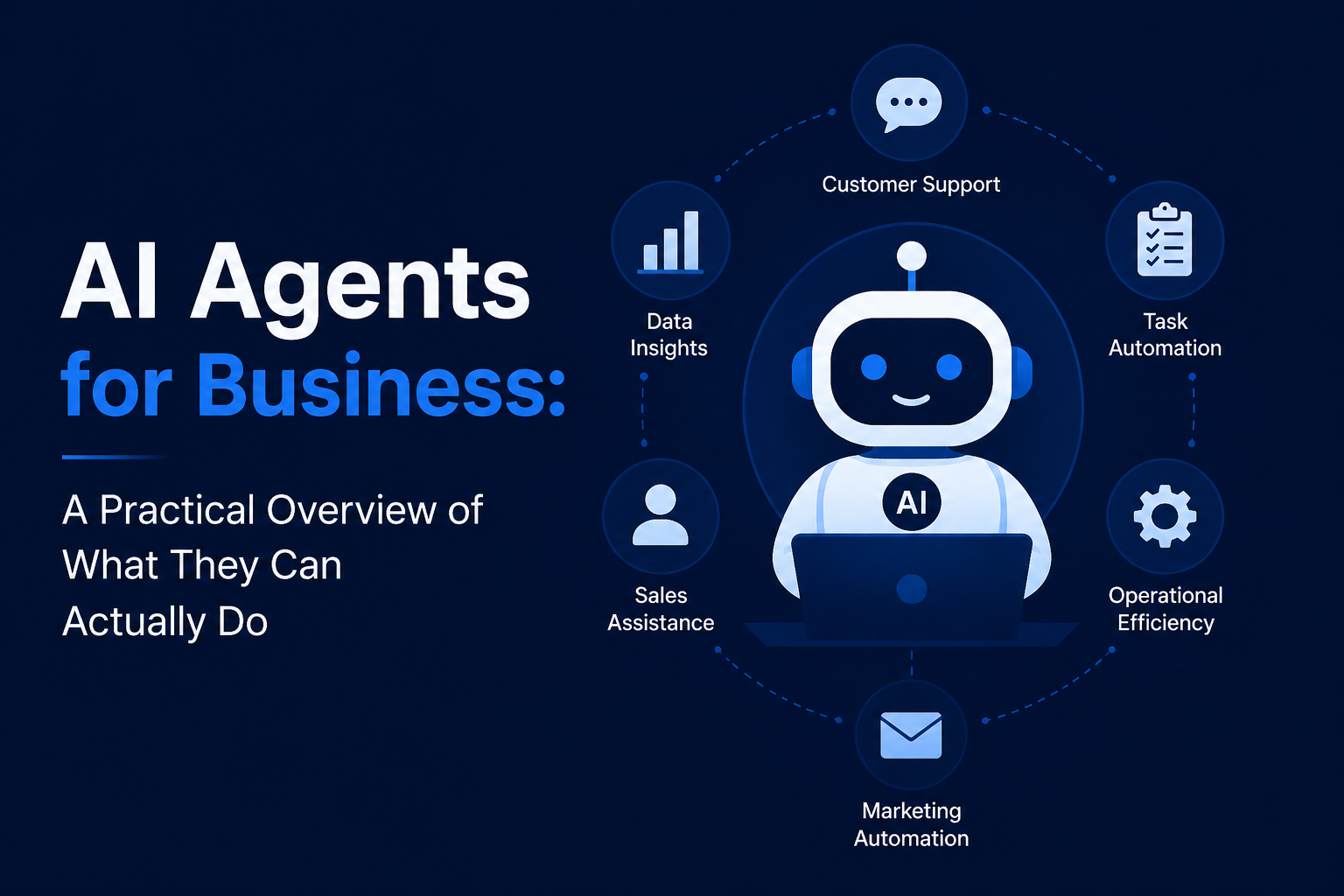
AI agents have been developed from experimental technology to actual business application tools; however, there is an immense difference in the scope of business applications where such tools are actually used and their degree of readiness for practical implementation. Below are practical examples of how businesses use AI agents.
Why Businesses Are Adopting AI Agents
In order to automate the process with traditional software, all steps have to be explicitly coded beforehand. AI agents, constructed on the basis of large language models, are capable of dealing with situations which are too judgmental and flexible for automation via traditional software because of their capability to reason about them. However, this implies that they may also make some mistakes which traditional software would not make.
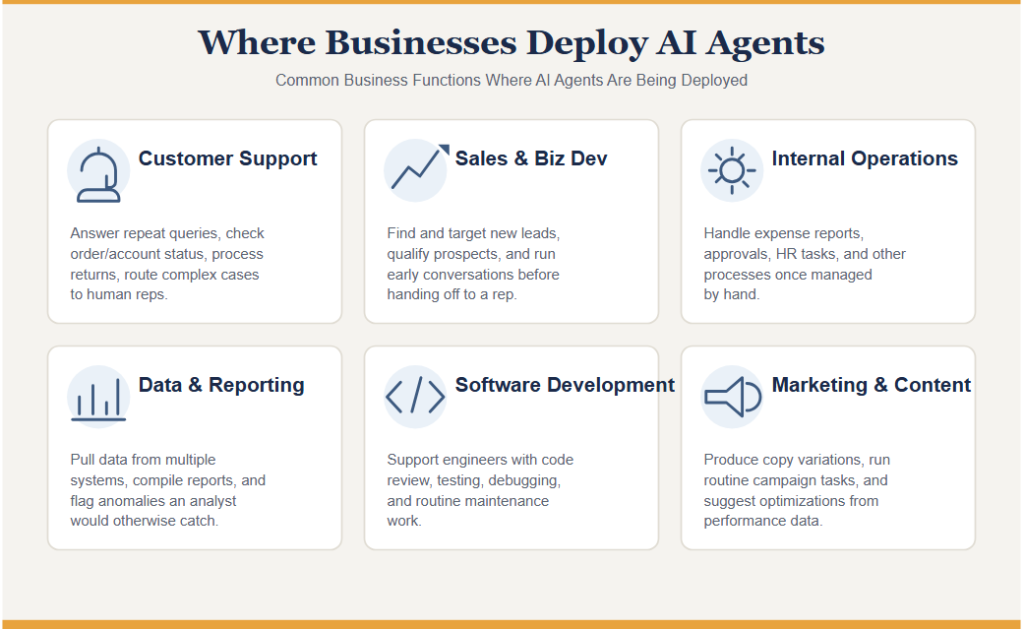
Common Business Functions Where AI Agents Are Being Deployed
Customer Support
Responding to queries that come up repeatedly, verifying the status of an order or account, processing simple requests such as returns and address updates, and routing complicated matters to live human representatives.
Sales and Business Development
Finding new leads, targeting them individually, qualifying them, and in some cases even conducting initial conversations before passing control to a human sales representative who can negotiate.
Internal Operations
Managing complex internal processes like processing of expense reports, approvals, human resource tasks, and other activities that were previously managed manually.
Data Analysis and Reporting
Aggregating data from several internal systems, compiling them into reports, and identifying anything unusual or noteworthy that would have to be manually identified by an analyst otherwise.
Software Development
Providing support to engineering teams for reviewing code, testing, debugging, and regular maintenance, which helps save time on engineering work.
Marketing and Content Operations
Creating different versions of copy, handling regular campaign activities, and performing analysis of performance data in order to make optimization suggestions.
How Businesses Should Think About Readiness
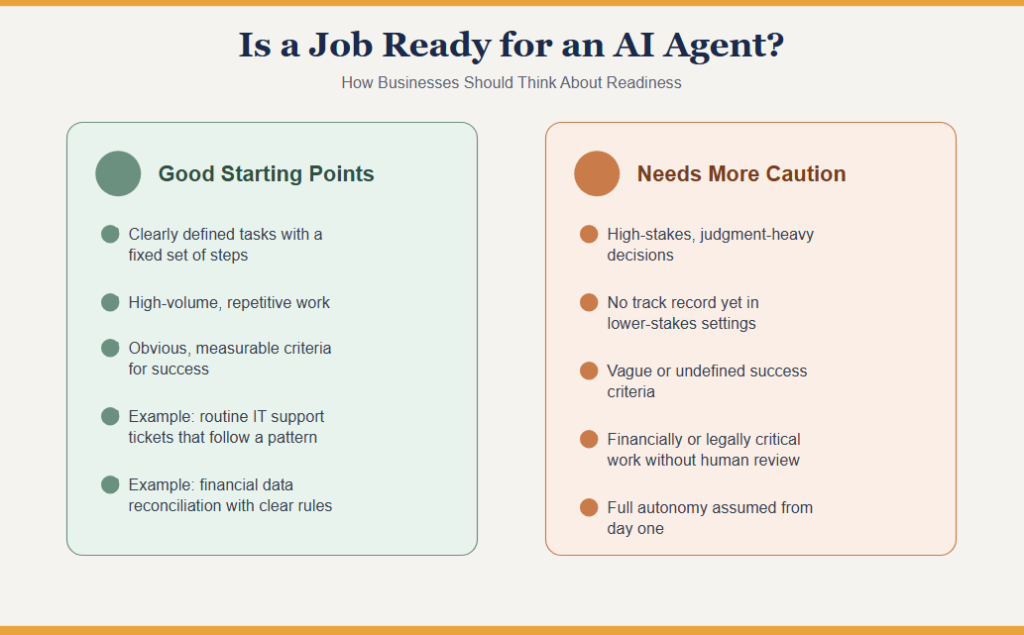
However, not all functions within an organization are equally prepared to be taken over by AI agents right now. Jobs that have been clearly defined, involve high-volume work, and have obvious criteria of success (e.g., an IT support job where a certain kind of request always follows a certain pattern, a financial data-reconciliation job that involves clearly defined procedures) would probably make good starting points for automation by AI agents.
Building a Realistic Business Case for AI Agents
Before deploying the agents widely, it might be worthwhile to specify:
- What exactly does the agent need to accomplish (e.g., faster response, lower cost, task completion)
- What exactly is the baseline currently, so that there is a way to measure any improvement
- How much autonomy the agent needs for a particular task (based on the risks involved)
- What happens if an agent fails in completing a task
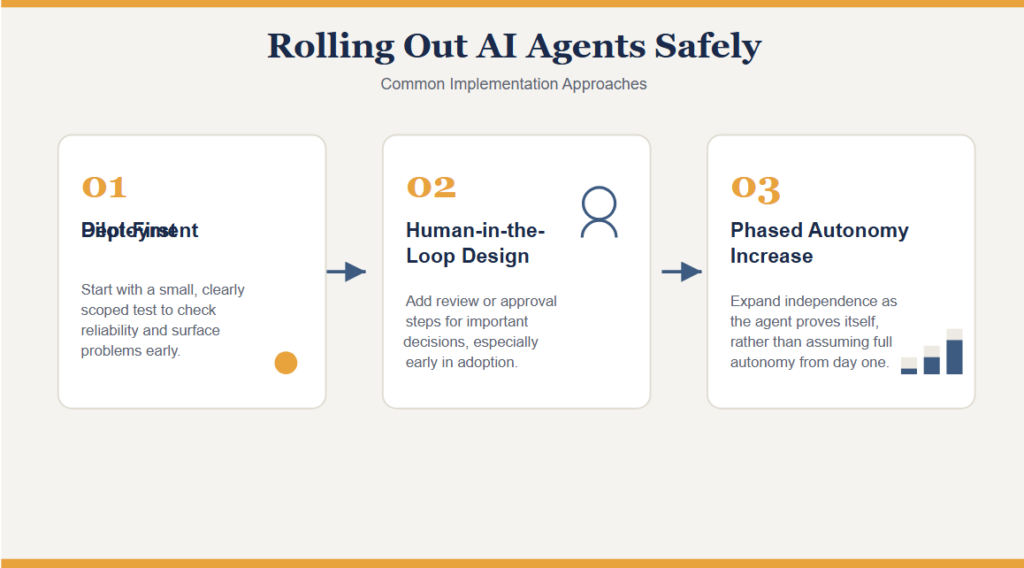
Common Implementation Approaches
Pilot-First Deployment
Beginning with a small-scale test of the process that is clearly scoped in advance, allowing an organization to gain true assurance regarding reliability and discover problems before implementation on a larger scale.
Human-in-the-Loop Design
Putting in place review or approval processes for more important decisions, especially in the initial stages of adoption..
Phased Autonomy Increase
Increasing the agent’s independence as its performance history on a particular job becomes more credible, instead of making the initial assumption that the agent should operate autonomously from the very start.
Common Mistakes Businesses Make with AI Agents
- Use of agents in high-stakes and judgment-oriented jobs without proving their reliability in low-stakes scenarios first
- Underestimation of performance measurement, which leads to realization of poor performance only when a problem occurs
- Belief that the agents should work autonomously without proper human supervision, especially for financially and legally critical decisions
- Lack of a clear criteria for success, hence, difficulty in measuring success
Bottom Line
AI agents have real value to offer businesses in customer service, sales, operations, and other business functions; however, the technology should be applied carefully from the very start, with limited, well-defined tasks initially, proper human monitoring of higher-level decision-making, and gradual increase in autonomy as success is proven.