Project Budget Management: How to Plan, Track, and Control Project Costs

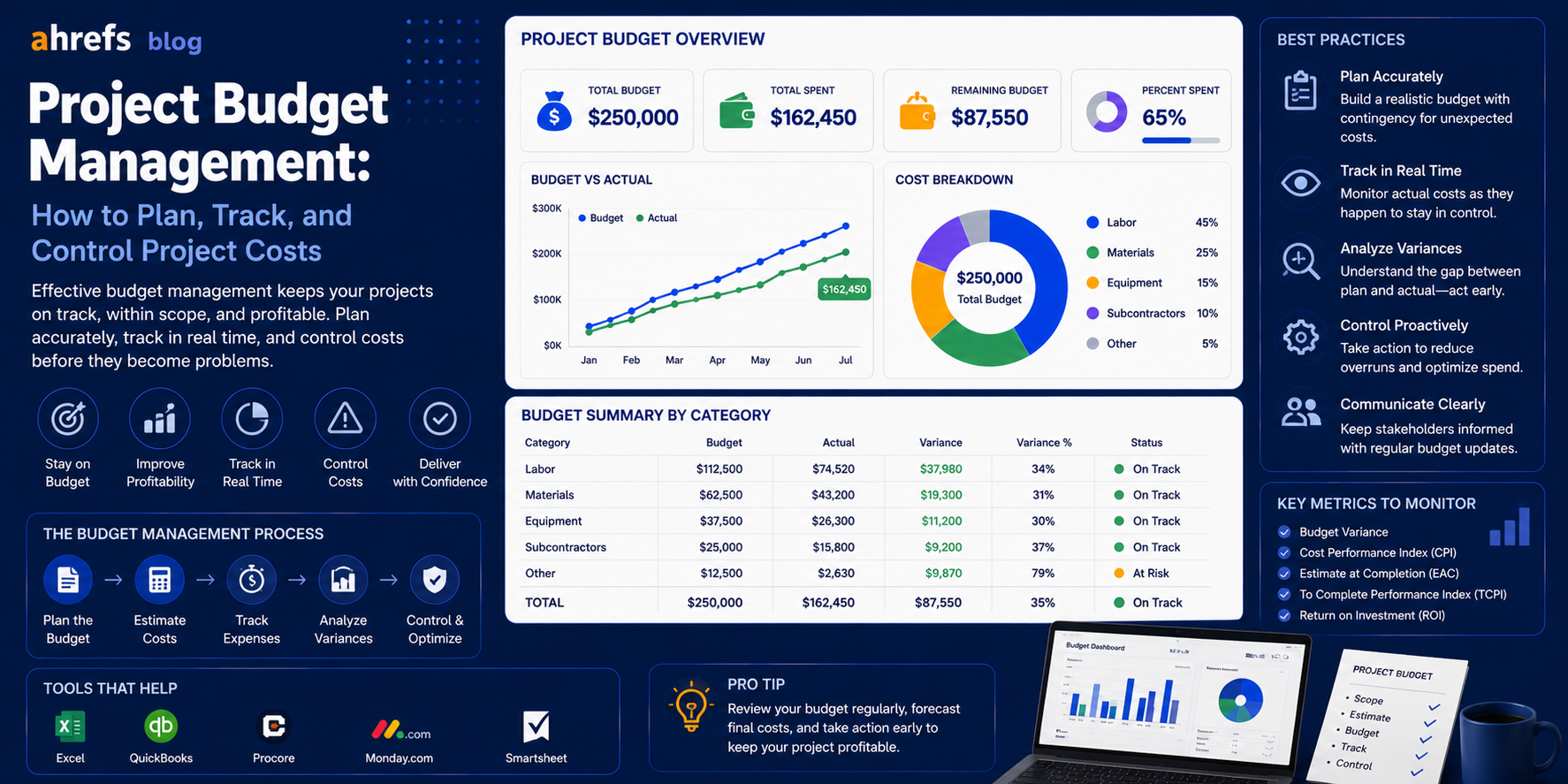
Projects rarely exceed their budgets due to unforeseen catastrophes; projects exceed their budgets due to either poor cost tracking or no cost tracking in the first place, and once it became obvious, it was too late to do anything about the overrun. This is where project budget management comes into play. It’s how it works.
Table of Contents
- Project Budget Management: What Is It?
- Project Budget Management: How to Create a Project Budget
- Project Budget Baseline
- Project Budget Tracking
- Earned Value Management (EVM): Professional Approach
- Budget Management Missteps
- Budget Management Tools
- Conclusion
What Is Project Budget Management?
Budget management for the project is the process of budget estimation, budget allocation, monitoring and control of project resources. The whole cost cycle includes:
- Cost estimation prior to the start of the project
- Setting budget baseline
- Monitoring costs during execution of the project
- Cost forecast at the completion of the project
- Control of any changes which influence budgeting
- Budget reporting to stakeholders
Budget management is not a single point activity done only at the start of the project. This process is continuous and goes parallel to all other processes of project management.
How to Build a Project Budget
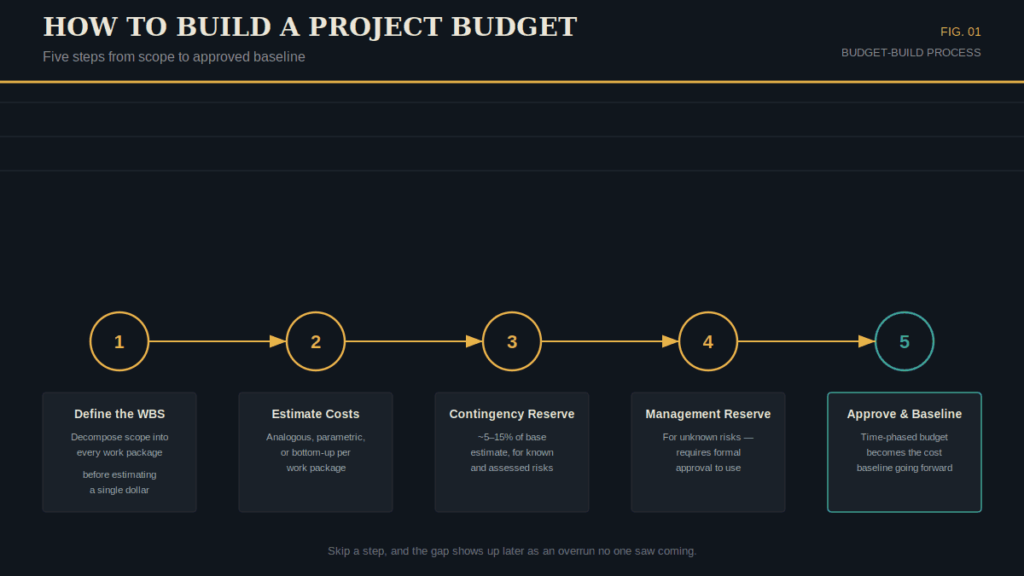
Step 1: Define the Work Breakdown Structure (WBS)
Budgeting without a full-fledged WBS leads to under-budgeting. Begin with decomposition of the project scope into the full set of work packages. It is impossible to do estimations without having a proper definition.
Step 2: Estimate Costs for Each Work Package
Basic techniques of estimation:
- Analogous estimating: Take real costs of similar projects from the past. Quick, however, less precise.
- Parametric estimating:Take cost per unit ($X per square foot, $X per developer hour). More precise when unit costs are clear.
- Bottom-up estimating: Estimate costs of each activity first and then add up to the work package/project. Precise and time-consuming method.
Step 3: Add Contingency Reserve
Contingency reserve accounts for those risks that have been identified and whose likelihood and impact have been assessed. Commonly, the percentage of contingency reserve is around 5-15% of the base estimate of the total cost for the majority of projects.
Step 4: Add Management Reserve
The management reserve accounts for unforeseen risks. What makes the management reserve different from contingency reserve is that the former cannot be controlled by the project manager because it requires formal approval.
Step 5: Get Approval and Establish the Baseline
The budget, allocated throughout the project timeline, forms the cost baseline, which is used to measure the project’s performance against.
The Project Budget Baseline
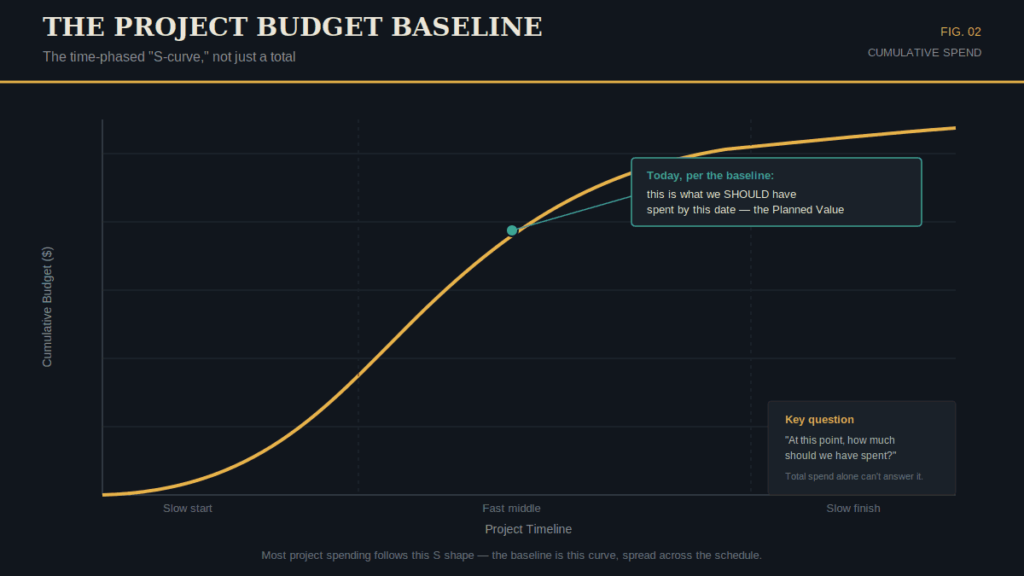
The cost baseline is not merely the total amount but is the budget spread through time, referred to as the “S-curve” since the spending pattern of the vast majority of projects usually resembles the letter “S,” with slow progress at the beginning, fast progress in the middle, and slower again near completion.
The baseline answers: “At this point in the project, how much should we have spent?”
Without the time-phased baseline, one cannot find out if he is under or over budget but will know how much has been spent in total, which is basically useless information.
How to Track Budget Throughout the Project
Monitor three figures consistently:
- Planned Value (PV):What was budgeted to have been accomplished so far
- Actual Cost (AC): What is the actual amount spent so far
- Earned Value (EV):The budgeted value of what has been accomplished so far
The comparison of these three figures will tell you if you are on track, over budget, behind schedule, or all three.
Earned Value Management (EVM): The Professional Standard
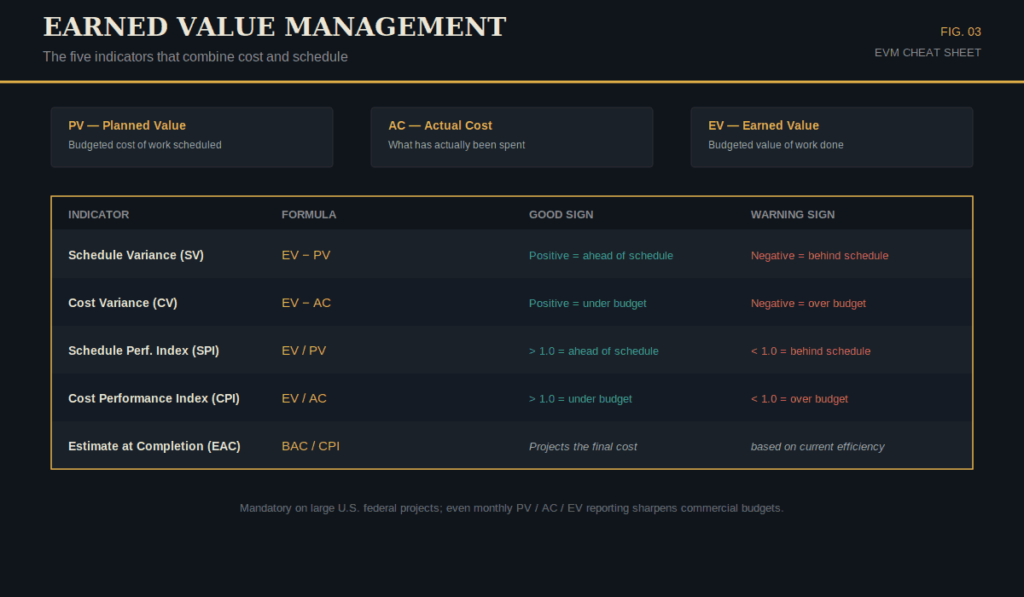
EVM is the official methodology to combine cost and schedule into one performance measurement system.
Key Indicators
Schedule Variance (SV)
Formula: EV − PV
Positive = ahead of schedule; negative = behind schedule
Cost Variance (CV)
Formula: EV − AC
Positive = under budget; negative = over budget
Schedule Performance Index (SPI)
Formula: EV / PV
SPI > 1 = ahead of schedule; SPI < 1 = behind schedule
Cost Performance Index (CPI)
Formula: EV / AC
CPI > 1 = under budget; CPI < 1 = over budget
Estimate at Completion (EAC)
Formula: BAC / CPI (where BAC = Budget at Completion)
Predicts the project’s final cost based on its current efficiency.
The use of EVM is mandatory for large U.S. federal projects, and is common in construction, aerospace, and defense industries. In commercial projects, even basic EVM reporting, which means reporting PV, AC, and EV per month, makes a significant difference to budget management.
Common Budget Management Mistakes
Building the Budget Before the Scope Is Fully Defined
Estimating work that isn’t yet defined is impossible. Gaps in scope definition at the time of estimating translate into gaps in budgeting during execution.
Skipping Contingency Reserve
Handling surprises as they come is an approach to budget management that guarantees budget overruns.
Tracking Spend but Not Earned Value
Spending $50K from a $100K budget allocation means nothing in terms of whether your efforts have been on target. Spending $50K while having completed work worth $35K indicates that you are 30% over budget for what has been accomplished.
Not Forecasting Regularly
A budget forecast which starts and ends a project but never updates in the meantime loses the critical opportunity to make the necessary corrections.
Letting Scope Changes Absorb Contingency
Changes to the approved scope must receive their own budget allocations using a proper change control process rather than silently taking away from the contingency reserve.
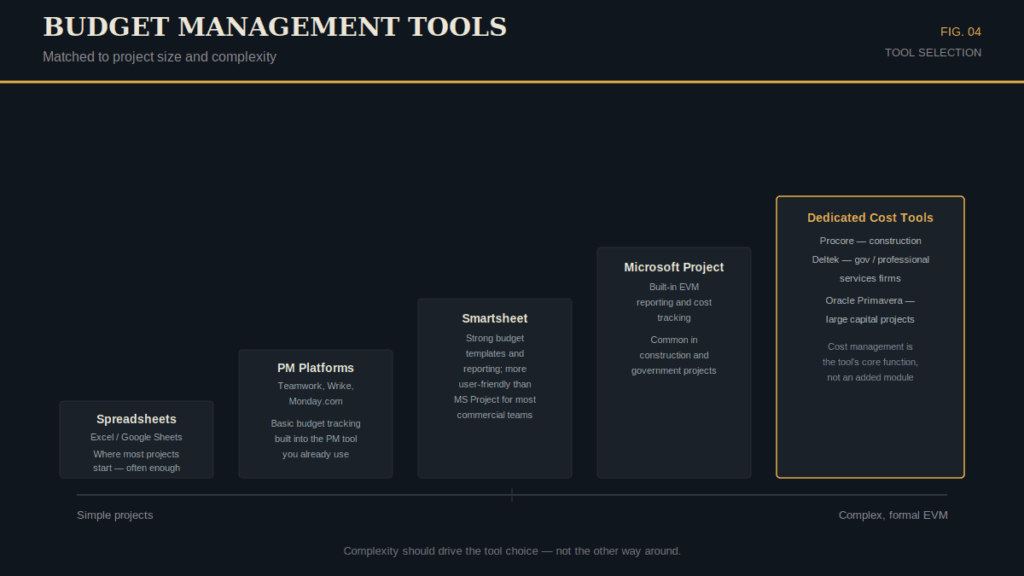
Tools for Project Budget Management
Spreadsheets (Excel / Google Sheets)
Works well for straightforward projects. Most project management budget control begins with this, and for smaller projects, nothing more is ever needed.
Microsoft Project
Good budget tracking capabilities and EVM reporting features built in. Very common in construction and government project settings.
Smartsheet
Good budget tracking templates with good reporting features; more user-friendly than MS Project for most commercial groups.
PM Platforms with Budget Features
Budgeting modules are available in Teamwork, Wrike, and Monday.com. Useful for basic budget tracking but not as powerful as MS Project and Smartsheet for EVM.
Dedicated Cost Management Tools
Construction companies will use Procore, Deltek for government/professional services firms, and Oracle Primavera for large capital projects where cost management is their key function.
Final Thoughts
Managing a budget for a project has nothing to do with tracking how much of your budget has been spent. Budget management is all about ensuring that at any particular time you know whether you have obtained the value for money that you have spent and where you are likely to end up before it is too late. Create a full budget based on a scope, create a time-phased budget baseline, track earned value (and not just actual cost), and forecast frequently.