What Is a Content Pillar? (And How to Build One for SEO)


If your blog seems unorganized and lacks any sort of structure, then you might be ignoring one of the most critical strategies in SEO, content pillars.
A content pillar will help you establish yourself as an authority in your topic, optimize your site’s internal links, and send signals to search engines that you are a valuable source of information. This guide will walk you through everything you need to know about content pillars and how to create them.
What Is a Content Pillar?
Content pillar refers to the creation of in-depth content covering an extensive subject matter on an issue of interest. It functions as the core content in the development of a topic cluster, whereby several pieces of related information (referred to as the cluster content) are linked back to it.
How the Content Pillar Model Works
- The pillar page will address the topic of interest broadly
- Cluster pages address the subtopic of interest in-depth
- Interlinked content links all topics
Example Structure
Where you have chosen a pillar topic such as “Beginner’s Guide to SEO,” some of the topics covered in the clusters may include:
- Keyword research guide
- On-page SEO techniques
- Backlinks generation tips
- Technical SEO tips
- Tools and metrics of SEO
Visual Structure of a Content Pillar
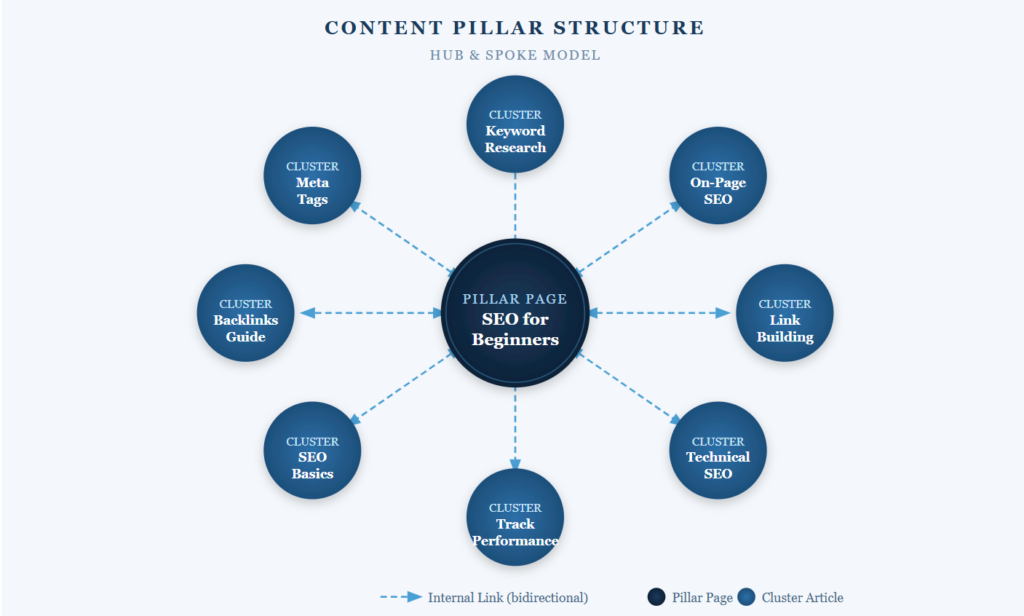
Think of it like a wheel:
- The pillar page is the hub
- The cluster content are the spokes
- Internal links connect everything into a structured ecosystem
This structure helps search engines understand your site hierarchy and topical relevance.
Types of Content Pillars
There are several formats you can use for content pillars depending on your goals.
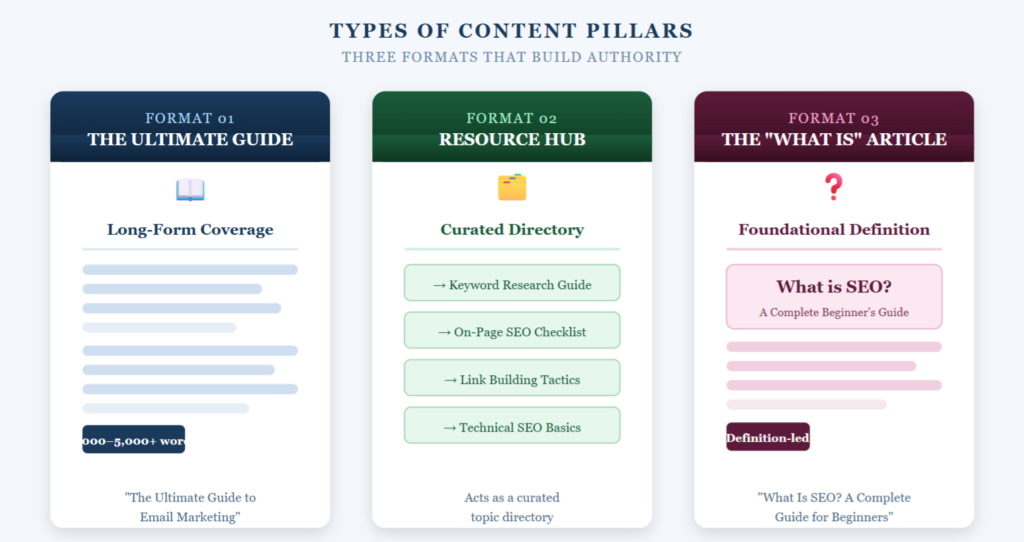
1. Ultimate Guide Pillar
A long-form, in-depth article that covers everything about a topic.
Example:
- “The Ultimate Guide to Email Marketing”
These are typically 2,000–5,000+ words and are highly SEO-focused.
2. Resource Hub Pillar
A curated page that links to multiple detailed resources on subtopics.
Best For:
- Educational websites
- SaaS companies
- Content-heavy blogs
3. “What Is” Pillar Page
A foundational article that defines and explains a core topic.
Example:
- “What is SEO? A Complete Beginner’s Guide”
These are ideal for capturing informational search traffic.
4. Product or Service Pillar Page
Used in commercial SEO to cover broad product categories.
Example:
- “Best Email Marketing Tools”
- “Web Hosting Services Overview”
These pages link to product-specific landing pages.
Why Content Pillars Are Important for SEO
Content pillars are powerful because they align with how search engines evaluate expertise and how users consume information.
1. They Build Topical Authority
Google evaluates your entire website, not just individual pages.
A strong pillar + cluster structure signals:
- Deep expertise in a topic
- Comprehensive content coverage
- High relevance to search intent
This increases your chances of ranking across multiple keywords.
2. They Strengthen Internal Linking
Internal links are a key SEO ranking factor.
Content pillars naturally create:
- Structured internal linking
- Better crawlability
- Improved distribution of link equity
3. They Match User Search Behavior
Users often start with broad searches and then refine their queries.
Example Journey:
- “What is SEO?”
- “How to do keyword research”
- “How to build backlinks”
A content pillar strategy captures users at every stage.
4. They Help You Rank for Multiple Keywords
A single pillar page can rank for:
- Head keywords
- Long-tail variations
- Related semantic keywords
As cluster content gains rankings, authority flows back to the pillar page.
How to Build a Content Pillar (Step-by-Step)
Step 1: Choose Your Pillar Topic
Your pillar topic should be:
- Broad enough to support 6–10+ articles
- Specific enough to stay focused
- Relevant to your business or audience
Good Examples:
- Content marketing
- Local SEO
- Email marketing
- Link building
Too Broad:
- Marketing
- Business
- Technology
Too Narrow:
- Writing subject lines for cold emails
Step 2: Perform Keyword Research
Use keyword research tools to find subtopics related to your pillar.
Group keywords into clusters such as:
- Beginner topics
- Advanced topics
- Tools and resources
- Tutorials and guides
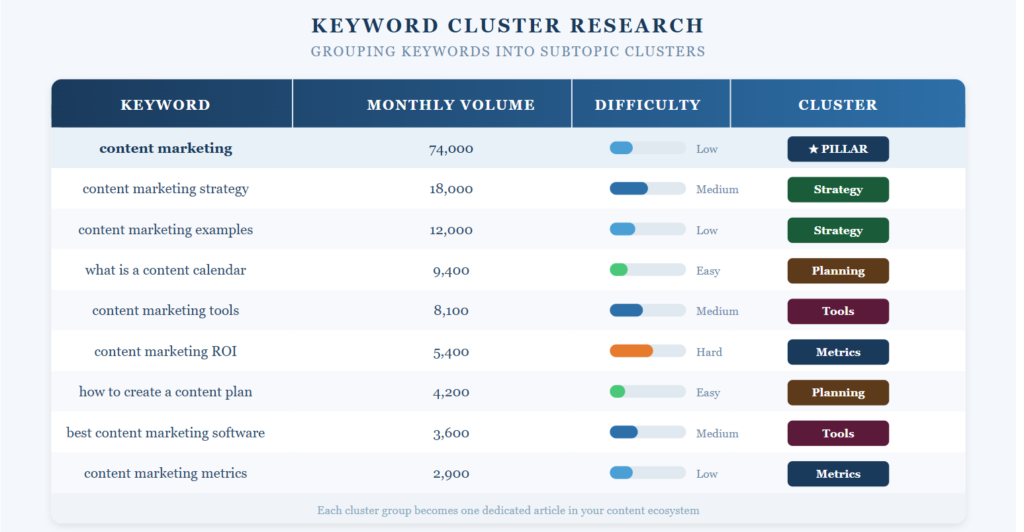
Each cluster becomes a potential blog post.
Step 3: Create the Pillar Page
Your pillar page should act as a central guide, not an overly detailed deep dive.
Pillar Page Requirements:
- 2,000–5,000+ words
- Target a broad head keyword
- Include a table of contents
- Cover all major subtopics briefly
- Link to cluster articles
Step 4: Create Cluster Content
Each cluster article should go deep into one subtopic.
Cluster Article Rules:
- Target long-tail keywords
- Provide detailed explanations
- Link back to the pillar page
- Link to related cluster articles
Step 5: Build Internal and External Links
Once your content is published:
- Link all cluster articles to the pillar page
- Interlink related cluster articles
- Build backlinks to the pillar page
This strengthens the entire content ecosystem.
Real-World Content Pillar Examples
Ahrefs
Ahrefs uses a powerful content hub structure around SEO topics like keyword research, link building, and technical SEO.
HubSpot
HubSpot builds extensive pillar pages around inbound marketing, email marketing, and social media marketing.
Backlinko
Brian Dean uses “ultimate guide” style pillar content supported by detailed SEO-focused articles.
Common Content Pillar Mistakes
1. Choosing a Topic That’s Too Broad
A pillar on “marketing” is too general. Focus on specific disciplines like “email marketing” or “SEO strategy.”
2. Not Creating Cluster Content
A pillar without supporting articles is just a long blog post, not a strategy.
3. Ignoring Updates
Pillar pages must be updated regularly to maintain rankings and relevance.
4. Weak Internal Linking
Cluster articles should link not only to the pillar but also to each other.
Frequently Asked Questions
How many content pillars should I create?
Start with 1–2 strong pillars. Expand once those are fully developed and performing well.
How long should a content pillar be?
Most pillar pages range between 2,000 and 5,000 words, but complexity may require more depth.
Can a blog post be a content pillar?
Yes. A well-structured “ultimate guide” blog post can function as a pillar page.
What is the difference between a content pillar and a content strategy?
A content strategy is the overall plan. A content pillar is a tactical structure within that plan.
Final Thoughts
Content pillars are one of the most effective SEO strategies for building long-term organic traffic and authority.
Instead of publishing random blog posts, you create a structured ecosystem where every piece of content supports the others.
Start by choosing one strong topic you can genuinely cover better than competitors. Build your pillar, expand with cluster content, and let internal linking do the rest.
Over time, this structure becomes a scalable content engine that is difficult for competitors to outrank.