Why Is a Quality Assurance Tester Needed on a Software Development Team?

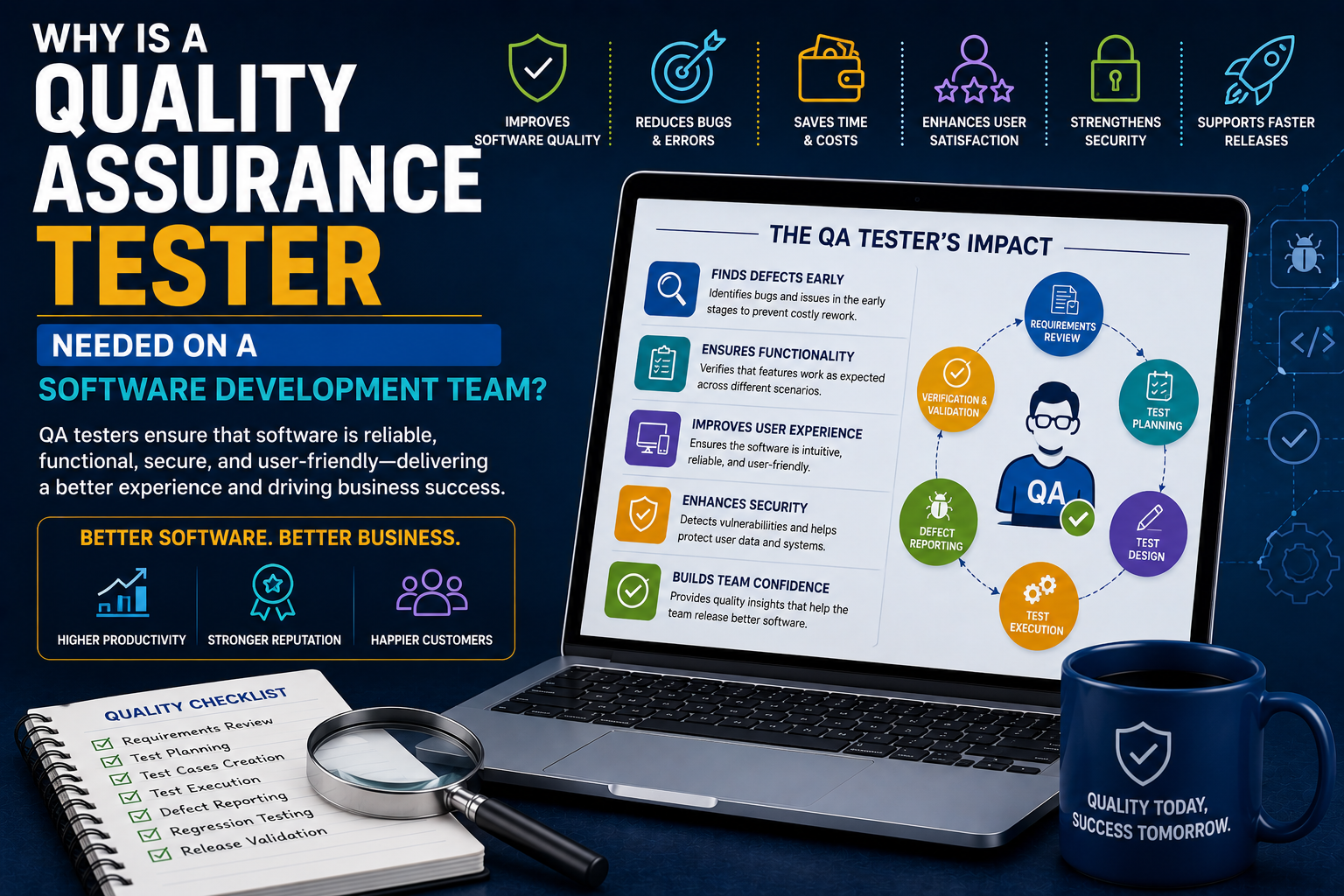
Question any non-technical stakeholder about the reason behind the existence of QA testers, and you’ll get some variation of, “for catching bugs before we launch.”
Well, yes, and that’s an understatement by around 90 percent.
Quality assurance testers aren’t just for identifying bugs. They save your customers from harm, cut your expenses, safeguard your corporate reputation, and often stop major disasters before they happen.
Let’s take a look at what QA testers do for you.
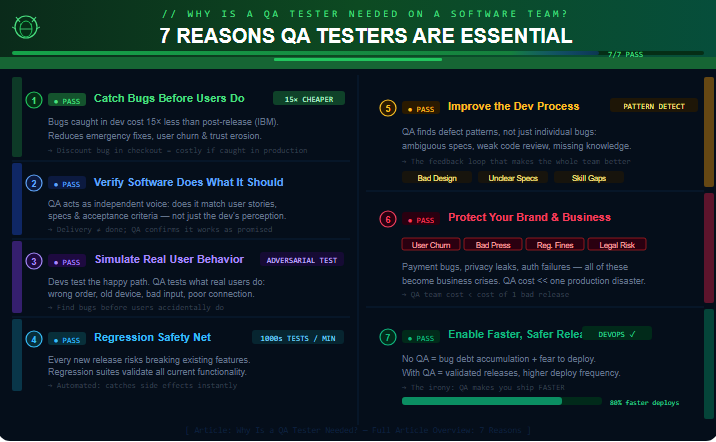
1. They Catch Bugs Before Users Do
That is an obvious one but needs to be stated explicitly.
On average, fixing bugs during production is far more expensive than fixing them during development. IBM research showed that on average bugs discovered after release cost 15 times more than bugs caught during development.
QA testers find problems before they get out to the users. This implies:
- Reduced cost of fixing issues
- Reduced need for emergency fixes during engineering sprints
- Reduced risk of damaging trust and retention of users
What This Looks Like in Practice
The QA tester conducting the regression test for a newly implemented checkout process may come across an issue where the discount code causes an issue in calculating the order amount. This is a quick fix when identified during testing, but a nightmare when spotted in production after 500 orders.
2. They Verify That Software Actually Does What It’s Supposed to Do
Developers develop according to the specifications. But these specifications were written by people, and then understood by other people, and implemented by yet others.
Stuff gets lost along the way.
This is why QA testers come in to act as the independent voice asking whether this software is actually doing what we promised it would do. They verify against specifications, user stories, acceptance criteria, not only against their own perceptions.
And without QA, there’s every chance that we can deliver software which works but doesn’t really address the user’s needs.
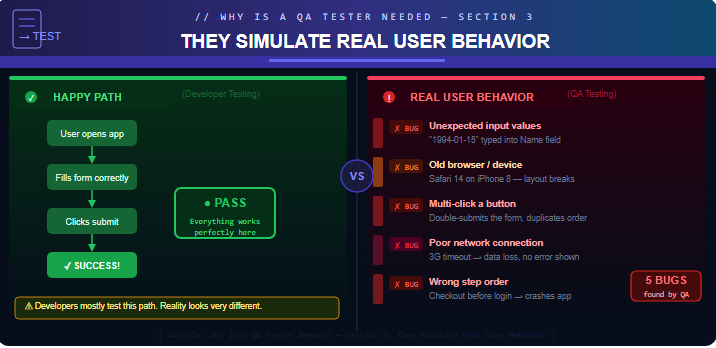
3. They Simulate Real User Behavior
Programmers usually test what is called the “happy path,” where everything works perfectly fine.
Real users do not do this. They:
- Input unexpected values (“what happens when somebody inputs their birth date in the name field?”)
- Have an old browser or device
- Click on buttons several times
- Connect with poor internet connection
- Perform actions in the wrong order
QA engineers know how to find bugs by doing things the way real users do. They approach testing adversarially, finding ways to break the program just like regular people accidentally will.
4. They Maintain a Regression Safety Net
With each release of your application comes the risk of breaking something that used to function properly. This is known as a regression.
It is the responsibility of QA testers to develop and manage a set of regression test cases which validate the current functionalities of the system in the face of every new release. Otherwise, the development team will be sailing in the dark.
Automated regression testing helps in performing thousands of tests within minutes, assuring you of no side effects from the newly developed feature.
5. They Improve the Development Process, Not Just the Product
Good QA professionals do not only find defects but also detect the pattern.
If the same defect repeats itself consistently within the same portion of the code base, there is definitely a message to be read from this, such as an ambiguity in the requirement, lack of proper code review, missing knowledge from the developer side or bad design of the system.
This feedback loop is provided by the QA tester.
6. They Protect Your Brand and Business
Bugs in software are not only technical issues, but business issues.
A payment bug that charges customers too much money. A data privacy bug that compromises user data. An authentication issue that denies access to logged-in users. All of these can precipitate a situation where:
- User churn
- Negative press coverage
- Regulatory fines
- Legal liability
QA testers are among the most important shields that prevent such consequences. The amount of money invested in the quality assurance team will always be much lower than that for just one production problem.
7. They Enable Faster, Safer Releases
The irony is that teams which have good QA capabilities actually deploy faster.
How come?
If you don’t have QA, your software will be full of bugs under the surface. You’re accumulating technical debt. Every release is becoming more and more risky because no one knows what could break. You’re scared to deploy.
With QA in place, all your releases are being tested and validated. You’re building confidence in your process. Deployment rate is higher. Your users get more value sooner.
That’s the reason why QA is an essential part of any DevOps practice.
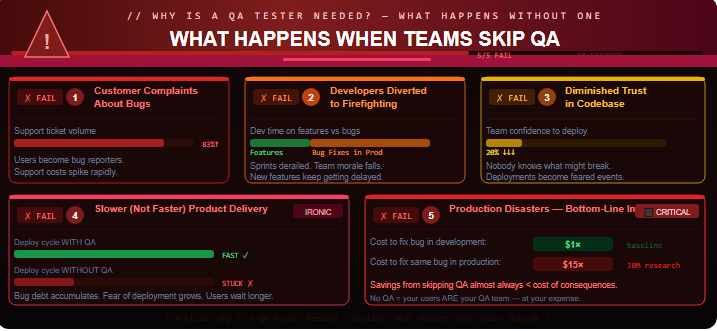
What Happens When Teams Skip QA?
When development teams bypass or skimp on the QA process, they often have:
- Many customer complaints about bugs
- Developers who are frequently diverted from their work to solve problems in production
- Diminished trust in the codebase
- Slower, not faster, product deployment cycles
- Occasional disasters that impact the bottom line
Most of the time, the savings made from not investing in QA are more than offset by spending to address the resulting problems.
Bottom Line
Having a quality assurance tester is not an option, they are the key player in any software development team that cares about their users.
They spot bugs that can slip through before even users do, confirm the satisfaction of the requirements, mimic the behavior of a user, provide regression safety nets and empower the development team to move quickly. Not having them means higher chances of shipping a buggy product and the higher price that comes with fixing it after each release.
Lack of QA within your team does not mean that you have a lean process, but that your users do your QA for you.