What Are the Skills Required for Software Development

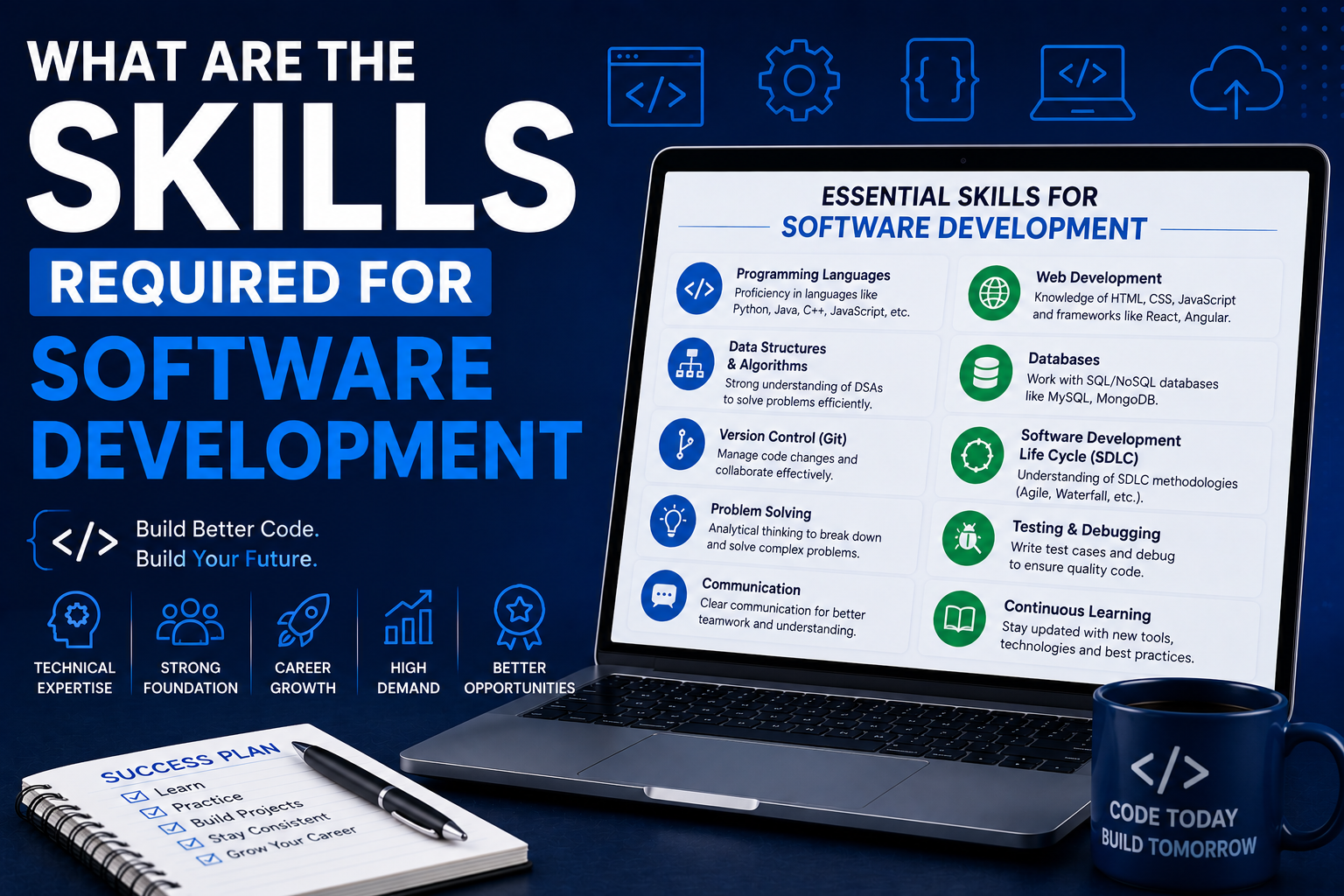
It is one of the most rapidly developing industries in the world, however, succeeding in it or moving up in the ranks takes much more than coding expertise alone.
But what exactly should you know in order to become a successful software developer in 2024?
We have put together a list of technical skills, soft skills, and new skills emerging in the sphere.
Technical Skills
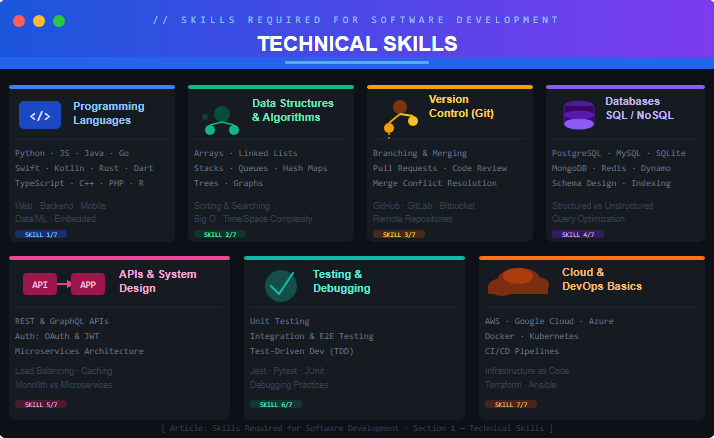
1. Programming Languages
The first step to becoming an excellent software developer is mastering at least one programming language and preferably two or three.
Which Language Depends on Your Specialization
- Web development: JavaScript, TypeScript, HTML/CSS
- Backend development: Python, Java, Go, Ruby, PHP
- Mobile development: Swift (iOS), Kotlin (Android), Dart (Flutter)
- Data/ML engineering: Python, R, Scala
- Systems/embedded: C, C++, Rust
The language itself is less important than your capability to think through problems in a programmatic way. Many programmers learn new languages rapidly after acquiring the basics.
2. Data Structures and Algorithms
Knowledge of how to handle and access data effectively is very important in writing efficient software.
Key Areas to Know
- Arrays
- Linked lists
- Stacks & Queues
- Hash Maps/Hash Tables
- Trees & Graphs
- Sorting & Searching Algorithms
- Big O notation & Time/Space Complexity
These topics make up the fundamentals of most software company technical interviews.
3. Version Control (Git)
Git cannot be negotiated. All software teams make use of version control systems for tracking, collaboration, and history of changes in the code.
You Need to Be Comfortable With
- Branching and merging
- Pull requests and code review
- Handling merge conflicts
- Using remote repositories (GitHub, GitLab, Bitbucket)
4. Databases
Every software stores data in one way or another. Therefore, software engineers must know how to work with both relational and non-relational databases.
Relational (SQL)
PostgreSQL, MySQL, SQLite, for structured data..
Non-Relational (NoSQL)
MongoDB, Redis, DynamoDB, for unstructured data having large volumes.
You need to have a grasp on writing queries and designing schemas and basic knowledge about indexes.
5. APIs and System Design
Software applications do not normally operate independently in today’s world. It is important for developers to know how to develop and consume APIs, including REST and GraphQL, and create scalable and manageable systems.
Key Concepts
- Design principles for REST API
- Authentication (OAuth, JWT)
- Microservices vs. monolithic architecture
- Load balancing and caching
6. Testing and Debugging
Programming is just one part of the process. Testing your work and debugging your program is just as critical.
Types of Testing Every Developer Should Understand
- Unit testing
- Integration testing
- End-to-end testing
- Test-driven development (TDD)
Testing frameworks (Jest, pytest, Junit) are common knowledge among most companies.
7. Cloud and DevOps Basics
And even if you are not a DevOps engineer, knowledge of the cloud infrastructure is required of developers today.
Useful Areas to Know
- Cloud providers: AWS, Google Cloud, Azure
- Containerization: Docker, Kubernetes
- CI/CD pipelines
- Infrastructure as code (Terraform, Ansible)
Soft Skills
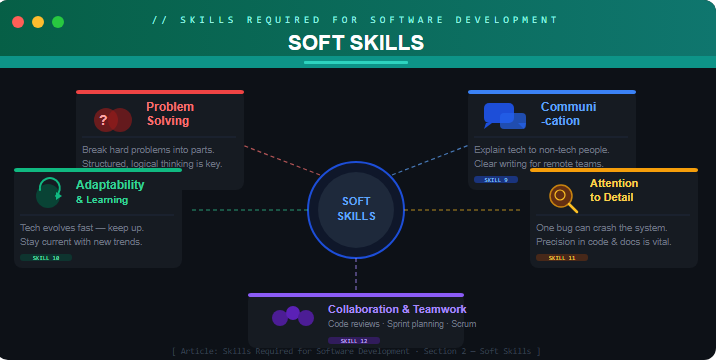
Technical skills will help you enter the door. Soft skills will help you stay and grow.
8. Problem-Solving
Software engineering is all about problem solving. Being able to break a difficult problem down into parts and solve them is what distinguishes skilled software engineers from brilliant software engineers.
9. Communication
Engineers do not develop applications in isolation. There comes a time when they have to justify technical choices to people who are not familiar with technology.
Clear written communication is especially important for remote teams.
10. Adaptability
Technology evolves at a rapid pace. Technologies, languages, and methods which are considered state-of-the-art five years ago could now be outdated. It takes a developer to learn continuously and keep abreast of the latest trends and developments.
11. Attention to Detail
One missing semicolon or a mistake by one could bring the whole system crashing down. Developers must have a keen eye for detail in their code and documentation.
12. Collaboration and Teamwork
Almost all commercial software development efforts are done in teams. It is important for developers to know how to effectively participate in the process of coding reviews and plan together in a team environment (such as scrum).
Emerging Skills Worth Developing
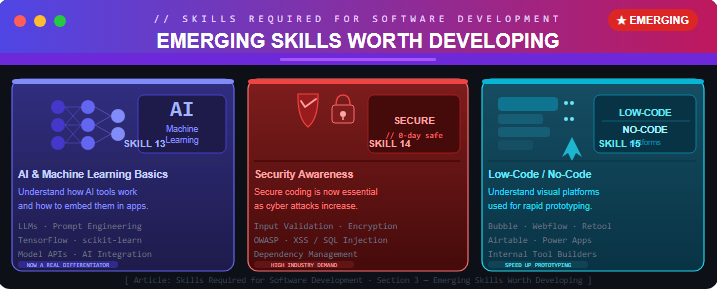
13. AI and Machine Learning Basics
Data science knowledge is not a necessity, but familiarity with how the AI tools function and can be embedded in applications is now a real differentiator.
14. Security Awareness
Since the number of cyber attacks is increasing, developers that are familiar with secure coding techniques such as input validation, encryption, and dependency management are very much sought after.
15. Low-Code/No-Code Familiarity
Traditional developers also gain an advantage by understanding how low-code platforms work, which are increasingly being used to rapidly prototype internal tools.
Bottom Line
There are many skills that software developers must possess, ranging from technical knowledge such as programming languages and data structures to soft skills such as communication and adaptability.
You don’t have to know all of it immediately; start with the basics, specialize in an area, and add the rest along the way.
The most successful software developers never stop learning. There is very little that can compare to being curious in the world of software development.