SEO for Lawyers: The Complete Guide to Ranking Your Law Firm

The SEO for Lawyer relates to the optimization of your law firm’s website in addition to its online visibility in such a way as to be ranked highly by Google and hence visible to individuals who might need your services from the Google search results page.
Even though SEO alone is a very good marketing tool, the SEO for Lawyers ranks amongst the most challenging and costly forms of internet marketing due to its competitiveness as well as cost per click.
In this guide, I will take you through all the necessary steps to implement an efficient SEO plan for lawyers.
Why SEO Matters for Law Firms
The very first thing that any person who needs a lawyer has to do is go and run a search on Google. “Personal injury attorney near me.” “Best DUI attorney in Chicago.” “How do I file for divorce in Texas?”
But if your number doesn’t appear on that page-one listing, somebody else’s will.
Consider the Numbers
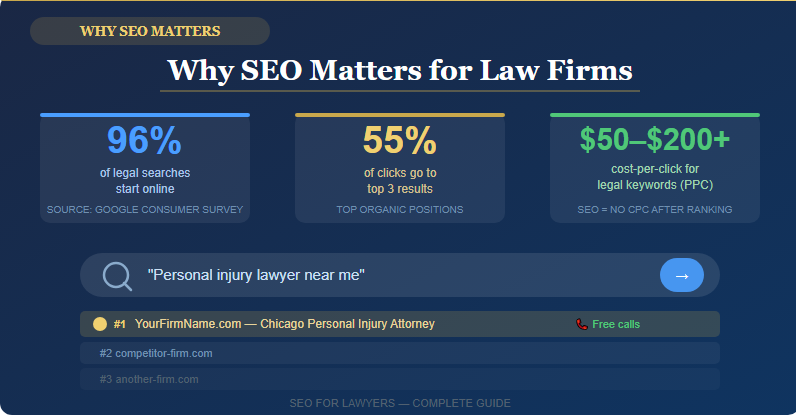
- Some of the most expensive keywords when purchasing via Google AdWords include “Legal Keywords” (CPC between $50 to $200+ depending on which field of practice).
- 96% of all people who are searching for legal knowledge start off their search online.
- The top three spots organically receive slightly more than 55% of all clicks.
- By doing SEO, one can gain access to this traffic for free once ranked.
The Three Pillars of Law Firm SEO
Effective law firm SEO rests on three foundations:
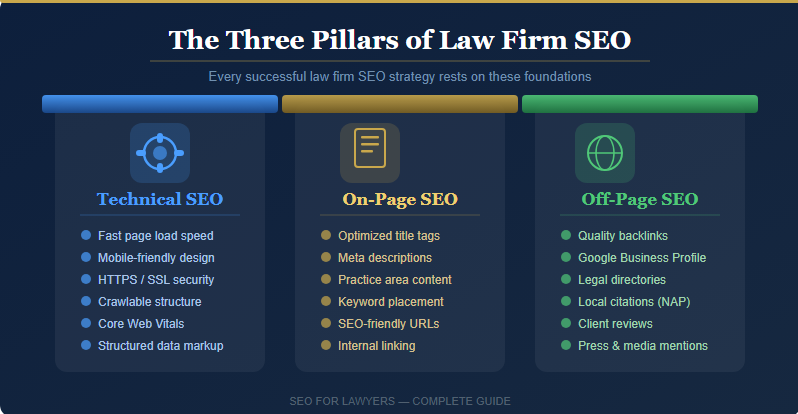
1. Technical SEO
Your website needs to be fast, mobile responsive, SSL secured, and indexable by search engines.
2. On-Page SEO
Your content must tell visitors about what services you offer, the locations where you offer your services, and who your services are meant for, using proper keyword usage.
3. Off-Page SEO
Your website will have to acquire authority through quality backlinks and local citation signals.
Both are necessary. Good content won’t rank on a website that is not working effectively. So is good content on an ineffective website.
Keyword Research for Law Firms
Keyword research involves identifying the precise search terms utilized in seeking professional help.
Practice Area Keywords
Some keywords describing your industry are:
- “Personal injury lawyer”
- “Criminal defense lawyer”
- “Family law lawyer”
- “Estate planning lawyer”
Local Keywords
The below is a list of expertise along with location, and these are generally high converting keyword searches:
- “personal injury lawyer Chicago”
- “DUI attorney near me”
- “divorce lawyer Houston TX”
- “estate planning attorney near me”
Question and Informational Keywords
Potential clients tend to research before engaging services. Keyword ranking for information purposes establishes credibility and brings in leads initially:
- “How can I act after a car crash?”
- “How long does it take for personal injury suits to be settled?”
- “What is the average payout of a slip and fall lawsuit?”
- “Do I need a lawyer for my drunk driving case?”
Long-Tail Keywords
More keyword ideas featuring high conversion potential with low search volumes:
- “Best lawyers for workman’s compensation in the construction industry in LA”
- “How to pick the best divorce attorney if my spouse is hiding money?”
The best way to get data on keyword search volumes and competitiveness for your chosen area of law is through Ahrefs’ Keywords Explorer or Google Keyword Planner.
On-Page SEO for Law Firms
Once you have identified your keywords, you can move forward with optimizing your site for their use.
Key On-Page Elements
Title Tags
Mix your keywords with the geographical location.
Sample: “Chicago Personal Injury Attorney :
Meta Descriptions
Craft a concise summary of 150 characters integrating your keywords and call to action.
H1 Heading
Must be similar or as close as possible to the title tag. H1 tag is only used once per page.
Content
Each page on best practices must include:
- Whom you represent
- The legal process
- Firm achievements
- Why you are a better choice than other law firms
URL Structure
Make URLs SEO-friendly:
Example: yourfirm.com/chicago-personal-injury-lawyer
Internal Linking
Link the pages related to different practice areas of your firm to those which include blog posts to help search engines understand the structure of your website.
Local SEO for Law Firms
As people look for lawyers who would be able to meet them personally, law firms usually aim at targeting the clients that live locally.
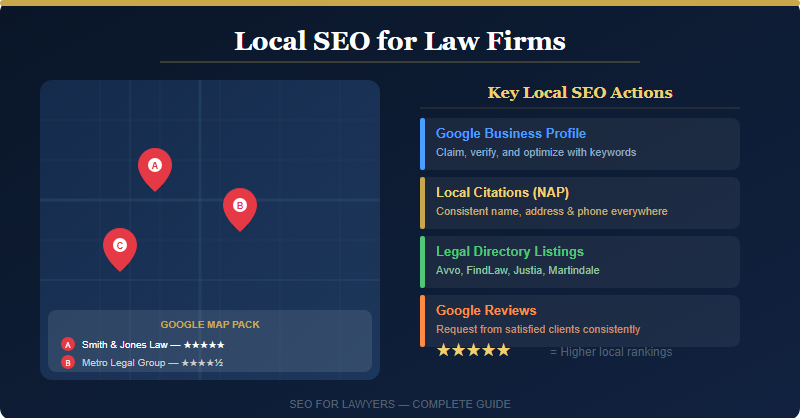
Google Business Profile (Formerly Google My Business)
Google My Business Listing
This is the listing that you wish to feature in the Map Pack, which consists of map-based results showing three local businesses from a Google search.
Optimizing Your Profile
- Visit business.google.com and claim your business listing there.
- Choose relevant categories (primary and secondary, for example, “Personal Injury Lawyer”).
- Enter the proper name, address, and telephone number of your business.
- Write a detailed business description containing key phrases.
- Upload photos of your office, staff, and business logo.
- Get and answer Google reviews frequently.
Local Citations
Any online reference to your law firm’s name, address, and phone number (NAP) is known as a citation.
Key Citation Sources for Law Firms
- Avvo
- FindLaw
- Justia
- Lawyers.com
- Martindale-Hubbell
- Yelp
NAP Consistency
You should always make sure that all citations have the same NAP information regarding your firm. A single discrepancy will definitely influence your ranking.
Local Reviews
Google Reviews hold great importance in Local Pack ranking positions
How to Build Reviews
- Asking satisfied clients to leave reviews via Google Reviews
- Including a link to write a review in emails after closing a case
- Training your employees to request a review if the client is satisfied
Content Marketing for Law Firms
There are two reasons content marketing, which consists of writing educational articles, guides, and FAQ pages, works well for lawyers:
- First, because it drives traffic from informational searches.
- Second, because it builds trust via proving knowledge and expertise
Blog Content Ideas for Law Firms
- “How to Act Quickly After Having Been Involved in an Accident?”
- “How Long Will It Take to Resolve a Personal Injury Case?”
- “What Is the Statute of Limitations on Filing a Medical Malpractice Case?”
- “How Is a Personal Injury Case for Pain and Suffering Calculated?”
- “Punishment for a First-Time DUI Conviction”
Every content needs to have one keyword, which your potential clients search for, something that is helpful for them, and includes a call to action.
Avoid Thin Content
Nobody will rank or read a 300-word blog post concerning a complicated legal topic. Try your best to address the query completely using about 1,000 to 2,500 words per complicated legal topic.
Link Building for Law Firms
“Backlink,” a term that refers to links back to your website from other external sources, is one of the main ranking factors considered by Google.
Effective Link-Building Strategies
Legal Directories
Being listed in Avvo, FindLaw, Justia, and other directory-type sites can give you very important backlinks.
Local Press and News
Being involved in sponsoring community events, responding to news articles or providing newsworthy content about your firm, may increase your chances of media coverage.
Legal Scholarship Programs
Many law firms sponsor scholarships for law students by having an announcement posted on .edu sites.
Guest Posts
Blogging about legal matters will establish your reputation and generate traffic to your site.
HARO (Help a Reporter Out)
Most journalists reach out to lawyers for their opinions. By providing relevant answers to these questions, you might get cited in some famous magazines and newspapers.
Technical SEO Essentials for Law Firm Websites
Mobile Optimization
Over 60 percent of all searches are made from mobile devices. It is essential to make sure that your site is mobile-friendly and mobile-fast.
Page Speed
Slow websites do not rank well and lose potential customers.
Try to have excellent Core Web Vitals scores. Optimize images, pick a quick hosting service, and cut down code.
HTTPS
Your website requires HTTPS (SSL). It is a ranking factor by Google officially and helps build trust among your site’s visitors.
Structured Data Markup
Using LocalBusiness and Attorney schema markup on your website will help Google understand your business data better.
How Long Does Law Firm SEO Take?
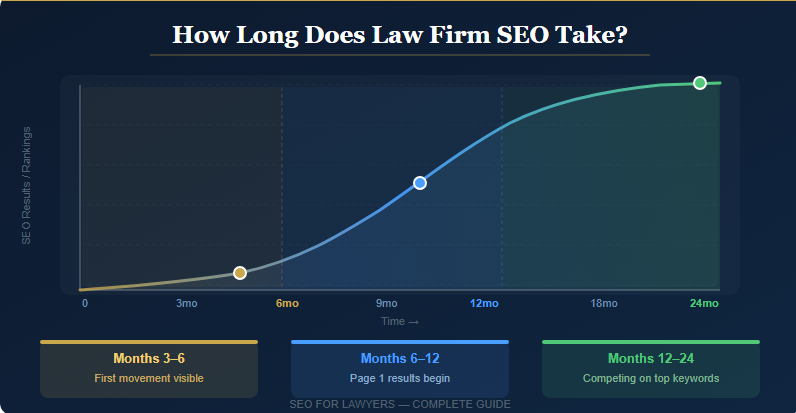
SEO is not something that happens overnight. For highly competitive markets in big cities, you can look forward to:
- After 3-6 months before seeing any kind of action at all
- After 6-12 months before showing up in first page results for majority keywords
- After 12-24 months before competing against competitive keywords
The more non-competitive the market was, the quicker the results would be.
The increased competition would require more investment and a greater time frame.
The Key Is Consistency
It is likely that if law firms create content, build backlinks, and attend to their local presence for up to one year, they would definitely reap some rewards.
Measuring Law Firm SEO Success
Here are some measurements that you need to check to know if your SEO campaign is successful:
Organic Traffic
Is your site visible through search engines?
Keyword Rankings
Have you improved the Google rankings using the target keywords?
Phone Calls and Form Fills
Traffic rising through SEO optimized web pages?
Local Pack Appearances
Appearing on the Google map pack results for your search keywords?
Google Business Profile Views and Clicks
This is possible from within your business profile section.
Final Thoughts
SEO is one of the best long-term investments to make in terms of marketing. Once ranked, this is something that just keeps flowing all day every day with no pay per click needed.
First thing first: Optimize your Google Business Profile, make practice areas pages, and start writing blogs. Once that is done, you can focus on link building and making technical improvements.
In an increasingly competitive market, SEO serves as the great equalizer because SEO gives any law firm, regardless of its size, the opportunity to compete on the same level as larger firms.