SEO Terms: The Complete Glossary for 2025

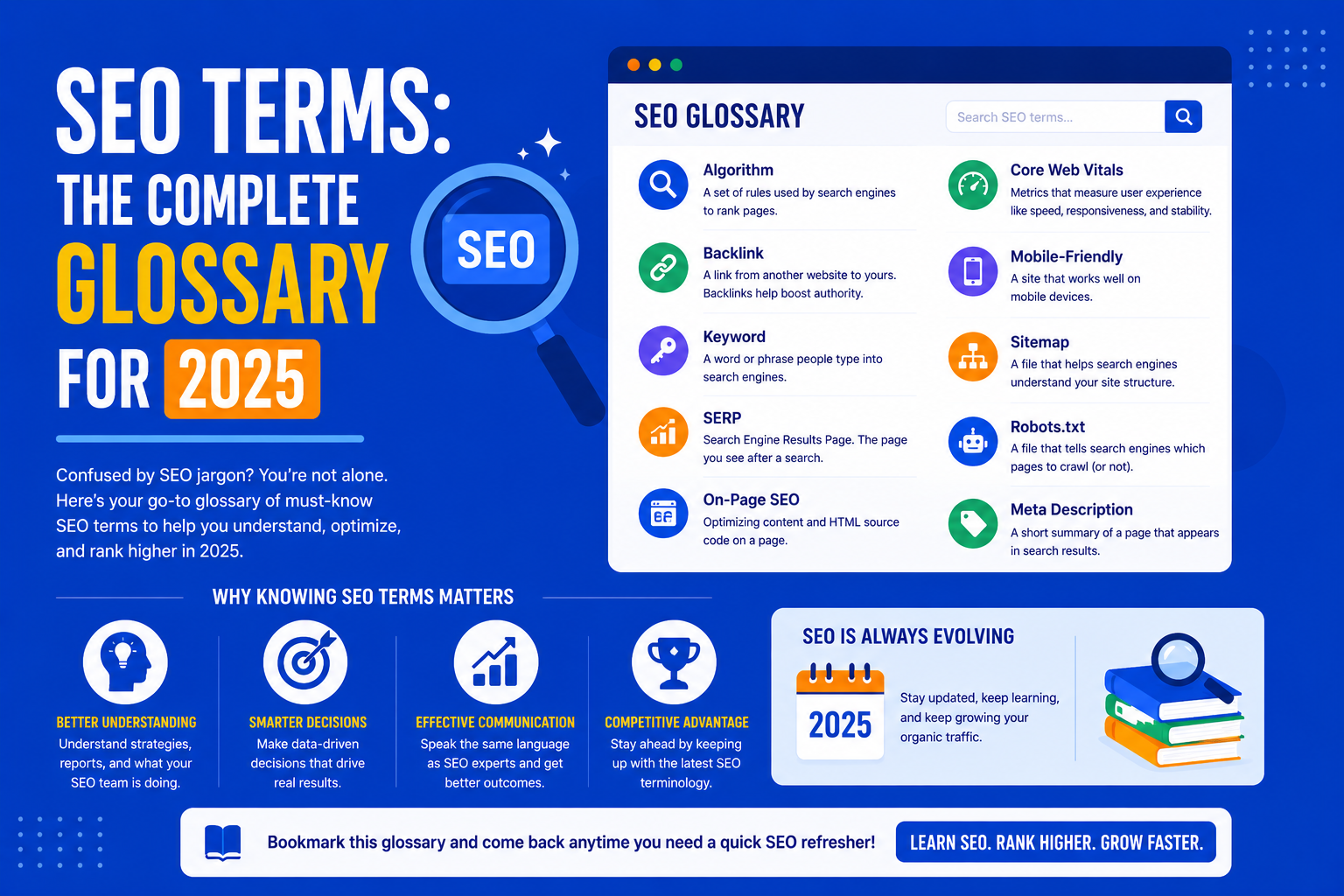
Whether you are learning SEO yourself or educating someone about it, good understanding of the SEO language will ensure that you do not get misunderstood by the other person.
The following is a list of key SEO vocabulary terms which you need to be aware of. clearly, with practical context.
A
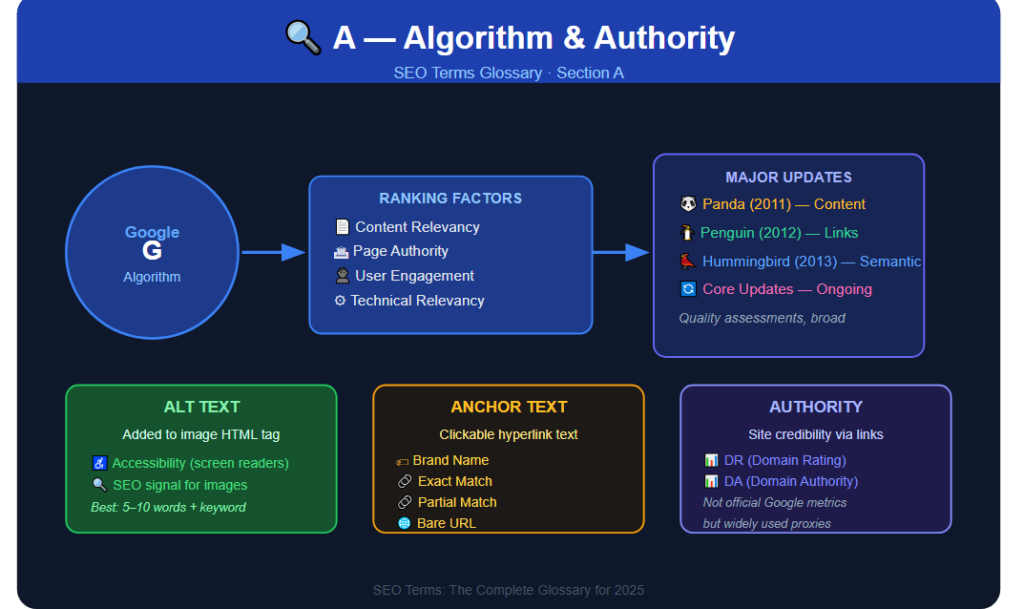
Algorithm
The ranking system used by Google and other search engines for web pages.
Google’s ranking system takes into consideration hundreds of factors like:
- Content relevancy
- Page authority
- User engagement
- Technical relevancy
Major Named Updates
- Panda (content quality, 2011)
- Penguin (backlinks quality, 2012)
- Hummingbird (semantically relevant, 2013)
- Core updates (quality, ongoing)
Alt Text (Alternative Text)
Description added to the image’s HTML tag.
Purpose
- Accessibility (screen readers can read it)
- SEO (it will help search engines understand what the image is about)
Best Practice
Provide an accurate description in 5-10 words, including relevant keywords.
Anchor Text
Hyperlinks with visible clickable text.
If a website references you with an anchor text such as “technical SEO guide,” Google considers it to be about that subject.
Common Anchor Text Types
- Brand Name
- Bare URL
- Partially Matched
- Exactly Matched
- General (“Click Here”)
Authority
The credibility or trust of the whole site according to Google, which depends mainly on the links that point to the site.
Not an actual Google factor, however, DR and DA are popular tools used by Google for this purpose.
B
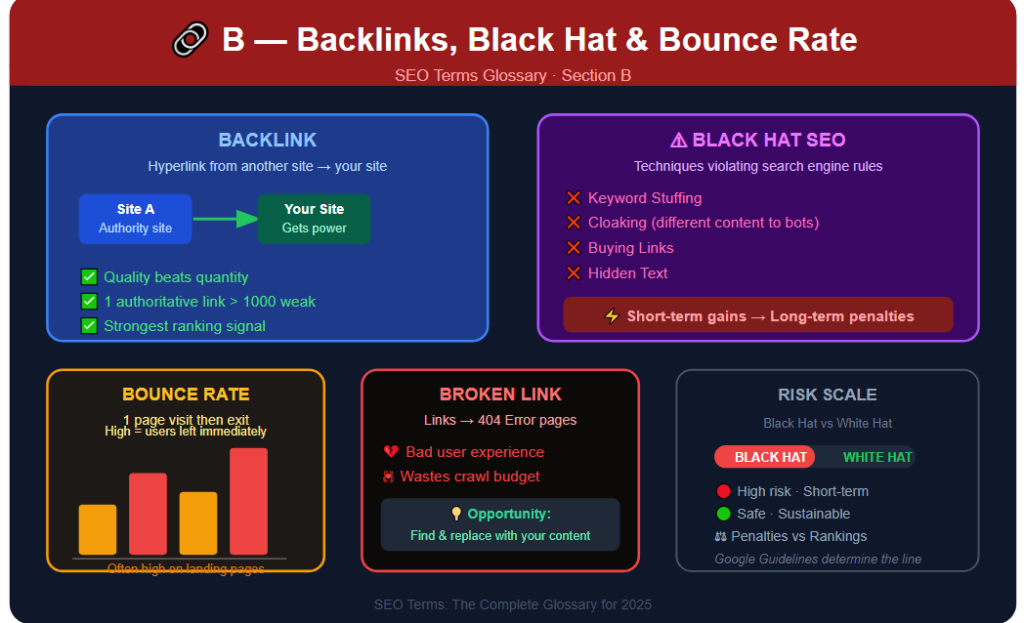
Backlink
This is a hyperlink from one site that leads to another.
A very powerful ranking signal in Google.
Key Principle
Quality is more important than quantity.
One backlink from an authoritative source can be worth a thousand lower-quality backlinks.
Black Hat SEO
Improper optimization techniques according to search engines’ rules.
Examples
- Keyword stuffing
- Cloaking
- Link buying
- Text hiding
Risk
It may help boost rankings in the short term but is a highly risky approach that will result in penalties from search engines.
Bounce Rate
A measure of the number of times visitors only visit one page during a session.
Bounce rate is often high on landing pages because of an expectation versus reality discrepancy.
Broken Link
Hyperlink linking to a dead web address (results in 404 error).
Impact
- Negative impact on user experience
- Wasted crawling budget
Opportunity
Identify broken links on relevant web pages and promote your own content instead.
C
Canonical Tag (rel=canonical)
HTML tag that tells the search engine which URL represents the original page among several duplicate or near-duplicate pages available on the web.
Benefits
- Helps consolidate link juice
- Eliminates duplicate content problems
Example
In case you have the same page available at www and non-www versions, the canonical will point to your preferred version.
Click-Through Rate (CTR)
The proportion of individuals who click on your listing after viewing it in the search engine results pages.
Formula
CTR = Clicks ÷ Impressions x 100
Available in Google Search Console.
Improve CTR By:
- Attractive title tags
- Effective meta descriptions
Cloaking
Violation of a guideline by presenting different content to search engine crawlers and humans.
Result
Manual penalties will be applied if discovered.
Content Gap
Keywords used by the competition which they have rankings for while your site does not.
Benefit
The identification of content gaps helps in the generation of new content ideas.
The Ahrefs Content Gap tool does this automatically.
Core Update
Algorithm updates are performed by Google periodically throughout the year and affect search quality.
Core updates are not designed to fix a particular problem but instead assess page quality more broadly.
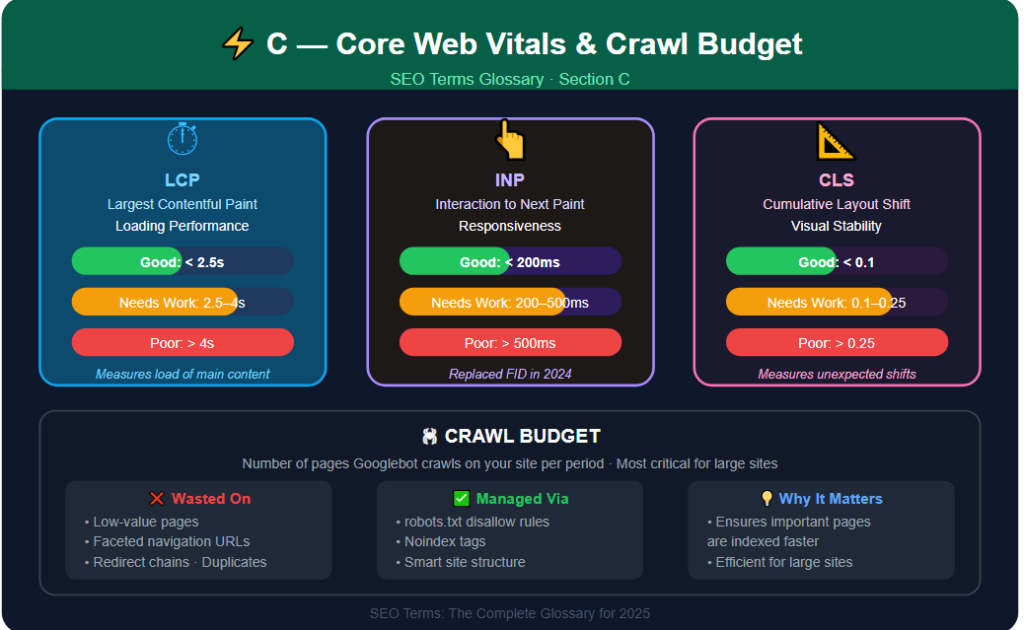
Core Web Vitals
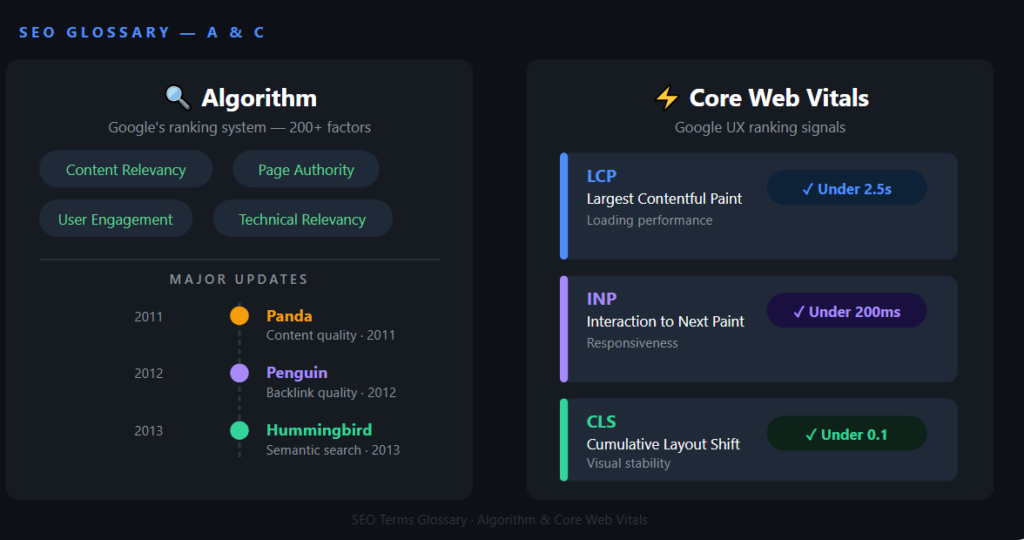
Metrics that Google uses related to user experience as ranking signals.
LCP (Largest Contentful Paint)
Loading performance.
Good: Under 2.5 seconds
INP (Interaction to Next Paint)
Responsiveness.
Good: Under 200ms
CLS (Cumulative Layout Shift)
Visual stability.
Good: Under 0.1
Crawl Budget
This is the number of pages Googlebot will spider on your website within a certain amount of time.
Most relevant to large sites.
Crawl Budget Is Often Wasted On
- Pages of low value
- Faceted navigations
- URLs
- Redirects
- Duplicate content
Managed Through
- Robots.txt disallow instructions
- Noindex tags
- Site structure
Crawlability
Whether bots can reach and index your pages.
Essential for being indexed in search engines
Common Crawlability Issues
- robots.txt disallow rules
- nRobots.txt disallow instructions
- Noindex tags
- JavaScript rendering problems
- Server-side issues
D
De-index
The process of having a page de-indexed by Google.
Common Causes
- noindex tag
- Manual penalty
- Google quality assessment
Pages that are de-indexed will not be shown on search engine results.
Disavow
The process of requesting Google to disregard certain backlinks during indexing.
Used For
Toxic backlinks created by:
- Negative SEO campaigns
- Manipulation tactics used in the past
Cannot be deleted manually.
Domain Rating (DR)
Proprietary metric by Ahrefs that assesses backlink profile strength on a logarithmic scale from 0 to 100.
Highly indicative of ranking capabilities.
Not an officially recognized Google metric.
Duplicate Content
Duplicate or almost duplicate information across different URLs.
Issues
- Lowers link authority
- Frustrates Google as to which one should be ranked
Solutions
- Canonical URL
- 301 redirect
- noindex meta tag
Dwell Time
Amount of time spent on the webpage following the click through from the search engine results page.
Improved By
- Matching search intent
- Engaging content structure
- Fast load times
E
E-E-A-T
Experience, Expertise, Authoritativeness, Trustworthiness
Guidelines used by Google’s Search Quality Raters when assessing the quality of information.
Note
The “Experience” criterion was introduced in December 2022.
Importance
Particularly crucial for YMYL queries.
External Link
Hyperlink from your site to any other website.
Benefit
Providing links to credible and relevant external sources helps establish authority and provides signals to Google.
F
Faceted Navigation
Filtering mechanism for an ecommerce website or database website, whereby a URL is uniquely generated based on the filters selected.
Examples
- Color
- Size
- Price range
If handled improperly, it can create thousands of thin/duplicate pages.
Featured Snippet
Highlighting an answer box within the Google search result page (Position 0).
Types
- Paragraph
- List
- Table
How to Earn One
Providing clear answers to specific questions.
Necessitates a placement among the first 10 search results.
G
Google Business Profile (GBP)
Google’s free tool for businesses (previously known as Google My Business).
Important For
Local SEO ranking and Local Pack ranking.
Optimization Areas
- Business Information
- Images
- Reviews
- Posts
- Details about service
Google Search Console (GSC)
Google’s free resource to keep track of your site’s performance in Google search.
Key Features
- Indexing
- Core Web Vitals
- Speed
- Mobile-Friendly
- Manual actions
GSC is required for each site.
H
Header Tags (H1–H6)
Content hierarchy with HTML elements.
Structure
- H1 = Page title
- H2 = Major sections
- H3 = Subsections
It is crucial for better readability and understanding of content.
Hreflang
HTML attribute for determining the language of the document.
Important for international websites offering services in several languages.
I
Index
Google’s database of crawled and cached web pages.
Indexation is needed for the page to get into the search engine results.
Check Indexation Using
- site: operator
- Google Search Console URL Inspection tool
Internal Link
Hyperlink from one of your website’s pages to another.
Benefits
- Spreads the PageRank
- Aids search engines in understanding content associations
K
Keyword
Search term used by visitors on search engines.
Types
- Short-tail
- Long-tail
- Branded
- Local
- Informational
- Commercial
- Transactional
Keyword Cannibalization
Several pages within the same website focusing on the same keyword.
Problem
Internal competition and divides link value.
Fixes
- Use 301 redirects for pages
- Pages should be classified by intent
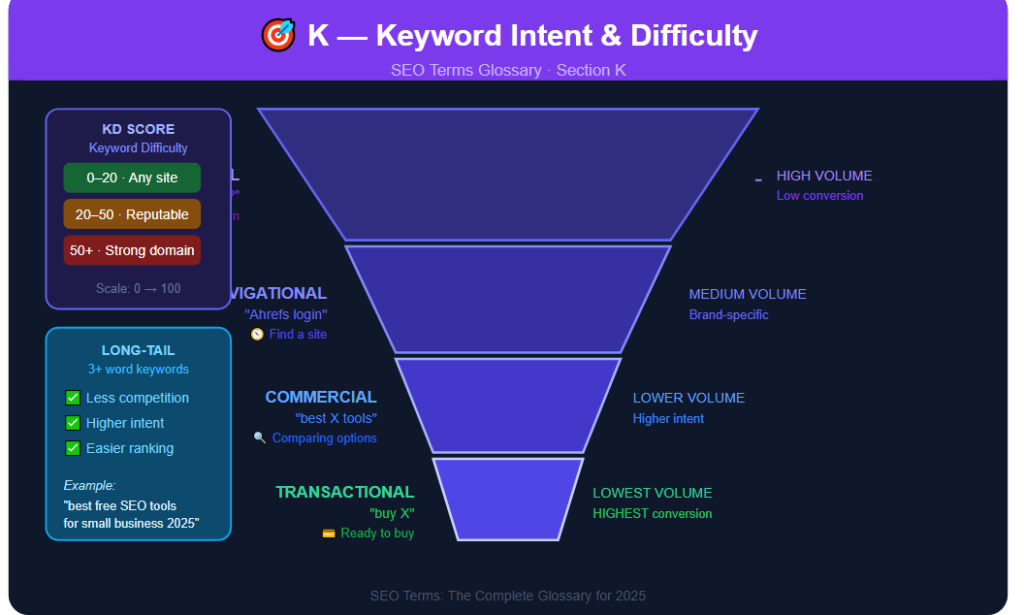
Keyword Difficulty (KD)
Score from 0 to 100 representing the difficulty of ranking.
General Benchmarks
- Below 20 is possible for almost any website
- 20 to 50 takes a reputable website
- Above 50 needs a strong domain
Keyword Intent (Search Intent)
The fundamental reason behind making the search.
Informational
Trying to learn something.
Example: “How does X work?”
Navigational
Trying to find a certain website.
Example: “Ahrefs login.”
Commercial
Looking at alternatives.
Example: “best X tools”
Transactional
Ready to make a purchase.
Example: “buy X”
L
Link Building
It is known as link building.
Legitimate Methods
- Content-based link earning
- Digital PR
- Guest posting
- Broken link building
- Partner links
Illegitimate Methods
- Buying links
- PBNs
Link Equity (Link Juice)
Ranking power flowed via the hyperlink.
Pages with high authority transfer more power.
Local Pack (Map Pack)
Three local business listings that show up with a map for location-specific searches.
Powered by Google My Business.
Long-Tail Keywords
Keywords used to search, usually three or more words.
Advantages
- Reduced competition
- Increased intent to buy
- Easier ranking
M
Manual Action
Penalty imposed on a website by a Google human inspector for breaking the Google Webmaster Guidelines.
Viewable via Google Search Console.
Meta Description
A brief description of a page shown in search engine results below the title.
Best Practice
Include:
- Primary keyword
- Strong reason to click
Meta Title / Title Tag
The HTML title tag showed up in search results and browser tabs.
Best Practices
- Keyword to use
- Under 60 characters
- Should be unique
- Should attract clicks
N
Nofollow
The rel=nofollow HTML link attribute.
Originally was meant to prevent PageRank inheritance.
Since 2019, Google regards it as an advisory.
Noindex
SEO instruction not to have the page indexed by search engines.
Common Uses
- Thank-you pages
- Admin pages
- Staging sites
- Content farms
O
Organic Traffic
Organic search visitors..
Highest return on investment of all acquisition methods because rankings build over time.
P
PageRank
Google’s initial algorithm that provided importance scores to pages through backlinking.
This remains central to today’s ranking algorithms.
Panda (Google Panda)
An algorithm update in 2011 focusing on:
- Thin content
- Duplicate content
- Low-quality content
Now incorporated within Google’s core algorithm
Penguin (Google Penguin)
An algorithm update released by Google in 2012 that targeted abusive link-building techniques
Now operates in real time within Google’s core algorithm..
R
Redirect
A method to direct both users and search engines to a different URL.
301 Redirect
Redirect.
Transfers almost all link equity.
302 Redirect
Temporary redirect.
Appropriate only in temporary cases.
Redirect Chain
A → B → C sequence.
To be eventually consolidated to direct redirects.
Referring Domain
A site that has at least one backlink linking back to yours.
Sometimes, unique referring domains are better than total number of backlinks.
Rich Results (Rich Snippets)
Search results improved by schema markup.
Examples
- Star ratings
- Prices
- FAQs
- Recipes
- Events
- Jobs
Robots.txt
A document that tells the search engine which pages or sections not to crawl.
Important Note
Doesn’t stop the page being indexed.
Use noindex for such cases.
S
Schema Markup
Code that provides context about content for search engines to process.
Common Types
- Article
- FAQ
- HowTo
- Product
- LocalBusiness
- BreadcrumbList
- Review
Search Console
See: Google Search Console.
SERP (Search Engine Results Page)
Page returned following user search input.
Common SERP Features
- Search Results Types
- Organic Search Results
- Featured Snippets
- People Also Ask
- Local Pack
- Shopping Results
- Image Packs
- Video Carousel
- Knowledge Panel
- AI Summary
SERP Feature
Anything else appearing in the SERPs other than the regular organic results.
Share of Voice (SOV)
Percentage of clicks that your site generates compared to your competitors via organic searches.
Market share measure for your competitor.
Sitemap (XML Sitemap)
List of the key URLs within your website.
Benefits
- Helps with discovery
- Enhances crawling process
Submit to Google Search Console.
T
Technical SEO
Optimization of technical aspects of the website such as:
- Crawl ability
- Indexing
- Speed
- Mobile optimization
- Structured data
- HTTPS
- Canonicalization
The basics of SEO.
Thin Content
Pages with less original content or user value.
Solutions
- Enhance content quality
- Merge similar pages
- Delete pages or redirect them
Topical Authority
The extent to which a website has gained expertise in the matter.
Created by:
- Full coverage of the topic
- Backlinks that relate to the topic
- Expertise
U
URL (Uniform Resource Locator)
The web address of a site.
SEO Best Practices
- Short
- Descriptive
- Keyword-rich
- Lowercase
- Hyphenated
W
White Hat SEO
Optimization techniques that meet the search engines’ criteria.
Focus Areas
- Valuable information
- Good backlinks
- Positive user experience
Ensures lasting, sustainable benefits.
X
XML Sitemap
See: Sitemap.
Y
YMYL (Your Money or Your Life)
Google categorizes content that has the ability to greatly affect a user’s:
- Health
- Finances
- Safety
- Wellbeing
Examples
- Medically advised
- Fiscally advised
- Legally informed
- Notified of key events
A YMYL page requires an extra level of E-E-A-T.
Conclusion
The field of SEO has a huge vocabulary because SEO involves technical engineering, content marketing, data analytics, and psychology.
This glossary includes the terminology used most often, although the industry keeps moving forward.
Every time there is a new idea (AI Overviews, Search Generative Experience, Entity SEO), the basics are always:
- Provide search engines with information about your site
- Build trust through high-quality content and backlinks
- Create a useful experience for your visitors