SEO for Startups: How to Build Organic Traffic From Zero

There is one particular SEO dilemma with which all startups struggle: you need traffic right away, but SEO takes time. You have limited means, but SEO needs constant spending. And you are fighting for survival in competitive industries where big players have domain authority built up during years.
Luckily, there are certain strengths unique to startups. You can act fast, focus on niche markets ignored by competitors, and create fresh, relevant content before anyone even starts talking about it. Here is how to do it.
Why Startups Should Invest in SEO Early
This is very true, and most companies opt to invest less in SEO, preferring the use of paid acquisition for quicker returns.
The Compounding Argument for Early SEO Investment
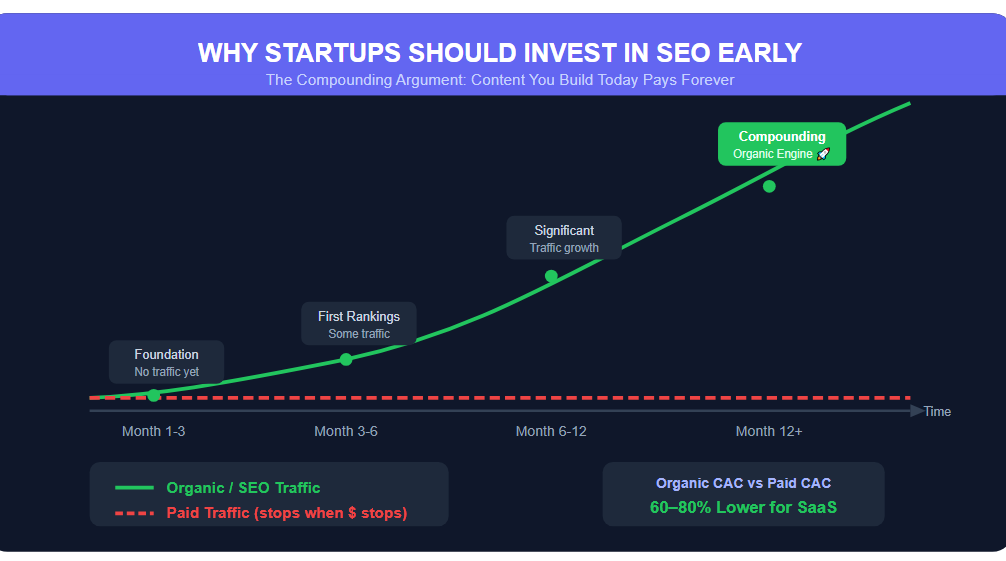
The content and authority you create today pay dividends for many years to come. The blog post ranked at month six earns traffic at month 24 without further costs. However, in paid acquisition, you have to keep investing for traffic to keep coming in.
Organic traffic has the lowest CAC over time. Once the ranking is done, then organic leads will become cheaper than any other type of paid lead. In case of SaaS companies, organic traffic will bring down the CAC by 60% to 80% of paid CAC.
SEO is scalable without proportionate cost scaling. Doubling your paid traffic will cost you double as well, but doubling your SEO traffic requires only content creation.
Organic growth is like giving an investor signal. When there is organic growth, it is a sign for the investor that you have found the right product-market fit and growth is sustainable through organic channels.
The Startup SEO Reality Check
First, be realistic about your timelines: SEO does not happen overnight:
- Months 1-3: Foundations laid, but nothing to show yet
- Months 3-6: Begin seeing rankings and some traffic
- Months 6-12: Generate significant traffic via your content
- Month 12+: Grow by compounding effects
But if you want leads within 30 days, go for paid channels. Use SEO to develop your engine over time so that paid channels become unnecessary.
The Startup SEO Playbook
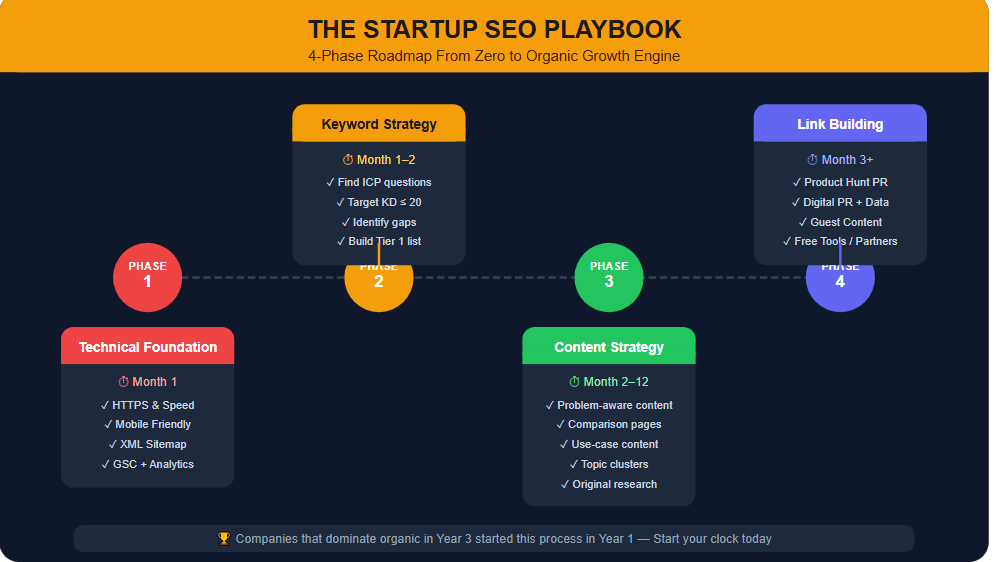
Phase 1: Technical Foundation (Month 1)
Prior to posting any content or acquiring any backlinks, make sure that Google is able to properly crawl and index your website.
Technical Checklist
- HTTPS throughout
- Quick Page Load (LCP < 2.5 sec)
- Mobile-Friendly
- Submitted XML sitemap through Google Search Console
- URL Structure (clean without parameters)
- Google Search Console & Analytics set up
- Not accidentally indexed
Phase 2: Keyword Strategy (Month 1–2)
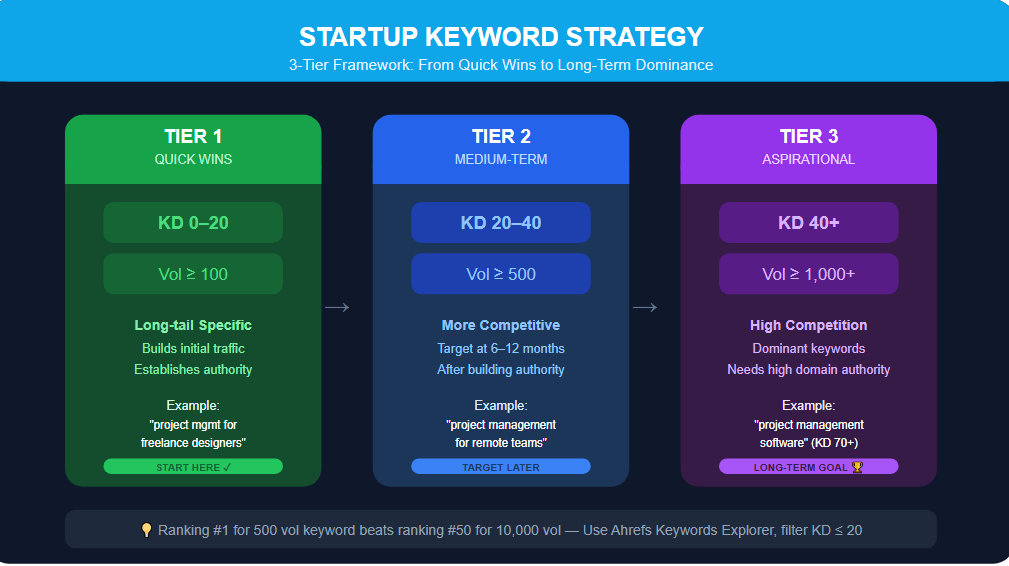
The major mistake entrepreneurs make in SEO during the early days of their business is choosing highly competitive keywords prematurely. A site with DR 5 cannot outrank competitors on a search query like “project management software” (KD 70+). But a query such as “project management software for freelance designers” (KD 15) may be conquered.
Startup Keyword Framework
Tier 1 — Quick Wins (KD 0–20)
Specific long-tail keywords with low competition. They will help you generate initial traffic and topical authority.
Tier 2, Medium-Term Targets (KD 20–40)
More competitive queries you can target after 6-12 months.
Tier 3, Aspirational (KD 40+)
Keywords you eventually want to dominate. The keywords which your website must rank for after developing its domain authority.
Begin solely in Tier 1. Use Ahrefs Keywords Explorer. Limit results to KD ≤20 and volume ≥100. A startup will benefit from being ranked #1 for a keyword with 500 volume rather than #50 for a query with 10,000 volumes.
Keyword Research Approach for Startups
- Determine the ICP (ideal customer profile) and the exact questions they have
- Keywords where competitors rank but which you can outrank with more relevant content
- Search for hot topic areas that currently lack good content
- Utilize the “Also Rank For” report on Ahrefs to identify related keywords to your top content opportunities
Phase 3: Content Strategy (Month 2–12)
Content forms the core mechanism for SEO success for startups.
The Type of Content That Works for Startups
Problem-Aware Content
Focus on keyword targets where your ideal customer would be looking for solutions to their problems. Example: “How to organize client projects without emails” for a project management software. Targeting customers at the beginning of the funnel.
Comparison Content
“X vs Y” and “[Best Category Tools]”. High commercial intent. Hard to rank well early on but very valuable.
Use Case Content
“[Category] for [Persona]”. Examples: “Project management for architects”, “Task management for remote teams”. Less competition, very focused.
Thought Leadership and Original Research
Publish original research that gets cited by others. Doing your own research in your space is an excellent way to get links.
Integration and Tool Content
Content about the integration of your product with widely used tools: “[Your Tool] + [Popular Tool]: How to Connect Them.” It ranks very high, and it attracts users who are currently using the popular tool.
Alternative Content
“Best [Competitor] Alternatives”: It captures searches that are evaluating your competitors but aren’t committed yet. They have high commercial intent.
Content Production for Resource-Constrained Startups
There is no requirement for you to publish 20 pieces each month. Good quality is better than higher quantity. Publishing just two pieces each month that are highly informative and optimized will beat publishing 20 pieces that are not useful enough for the readers.
Topic Clusters
Instead of publishing random pieces, create clusters based on your main topic. This means having one pillar piece for your broader topic and several cluster pieces for its specific aspects.
Phase 4: Link Building (Month 3+)
Fresh sites require backlinks for ranking.
Product Launch PR
Link building opportunities like Product Hunt, BetaList, SaaS directories, launch press releases, etc., usually include backlinks and will help you build authority.
Digital PR with Original Data
If your product has data that can be used, publish research studies on the basis of your data. The journalists and bloggers quote original data.
Guest Content
Write authoritative content pieces for places where your target audience goes. Each article you write helps you create a link and gets referral traffic.
Tool-Based Link Earning
Create a free tool which actually provides some value to its users. A free tool helps you gain quality backlinks and also gives you referral traffic regularly.
Partner and Integration Ecosystems
In case you integrate with other SaaS software, ask to be listed in their partners’ sections and integration pages because these tend to be high-quality links coming from relevant websites.
Community Building
Join communities that your target audience frequents (subreddits, Slack communities, forums), share valuable content (no promotions!), connect with people in such communities who will share your content naturally.
Startup SEO Priorities by Stage
Pre-Product/Launch Stage
- Create the technical underpinnings
- Start with your content hub before launching the product
- Develop topical expertise based on the challenge you solve
- Focus on less competitive informational keywords
Post-Launch (1–12 Months)
- Add commercial intent pages (product page, pricing, comparison pages)
- Generate links through the launch PR campaign and outreach
- Focus on those content topics that are getting early rankings
Growth Stage (12+ Months)
- Move onto more competitive keywords
- Cluster content around the core use cases
- Scale content creation
- Digital PR efforts for establishing topical authority
Common Startup SEO Mistakes
Optimizing the Homepage for the Product Name Instead of Problem Keywords
Your target audience is looking for solutions to their problems, not your business name, which they haven’t heard of before. Make sure that your website pages are optimized using problem keywords.
Ignoring Technical SEO
Startups typically begin operations on rapidly evolving stacks and do not pay attention to the technical aspects of SEO. Slow mobile optimization, poor speed, and crawling problems can result in bad rankings despite having high-quality content.
Expecting Quick Results and Abandoning Too Early
The period between 3-6 months before any traffic comes through sees most startups giving up on SEO. This is because firms that survive the difficult period have sustainable organic channels.
Publishing Content That Targets the Wrong Persona
It’s pointless to get SEO traffic that doesn’t convert. Allocate each keyword to its target persona and sales phase. Organic traffic that never leads to purchases of your product doesn’t grow.
No Conversion Path From Organic Traffic
The best organic traffic without any idea of how to make them try, sign up or request a demo is futile. Each SEO landing page should have an appropriate call to action related to their sales phase.
Measuring Startup SEO
Key Metrics by Stage
Early Stage (Months 1–6)
- Keywords ranking on first page 1
- Organic impressions growth
- Keywords ranking top 100
Mid Stage (Months 6–12)
- Organic traffic growth
- Trial/Sign Up Conversions (from organic)
- Keywords ranking in top 1
Growth Stage (12+ Months)
- Organic CAC vs paid CAC
- Organic Revenue Generation
- Share of Voice (Target Keywords)
Conclusion
Companies that prioritize SEO from day one have created a virtuous cycle of growth that decreases customer acquisition costs and creates a sustainable competitive advantage. It starts with having realistic expectations regarding timeframes, prioritizing low competition keywords where you can truly succeed, and consistently creating content focused on the challenges of your customers.
It’s those companies who dominate the organic rankings of their industry in Year 3 that started this process in Year 1. Start your clock today.