Enterprise Email Marketing: How Large Organizations Scale Personalization and Performance

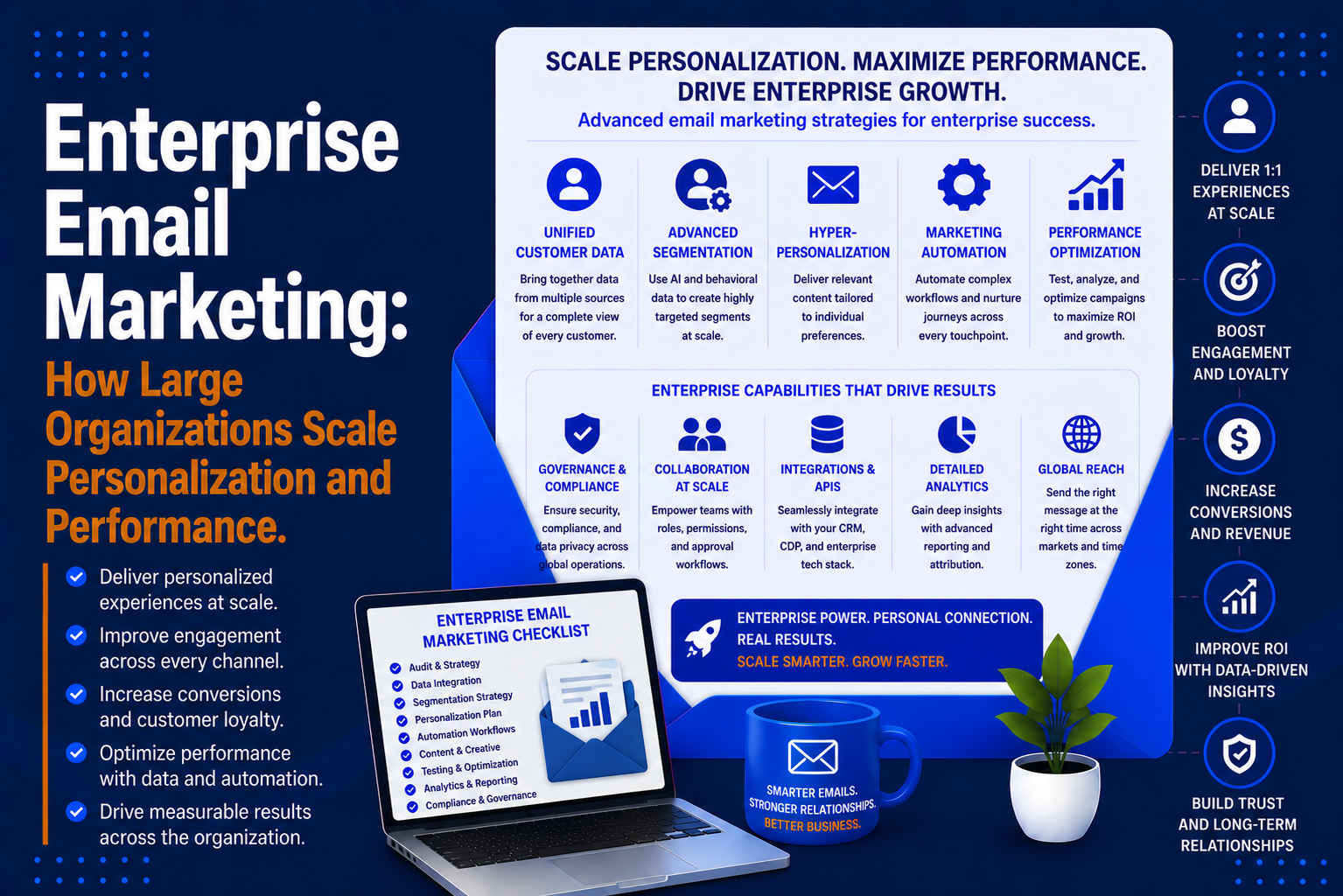
An enterprise email marketing campaign works on an entirely different level compared to the small business or even the mid-market email marketing efforts. It is no longer about newsletters; you have got to run multi-branded campaigns, deal with international compliances, build complex segmentation trees, and integrate a dozen platforms.
Here is your step-by-step guide to building a profitable email marketing effort from scratch.
What Is Enterprise Email Marketing?
Enterprise email marketing is defined as the email campaigns conducted by big businesses that have complex requirements:
- Substantial customer base sizes (from 100,000 to many millions)
- Multiple brands, regions, or products
- Stringent data management and compliance requirements (GDPR, CCPA, CAN-SPAM)
- Compatibility with CRM systems, CDP, and marketing automation software
- Involvement of multiple stakeholders during campaign approvals
The issues are unique. The technology is much better. And the risks are much greater.
The Core Components of Enterprise Email Marketing
1. Enterprise Email Service Provider (ESP)
Tools like Mailchimp meant for consumers cannot be used by enterprises. For that, you will have to use some other tools, such as:
- Salesforce Marketing Cloud: It is the industry standard for enterprises. Features deep CRM integration and an effective journey builder.
- Adobe Marketo Engage: Good for B2B enterprises having complicated lead nurturing needs.
- Oracle Eloqua: Good enterprise-level automation and CRM integration.
- HubSpot Enterprise: Great for enterprises that work on the inbound marketing approach.
- Braze: The best platform for customer engagement using emails, pushes, SMS and in-app.
2. Customer Data Platform (CDP)
Email marketing for enterprises needs a single view of the customer at all times. This can be achieved through CDP (Segment, Tealium, or Adobe Experience Platform), which will collect customer data from your website, CRM, transaction history, and tickets into one profile.
3. Marketing Automation
Automatically done:
- On behavior-based actions (visits, downloads, purchases)
- Lifecycle emails (onboarding, renewal, churn prevention)
- Transaction emails (receipts, shipments, account change notifications)
Segmentation at Enterprise Scale
Basic demographic segmentation is table stakes. Business-class email software makes use of behavioral, predictive, and real-time segmentation.
Segmentation Layers Used by Enterprise Teams
Behavioral Segmentation
- Frequency of product use
- Usage patterns of features
- Support ticket history
- Website engagement score
Predictive Segmentation
- Churn risk score
- Upgrade propensity
- Lifetime value prediction
- Next best action modeling
Real-Time Segmentation
- Activated from current occurrences (currently logged in, currently hit a threshold, currently opened a support ticket)
- Facilitates instantaneous mass communication
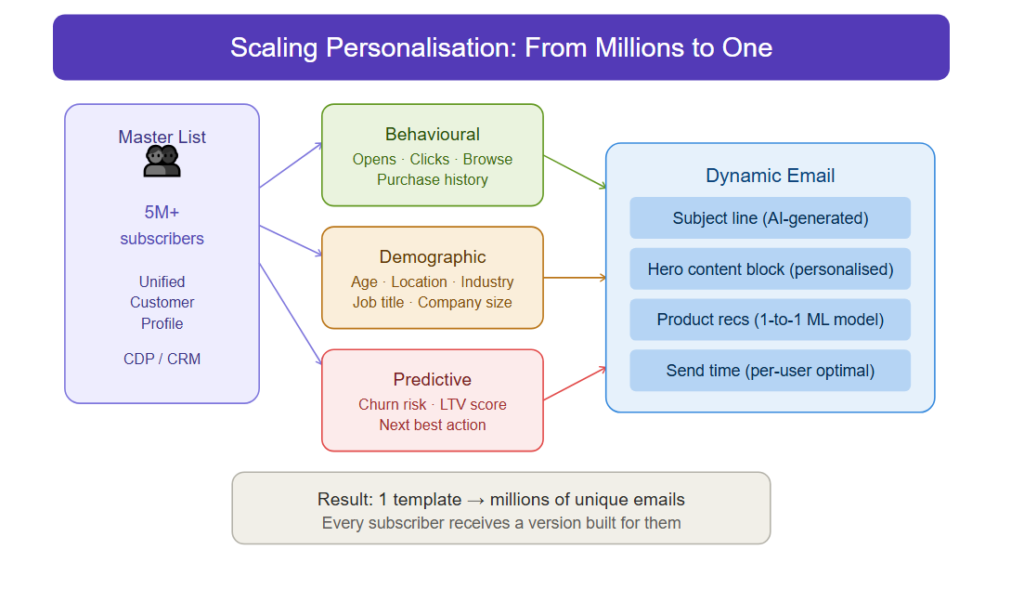
Personalization Beyond First Name
Enterprise personalization goes way beyond “Hi [First Name].”
Dynamic Content Blocks
Send varied email messaging to varied segments in the same campaign. For example, a financial services firm would be able to send:
- Different product recommendations for retail customers vs. institutional clients
- Regulatory disclosures specific to their region
- Messaging tailored based on past browsing activity
Predictive Product Recommendations
Bring up recommendations for your products in real time based on purchase history, browsing, and collaborative filtering (products purchased by similar customers).
Send Time Optimization
The artificial intelligence–powered send time optimization looks at the best time for every single subscriber to open their email and sends it to them right at that very moment, simultaneously dealing with millions of subscribers.
Enterprise Email Compliance and Governance
Being compliant is critical for enterprises. Failure to comply means multimillion dollar fines.
Key Compliance Requirements
- GDPR (EU/UK): Opt-in consent is mandatory. The right to erasure should be respected. Data Processing Agreements with all suppliers.
- CCPA/CPRA (California): Opt-out from the sale of personal information. Requirements regarding privacy policies.
- CAN-SPAM (US): Commercial emails should have a physical address and an unsubscribe facility.
- CASL (Canada): Express consent is necessary for commercial messages sent to Canada.
Enterprise Governance Best Practices
- Centralized consent management system (OneTrust, TrustArc)
- Approval flows for email with gates for legal/compliance review
- Automated suppression list management
- Data audits and documentation of processing activities
Email Infrastructure for Enterprise Sending
Enterprise deliverability infrastructure needs include:
- Dedicated IPs: Transactional emails versus marketing emails on separate IPs in order to maintain sender reputation
- Warming process: Start slowly with sending emails using new IPs within 4–8 weeks
- Sender Authentication: SPF, DKIM, and DMARC should be set up properly
- Feedback loop system: Subscribe to feedback loops offered by major ISPs
- Dedicated deliverability team: Most companies have a person responsible for email deliverability
Measuring Enterprise Email Performance
Email campaigns for enterprises demand more advanced metrics than open and click throughs.
Key Enterprise Email KPIs
- Revenue Attribution: To what degree does the revenue generated depend on email campaign? (First Touch, Last Touch and Multi-Touch Attribution)
- LTV of Customer by Email Cohort: Are customers generated through email channels more valuable than the average customer?
- Incremental Revenue: What revenue could have been expected otherwise but for email? (Hold out tests required)
- Brand Health Metrics: Unsubscribe rate, spam complaints, reply sentiments
- Program-level ROI: Revenue generated from email program compared to cost of the program (people, technology, infrastructure)
Building an Enterprise Email Marketing Team
A mature enterprise email program typically requires:
- Email Marketing Manager: Responsible for Strategy & Roadmap
- Campaign Specialists: Design and Run Campaigns
- Marketing Automation Engineer: Handles Platform Configuration & Integration
- Inbox Placement Specialist: Checks Inbox Placement and Sender Reputation
- Data Analyst: Tracks Performance & Attribution Models
- Compliance Officer: Regulatory Compliance
Common Enterprise Email Marketing Challenges
1. Data Silos
Disparate customer data in multiple systems results in inconsistent personalization and trigger events. Invest in a CDP.
2. Approval Bottlenecks
Review cycles with multiple stakeholders involved hinder campaign efficiency. Set up a streamlined workflow with SLAs.
3. Template Sprawl
Hundreds of inconsistent email templates among teams. Implement a design system.
4. Deliverability at Scale
Sending billions of emails needs robust infrastructure. Your sender reputation should always be considered.
5. Measuring True ROI
Attribution becomes challenging when email marketing combines with paid, organic, and direct efforts. Multi-touch attribution modeling investment is essential.
Final Thoughts
Enterprise email marketing is one of the most complicated and valuable fields within digital marketing. Those companies which practice it most effectively understand email marketing as a discipline focused on delivering data and information to customers, not just as a way of communication.
Choose a proper technology solution, form a dedicated team, and comply with regulations as well as focus on deliverability as key requirements. Once you have all this set up, enterprise email will become a scalable revenue generation machine.