B2B SEO Strategy: A Framework That Generates Pipeline, Not Just Traffic

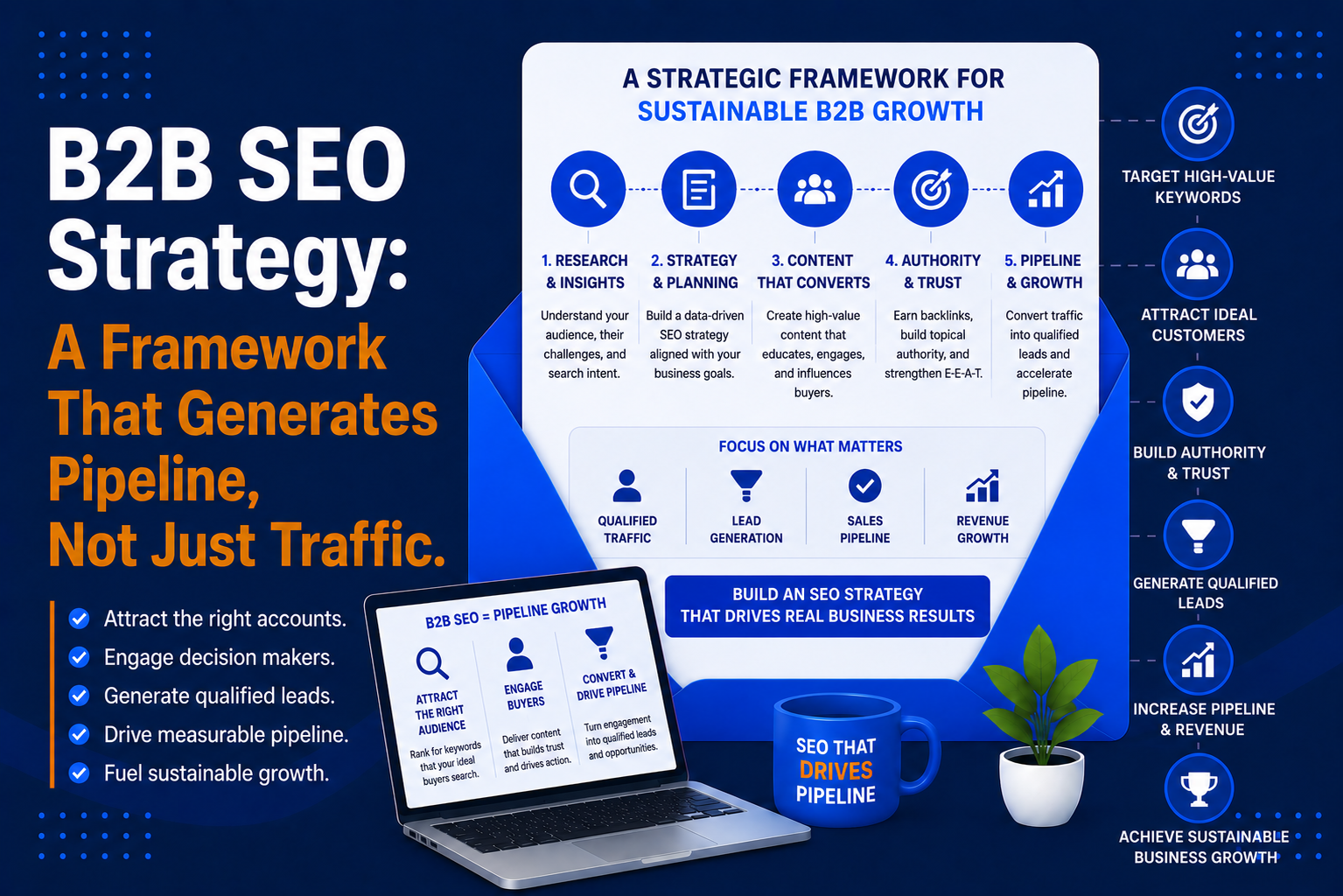
In fact, B2B SEO is completely distinct from B2C SEO. The keyword volume is smaller. The buying process is slower. The decision-makers are sophisticated individuals who don’t like generic content. And ultimately, traffic is irrelevant – what matters is pipeline and revenue.
Many B2B firms fail to apply SEO at all or perform B2C SEO strategies and are shocked that despite driving traffic to their content, no one converts into leads. The following guide can help you bridge the gap between organic search and sales.
Why B2B SEO Is Different
Before developing your strategy, make sure you know why B2B search is unique:
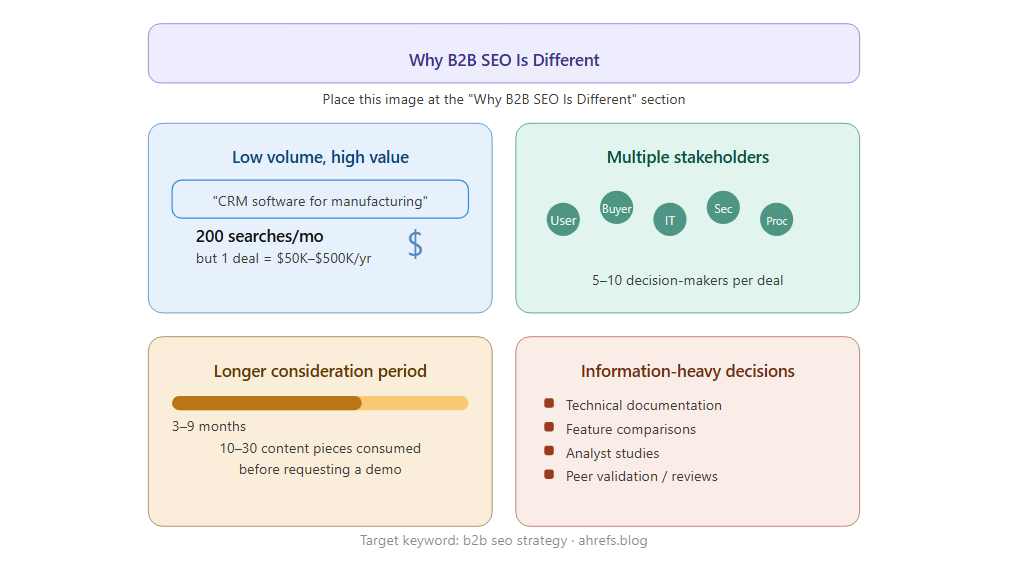
Lower Keyword Volumes, Higher Deal Values
A phrase like “CRM software for manufacturing” may attract 200 monthly searches. However, closing a single deal with a customer can bring you between $50,000 and $500,000 each year. This creates an incentive to use long-tail, high-intent keywords.
Multiple Stakeholders
In B2B transactions, there can be 5–10 buyers involved. An effective SEO strategy will target multiple personas (end-user, economic buyer, security, purchasing department). One landing page targeting one keyword doesn’t close business deals.
Longer Consideration Periods
A business-to-business buyer can consume up to 10 to 30 pieces of content over a period of 3 to 9 months before asking for a demonstration.
Information-Heavy Decision Making
Business-to-business buyers are experts at research. They will look into technical documentation, analyze feature sets, review analyst studies, and require peer validation before making any purchase decision.
The B2B SEO Strategy Framework
Phase 1: Define Your ICP and Keyword Universe
The foundation for a solid B2B SEO strategy is the ability to accurately identify your target audience.
Define Your Ideal Customer Profile (ICP)
- Industry / Vertical
- Size of company (based on revenue/employees)
- Location
- Technology used and tools they use
- Business problems and factors that trigger purchasing actions
Based on your ICP, develop a universe of keywords that the ICP will use at every stage of their purchase process.
Keyword Categories for B2B
Problem-Aware Keywords (Top of Funnel)
The problem is known to your ICP, but they probably don’t know that there are ways to fix it.
Examples:
- “How to minimize manual data input”
- “Why is our sales cycle too long?”
- “What are the difficulties of managing remote engineering teams?”
Solution-Aware Keywords (Middle of Funnel)
Your ICP is investigating solutions.
Examples:
- “Data Automation Tools”
- “Sales Process Software”
- “Remote Engineering Team Management Platform”
Product-Aware Keywords (Bottom of Funnel)
Your ICP is evaluating these solutions.
Examples:
- “Best [your category] software”
- “[Your tool] vs [Competitor]”
- “[Your tool] alternatives”
- “[Your category] software for [specific industry]”
Decision Keywords
Examples:
- “Is [your tool] worth it”
- “[Your tool] reviews”
- “[Your tool] pricing”
- “How to implement [your tool]”
Phase 2: Build a Full-Funnel Content Architecture
Each part of your architecture needs to be mapped to a particular stage of the customer journey and buyer persona.
Top-of-Funnel Content (Problem-Aware)
Content pieces related to informational keywords. This is the content that attracts customers early on in their search process.
Examples:
- “How to Reduce Customer Churn in SaaS”
- “The Complete Guide to Revenue Operations”
- “What Is a Product-Led Growth Strategy?”
Middle-of-Funnel Content (Solution-Aware)
More detailed content that describes how these solutions help solve the challenges you face. Include comparison analyses, use-case tutorials, ROI models.
Examples:
- “The Benefits of Revenue Operations Software in Shortening the Sales Cycle”
- “Selecting CRM Software: Everything You Need to Know for Mid-Market SaaS Businesses”
Bottom-of-Funnel Content (Product-Aware)
High-intent commercial content aimed at turning searchers into customers.
Pages:
- Product pages
- Comparison pages (“[Your product] vs [Competitor]”)
- Best-of articles (“Best [Category] Software”)
- Landing pages specific to certain industries (“[Your product] for [Industry]”)
Phase 3: Target the Decision-Maker Persona
SEO copy for B2B must target the right decision maker. If your blog is popular among developers but sells to CEOs, your pipeline will be nonexistent.
Persona-Aligned Content
End User Content
- How-tos/guides
- Include tutorials
- Integrations guides
Economic Buyer Content
- ROI calculators
- Business cases templates
- Executive summary
IT/Security Persona Content
- Security guide
- Compliance guide
- Technical specs
Procurement Content
- Price guides
- Evaluation guide
For each one:
- Who is the target audience?
- At what stage are they on the journey?
- What do you want them to do?
Phase 4: Build a Programmatic Content Strategy for Long-Tail Keywords
Long-tail keywords for B2B have low search volume individually but huge overall potential. A firm that sells HR software can have 500 long-tail keywords such as “[HR software] for [specific industry]” with between 50 and 200 searches per month.
In that case, manually writing content for each keyword is not practical. Create templated content, but customize it.
Use Case Pages
“Industry/[Job Role] Specific [Product]” pages that include industry specific information, case studies, and information related to integrations.
Integration Pages
“[Product] + [Tool] Integration” for all major tool integrations. These do very well because people searching for them are already using the partner product.
Location Pages
In cases where there is geographic importance, “[Service/Product] in [Country/City]” pages.
Competitor Alternative Pages
“[Best Alternatives to Competitor]” and “[Our Product] vs. [Competitor]” pages.
Phase 5: Earn B2B Backlinks
B2B Link Building needs different tactics from B2C.
Analyst and Research Platforms
Citation in Gartner, Forrester, and G2 research. It takes product quality and categorization, but the links are top-notch.
Industry Publications
Byline contribution to the thought leadership section in publications that your ideal customer persona reads. Trade magazines, industry blogs, and corporate press.
Integration Partner Ecosystems
Listing on Salesforce AppExchange, HubSpot App Marketplace, or other similar platforms’ directories. These links carry high authority and relevance.
Original B2B Research
Industry benchmarks, salary surveys, state-of-the-industry reports. Researchers in B2B use original research sources heavily.
Speaking and Event Presence
Presentations at industry conferences are frequently granted a link on websites.
Keyword Strategy: Prioritizing Low-Volume, High-Value Terms
The most common error in choosing B2B keywords is going after quantity rather than quality.
It does not matter that your keyword has 5,000 search results per month by marketing managers who will use you for nothing. The keyword with 100 searches per month done by CFOs considering enterprise solutions does matter.
Prioritization Framework for B2B Keywords
Rank the importance of each keyword according to the following criteria:
- Search volume
- Keyword difficulty
- Intent stage – more importance is attributed to bottom-funnel keywords
- Relevance to your ICP – does this keyword attract your target buyer?
- Expected deal size (if converted)
Those keywords that score highly for 3-5 factors are truly important, regardless of their search volume.
Converting B2B Organic Traffic
Organic traffic is useless until it gets you sales.
Common B2B Conversion Problems
No Relevant CTA
Info content should have relevant CTAs, not “Start Your Free Trial” in a blog post, but rather “Download Our [topic] Template” or “See How [Customers like you] Did This.”
Demo Request Too Early
The B2B buyer does not convert into a demo on his first contact. Make sure you provide an in-between CTA for him such as:
- Content download
- Newsletter signup
- Webinar sign up
- Free tool access
No Intent Signal Alignment
An individual who clicks through to find out “what is revenue operations” is right at the tip-top of the funnel. Using “Request a Demo” CTA on him doesn’t yield conversions. CTAs should be mapped against the stage of the buying cycle.
Missing Social Proof
Peer validation is critical in B2B. Customer testimonials, case studies, G2 reviews, and analyst endorsements on important landing pages increase conversions.
Attribution in B2B SEO
B2B attribution is intrinsically complicated.
The prospect could:
- Discover you organically (through blog post)
- Subscribe to your mailing list
- Attend a webinar
- Get an SDR touch
- Ask for a demo (6 months later)
In last touch attribution, SEO receives no credit. In multi-touch attribution, SEO could earn a lot of credit for the initial blog visit.
To Properly Measure B2B SEO Contribution
- Multi-touch Attribution: Implement first-touch, linear, or time-decay models.
- Measure organic traffic as a channel via your CRM tool (make use of UTMs).
- Evaluate the importance of organic interactions in winning business.
- Include organic-influenced pipeline as well as organic-driven pipeline in reporting.
Content Velocity: How Much to Publish
It is not about having content in SEO; it is about having the correct amount of content.
Recommended B2B Content Cadence
Early Stage (Months 1–6)
- 4-6 posts/month
- Focusing solely on low-competition keywords
- Product pages, solution pages, comparison pages
Growth Stage (Months 6–18)
- 6-10 posts/month
- Long-tail content through programmatic strategy
- Link building campaigns
Scale Stage (18+ Months)
- Equal post counts to that of competitors in topic clusters with greatest opportunity
- Complete keyword map development
Quality Signals That Matter More Than Cadence
- Subject matter expert experience – not just any writer
- Unique insights and information, not reused data
- More thorough content than competitors’ work on the same topic
- Professional design and format consistent with your buyer’s expectations
Measuring B2B SEO Success
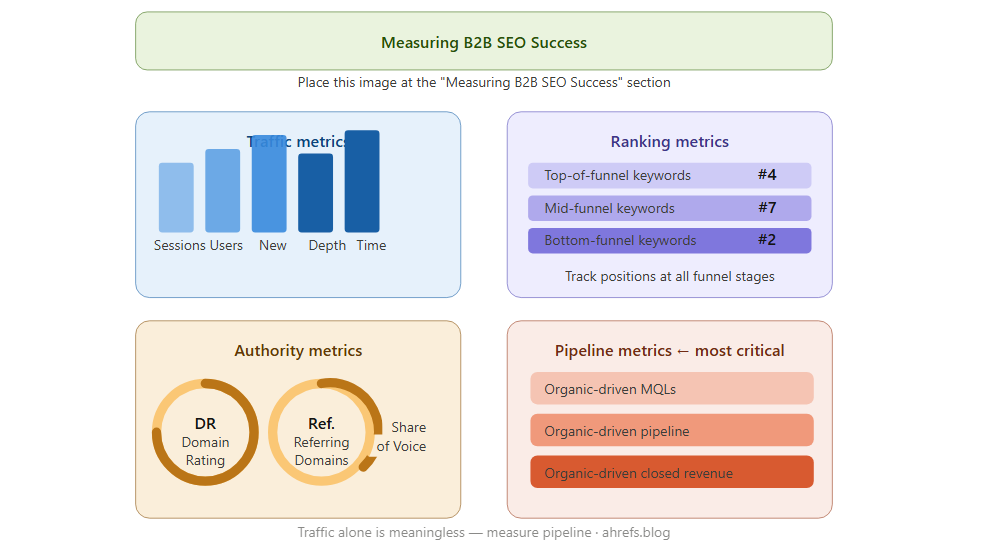
Monthly Reporting Metrics
Traffic Metrics
- Organic sessions
- New organic users
- Organic page depth
Ranking Metrics
- Position of keyword on target keywords at all levels of the funnel
Authority Metrics
- Domain Rating
- Referring domains
- Share of Voice
Pipeline Metrics
- Organic driven MQLs
- Organic driven pipeline
- Organic driven closed revenue
Efficiency Metrics
- Organic vs paid customer acquisition costs (CAC)
- Organic contribution to total pipeline
Quarterly Review
Look at organic traffic numbers and pipeline performance relative to the same quarter of the previous year (considering seasonality factors).
Conclusion
When it is executed correctly, B2B SEO can be considered as the best value marketing channel, bringing highly relevant leads who are actually searching for your solution at a much lower cost than paid acquisition.
It is important to treat it as a funnel strategy that supports the buyer journey and ICP, rather than a game about content volume. Identify the keywords that fit the persona. Convert the traffic with the proper CTA. Assess the pipeline results, not only the traffic performance. Establish yourself as a topic authority and build backlinks.