International SEO Strategy: How to Rank in Multiple Countries

One of the biggest opportunities within SEO is to increase your website’s reach internationally, which is also one of the most technically challenging aspects to accomplish. International SEO involves making deliberate choices regarding your site structure, language targeting, and localization that, if done incorrectly, will lead to the wrong content ranking in the wrong country or the loss of your site’s authority.
Learn how to build your own effective international SEO strategy here.
What Is International SEO?
International SEO refers to the optimization of your site such that the search engines are able to understand the countries you are targeting, thus serving you the most suitable languages/versions of your content in those regions.
There are two key issues that international SEO seeks to resolve:
Language Targeting
Delivering the appropriate language (English, Spanish, French, German, etc.)
Country Targeting
Providing country-specific content even when there are several countries using the same language (US English, UK English, Australian English; Brazilian Portuguese, European Portuguese)
International SEO requires that Google display your US content to US visitors, your UK content to UK visitors, and your German
International SEO Site Structure
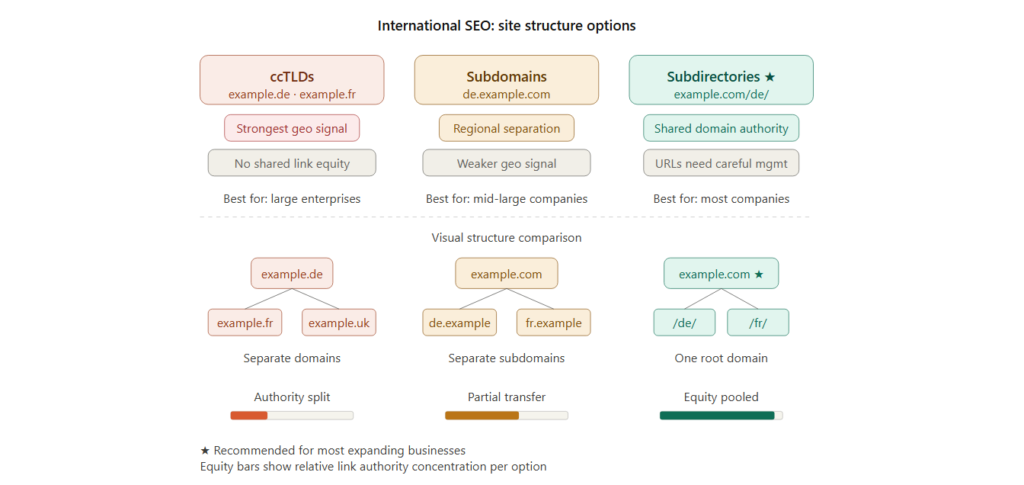
The first important choice when doing international SEO relates to site architecture. There are three principal choices, and each has distinct SEO implications.
Option 1: ccTLDs (Country Code Top-Level Domains)
Structure: example.de, example.fr, example.co.uk
Example: apple.com (USA), apple.com/uk (United Kingdom page), but many companies have dedicated ccTLDs for their significant markets.
Pros
- Most effective geo-targeting signal to Google
- Country association creates trust with the local user base
- Two completely different sites for monetization and host differently
Cons
- Most expensive and difficult to manage
- Equity will not transfer between domains, so both domains need authority individually built up
- Two completely different Google Search Console properties
Best For
Only suitable for big corporations that have the resources to manage two separate entities.
Option 2: Subdomains
Structure: de.example.com, fr.example.com, uk.example.com
Pros
- Separation adequate for geo-targeting via Google Search Console
- Manageable but slightly less so compared to ccTLD
- Some separation between content and possibly hosting for each region
Cons
- Does not transfer link equity from one to another
- Geo-signal less effective compared to ccTLD
- Confusing for crawlers, treated as different websites
Best For
Medium to large companies looking for regional separation without fully embracing ccTLD.
Option 3: Subdirectories (Recommended for Most Sites)
Structure: example.com/de/, example.com/fr/, example.com/uk/
Pros
- Link equity is concentrated in one root domain, which makes for the most effective SEO strategy.
- Easier to execute and manage than ccTLDs or subdomains.
- One Google Search Console listing with geographic targeting per subdirectory.
- Increases in domain authority benefit the whole geographic section.
Cons
- Not as strong as ccTLD when it comes to geographic targeting (but can use hreflang).
- URLs must be managed with caution as the website grows.
Best For
Most companies are expanding globally. There aren’t many good reasons for separate websites unless your company needs them for strategic reasons.
Hreflang: The Technical Backbone
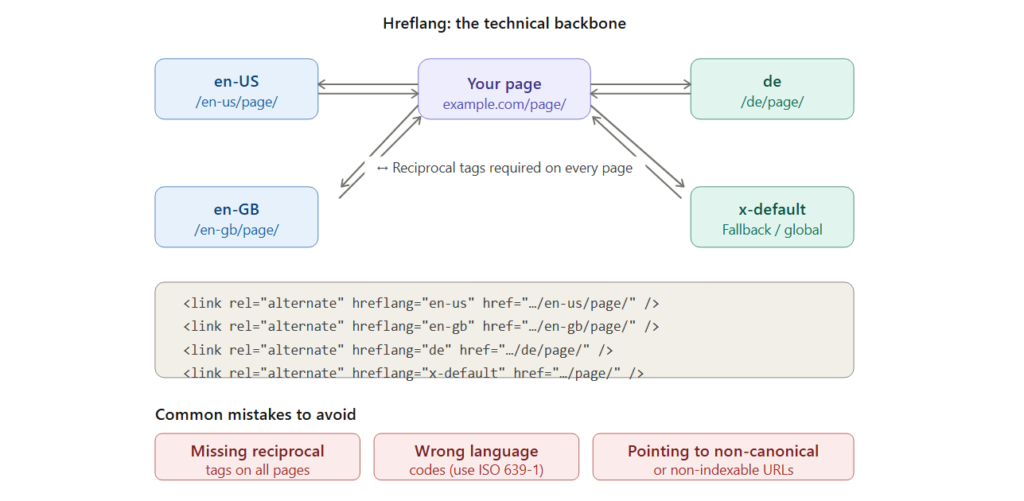
The hreflang attribute indicates to Google that there’s a different language and geo-targeted version of a particular webpage. The use of this attribute avoids duplicate content problems between the different languages versions.
Hreflang Implementation
In the <head> section of each page, include alternate links for all language/country variants:
<link rel=”alternate” hreflang=”en-us” href=”https://example.com/en-us/page/” />
<link rel=”alternate” hreflang=”en-gb” href=”https://example.com/en-gb/page/” />
<link rel=”alternate” hreflang=”de” href=”https://example.com/de/page/” />
<link rel=”alternate” hreflang=”x-default” href=”https://example.com/page/” />
The default or x-default tag identifies the default version of the page.
Common Hreflang Mistakes
Missing Reciprocal Tags
Every page needs hreflang tags not only for other languages but also for itself. The German page has to reference the English page if you reference the German page from the English one. Otherwise, the whole implementation will be considered incorrect by Google.
Incorrect Language Codes
Make sure to use the correct language codes in ISO 639-1 (en, de, fr, es) and the country codes according to ISO 3166-1 alpha-2 (US, GB, DE, FR). Note that “English-UK” should be used as “en-GB.”
Pointing Hreflang to Non-Canonical URLs
All hreflang tags need to reference the canonical and indexable pages. Otherwise, they will be considered invalid by Google.
Inconsistent Implementation
Hreflang should be done throughout your whole website, not on some pages alone. Incomplete use will have unpredictable outcomes.
Content Localization vs. Translation
International SEO is mostly unsuccessful not due to technical mistakes, but because translation and localization get confused. They’re not the same.
Translation
Translation is the process of changing the words from one language into another. Even top-notch machine translations can sometimes result in technically correct but culturally inappropriate content.
Localization
Localization is translating the content for the target culture, which includes local phrases, examples, currency conversions, local case studies, culturally appropriate references, and different user intent.
Why Localization Matters for SEO
Searching behavior is different according to markets. The searches that the users from Germany make regarding products and how they write their queries are different from the searches made by UK users for the same type of products. Local content suits local searches while translated content often fails to do so.
Localization Checklist
- Content should always come from native speakers and not from automated translators.
- Do not rely on keyword volumes being similar when translating them.
- Tailor all examples and case studies to fit the new market.
- Use local currency, date format, and other metric standards.
- Follow local laws, such as GDPR for EU markets and others elsewhere.
- Customize call-to-action (CTA) according to local practice.
International Keyword Research
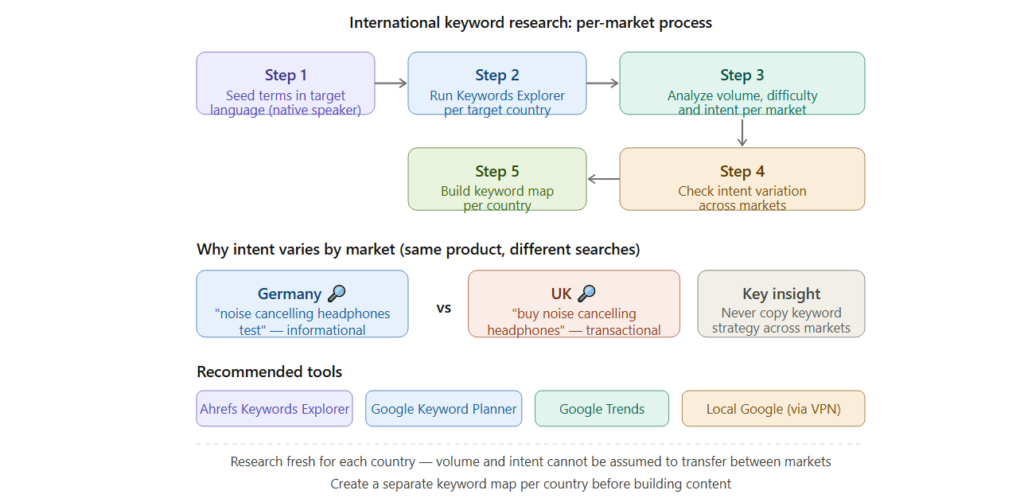
There should never be any assumption about the keyword strategy carrying over between markets. Research them afresh in each target location.
Process for International Keyword Research
- Seed terms should be identified in the target language (with feedback from a native speaker preferred)
- Ahrefs Keywords Explorer – choose target country separately for each target market
- Find volume, difficulty, and keyword intent for each target market individually
- Check if there is any variation of intent for certain keywords, where one target market searches informational intent, while the other transactional intent for the same product category
- Create keyword map for each country separately
Tools for International Keyword Research
- Ahrefs Keywords Explorer (choose target country)
- Google Keyword Planner (location set to target country)
- Google Trends (compare interest regionally)
- Google Search within target country (with VPN or Google country-specific domain)
Building International Authority
Authority is not transferred when changing markets. To rank in Germany, you must get backlinks from German websites. To rank in France, you must get backlinks from French websites.
International Link Building Strategies
Digital PR in Target Markets
Make sure your content is relevant to the local region, local market research, local data studies, and locally important news.
Local Partnerships and Sponsorships
Collaborate with local industry organizations, events, and other partners in the particular markets.
Local Directory and Citation Building
Market-specific business directories, lists from local chambers of commerce, and lists of local industries.
Translate Linkable Assets
If you have an English-language linkable resource (research, useful tool), translate and localize it into all languages, and publish it through local publishers.
International SEO Technical Checklist
Geographic Targeting in Search Console
Select the targeted country for each subdirectory via Google Search Console (Property Settings > International Targeting).
Canonical Tags
Canonical tags need to be aligned with hreflang tags. If canonical is pointing at a page in another language than the hreflang tag, Google will get confused.
Crawl Accessibility
Make sure Googlebot can crawl all language versions. Some geo-blocking settings may block Google from crawling pages in other markets than the main one.
Page Speed by Region
The secondary market users can be farther away from your servers. Make sure that you use a CDN with edge servers for every targeted geographical location to retain good performance levels.
Currency and Payment
E-commerce International SEO includes localized pricing, currency, and payments besides the local language.
Common International SEO Mistakes
Launching with Machine-Translated Content
Poor translation leads to poor-quality content that fails to cater to the localized search intent. Content quality is evaluated in all languages by Google.
Ignoring Local Search Engines
Although Google reigns supreme in all other markets, Baidu rules China (more than 80%), Yandex dominates Russia (more than 50%), while Naver rules South Korea. International SEO strategies need to be devised based on the ruling search engines.
Using the Same Keyword Strategy Across Markets
Keyword research always needs to be done anew for each market.
Neglecting Local Technical SEO
Site performance, mobile optimization, and Core Web Vitals need consideration for all markets.
Forgetting to Add the x-default Tag
This hreflang tag comes handy when there’s no specific localization for certain markets.
Measuring International SEO Success
Monitor different countries separately:
Google Search Console
Create separate views based on individual countries from the Performance report, which will display rankings, impressions, and clicks per country.
Ahrefs Rank Tracker
Create individual projects based on each country, targeting the appropriate keywords per country.
Google Analytics
Split your organic traffic based on countries/regional areas to measure independent growth internationally.
Revenue by Market
In the end, international SEO efforts need to tie back into revenue. Track conversions and revenue per country of organic visitors.
Conclusion
International SEO is one of the best opportunities for growth for any company that is doing well in its home country. It follows the same basic principles of creating excellent content, building authority, having everything technically correct, but the execution involves market research, hreflang usage, and localization beyond translation.
Begin by focusing on one country or market. Get the technical fundamentals in order (website architecture, hreflang setup). Spend money and effort on true localization. Create authority in that market, then expand to other markets using that playbook.