Risk Management: The Complete Guide

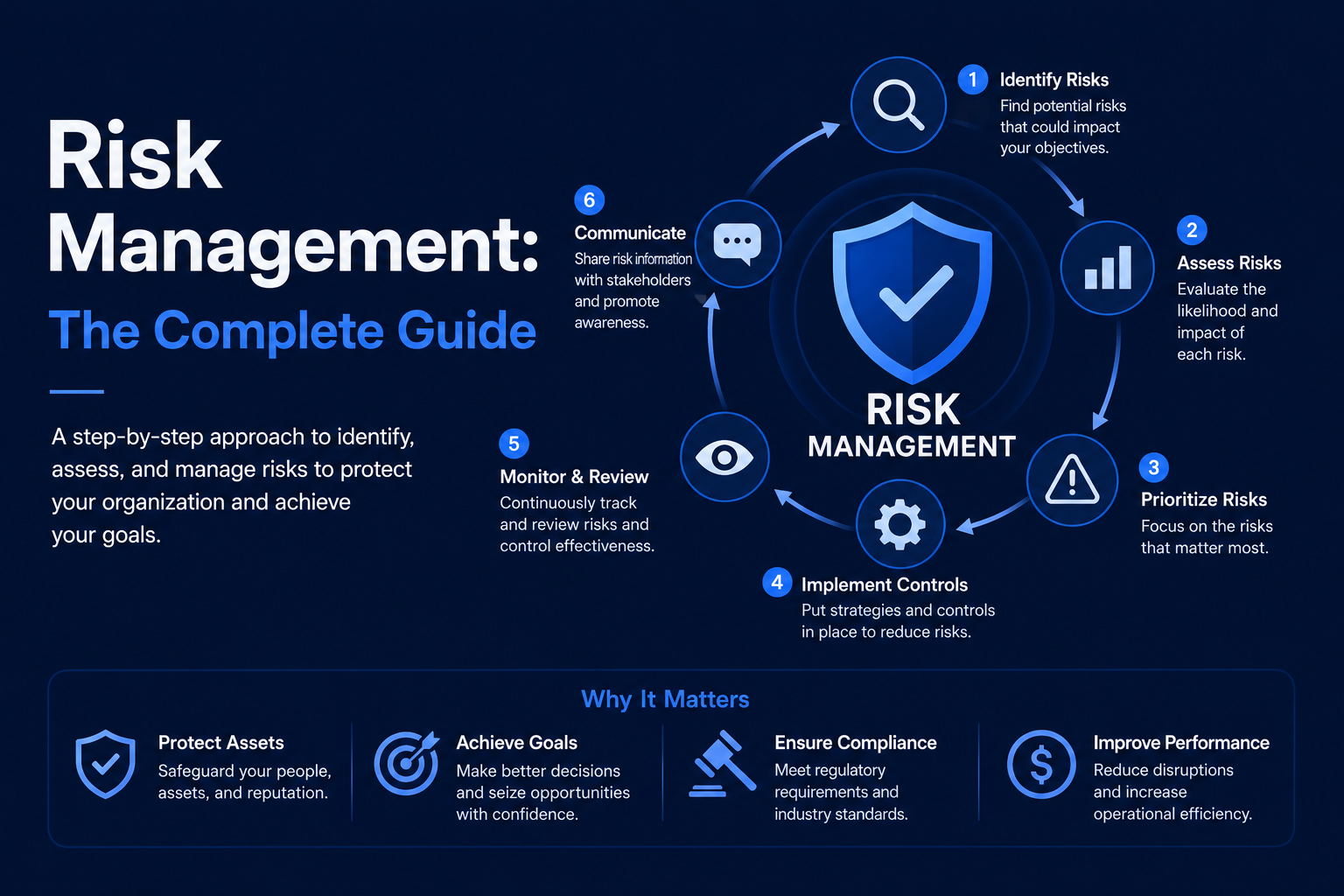
Each organization, large or small, irrespective of the sector, has uncertainties, market changes, operations failures, legal liabilities, and cybersecurity. Risk management is the process by which organizations identify such risks beforehand and make calculated responses in anticipation of them instead of only reacting to them.
What Risk Management Actually Means
Risk management involves identifying, evaluating, and addressing incidents or situations that may have either a negative (or sometimes a positive) impact on organizational goals. It is important to note that risk management is not meant to eliminate all risk from the organizational equation since this is impossible and also because some level of risk is required for growth purposes, rather it is a process aimed at gaining sufficient knowledge about the risk to make intelligent risk management decisions.
Why Risk Management Matters
If an organization does not employ a proper risk management process, then it is likely that any risks that arise will do so in terms of an incident that happens unexpectedly, a compliance obligation that is overlooked, a financial risk that is unhedged, or a vendor risk where no alternative supplier exists.
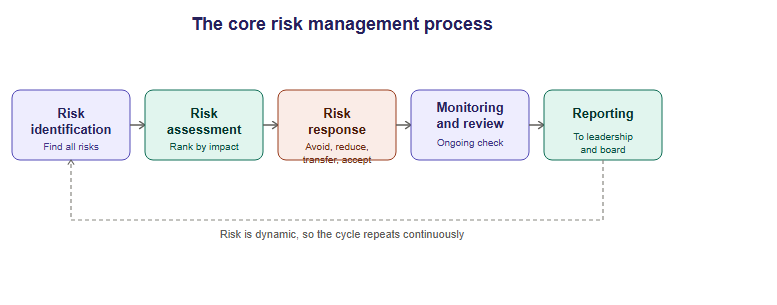
The Core Risk Management Process
Risk Identification
Risk identification in a systematic manner for all the risks within the company, including operational, financial, strategic, compliance, reputation, and technical risks, usually accomplished through risk workshops, analysis of past incidents, and benchmarking with the industry.
Risk Assessment
Assessment of the likelihood and impact of each of the risks identified, generally resulting in the ranking of risks.
Risk Response
Determining the way of managing the risk: by not undertaking the activity that causes it, decreasing the chance or effects of the risk using controls, transferring the risk (typically insurance or contracts), or accepting the risk.
Monitoring and Review
Monitoring continuously whether the controls put in place have been effective, and whether new risks have come up, since risk is dynamic, and everything about market environment, laws, and organizational activities is continuously changing.
Reporting
Conveying the status of risk management to leadership and the board, when applicable, to enable making decisions based on risk information.
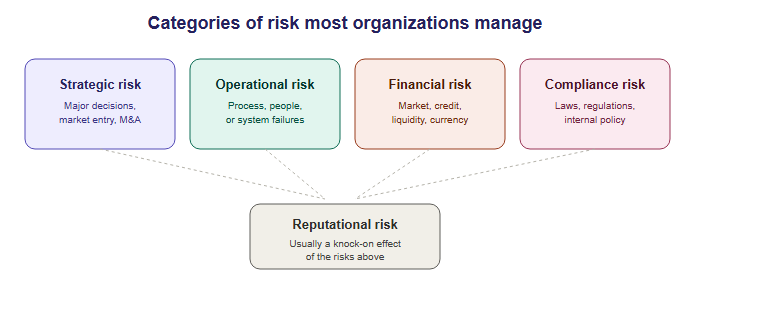
Categories of Risk Most Organizations Manage
Strategic Risk
Risks associated with major business decisions, market entry, a major product launch, an acquisition, etc., whereby making the wrong decision can have an amplified impact on the business.
Operational Risk
Risks that may emanate due to a failure in internal procedures, people, or systems, failure of the supply chain, failure of a critical system, human error in critical processes.
Financial Risk
Risks that may result from market movements, risks in terms of credit, liquidity, or currency that may affect the financial standing of the organization.
Compliance Risk
The risk of non-compliance with laws, regulations, or organizational policies, leading to fines, penalties, or damage to reputation.
Reputational Risk
Impact on reputation or stakeholder confidence, usually as a result of an incident in another type of risk, not an independent risk on its own.
Common Risk Management Frameworks
Few firms construct a risk management framework entirely on their own; most choose frameworks such as ISO 31000, which is a general risk management framework, and COSO’s Enterprise Risk Management framework, which have both been tested and offer a common language for risk communication and, possibly, for external auditing.
Qualitative vs. Quantitative Risk Assessment
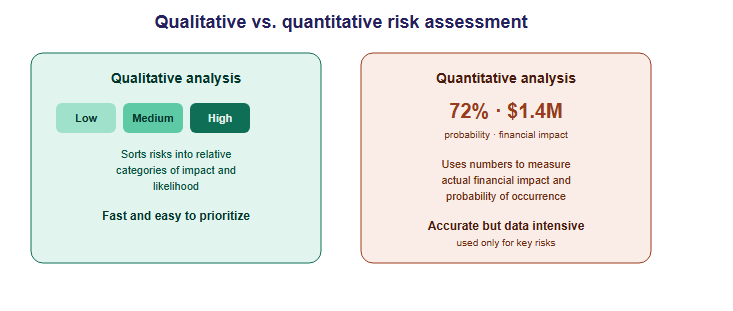
Qualitative analysis classifies risks into categories based on relative levels of risk and their impact and likelihood, making prioritization fast and easy, whereas quantitative analysis uses numbers and measures the actual financial impact, as well as the probability of its occurrence, providing accuracy and being more time consuming and data intensive, and is used only for the firm’s key risks.
Who Owns Risk Management Within an Organization
Small companies do not create an independent risk management function; risk management is delegated to existing departments, where finance deals with financial risks, IT with IT risks, and operations with operational risks. Large firms may create an independent risk management function, often headed by a Chief Risk Officer, that coordinates an integrated approach to risk management.
Risk Management Software and Tools
As an organization expands and faces a variety of overlapping risk categories, it tends to install specialized risk management software or, at least, GRC software that combines governance, risk, and compliance into one solution, which allows consolidating the risks, monitoring them, and producing reports.
Common Mistakes in Risk Management
- Assuming that risk management is a one-off effort instead of being a continuous process that keeps changing over time
- Looking at risks only when they have occurred before instead of identifying new or emerging risks
- Not turning risks into actions after they have been identified but just writing them down
- Having inconsistent criteria for assessing risks among different departments
Bottom Line
The process of risk management provides a system for dealing with uncertainties in advance so that the element of surprise is eliminated. Regardless of whether this activity is carried out manually using a spreadsheet or even software, there are basic steps to be followed, which are to identify, assess, respond to, and monitor the risks.